Key Takeaways
- A workable MOQ for a customized wine tumbler is usually 1,000-3,000 pcs per color, with sample lead time of 5-10 days and mass production in 25-35 days
- For 12 oz double-wall 304 stainless tumblers, FOB China pricing often lands around USD 2.80-4.60 depending on finish, lid, and logo process
- Use AQL 2.5 for major defects and AQL 4.0 for minor defects, with leak, coating adhesion, and carton drop tests written into the PO
- If you need retail or Amazon prep, confirm barcode placement, FNSKU labeling, and master carton weight under 15 kg before production starts
You are not buying a gift item. You are buying a branded SKU that has to ship on time, survive transit, clear basic compliance, and still leave margin after duty and inland freight. On our line, a 0.2 mm change in steel thickness, a loose lid fit, the wrong print method, or one failed carton drop at 76 cm can turn a clean pre-production sample into a claim.
A practical buyer in Europe or North America usually starts with one question: what exactly should I lock before I send a PO? Good question, but this is often the wrong question to ask. The better one is: what can still go wrong after the PO is signed? If you are sourcing from Zhejiang, China, or comparing a canteen manufacturer, canteen supplier, or distributor drinkware program, the steps are close. We run the order from brief to final inspection, and QC pulled enough samples over the years to prove this point: control the failure points early, or the math doesn't work.
Start with the real brief
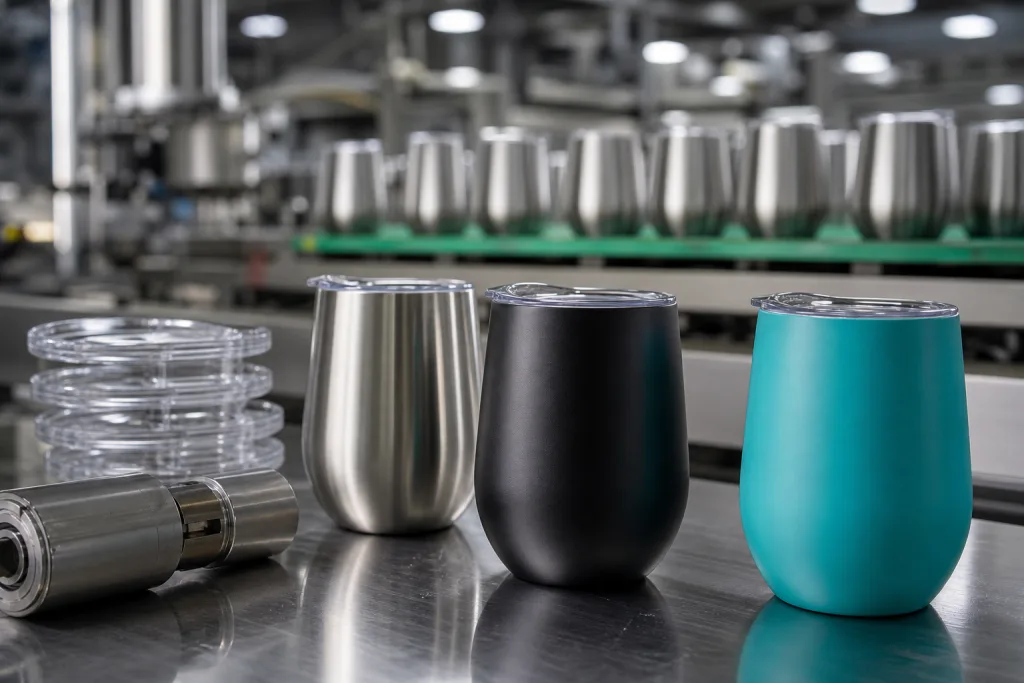
Start with the actual brief. Say you are launching a fall promotion for 8,000 pcs of 12 oz stemless tumblers for the US and Germany: matte powder-coated body, clear push lid, one-color outside logo, retail gift box, and a 45-day delivery window from deposit. We run orders like this every week in Zhejiang, but only when the spec is locked on day one. If the PO just says “black tumbler with logo,” the line stalls before we even open the Pantone book.
The RFQ should not say only customized wine tumbler, black, with logo. That is the wrong question to ask. It needs the commercial points that change cost, tooling, test risk, and packing volume:
- Capacity: 12 oz / 355 ml, measured to brim or usable fill line
- Material: inner and outer 18/8 stainless steel, commonly called SS304
- Construction: double-wall vacuum, copper lining optional
- Body finish: matte powder coating, Pantone reference if color critical
- Lid type: AS, SAN, or Tritan style clear lid with sliding closure
- Logo: 1-color silkscreen or laser engraving, artwork file format
- Packaging: egg-crate bulk pack, white box, or color gift box
- Market requirements: REACH, LFGB, FDA-contact expectations, California Prop 65 if relevant
This is the same discipline used for a custom canteen, custom growler, or customized drinkware line from a canteen vendor. If you leave the steel grade open, one factory prices SS304 and another slips in a lower spec on the inner wall. If you leave the lid resin open, one quote is AS and another is Tritan, and the buyer flagged the price gap later. If packaging stays open, freight math turns into guesswork fast; a color gift box can push carton size up by 18 to 22 mm.
At BottleForge Industrial in Hangzhou, Zhejiang, we usually see buyers cut 3 to 5 days by sending a one-page spec sheet and a packing target with the first inquiry. Our mixed drinkware capacity is around 500,000 units per month, so we ship quotes fast, but the buyer still has to choose where the money goes: coating thickness, lid resin, or carton count. QC pulled one sample last month because the PO said “12oz” and the artwork file said “10oz.” Small miss, big delay. We’ve seen this go sideways.
Build the cost before sampling
Once the brief is clear, build the cost by channel before you sample. This sounds basic. Buyers still skip it. A customized wine tumbler is easy to quote on paper, but the numbers shift fast once the line starts stacking coating, print, lid fit, and pack-out. For a 12 oz vacuum tumbler from China, typical FOB pricing at 1,000 pcs may be around USD 3.60-4.60 with a clear lid and one-color print. At 3,000 pcs, the same item may drop to USD 2.80-3.70 FOB depending on coating and pack-out.
Where does the money go?
- Steel and weight: a body using 0.4 mm outer wall and 0.3-0.35 mm inner wall costs less than heavier construction, but dents more easily. We’ve seen QC pull a rim sample with a 0.2 mm dent after drop testing from the packing table.
- Vacuum process: better vacuum consistency reduces temperature complaints and leak-back issues. On our side, this gets checked at the vacuum station and again during hold-time inspection.
- Finish: standard spray paint is cheaper; powder coating usually adds USD 0.18-0.35 per unit. The buyer flagged scratch marks on a matte black run last month, and the rework cost more than the coating upgrade would have.
- Decoration: 1-color silkscreen may add USD 0.06-0.12; laser engraving can be USD 0.10-0.25 depending on area. Big wrap prints slow the line, and the math doesn’t work if you price them like a small front logo.
- Lid: a basic AS lid is cheaper than a better-fit Tritan-style option. Fit matters. We check snap force by sample, not by catalog photo.
- Packaging: a color box can add USD 0.28-0.75 plus higher CBM. A 24 pcs master carton at 8.5 kg gross weight ships differently from a loose bulk pack, and that freight delta gets missed all the time.
If you are a canteen distributor or one of several canteen distributors bidding for a private-label program, ask for pricing on at least three pack scenarios: bulk, white box, gift box. Also ask for carton size, units per carton, and gross weight. This is the right question. A low unit price with a poor carton layout can cost more after ocean freight. We ship both ways, and a bad carton plan has turned a “cheaper” tumbler into the expensive option after CBM was calculated.
This is also the right moment to test your MOQ assumptions. A lot of canteen manufacturers and canteen suppliers in China will quote 500 pcs, but the efficient MOQ for stable coating and packaging is often 1,000 pcs per color. We run small trial lots, but we’ve seen this go sideways: four body colors at 500 pcs each sounds flexible, then setup waste, powder change, and carton changeover push the price up. One PO even came in with “navy” typed as “nany,” and the line had to stop to confirm the shade. Those are real costs, not sales talk.
Sample what can actually fail
Most buyers stare at the sample finish and miss the failure points. That is the wrong question. The sample has to tell you three things: does the tumbler match the brand spec, does it work, and can we run it again at line speed without drama?
For a customized wine tumbler, we ask for two samples. First, a stock-body visual sample with your logo and a close finish in 5 to 7 days. Second, a pre-production sample built to your confirmed packaging and decoration method in about 7 to 10 days after artwork approval. If a canteen customizable or customizable drinkware supplier only ships a pretty sample and skips transit checks, you still do not know much. We had one buyer flag a PO typo on the lid code, and the line had to stop for half a day.
What to check on the sample
- Net weight tolerance, usually within plus or minus 5%
- Lid fit and wobble, especially on powder-coated rims
- Print position measured from rim and seam, not judged by eye
- Base flatness so the tumbler does not rock on a tabletop
- Coating consistency near the bottom radius and weld area
- Odor after 24 hours closed with warm water
- Basic thermal hold claim under a defined method
Watch the marketing claims. A seller may say 6 hours hot and 12 hours cold, but if you do not lock the test method, the numbers are noise. We run hot water at about 95 degrees C, fill and cap at room temperature, then record at 1, 3, and 6 hours. For cold retention, use the ice-water ratio and ambient temperature, not a hand-wave. QC pulled one sample last month that smelled off after 24 hours closed, and the buyer killed the order on the spot. Lab-perfect is not the goal. Repeatable is.
Practical rule: if the sample looks good but fails pack-out or lid fit, do not approve it. Production will make the defect louder.
The same logic applies whether you buy a customized canteen, customizable canteen, customized growler, or canteen promotional line. The product name changes. The approval discipline does not. We have seen this go sideways on a 1,000-piece MOQ because someone skipped the drop test on the carton.
Write the PO like QC instructions
A purchase order is a commercial document, yes. For imported custom drinkware, it should also read like your first QC sheet. If the PO only shows SKU, quantity, and price, the line will fill in the blanks on its own, and we’ve seen that go sideways over a 2 mm logo shift.
Your PO or attached product spec needs measurable standards, not general comments. Any solid canteen supplier or canteen manufacturer in China should accept that without drama. This is the wrong question to ask: not “Can you make it?” but “What exactly are we approving?” We run better when the target is clear.
- Approved sample reference number and date
- Material callout: SS304 inner/outer, BPA-free lid resin if required
- Color standard: Pantone code or signed color chip, with acceptable tolerance
- Logo method, logo size, and placement in mm
- Vacuum leak test requirement, for example 100% air-pressure or hot-water spot check per line
- Coating adhesion test, such as cross-hatch tape test after cure
- Salt spray expectation if you need corrosion screening on coated parts
- Packaging construction: box board grade, insert type, barcode label position
- Inspection standard: AQL 2.5 major / 4.0 minor
- Shipment term: FOB Ningbo or Shanghai, ex-factory, or DDP if negotiated
If you sell through retail or Amazon, add carton limits to the PO. Buyers miss this all the time. Set a maximum master carton weight. Keep it below 15 kg if warehouse handling matters. We had one buyer flag a 17.8 kg carton after drop test because their 3PL rejected it at inbound. If you need FNSKU labels, carton marks, suffocation warning, or country-of-origin labels, send the artwork before production. QC pulled the sample more than once over a PO typo in the barcode panel.
For buyers comparing a distributor canteen source against direct factory supply, this is usually where direct wins. A canteen vendor or canteen vendors network can work for repeat orders with no changes, MOQ 500 and standard box. On a branded project, direct access to packaging, tooling, and QC staff usually cuts revision time by a week or more. In our shop, it is often 12 days vs 18 days because the buyer gets answers from the carton supplier, laser marking station, and QA table without a middle layer.
Control production, not just inspection
Final inspection matters, but the cheapest defect is the one you stop on day 3, not day 28. For an 8,000-piece run, production may take 25 to 35 days from deposit and sample approval, depending on coating queue and packaging complexity. We’ve seen a 0.4 mm logo shift repeat through 6 cartons before the line caught it. That is enough time for good control, or enough time for a small issue to repeat 8,000 times.
Set 3 checkpoints and make each one do a job: raw material confirmation, mid-line production review, and pre-shipment inspection. If your order is with a canteen factory in Zhejiang or elsewhere in China, ask for timestamped photos and 20 to 40 second videos from each stage. Serious factories already run this as a daily habit. If a supplier pushes back on sharing batch photos, this is the wrong question to skip.
Mid-line checks that actually matter
- Body weight and wall thickness by batch, checked with a digital scale and wall gauge
- Vacuum retention spot checks after 2 to 4 hours, not just a claim on paper
- Lid torque or snap-fit consistency across cavities, because cavity 3 often drifts first
- Logo adhesion after curing and rub test, with QC pulled the sample from live production
- Color drift between first and later coating batches, especially after a powder change
- Inner cleanliness before final assembly and packing, including dust or coating flakes inside
For inspection, use a sampling plan that the factory and inspector both understand. AQL 2.5 major and 4.0 minor is common for drinkware. Critical defects should be zero tolerance: sharp burrs on the mouth, missing country-of-origin marking if legally required, severe coating contamination inside the drinking contact area, or obvious leakage. We check burrs by fingertip and visual under line light, because this one goes sideways fast. Major defects include rocking bases, off-center logos beyond tolerance, dented bodies, or lids that do not seat correctly. Minor defects might be small print specks or slight color variation within approved tolerance.
If you source customizable growler, custom growler, or canteen customized programs from the same supplier base, align your QC language across all SKUs. One defect library works better than 3 different versions on 3 POs. We ship faster when standards are shared, and the buyer flagged fewer disputes once the same reject photos were used for tumblers, bottles, and growlers. Buyers who define one standard library for tumblers, bottles, and growlers usually reduce claims by 20% to 30% over a season because inspectors know exactly what to reject.
Plan compliance and freight early
The order looks ready to ship. This is where first-time buyers lose margin fast. Compliance and freight are not back-office paperwork. They decide whether your customized wine tumbler clears sale in your market and whether the landed cost still leaves room. We’ve seen this go sideways after final packing, when QC pulled the sample and the warning label file was still wrong.
For Europe, buyers usually ask for REACH screening and LFGB-related material expectations for food-contact drinkware. For the US, FDA-contact expectations and Prop 65 attention may come up depending on components and retail channel. If your customer asks for social compliance, BSCI or similar audit status may matter at factory level. This is the wrong question to ask late. If a test report is required, confirm at PO stage whether you need a full finished-product test or only material declarations. A full test can add 5 to 10 working days and several hundred to over USD 1,000 depending on scope. On our side, the common miss is a silicone gasket or printed coating that was not included in the lab submission list.
On freight, compare FOB and landed cost with real carton data, not a rough quote from week one. A 12 oz tumbler in a gift box may use nearly double the cube of a bulk-packed unit. The math doesn’t work if the ex-factory price is lower by USD 0.20 but the carton cube jumps from 0.048 cbm to 0.091 cbm. Ask your canteen supplier for:
- Master carton dimensions in cm
- Units per carton
- Gross and net weight
- Container loading estimate by 20GP and 40HQ
- Palletized dimensions if your warehouse requires them
If you are shipping to Amazon or 3PL, confirm barcode readability and outer carton label position before mass packing. FNSKU labels applied crooked or over box seams can create receiving delays. We ship samples with the label 15 mm away from the carton edge for this reason. If your channel is promotional, your buyer may care more about hitting an event date than retail presentation, so bulk pack is often the better call. The buyer flagged this on one PO last month because the gift box looked good, but the event delivery window was only 12 days vs 18 days by the cheaper route.
A good canteen manufacturer or distributor growler partner should explain these tradeoffs with plain numbers. If they cannot, you are not buying a factory program. You are buying uncertainty.
Get a workable customized wine tumbler quote
Send your target quantity, finish, logo method, and packaging plan. We will reply with FOB pricing, MOQ, lead time, and QC points you should lock first.
Frequently asked questions
What MOQ should I expect for a customized wine tumbler order?
For a standard 12 oz stainless steel customized wine tumbler, a realistic MOQ is 1,000 pcs per color with one logo treatment. Some China factories will accept 500 pcs, but the unit price usually rises by USD 0.30-0.80 and color consistency becomes harder on powder coating. If you need a gift box, insert, or custom lid color, 1,000-3,000 pcs is more efficient. For mixed SKUs with a custom canteen or customized growler program, you can sometimes combine steel body colors under one PO, but packaging MOQs still apply separately. Ask whether MOQ is based on total order quantity, per color, or per carton pack configuration before you approve the quote.
Which logo method is best for a wine tumbler: silkscreen or laser engraving?
Use silkscreen when you want strong color and the lowest cost. On a matte powder-coated tumbler, a one-color print often adds about USD 0.06-0.12 per unit at 1,000-3,000 pcs. Use laser engraving when you want a premium look and better rub resistance; that often adds USD 0.10-0.25 depending on size and coating type. Engraving on powder coat usually exposes the stainless underlayer, so check contrast on your chosen body color. For fine lines under 0.3 mm, laser is usually more reliable. For large filled logos, silkscreen is cleaner. Ask your canteen factory for both options on the same sample photo before deciding.
How do I quality-check a customized wine tumbler before shipment?
Set the standard before production, then inspect to that standard. For most B2B orders, use AQL 2.5 for major defects and 4.0 for minor defects. Require checks on lid fit, leak performance, rocking base, logo position, coating adhesion, body dents, and inner cleanliness. A practical pre-shipment inspection for 3,000-10,000 pcs usually samples according to ANSI/ASQ Z1.4 or equivalent. Add simple performance checks such as hot-water retention comparison after 2-4 hours and carton drop tests on packed goods. If your order ships from Zhejiang, China, a third-party inspection typically costs around USD 250-400 per man-day, which is cheap compared with a rejected container or customer claim.
What certifications or compliance documents should I ask for?
Ask for documents based on your market, not a random certificate pile. For Europe, REACH-related material compliance and food-contact expectations such as LFGB are common discussion points. For the US, FDA-contact expectations matter, and some channels ask about California Prop 65 depending on components. At factory level, BSCI or similar social audit status may be important if you sell to larger retail groups. Also ask for stainless steel grade confirmation, BPA-free statement for lids if relevant, and test report scope and date. A finished-product lab test can take 5-10 working days, so do not leave it until cargo is booked. Your canteen supplier should tell you what is standard and what needs fresh testing.
Should I buy direct from a factory in China or through a distributor?
If your order is repeatable, branded, and over about 1,000 pcs per SKU, direct factory buying usually gives better control on packaging, decoration, and QC. You can lock steel grade, wall thickness, logo placement, and carton spec with the production team. That matters for custom drinkware. A distributor can be useful for very small MOQs, local warehousing, or mixed imports from multiple categories. The tradeoff is usually higher unit cost and slower communication on revisions. For a customized wine tumbler program from Zhejiang, China, direct factory lead time is commonly 25-35 days after deposit and sample approval. Through a distributor, you may gain convenience but lose one layer of technical visibility.