Key Takeaways
- A realistic MOQ for a customized water bottle is often 500-3,000 pcs, with 30-45 days lead time after sample approval
- Laser engraving usually costs less than full-color print on stainless steel, but print can add 8-15% higher retail appeal
- For EU and North America, ask for REACH, LFGB, FDA, and an AQL 2.5 inspection plan before you confirm
- A canteen manufacturer in Zhejiang should quote FOB, carton data, and monthly capacity, not just a sample price
If you are buying a customized water bottle for retail, promotion, or a private-label launch, the logo is not the hard part. The real call is cost against durability, then how much first-order risk you want to carry. A 500ml stainless bottle at USD 3.20 FOB is a different item from a Tritan bottle at USD 1.65, and we see that gap on the line fast: carton weight, freight per cbm, and leak rejects at the 0.2MPa air test. Nice sample photos fool people. The math does not.
In Zhejiang and across China, a good canteen factory will ask you four things first: material, decoration, lid system, and annual volume. That sequence is right. We run quotes in that order because one wrong call can break the whole canteen custom order at packing, leakage, or margin; last month a buyer flagged a lid insert that added 3 mm and forced a master carton change. The practical buyer approach is simple: choose the product category, choose the branding method, choose the compliance level, then pressure-test the MOQ and lead time against your channel. If you skip that check, we have seen this go sideways by PO stage.
Start with the sales channel
The first call is not color or lid style. It is sales channel. A wholesale reseller order moves on different math than a canteen promo run or an Amazon private-label launch, and we’ve seen buyers mix these up on the same PO. If you sell through canteen distribution, you usually want broad appeal, stable repeat orders, and tighter carton count—like 24 pcs per master carton instead of 20 pcs if the bottle diameter stays under 78 mm. If this is for a brand activation, paying USD 0.25 more for a 2-color logo, gift box, or a 12-day lead time vs 18 days can make sense.
Retail has to win on shelf in 3 seconds. Corporate gifting has to hold up through a workweek. Amazon and DTC are a different animal: the FNSKU label position, barcode scan rate, and mailer strength get checked as hard as the bottle body. QC pulled a sample last month because the outer box print was 4 mm off center, and the buyer flagged it before mass pack-out. A customizable drinkware program should follow channel margin first. Product preference comes after. This is the wrong question to ask if the unit economics do not work.
Ask the canteen supplier to quote three versions side by side: bare bottle, standard logo bottle, and premium pack-out. Put the numbers next to each other. On a 1,000 pcs order, a difference of USD 0.18 per unit becomes USD 180 before freight. On a 10,000 pcs program, that is real money. We run this comparison all the time, and the line usually finds savings in carton count, insert cards, or sleeve spec before touching the bottle itself. In Zhejiang, experienced canteen vendors know where margin disappears fast; one extra insert or a typo on the PO for sleeve size can throw off the whole pack plan.
Pick the material before the style
Material sets the cost, the use life, and the test path. Start there. For cold drinks and casual retail, Tritan or AS usually gives you the right price band and clear body. If you need insulation, 304 stainless steel is the standard pick because we can run vacuum hold tests on the line and see the result fast. For a custom growler or customizable growler, we usually quote thicker stainless steel, often 18/8 inner wall with 0.4-0.5 mm gauge, because pressure, odor resistance, and brush cleaning matter more than shelf looks. We’ve seen this go sideways when a buyer pushes thin wall to save $0.18 and then QC pulled the sample with a dent at the shoulder.
A canteen custom order should not start with color. That is the wrong question to ask. Start with use case and who will carry it for 6 hours. Kids' bottles need lower weight, softer lids, and fewer pinch points around the spout hinge. Gym bottles need one-hand operation and leak control; on our bench, a lid usually gets a 1 meter drop test and a 30-minute inverted leak check. Promotional bottles need a sharp target price and enough flat logo area for screen printing. A customized canteen for a retailer in Europe may need a cleaner matte finish and stricter migration testing than a canteen promotional item for a trade show, and yes, the buyer flagged this before over a 0.3 mm dust nib in the coating.
- Tritan/AS: lower cost, light weight, good clarity, common MOQ 3,000 pcs per color
- 304 stainless steel: mainstream for insulated bottles and growlers, easy to source and stable for mass production
- 316 stainless steel: higher corrosion resistance, usually premium pricing, often requested for saltwater or electrolyte use
- Glass: clean taste, but higher breakage and heavier freight, so the carton drop risk goes up
A reliable canteen factory in China should show wall thickness, coating type, and whether the lid uses PP, ABS, or silicone. Ask for the actual spec sheet. We ship these details on drawings every day, down to neck diameter and silicone hardness, because vague answers turn into claim costs later. If a supplier cannot state those details clearly, you are not buying from a serious canteen manufacturer.
Choose the decoration method wisely
Your logo method changes unit cost fast, and it changes sell-through just as fast. Laser engraving stays clean after daily use, especially on 304 stainless steel, because the mark sits in the surface instead of on top of it. Screen printing works for 1-color or 2-color logos and keeps cost down on the line. Heat transfer and water transfer handle photo-style artwork, gradients, and full-wrap graphics, but setup is fussier. For a customized drinkware program, match the decoration to the sales channel. Mood board first is the wrong question to ask.
On a 500ml bottle, laser engraving may add only USD 0.08-0.20, while a 4-color wrap print can add USD 0.25-0.60 depending on setup and coverage. The gap looks minor until the PO says 5,000 pcs and the math lands on the buyer's desk. At that volume, the spread is USD 850 to USD 2,600. We have seen buyers push for full-wrap art, then cut it back after sample costing. For a canteen distributor, durability matters because returns eat margin and scratched logos come back fast. For canteen customized gift programs, a larger print area and shelf appearance often matter more than abrasion life.
Practical rule: if the bottle will be washed daily or used outdoors, choose the most durable logo method you can afford. If it is a short-run promotional bottle, accept lower decoration durability and protect the target landed cost.
Ask for a decorated sample, not a blank one with a pasted logo photo. QC should pull the sample from the line and run an ink adhesion check with 3M tape, then show the actual finish in close-up. Ask for dishwasher guidance, too. We ship into Europe and North America every week, and buyers there usually ask for this on the first round. The supplier should also tell you if decoration adds 5-7 days to lead time. If they stay vague, we have seen this go sideways.
Set compliance before price
Price matters after compliance is nailed down. If you sell into the EU or North America, ask for REACH, FDA, LFGB where applicable, and a declaration of food-contact materials. For insulated stainless items, ask how the factory supports any hot-and-cold retention claim on the sheet—12 hours, 24 hours, whatever they printed. We usually see buyers focus on unit cost first; this is the wrong question to ask. You do not need brochure copy. You need traceable test reports, lot numbers, and a sample ID that matches the cup QC pulled from the line.
On a serious canteen manufacturer quote, you should see package details, carton drop-test expectations, and the inspection standard. AQL 2.5 is common for major visual defects, though premium retail accounts often push tighter after one scratch complaint on a brushed finish. Ask for the carton spec too: 5-ply or 7-ply, carton size, and gross weight in kg. If the product uses a silicone gasket, ask for odor, migration, and hardness specs; we normally check Shore A and the buyer flagged a 2 mm seal once because the lid torque felt too stiff. If the lid has a straw, ask for BPA-free confirmation and whether replacement parts are stocked or made only against MOQ.
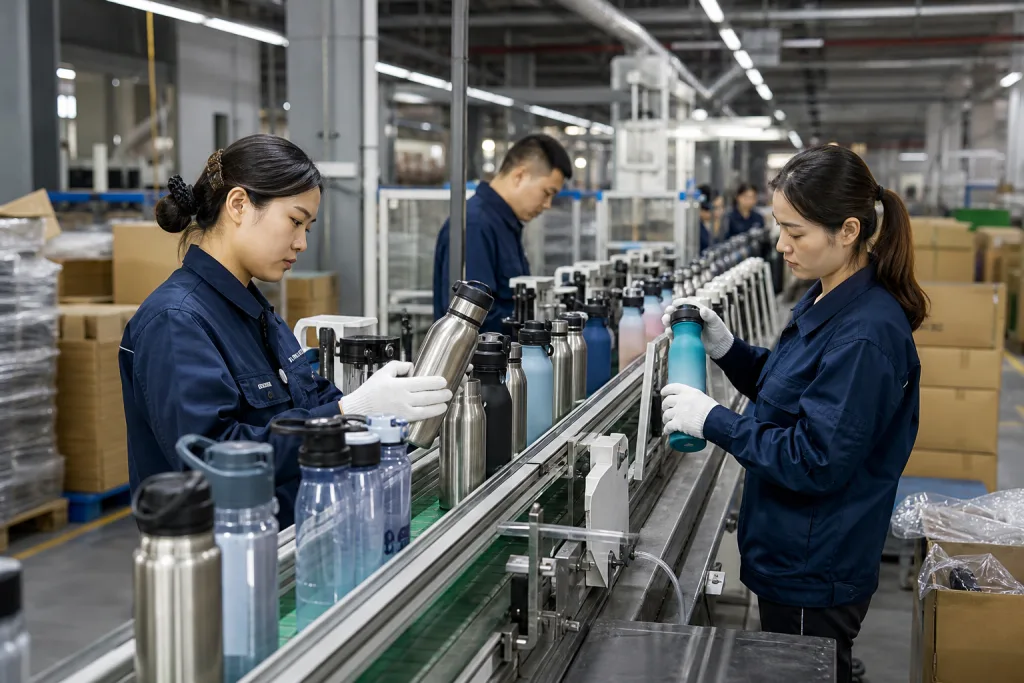
This is where 6 canteen manufacturers can look the same on paper and still run differently on the factory floor. A Zhejiang canteen factory that exports monthly 200,000-500,000 units should be able to spell out its testing routine, from incoming raw material checks to 100% leak testing or random vacuum checks, depending on the item. We ship this every month, and we have seen it go sideways when a supplier talks only about “good quality” but cannot name the gauge, the test frequency, or an inspection finding from last week. If that is the answer, keep moving.
Match MOQ to your cash flow
MOQ is not a factory rule on paper. It is a cash-flow call. For a customized water bottle, we usually run 500 pcs for simple laser engraving, and 1,000-3,000 pcs once you add screen printing or custom parts. If you need a new mold, MOQ often moves to 5,000 pcs or above. That is standard. For a custom growler or a canteen customizable lid system, the line usually needs extra setup time, and the mold trial sample often comes back with a 0.2-0.4 mm fit adjustment before approval.
Ask for three numbers up front: sample lead time, mass production lead time, and monthly capacity. A Zhejiang canteen factory might quote 7-10 days for a pre-production sample, 30-45 days for production, and 300,000 units/month across several lines. QC pulled the sample on one lid project last month and found the silicone ring sitting proud by 1 mm, which pushed the sample sign-off back two days. That is why this question matters for a canteen distributor with seasonal spikes. The wrong question to ask is only unit price.
Do not let a low unit price hide a weak MOQ setup. A USD 2.95 bottle at 5,000 pcs can be worse than a USD 3.25 bottle at 1,000 pcs if your sell-through is unclear. The math does not work if 4,000 pcs sit in stock for 90 days. We have seen buyers flag this after the PO is issued, usually once they check warehouse space or carton count. A solid canteen vendor should help you start with a test order, then scale into a repeat order with tighter packing density and lower decoration cost. That is how distributor canteen programs turn into repeat business instead of one-off mistakes.
Check packaging and freight math
For export drinkware, packaging is part of the landed cost, not window dressing. On our line, a custom canteen in a brown box usually saves USD 0.10-0.25 per unit against a color box, and that number is real. Retail buyers still push back if the shelf face looks flat. For Amazon and DTC, the wrong question is often bottle color first. Carton size, master carton count, and barcode position on the outer case will hit your freight and receiving costs faster than a cap color change.
Ask for exact gross weight, carton dimensions, and units per carton on the quote, not later on a packing list draft. A 500ml stainless bottle might ship at 12-14 kg per carton depending on packing, and we see buyers miss that spread all the time. That changes FOB math and ocean freight math. If you compare canteen suppliers in China, make sure every quote uses the same incoterm. We have seen a low ex-works quote go sideways after inland trucking, export documents, and consolidation fees were added, and once QC pulled the sample, the PO still had the old carton count typed on it.
For North American buyers, pallet pattern matters because warehouses will flag overhang fast. For European buyers, carton strength and customs description matter more, especially if the drop test report or HS wording is sloppy. A solid custom drinkware supplier in Zhejiang should send packing photos, carton test data, and barcode options before mass production. We ship this as standard, usually with outer carton measurements in mm and a pallet load sketch. If a supplier cannot provide that, your ops team pays later in relabeling, repacking, or a receiving delay.
Use samples to test the factory
Samples are not only for product approval. They test the factory too. A canteen manufacturer that replies in 24 hours, sends a corrected proof in 2 days, and shares a sample tracking photo with the carton label visible is usually easier to run in mass production. We’ve seen the opposite go sideways: a factory took 7 days to answer a 2 mm lid-dimension question, then missed the pilot run slot the buyer had booked.
Ask for three sample checks. Logo position. Leak performance. Finish consistency under normal light, not just a polished studio photo. If the product is a canteen custom insulated bottle, fill it with hot water and check the exterior after 30 minutes; QC pulled one last month and the sidewall stayed cool except for a warm ring near the neck. For a customized growler, check cap sealing, handle strength, and any metallic smell after 12 hours closed. For a customizable canteen with straw lid, test the straw angle and whether a 6 mm cleaning brush can pass through without snagging. These details look small. They drive returns.
When you compare canteen vendors, “same as sample” is the wrong answer. Ask for a signed pre-production sample and production photos at key stages, like logo printing, vacuum test, and final packing on the line. A disciplined canteen factory in China usually sends that without a fight because they know sample luck is not the same as stable output, and the buyer flagged that gap on more than one PO.
Send your bottle spec, get a quote fast
Share material, capacity, logo method, and target MOQ. We’ll quote your customized water bottle program with clear FOB pricing and lead time.
Frequently asked questions
What is a realistic MOQ for a customized water bottle?
For a standard customized water bottle, MOQ is often 500-1,000 pcs for simple logo work and 1,000-3,000 pcs for printed or special-pack versions. If you need a new mold, expect 5,000 pcs or more. A Zhejiang canteen factory with stable export lines may still quote 30-45 days lead time after sample approval, but decoration method and packaging can add 5-10 days.
Which is better for B2B: laser engraving or printing?
Laser engraving is better if you want durability and a clean premium look, especially on stainless steel. Printing is better if you need color, larger logo area, or lower upfront cost. On a 1,000 pcs order, engraving may add USD 0.08-0.20 per unit, while multi-color printing can add USD 0.25-0.60 depending on coverage. For a distributor drinkware line, engraving usually means fewer complaints.
What compliance documents should I ask for?
For EU and North America, ask for REACH, FDA food-contact declarations, and LFGB where relevant. For insulated bottles, request thermal claim test data and material specs for stainless steel, silicone, and PP lids. You should also ask for inspection standards such as AQL 2.5, plus carton photos and a leak-test procedure. A serious canteen supplier in China should provide these without delay.
How do I compare quotes from different canteen manufacturers?
Compare the same product structure, same logo method, same lid, same packaging, and same incoterm. A quote at USD 2.80 FOB may be worse than USD 3.05 if the cheaper bottle uses thinner steel, weaker packaging, or no testing. Ask for wall thickness, carton dimensions, monthly capacity, and sample lead time. That is how you compare canteen manufacturers honestly.
Can I source a custom growler or customized canteen in small quantities?
Yes, but expect limits. A custom growler or customized canteen with existing tooling may start at 500 pcs, while a fully new shape often needs 3,000-5,000 pcs. Small orders are easier if you use existing molds and standard lid systems. A China-based canteen factory can usually support mixed SKUs if your total order reaches 3,000-5,000 pcs across styles.