Key Takeaways
- A practical MOQ for a customized vacuum insulated bottle is usually 1,000 to 3,000 pcs per color, with logo setup from USD 40 to USD 120
- 304 stainless steel inside and outside is standard; 316 inner wall typically adds USD 0.35 to USD 0.90 per unit depending on size
- Reliable mass production lead time from Zhejiang, China is commonly 25 to 45 days after sample approval and deposit
- Ask for AQL 2.5/4.0, 1.2 m drop test, and documented temperature retention such as 6 hours hot above 60°C
You can buy a customized vacuum insulated bottle from 50 factories in Zhejiang and still get 3 different builds at 3 different quality levels. On the quote sheet, they look the same: 18/8 stainless steel, double wall, powder coating, laser logo. On the line, a 0.1 mm wall gap, the vacuum reading, or a lid resin swap changes the result fast. We’ve seen one bottle pass a 1.2 meter drop and another dent at the base seam. Same drawing. Different factory control. Heat hold for 12 hours and REACH clearance also come down to those small spec lines, not brochure wording.
If you buy for retail, promotion, or distribution, read the spec sheet like an engineer. Not a catalog reader. This is the right place to be picky. Ask about wall thickness, vacuum rate, lid resin, AQL level, MOQ, and what the supplier will put in writing on the PO. QC pulled the sample on one order because the buyer flagged “PP lid” but the factory had quoted ABS in the cap insert; that kind of mismatch is where projects go sideways. Whether you are building a custom drinkware range, buying as a canteen distributor, or adding a customized growler with bottles, the wrong question is “Can you make it look the same?” The better question is “What exactly do you run, and what do you ship?”
Start with the steel grade
The first line on the spec sheet should state which steel touches the drink and which steel is used for the outer shell. For a customized vacuum insulated bottle, the standard commercial build is SS304 inside plus SS304 outside, sometimes marked 18/8. That covers most coffee, water, and tea programs in Europe and North America. If the bottle will hold acidic drinks, electrolyte mixes, or sit warm in a truck or warehouse for 12 days vs 18 days, ask for 316 on the inner wall. On our line, a 316 inner usually adds USD 0.35 to USD 0.90 per bottle in 500 to 750 ml sizes, depending on coil price and MOQ.
Do not stop at steel grade. Ask for wall thickness. Typical retail spec is 0.4 mm inner and 0.45 to 0.5 mm outer. Some promo orders get pushed down to 0.35 mm to hit a target FOB. The math doesn’t work. At quotation stage the bottle still looks clean, but after drop testing, dents go up, thread stability gets worse, and powder coat chips faster. We have seen QC pull samples where the neck thread deformed after torque testing at 6 N·m. If you are a canteen vendor or distributor drinkware buyer serving institutional clients, those returns will eat margin fast.
What to request from your canteen manufacturer or canteen factory:
- Material declaration for all food-contact parts
- Steel grade confirmation for inner and outer walls
- Measured wall thickness tolerance, not just nominal thickness
- REACH and LFGB or FDA alignment depending on market
Plenty of canteen manufacturers in Zhejiang, China will quote a lower-cost bottle that looks the same in photos. The gap usually sits in steel gauge and finish control. We ship samples every week where the buyer flagged color first, then found the body weight was 18 to 25 g under target. This is the wrong question to ask: “Can you match the sample look?” Ask instead for the steel spec in the PO and purchase contract, not only in sample approval.
Vacuum performance is not one number
Buyers ask, “How many hours hot and cold?” Wrong question. The spec needs test conditions on paper: fill with 95°C water, ambient 20°C, then record the result at 6 hours and 12 hours. On our line, QC uses a digital probe thermometer, not a guess. For a dependable 500 ml double-wall bottle, we usually want above 60°C at 6 hours and above 45°C at 12 hours. Cold-retention claims swing from 12 to 24 hours, and the gap usually comes from ice ratio, headspace, and lid style.
Vacuum performance is not decided by the word “vacuum.” It comes from the copper coating or other reflective treatment, the weld at the bottom, the neck structure, and whether the lid leaks under pressure. A bottle with a 55 mm wide mouth and straw lid will almost never match a narrow-mouth screw-cap bottle. Buyers still compare those two in the same RFQ. We’ve seen this go sideways, especially on custom canteen projects where the buyer flagged weak heat retention after choosing the sport lid.
Useful buyer questions
- What test method do you use for heat retention?
- Is the inner tank copper coated?
- What is the vacuum failure rate in final inspection?
- Do you do 100% vacuum check or sample check?
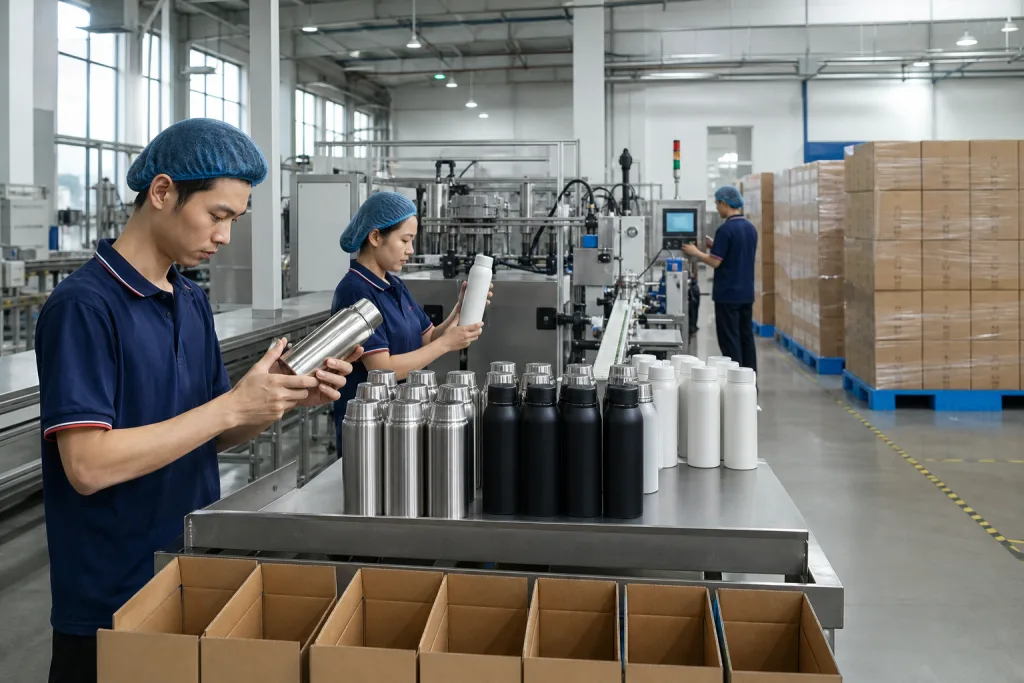
At factory level, better lines run 100% vacuum testing because a failed vacuum bottle is scrap once it is packed. No fix. A serious canteen supplier separates appearance inspection from functional inspection; if you mix them, defects slip through during peak season. If your supplier capacity is 300,000 to 500,000 units per month, ask how many vacuum-testing stations they run and whether batch data is recorded. We run dedicated stations, and each unit passes the vacuum checker before cartoning.
A low FOB price is easy to offer when the hot-retention claim is copied from a previous item. Ask for the actual test report on your exact bottle and lid combination.
This hits canteen promotional orders too. If the insulation is poor, the bottle gets used once and then sits in a drawer. The client remembers the logo. Not the $0.18 saved per piece.
Size, mouth, and weight tradeoffs
Capacity is the spec buyers oversimplify first. A 350 ml, 500 ml, 750 ml, and 1,000 ml bottle ship differently, sit on shelf differently, and feel different in hand. For most retail and promo programs, a 500 ml customized vacuum insulated bottle is the safe opening SKU because the freight math works and daily use is easy. On our line, typical net weight lands around 280 to 340 g depending on body profile and steel thickness, and QC checks that on the digital scale before packing approval.
Ask for three dimensions as separate numbers: body diameter, total height, and mouth diameter. Do not accept one rough sketch. If the end user wants cup-holder fit, keep the body around 70 to 74 mm diameter; we have seen 76 mm get rejected after the buyer flagged a car console test. If they want easier cleaning or ice fill, a wide mouth of 45 to 55 mm does the job, but heat retention usually drops a bit and the lid structure gets more parts. This is the wrong question to ask by itself—mouth size has to match the use case.
For a customizable canteen sold into schools, gyms, or outdoor channels, shape matters. Dent claims show up fast. A straight cylindrical body runs more cleanly on the line than a heavy taper or faceted wall, and the hydroforming die setup is simpler. Complex silhouettes look fresh in a showroom, then yield drops, weld seam matching gets fussy, and carton loading wastes space. We have seen this go sideways on a 3,000 pcs order where the outer carton count had to be cut because shoulder flare made the packout fail the drop test.
Typical buyer impacts by size:
- 350 ml: lower freight cost, common for coffee programs, but the printable area is tighter and logo height gets squeezed
- 500 ml: best all-round retail SKU, easiest MOQ planning; we run this size most often because lid and carton options are broader
- 750 ml: stronger outdoor positioning, higher drop risk when full; a full unit adds enough top weight that QC pulled the sample after a cap-impact test
- 1,000 ml: higher perceived value, but carton weight and leakage claims matter more, especially once packed 24 pcs per master carton
If you are also buying a customizable growler or custom growler in the same program, align carton dimensions and decoration process where possible. We ship mixed-SKU programs faster when the box footprint matches and the same spray line or silk-screen jig can run both items. Shared components help too. One buyer even had a PO typo on lid color across two SKUs, and common packaging standards saved a repack bill.
Lid resin and seal details
The lid drives more after-sales claims than the bottle body. Read that again. You need four details up front: lid shell material, food-contact resin, gasket type, and the drink use—hot fill, carbonated, or cold water only. On our line, the common builds are PP, Tritan, or stainless shell with a PP inner structure. Same bottle, different lid, and the complaint rate changes fast. We’ve seen buyers focus on 304 stainless on the body and skip the resin spec in the cap; this is the wrong question to ask.
For hot beverage bottles, a plain screw cap with a silicone gasket is still the safest option. Flip lids, push-button lids, and straw sets sell better on shelf, but they add leak paths, odor hold, and break points. QC pulled a sample last month where the button spring was fine, but the straw seat sat off by 0.6 mm and failed after carton vibration. If you supply corporate gifting canteens, simple usually wins. If you supply retail chains, convenience features can make sense, but you need extra testing and you should accept a higher defect allowance in the PO.
Specify gasket hardness if you can, usually silicone around 50 to 70 Shore A, and ask for spare gaskets. A bottle may pass a bench leak test and still fail in transit if thread engagement is shallow or seal compression shifts lot to lot. We run upside-down leak tests on finished goods, and drop tests at random from 80 cm after packing. The buyer flagged one order because caps felt “tight”; torque check showed 1.8 N·m on one cavity and 1.2 N·m on another. That spread is where complaints start.
Minimum lid checks worth writing into your PO
- 100% leak test after assembly
- No BPA and food-contact declaration
- Dishwasher recommendation clearly stated; painted bottles are often hand-wash only, and we’ve seen “dishwahser safe” typed on a PO by mistake
- Torque range for cap closure if the lid uses mechanical locking parts
This is where canteen vendors often underestimate risk. A lid that saves USD 0.18 can create a 3% complaint rate. The math doesn't work. For distributor canteen programs, that is false economy, especially once you count replacement freight and the labor to sort returns.
Decoration drives cost and reject rate
Most custom drinkware buyers look first at logo size and color count. On the factory side, we watch surface prep, oven curing, and print registration because that is where cost and rejects show up. You need both views. Common body finishes are powder coating, spray painting, brushed stainless, polished, and tactile coatings like rubberized paint. Powder coating is still the mainstream pick if you want stable color and fewer complaints in transit. Typical upcharge versus plain stainless can be USD 0.25 to USD 0.60 depending on bottle size and color. On the line, a bad pretreatment stage by even 1 step shows up later as peeling around the shoulder radius.
For branding, silkscreen is the low-cost option for simple 1- to 2-color logos on volumes above 1,000 pcs. Heat transfer fits larger multi-color graphics, but we have seen reject rate climb 2% to 4% if the film alignment drifts on curved bodies. Laser engraving is clean and durable, especially on powder-coated surfaces, though logo visibility depends on substrate color and laser depth settings. Black on dark navy often looks weak; the buyer flagged it more than once. If you are planning a canteen promotional campaign, ask for a rubbed-off test or tape adhesion test after curing. QC pulled the sample after 24 hours, not straight out of the oven, because that quick check gives false confidence.
Decoration changes MOQ too. A plain bottle may have a stock body MOQ of 500 pcs, but a customized vacuum insulated bottle with a Pantone body color and custom box is more realistically 1,000 to 3,000 pcs. New mold lids can push MOQ to 5,000 pcs or more. At BottleForge-scale factories in China, sample lead time is commonly 7 to 12 days for existing models and 20 to 35 days for new tooling review and prototype confirmation. Buyers ask for 300 pcs with a custom lid all the time; this is the wrong question to ask, because the math doesn't work once tooling, color matching, and carton print plates are on the table.
Cost checkpoints:
- Silkscreen setup: about USD 40 to USD 80 per color
- Laser logo: often USD 0.08 to USD 0.20 per unit
- Custom color box: roughly USD 0.18 to USD 0.45 depending on size and print coverage
- Mold charge for new lid or base: from USD 2,000 upward
Whether you buy customized drinkware, customized growler items, or a canteen customizable line, ask for the acceptable appearance standard in writing. Minor dust points and slight color variation may be normal industrial tolerance. Define it before mass production. We usually mark it against an approved sample and AQL 2.5, then everyone is looking at the same target. Skip this step and we've seen it go sideways over one 0.5 mm paint nib near the logo.
Packaging, carton math, and shipping
Packaging is where new B2B buyers quietly lose margin. We’ve seen a bottle with a sharp FOB price turn into a costly item because the carton count was wrong or the gift box crush rate hit 3% after a simple drop check. Ask for unit pack dimensions, master carton size, gross weight, and loading quantity by 20GP, 40GP, and 40HQ. For a standard 500 ml bottle with color box, you may see 24 pcs per carton, carton size around 49 x 33 x 29 cm, and gross weight near 9 to 10 kg. Those numbers drive freight, pallet pattern, and warehouse labor. The wrong question is “What’s your carton?” Ask, “How many cartons fit cleanly on my pallet and what was the last actual loading report?”
If you sell into Amazon FBA or major retail distribution, lock packaging specs early. Barcode placement matters. So does the suffocation warning if polybag is used, the drop test requirement, and the carton labeling format. FNSKU sticker application is simple on paper, but on the line we still control sticker position with a 2 mm placement window because one skewed label can block inbound scanning. QC pulled the sample on this more than once. A canteen distributor should also confirm if mixed-color assortments are allowed in one carton or one PO line, because that changes picking speed and claim handling. We’ve seen this go sideways when the buyer flagged a mixed pack that the PO typo never cleared up.
From Zhejiang, China, sea freight is still the standard route for larger orders. Build the schedule from factory production time plus port congestion margin, not from the sales promise. A realistic schedule for a repeat customized vacuum insulated bottle order is 25 to 35 days production after deposit and artwork approval. New color, new packaging, or pre-shipment corrective actions can push it to 40 to 45 days. One common delay is a carton mark change after the first print run; if the outer box font is off by 1.5 mm, some retail buyers reject it and we reprint.
- Stock sample dispatch: 2 to 4 days
- Pre-production sample: 7 to 12 days
- Mass production: 25 to 45 days
- Typical MOQ: 1,000 pcs for customized body and logo, sometimes 3,000 pcs for special finishes
If your canteen suppliers or canteen vendors promise 15-day delivery on a fully custom project, ask what exactly is custom and what is already sitting in inventory. We ship rush orders every month, but the math doesn’t work if the body color, logo, color box, and carton marks all start from zero.
Compliance, inspection, and supplier control
The last lines on the spec sheet decide whether we ship on time or spend 9 days arguing over liability. For Europe, ask for REACH and food-contact compliance. For the US and Canada, ask what test reports the factory can support for your channel—Amazon, retail, or promo buyers do not ask for the same file set. If the bottle is for children, check ASTM-related points against the actual accessory design, especially straws, bite valves, and small detachable parts under 31.7 mm. Larger retail buyers often ask for BSCI. ISO 9001 is still a useful process sign, but this is the wrong question to stop at; we have seen ISO-certified plants ship bad vacuum lots because the line skipped leak rechecks after welding.
Inspection should be written down, not left as “factory standard.” Set an AQL target. A common setup is AQL 2.5 for major defects and 4.0 for minor defects on final random inspection. Define major defects in plain words: leakage, failed vacuum, wrong logo, sharp edge over 0.3 mm, missing parts, severe dent. Define minor defects too: slight color variation, one dust point, light scratch under a set length such as 5 mm. QC pulled the sample, and the buyer flagged it. That happens all the time when the PO says “matte black” but the artwork file says “rubber paint black,” or when the logo position drifts 2 mm and nobody agreed on tolerance.
Good canteen suppliers in China will show you the production flow, not just talk around it: raw material incoming check with XRF or wall-thickness gauge records, semi-finished body inspection, vacuum test, coating inspection, logo inspection, packing audit. Ask whether they hold spare lids, straws, and seals in stock, and ask how claims are settled—by replacement quantity, credit note, or remake. We ship plenty of repeat programs where 500 spare lids per 10,000 pcs saves more trouble than chasing another USD 0.10 on unit price. If you are building a distributor growler or distributor drinkware program, the math does not work any other way.
The best supplier is not the one who says yes fastest. It is the one who tells you where failure usually happens and writes the control points into the PI and artwork file.
That is how a canteen factory becomes a long-term canteen supplier. Not a one-order canteen vendor. On our side, that usually means the PI carries the test method, carton drop standard, and even the old typo from the buyer PO if it affects print content, so nothing gets “assumed” once the line starts.
Send your bottle spec and get a practical factory review
We will check steel, lid, decoration, MOQ, and lead time line by line so you can source in China with fewer surprises.
Frequently asked questions
What is a realistic MOQ for a customized vacuum insulated bottle?
For an existing bottle model with a standard screw lid, 1,000 pcs per color is a realistic starting MOQ from many factories in Zhejiang, China. If you only change the logo on a stock color, some suppliers may accept 500 pcs, but unit price usually rises by USD 0.20 to USD 0.50. If you want a Pantone body color, custom packaging, and a special lid finish, expect 1,000 to 3,000 pcs. New tooling for a custom lid or base can push MOQ to 5,000 pcs and add a mold charge from about USD 2,000. Always ask whether MOQ is per SKU, per color, or per shipment, because suppliers use those terms differently.
How much should I budget per bottle for a mid-range retail program?
For a 500 ml customized vacuum insulated bottle in SS304 with powder coating and a 1-color silkscreen logo, a common FOB China range is roughly USD 2.80 to USD 4.80 depending on structure, coating quality, and order quantity. Better lids, 316 inner wall, premium packaging, or laser logo can push the price above USD 5.00. At 1,000 pcs, decoration and setup costs have a visible impact; at 5,000 pcs, pricing becomes more efficient. If a quotation is far below market, check steel thickness, vacuum testing, and packaging. On paper you may save 8%, but freight damage or leakage claims can cost more than the price gap.
What tests should I require before shipment?
At minimum, require a documented leak test, vacuum retention test, and appearance inspection against an approved golden sample. For a standard program, many buyers use AQL 2.5 for major defects and 4.0 for minor defects during final random inspection. Functional checks should include 100% leak testing and either 100% vacuum testing or a validated in-line control system. Practical physical tests are 1.0 to 1.2 meter drop test in retail packaging, coating adhesion test, and barcode scan check if you sell through distribution or FBA. For Europe, request REACH-related support and food-contact declarations for steel, silicone, and plastic parts. Write the exact pass/fail points into the PO, not just 'as per standard.'
How long does development and production usually take?
If you choose an existing bottle from a canteen factory and only change logo and color, stock sample can ship in 2 to 4 days and pre-production sample usually takes 7 to 12 days. After sample approval and deposit, normal production lead time is 25 to 35 days. If you add custom packaging, multiple decorations, or peak-season scheduling, 40 to 45 days is more realistic. A new lid mold or major structural change can add 20 to 35 days before production even starts. Buyers often lose time on artwork confirmation and carton labeling, so freeze those files early. If your supplier in China promises very fast lead time, ask what parts are already in stock.
Should I choose a simple screw lid or a feature lid?
For most B2B programs, a simple screw lid is the safer commercial choice. It is cheaper, usually by USD 0.15 to USD 0.60 versus more complex lids, and it produces fewer leakage and breakage claims. If your channel is corporate gifting, school, or broad retail, simple lids generally give the best balance of durability and thermal performance. Feature lids such as flip tops, push buttons, or straws can improve user convenience and retail appeal, but they need tighter QC and clearer usage instructions. If you choose a feature lid, ask for cycle testing, spare gasket availability, and hot-drink suitability. A feature lid can lift sell-through, but only if your canteen supplier controls assembly consistently.