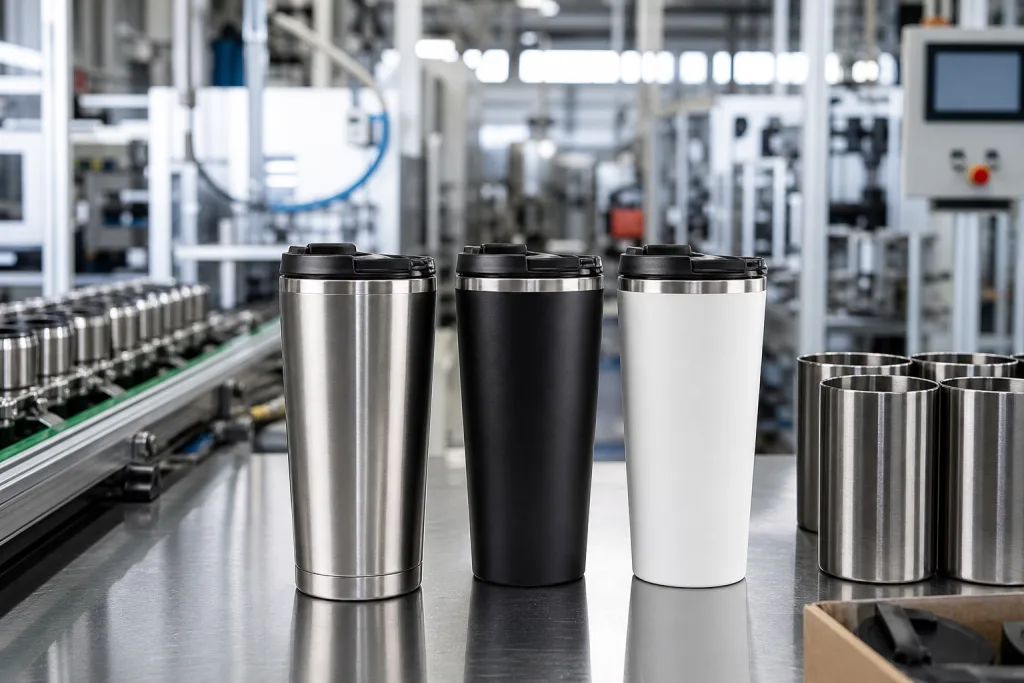
Key Takeaways
- For a customized travel mug, practical MOQ is usually 500-1,000 pcs per color, while fully custom molds often start at 3,000-5,000 pcs
- A 304 stainless steel double-wall tumbler with powder coating typically lands around USD 3.20-6.80 FOB China depending on size, lid, and decoration
- Pre-production samples add 5-10 days, and mass production usually takes 25-35 days after deposit and artwork approval
- Use AQL 2.5 for major defects and confirm REACH, LFGB, FDA, or ASTM requirements before you place bulk travel tumbler orders
You can buy a customized travel mug from fifty factories in China by Friday. Easy part. The hard part is getting lid fit, coating adhesion, retail packaging, and delivery timing right when the launch date is fixed and margin is tight. We have seen a 0.3 mm lid thread mismatch stop a whole line, and one carton drop test failure can send the insert back for rework. If you are sourcing for a coffee brand or a corporate-gift program, small errors spread fast across 2,000 to 20,000 units.
Buyers in Europe and North America usually ask the same questions: what MOQ is realistic, which print method still looks clean after 500 dishwasher cycles, whether 304 stainless is enough, and how to control quality before shipment from Zhejiang, China. That is the right place to start. A good supplier should answer with numbers, sample photos, and inspection records, not sales talk. Our factory in Zhejiang runs 300,000 units per month, standard lead time is 25 to 35 days, and QC pulled three lid leak samples last month at AQL 2.5 before we shipped. Frankly, asking only for the lowest price is the wrong question; the math does not work if 4% of the mugs come back with print rub or loose lids.
What are you really buying?
When you request a customized travel mug, you are not buying a logo print by itself. You are buying the steel grade, the vacuum structure, the lid fit, the decoration process, the packing standard, and the paperwork behind it. On our line, two suppliers can quote the same 20 oz photo and still land 30% apart because one is pricing 0.4 mm inner + 0.5 mm outer with a better lid seal, while the other is pricing the lightest body he thinks you will accept.
Start with the use case, not the catalog photo. A coffee brand selling premium beans online usually wants a retail-ready tumbler with tighter Pantone control, tougher powder coat, and a branded box that survives courier drops; we often run a 1.2 m drop check on the packed sample before mass production. A corporate-gift buyer usually pushes for 12 days instead of 18 days, lower MOQ, and a safe mid-range spec that works for 3,000 employees in different offices. Same name, different job. Calling both a bulk coffee travel mug is where quotes start going sideways.
Your basic spec sheet should include:
- Capacity: 12 oz, 16 oz, 20 oz, or 30 oz
- Material: 18/8 stainless steel, commonly called SUS304, or 18/0 for lower-cost outer parts
- Construction: single wall or double wall vacuum
- Wall thickness: often 0.4 mm inner and 0.5 mm outer for a mid-range vacuum tumbler
- Lid type: slider lid, flip lid, screw lid, or straw lid
- Finish: spray paint, powder coating, electroplating, or raw stainless
- Branding: silkscreen, heat transfer, laser engraving, or 360-degree wrap
- Packaging: polybag, white box, color box, or mailer-tested e-commerce box
If a supplier does not ask these questions, you are getting a generic quote. Not a reliable one. We quote structure first, then artwork, and this is the right way to do it; last month a buyer flagged two “same” tumblers, and QC pulled the sample to show one had no vacuum and a 6 g lighter lid. That is how you avoid comparing a vacuum insulated bulk travel tumbler with a thinner, non-vacuum item that only looks similar on screen.
MOQ, pricing, and where costs move
New buyers often stare at unit price and miss the bigger cost buckets. That is the wrong question to ask. On a standard 20 oz stainless bulk coffee tumbler using an existing mold, normal MOQ is 500 to 1,000 pcs per color. We run that kind of order on the line with standard silicone lid parts and carton marks already set. If you ask for a custom lid, custom base, or an exclusive body shape, MOQ usually jumps to 3,000 to 5,000 pcs, and tooling runs from USD 2,500 to USD 12,000.
Typical FOB China pricing for a double-wall vacuum travel tumbler looks like this:
- Basic 20 oz tumbler, plain carton: USD 3.20-4.10
- Powder-coated body with one-color print: USD 3.90-5.20
- Retail gift box plus premium lid: USD 4.80-6.80
- Fully custom color box insert: add USD 0.35-0.90
- Laser engraving: add USD 0.12-0.30 per position
- Heat transfer wrap: add USD 0.25-0.60 depending on artwork coverage
For coffee mug bulk promo orders, the lowest cost usually comes from an existing model, one standard powder coat, and one logo position on the straight wall. Simple sells. We have seen buyers add a second print position and a custom insert card, then wonder why lead time moved to 18 days instead of 12 days. If you are building a retail product for a coffee brand, spending an extra USD 0.40 to 0.70 per unit on coating, lid fit, and packaging often saves return claims later. QC pulled the sample on one project last month because the slider lid leaked at a 45° tilt test; the extra lid upgrade fixed it.
A practical buyer checklist:
- Ask whether the quote is FOB Ningbo, FOB Shanghai, or ex-works Zhejiang
- Confirm whether mold charge, screen charge, and barcode labels are included
- Check if over/under production tolerance is ±5%
- Ask if spare lids or replacement parts can be supplied at 1% to 2% of order quantity
This matters whether you are buying from a coffee mug factory direct source or through a trading company. We have seen this go sideways over small things: a PO typo on carton quantity, a missing screen charge, a barcode label billed after approval. The best quotes are the ones you can audit line by line.
Which materials and insulation make sense?
For most North American and European buyers, the safe default is 304 stainless steel on both inner and outer walls for any coffee mug custom made project meant for daily use. That spec is easier to sell as premium, and it holds up better against tea, coffee, and light acid drinks. Some entry-level items run 201 or mixed-grade steel on outer shells or hidden parts. That may work for a promo run at 3,000 pcs MOQ, but this is the wrong question to ask if the mug is for retail or repeat orders. Not all stainless is equal, and we have seen buyers flag rust spots after a 48-hour salt-spray check on cheap stock.
For heat and cold performance, double-wall vacuum is the standard we ship every day. A decent 20 oz vacuum tumbler should keep drinks hot for 6 to 8 hours and cold for 12 to 18 hours under normal test conditions. If a supplier claims 24 hours hot on a standard office tumbler, ask for the test setup: starting water temperature, fill volume, ambient room temperature, and whether the lid was on. QC pulled the sample once on a claim like that, and the flask body was 0.42 mm thicker than the approval sample. Real numbers matter.
Material questions worth asking
- Is the interior body SUS304 or SUS316?
- Are lids BPA-free PP, AS, Tritan, or SAN?
- Is the gasket food-grade silicone?
- Does the coating pass adhesion and cross-hatch testing?
- What is the actual net weight and wall thickness?
For a bulk coffee mug program, lid material gets missed too often. We see more claims on lids than cups: leaking slider lids, weak snap tabs, and odor from low-grade plastic resin. If the end user commutes, ask for a threaded lid or a tighter press-fit design with a leak test standard, such as upside-down for 30 minutes or 1 meter drop testing with water inside. If the mug stays on a desk, a slider lid is usually enough and cuts cost. One buyer pushed back on a threaded lid because of price, then came back after the first 500 pcs had splash complaints.
A lower-priced tumbler is not always cheaper. If 3% of units leak and your customer service cost is USD 8 per complaint, your savings disappear fast.
In China, especially in Zhejiang, factories with mature vacuum lines usually show better control on welding, evacuation, and seal testing. We run helium checks on some orders and water-bath vacuum inspection on others, depending on the spec and target price. If a supplier cannot explain how they test vacuum loss, what the reject standard is, or why one body weighs 320 g and another 285 g for the same size, it is probably not the right coffee mug manufacturer for your program. We have seen this go sideways when the line skips seal inspection to catch a ship date.
How should your branding be applied?
A coffee mug customizable product can carry branding in a few standard ways, and each one has a hard limit on color, surface fit, or wear resistance. For corporate gift orders, we usually run the durable option first. For retail programs, buyers push harder on color match, logo position, and shelf look under store lighting.
The main decoration methods are straightforward:
- Silkscreen: low setup cost, good for 1-2 spot colors, best on simple logos; on the line we normally control logo position within about 1.5-2.0 mm on straight bodies
- Laser engraving: permanent, premium look, strong for stainless or under powder-coat reveal; QC pulled samples last month where the reveal edge looked rough on a thin coating
- Heat transfer: works for multi-color artwork and wrap designs; better choice when the logo has gradients or small text under 2 mm high
- Digital print: suits short runs on selected surfaces, but verify scratch performance; this is the wrong place to save money if the mug will ride in cup holders and backpacks every day
For a coffee mug custom retail product, powder coating plus laser engraving is a reliable combination because it looks clean and holds up well after repeated handling. We ship a lot of these in 3,000-5,000 pc retail runs. For a coffee mug promotional products campaign, a one-color silkscreen on a standard coated body usually gives the best cost-to-speed ratio, especially when the buyer wants 12 days instead of 18 days.
Ask for the following before mass production:
- A vector artwork proof with logo size in millimeters
- A pre-production sample matching the actual coating color
- Pantone reference and acceptable tolerance
- Print position photos on the real body shape
- Dishwasher disclaimer if hand wash is recommended
If your order includes Amazon or retail distribution, add FNSKU labels, carton marks, and barcode placement to the approval process. We have seen this go sideways over one small typo on a PO or an insert card size off by 3 mm. A lot of coffee mug distributors and importers lose a week because they approve the body artwork and miss the outer carton details. A competent coffee mug oem manufacturer should roll all of that into one approval file and get sign-off before the line starts.
What compliance documents should you request?
If you import into Europe or North America, compliance is not a file to collect and forget. It decides whether the shipment clears in 12 days or sits for 18, and whether your brand gets claims after sale. For drinkware, test scope changes by material, selling market, and age grading. A 304 stainless tumbler with a PP lid does not use the same report set as a kids' bottle with a silicone straw. On our line, QC pulled a sample once because the PO said “adult promo mug” but the artwork showed cartoon characters, which changed the review path.
For adult stainless tumblers, common requirements include:
- EU: REACH, LFGB where requested, and packaging rules
- US: FDA food-contact expectations, California Proposition 65 where relevant
- Children's items: extra ASTM and CPSIA review if marketed to kids
Ask for factory social-compliance and quality-system documents too. BSCI and ISO 9001 do not guarantee good product. They show the factory runs with documented controls, traceability, and corrective action records. That matters if you are buying as a coffee mug distributor or clearing a vendor file for a large retailer. We have seen buyers flag a factory just because the audit was 14 months old, even when the sample looked fine. This is the wrong question to ask: “Do you have certificates?” Ask for the issue date, scope, and factory name match.
Your document checklist should include:
- Material test reports for food-contact parts
- Declaration of conformity where applicable
- Factory audit status such as BSCI or Sedex, if required
- Production inspection standard using AQL 2.5 or your own limit
- Carton drop-test result if using e-commerce packaging
A good coffee mug supplier in China should tell you which reports are current and which ones need a fresh test for your exact SKU. We ship plenty of similar-looking tumblers, but a lid gasket change from 2.0 mm to 2.5 mm or a new inside coating means the old file may not cover the new build. Buyers push back on test cost here; fair enough, but the math doesn't work if customs or Amazon asks later. Watch for copied reports, old lab dates, and mismatched product photos. The report should match the real material set and construction of your item, not a close cousin from last season. That is why buyers build a tighter coffee mug supplier directory instead of collecting 35 random quotations.
How do you control production risk?
Most procurement managers come to us with the same risk list: late production, color mismatch, and complaints after the goods land. All three are controllable if you check the order in stages instead of waiting until 1,200 cartons are taped shut. We’ve seen this go sideways when the buyer only checks the final photos.
A sensible timeline for a standard bulk travel mug order is:
- Day 1-3: final quote, artwork review, sample request
- Day 4-10: pre-production sample and packaging confirmation
- Day 11-15: deposit paid, production plan locked
- Day 16-35: mass production
- Day 30-36: final inspection and balance payment
That schedule works if approvals move on time. If the PO has a logo size typo or the Pantone callout is missing, Day 4 becomes Day 7 fast. On our side, we usually lock the sample with a signed artwork file, a carton mark sheet, and one taped retain sample at the line office.
For quality control, do not wait for one last look at sealed cartons. Put checkpoints into the run:
- Confirm raw material grade before production
- Approve color chips or actual sprayed sample
- Check logo adhesion and position at pilot stage
- Inspect lid fit, leak test, and vacuum performance during line output
- Run final random inspection by AQL before shipment
This is the right place to get specific. QC pulled the sample and checks steel grade records first, then compares coating color under a light box, not from a phone photo. At pilot stage, we measure logo position in mm, run a tape test for adhesion, and check lid thread fit on actual bodies from the line. For vacuum items, we spot-check heat retention and leak test units after assembly, not the next morning when rework is harder.
Ask for defect photos by category: dent, scratch, paint dot, print shift, lid gap, and carton damage. That gives both sides the same language. A serious coffee mug factory or coffee mug manufacturers group should already sort defects this way, with clear limits on what passes and what gets pulled.
If you are comparing multiple coffee mug suppliers from a coffee mug supplier list, do not judge on quote alone. The lowest price is often the wrong question to ask. Judge how they answer when the buyer flagged a lid gap, when color drift showed up on lot 2, or when QC found 7 dented rims in random check. In Zhejiang, China, the factories worth keeping long term are usually not the ones promising 12 days on a custom order that needs 18. They are the ones that tell you straight when a custom coating needs 3 more days to cure and test properly before we ship.
Private label details buyers forget
Plenty of buyers ask for a coffee mug private label project, but after the first call it turns out they just want a stock tumbler with a printed logo. Real coffee mug private labeling is a different job: brand insert card, custom box, barcode control, spare lid planning, and repeat-order consistency. On our line, QC pulled two “same logo” samples last month and the lid tint was off by one shade because the buyer never locked the resin color chip.
If you want a program you can reorder for 12 to 24 months, lock the details now. This is not admin work. It decides whether the second PO ships smooth or gets stuck over a 3 mm carton height change.
- Body Pantone or approved physical sample
- Lid material and tint level
- Master carton dimensions and max gross weight
- Barcode format, FNSKU, carton labels, and country-of-origin mark
- Packaging insert wording and language versions
- Spare part policy for lids, straws, and seals
This is where coffee mug manufacturers start to separate. The first quotation can look the same, then the PO lands and the gaps show up fast. We’ve seen this go sideways: one factory was USD 0.15 cheaper, then changed the slider lid vendor on the repeat order and the replacement parts no longer fit the old stock. If a supplier can hold accessory fit and coating batches steady across repeat runs, that supplier is worth more.
For a coffee mug customized corporate-gift order, you might skip part of this and still ship fine. For a branded retail launch, skipping it is the wrong call. The buyer flagged this on one PO because the FNSKU line was typed as “FSNKU,” and 6 cartons had to be relabeled before loading. The same logic applies whether you are ordering coffee mug in bulk for one season or building an ongoing range with a coffee mug private label partner. Buy the system, not just the sample.
Get a practical customized travel mug quote
Send your target quantity, capacity, logo file, and delivery deadline. We will recommend the right tumbler structure, MOQ, decoration method, and FOB China pricing.
Frequently asked questions
What MOQ should I expect for a customized travel mug?
For an existing tumbler model with custom color and logo, expect 500 to 1,000 pcs per SKU in most China factories. If you need a custom lid, exclusive body shape, or dedicated packaging insert set, MOQ usually increases to 3,000 to 5,000 pcs. Some factories in Zhejiang will quote 300 pcs, but that often means limited color choices, digital mockups instead of real samples, or higher unit cost. For corporate-gift buyers, 500 pcs is a practical starting point. For coffee brands planning retail distribution, 1,000 pcs per style usually gives better price control and more stable decoration quality.
How long does bulk production take after sample approval?
For a standard 20 oz stainless vacuum tumbler, sample approval to shipment is normally 25 to 35 days after deposit, assuming artwork and packaging are already confirmed. A pre-production sample takes another 5 to 10 days before that. If your order includes a new mold, color box development, or multiple print methods, add 10 to 20 days. Peak season before Q4 gifting can push lead times beyond 40 days. Ask your supplier in China for a dated production schedule covering sampling, raw material purchase, coating, assembly, packing, and final inspection rather than accepting a single verbal promise.
Which print method lasts best on a coffee travel tumbler?
Laser engraving is the most durable for long-term use because it does not sit on the surface like ink. On powder-coated stainless steel, laser can create a clean metallic contrast and usually performs well over years of handling. Silkscreen is lower cost and works well for promotional runs, but it depends heavily on curing and user care. Heat transfer is good for multi-color graphics, though scratch resistance varies by coating system. If you are ordering 2,000 units or more for a retail coffee brand, ask for an adhesion test, rub test, and a real production sample before approval. The extra 7 days is usually worth it.
What tests or compliance documents should I ask for?
At minimum, ask for material and food-contact compliance documentation matching the exact SKU you are buying. For Europe, REACH is common and LFGB may be requested depending on your channel. For the US, buyers often ask for FDA-related material compliance and Proposition 65 review where relevant. If the item is marketed to children, add ASTM and CPSIA checks. Also request inspection standards such as AQL 2.5, especially for appearance and function defects. If you sell online, ask for carton drop-test results too. Good factories in Zhejiang, China can usually provide current reports, but confirm the reports match the same lid, gasket, coating, and steel structure.
How do I choose between factory direct and a trading company?
Factory direct can give you better technical answers, more control over lead time, and slightly lower cost—often 5% to 12% on stable volume orders. It works best when you already know your specs and can manage sampling, QC, and shipping details. A trading company can still be useful if you need mixed products, lower communication burden, or broader sourcing. The key is transparency. Ask who owns production, where the goods are made, and whether you can audit the manufacturing site. A reliable supplier should disclose if it is a coffee mug factory, a sourcing office, or both. For repeat private-label tumbler programs, direct factory communication usually reduces mistakes.