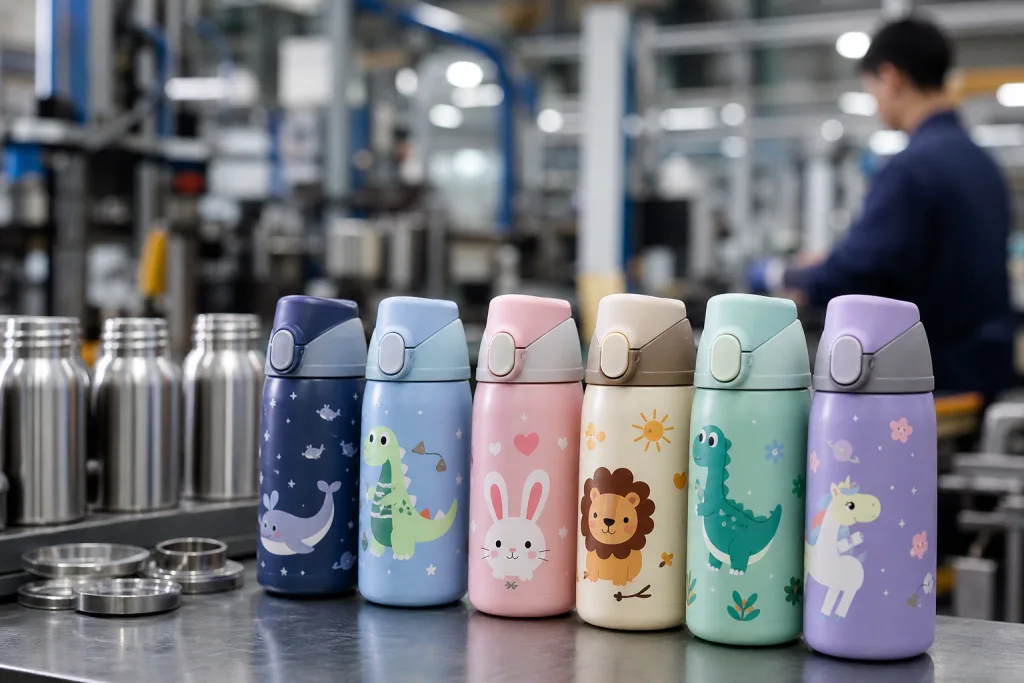
Key Takeaways
- For a customized toddler bottle, practical MOQ is usually 1,000 to 3,000 pcs per SKU, with sample approval in 7 to 12 days and mass production in 30 to 45 days
- 18/8 stainless steel inner walls at 0.4 to 0.5 mm and PP lids with food-grade silicone are the common low-risk material stack for EU and US markets
- AQL 2.5 for major defects and 4.0 for minor defects is a workable pre-shipment inspection standard for most custom drinkware orders
- Artwork, drop test, leak test, and carton spec should be frozen before deposit, or you can easily add 10% to 15% in hidden rework cost
You are not buying a generic promo item when you source a customized toddler bottle. You are buying a children’s product that has to survive a 1.2 m drop test, pass migration testing, fit small hands, and still land at your target cost. That is where first orders break down. We’ve seen catalog samples look fine, then fail on leak rate, coating adhesion in a cross-hatch test, straw bite resistance, or labeling compliance once the goods reach Europe or North America. QC pulled one sample last month with a silicone straw wall under spec by 0.3 mm, and the buyer had already approved the artwork.
The practical way to handle this is to treat the order like an engineering project, not a logo purchase. At our Zhejiang, China production base, we run into the same pattern: buyers who lock spec, packaging, and QC points before sampling usually hit launch dates, while teams that change lid details after mold approval often lose 2 to 4 weeks. We ship faster when the line has a fixed BOM, a signed carton mark, and a drop-test standard before sampling starts. This is the wrong question to ask: not “which print looks best,” but “which spec stays stable through mass production.” For retail, e-commerce, or a distributor drinkware program, the workflow matters more than the decoration style.
Start with the child, not the logo
A typical brief lands like this: a Europe brand wants a back-to-school launch, or a North America canteen distributor needs kids’ hydration SKUs for mass retail. Sales pushes for landed cost under USD 4.80, design wants muted colors with a character print, and compliance asks for clean children’s contact-material paperwork. Normal brief. The problem is the order. Start with the child and the use case first, or the math on the line does not work.
For toddlers, capacity usually sits at 12 oz to 14 oz, or about 350 to 420 ml. Body diameter matters more than buyers think. Once we run above 75 mm, small hands lose grip; we have seen parents reject a sample at 77 mm for that reason. Spout flow matters too. Too fast, and the buyer flagged splashing on first sip. Carry loops are another weak point: if the loop stands proud from the lid, it can crack in carton drop. A solid first spec usually reads like this:
- Body: 304 stainless steel, single wall or vacuum, 350 ml
- Wall thickness: 0.4 mm inner, 0.45 mm outer for vacuum models
- Lid: food-grade PP with silicone seal and soft straw
- Target age: 18 months to 4 years
- Performance: leakproof when inverted for 30 minutes
- Drop standard: 3 drops from 1 meter with no functional failure
After function is locked, decoration and packaging get simpler. Buyers mix up a toddler bottle with general canteen custom or canteen promotional merchandise all the time, and this is the wrong question to ask. Kids’ items need tighter tooling control, wider testing review, and stricter safety checks. A custom canteen for a gym campaign can pass with broader cosmetic spread; a customized drinkware item for toddlers cannot. On our side in Zhejiang, China, QC pulled the sample and checked bite-area material, choke-risk points, and print placement away from mouthing zones before mass production. If your canteen supplier or canteen vendor does not ask those questions, we have seen this go sideways.
You are not just specifying appearance. You are specifying how the product fails, and how much failure the market will tolerate.
Build the specification before sampling
Move from concept to a usable RFQ. If you send only a reference photo and a logo file, you will get price gaps that make no sense on paper because each canteen manufacturer is quoting a different build. We see this every week. One factory prices single-wall, another prices vacuum, another swaps the straw set from a 2-piece to a 4-piece assembly, and nobody writes that clearly on page 1. The numbers look close, but QC pulled the sample later and the section cut told a different story.
A cleaner RFQ sheet for a customized toddler bottle should cover:
- Capacity tolerance: 350 ml plus or minus 5%
- Material: SS304 inside, SS201 or SS304 outside depending positioning
- Finish: powder coat 60 to 80 microns, Pantone reference required
- Logo: silk screen, UV print, laser, or heat transfer wrap
- Lid color: matched PP or standard stock color
- Packaging: egg-crate, polybag, white box, color box, or PDQ tray
- Compliance: REACH, LFGB or FDA-contact alignment, CPSIA/ASTM where applicable to market claim
For B2B buyers, the price change shows up fast. A basic 350 ml single-wall bottle may quote at USD 1.85 to 2.40 FOB China at 3,000 pcs. The same body in double-wall vacuum with custom color lid and retail box can move to USD 3.20 to 4.60 FOB China. Add a second straw set, barcode sticker, and hangtag, and you can add another USD 0.18 to 0.35 per unit. This is the wrong question to ask: “Why is one quote cheaper?” Ask what wall structure, straw BOM, and pack-out the line is actually pricing.
Do not leave packaging to the end of the RFQ. A lid with a raised handle can pass factory QA, then crack after a carton vibration run if it ships loose with only a polybag. We have seen a buyer flag this after a 1A drop test because the FNSKU label was placed over the box seam and the carton burst on the second drop. For Amazon FBA or DTC, carton drop resistance and FNSKU placement matter as much as product finish. Some canteen suppliers and canteen vendors quote low because they assume plain export cartons at 24 pcs per master carton. Once you ask for color boxes, bilingual warnings, carton marks, and drop-tested packaging, the real comparison starts.
At BottleForge Industrial in Zhejiang, our normal MOQ for a customized toddler bottle is 1,000 pcs per color for existing molds, with combined runs of 50,000 units per month across multiple drinkware lines. We run medium-scale production, and that is a normal level for a canteen factory in China handling private label and distributor canteen programs. If your quantity is only 500 pcs, expect fewer lid colors or a higher unit cost. The math doesn't work otherwise. Pad-print setup, powder waste, and extra carton labels eat too much margin on a short run.
Choose materials with compliance in mind
Most disputes on children’s drinkware start with materials, not printing. For Western markets, the stack we ship most is 18/8 stainless steel body, PP lid, food-grade silicone seal, and, if the design needs it, a PE or silicone straw tip. Plain spec is fine. On our line, the trouble usually starts when a buyer asks for soft-touch coating on a sip area or a mixed-plastic lid to save USD 0.08. The math doesn’t work. Exotic additives and low-cost blends add risk without adding much shelf value.
Ask your canteen manufacturer for a full BOM by component, not a broad “food safe” statement. You need resin family, steel grade, gasket material, masterbatch or colorant handling, and which part touches the mouth. We usually show this down to the lid insert and 2 mm silicone seal. If you are buying for the EU, REACH review is standard. If you are buying into North America, you may also need to check state-level claims based on packaging and decoration. For toddler items, this is the right question to ask: what happens when a child uses it the wrong way?
- Can the straw be pulled out by a child under moderate force?
- Can the handle trap fingers?
- Will powder coat chip after edge impact?
- Is the bite area free of coating and accessible for cleaning?
Single-wall versus vacuum is a commercial call first. A single-wall customized toddler bottle is lighter and cheaper, usually by USD 0.70 to 1.20 per unit, and we ship that spec a lot for daycare, promotions, and lower-price retail. A vacuum model holds temperature better and gives stronger shelf perception, but it adds weight and needs tighter weld control at the bottom seam. QC pulled the sample once on a vacuum kid bottle because the weld ring was off by 0.4 mm, and that is exactly why cost goes up. If your project is a canteen customizable platform with one body shared across adult and kids lines, vacuum may simplify the assortment. If the brief is pure value retail, single-wall usually wins.
Be realistic with claims. If you ask a canteen factory in China to print “dishwasher safe” on a powder-coated bottle, confirm the actual test method and number of cycles. We have seen buyers ask for the claim after only 20 cycles on an internal wash test, then flag fading at retail. That goes sideways fast. If the factory has no internal standard, ask for third-party verification or remove the claim. Same with “BPA free,” “spill proof,” or “24-hour cold.” These lines help sales, but they also raise return risk.
Good canteen manufacturers do not promise everything. They tell you the limits, even if the buyer flagged it on the first call. That honesty saves money later.
Sampling is where cost gets decided
Most buyers treat sampling as a looks check. That is the wrong question to ask. Sampling is where unit cost gets fixed or starts drifting. For a customized toddler bottle, ask for a pre-production sample, an artwork sample, and a packaging mockup. If the lid uses a new color or the straw part was changed by 0.5 mm, ask for that exact build. Not a nearest-stock substitute. We have seen buyers approve a stock PP straw, then the production quote jumped once the silicone vent and custom color masterbatch were added back in.
Typical sample timing from China is 3 to 5 days for stock decoration samples, 7 to 12 days for custom color and logo on an existing mold, and 20 to 30 days if you need a new cap tool or body mold change. Those numbers are normal on the line. A straightforward logo sample may cost USD 50 to 120 plus courier. A fully new molded part can run from USD 800 to 3,500 depending cavity and tool complexity. Last month a buyer pushed back on a USD 1,200 cap insert charge, but the math did not work without cutting steel for the new flip-top geometry.
What to check on the sample
- Leak test: invert filled bottle for 30 minutes and shake 20 times
- Print adhesion: 3M tape pull after 24-hour cure
- Cap torque: consistent open-close feel across 5 pieces
- Odor: no strong plastic or paint smell after washing
- Cleaning access: straw and seal can be removed without damage
- Retail fit: barcode panel, warning text, age grading, carton dimensions
This is also the point to fix branding errors. A wide wrap graphic may look clean on a custom growler or customizable growler, but on a toddler bottle it often eats into warning copy or climbs over the shoulder radius, where screen print starts to stretch. QC pulled the sample once because the age-grade text dropped into the curved area and blurred by about 1.2 mm. If you are a canteen distributor or distributor growler buyer adding kids’ items, do not reuse adult artwork rules as-is. We have seen this go sideways.
Lock one golden sample and reference it in the PO. Write the color tolerance clearly, then state that no component substitution is allowed without written approval. Short sentence. Big difference. Buyers skip that line all the time. Then the buyer flagged it after shipment because a canteen customized run came back with a softer lid color or a different straw finish than the approved piece. We even saw one PO with "staw finish" typed instead of "straw finish," and the factory used the old texture standard.
Production control and inspection points
After the deposit lands, set up a control plan the line can actually run. Skip the 20-page PowerPoint. For a customized toddler bottle, we break checks into incoming, in-line, and final, with one owner on each point. The critical items are body weld integrity, lid fit, seal insertion depth, straw cut length, decoration cure, and carton drop resistance. On our floor, QC pulled the first-off sample and checks straw length with a digital caliper to ±1 mm, because we have seen this go sideways fast.
A practical production schedule in Zhejiang, China looks like this: 2 to 3 days for raw material prep, 7 to 10 days for body forming and coating, 5 to 7 days for lid molding or assembly allocation, 3 to 5 days for decoration, and 5 to 7 days for final assembly and packing. Total lead time is usually 30 to 45 days after sample approval and deposit for 3,000 to 10,000 pcs, and peak season can stretch that to 38 days vs 45 days depending on mold loading and coating capacity. The buyer usually asks for a shorter promise first; this is the wrong question to ask. Ask which process is the bottleneck on that order.
Use a basic inspection framework:
- Incoming: steel grade cert, plastic color match against the signed chip, gasket hardness checked by Shore A meter, carton burst strength
- In-line: weld appearance under line light, vacuum retention if applicable, thread fit on the lid torque test, logo registration
- Final: leak, visual, count, barcode scan, carton mark, drop check from the agreed height
For third-party PSI, AQL 2.5 major and 4.0 minor is normal for this category. Major defects include leakage, sharp edges, wrong artwork, missing warnings, or lid function failure. Minor defects are usually small paint specks, slight print shift within tolerance, or carton scuffing. If your channel is premium retail, tighten cosmetic rules early and write them into the PO. If you over-specify powder coat cosmetics, the math doesn't work: reject rates climb, rework starts, and the ship date slips. We have had buyers flag a 0.3 mm print shift that was still inside the signed limit sample.
Good canteen suppliers accept inspection logic before mass production starts. Weak canteen suppliers wait until goods are packed and then argue the standard. If you work with canteen distributors or a distributor canteen network, agree on defect photos in advance and mark pass/fail right on the sheet. We ship cleaner when both sides judge against the same reference. One common mess is a PO typo on carton mark copy, then final inspection stops 1 day before loading because the buyer flagged it.
Shipping, landed cost, and repeat orders
The order is not finished when production ends. Margin is still on the table. Freight plan, carton efficiency, and repeatability decide whether the project makes money. A 350 ml vacuum customized toddler bottle packed 24 pcs per carton may weigh 9 to 11 kg gross depending packaging. We see this on the line all the time: if the color box grows by 8 mm on each side, the carton count per layer drops, and a 40HQ loses space fast. The math doesn't work if you win USD 0.03 on unit price and give it back in freight.
Ask for outer carton dimensions early and map unit fit by sea, rail, or air. Do it before PO approval. If you are shipping by sea under FOB China terms, compare the true landed cost instead of chasing the lowest quoted bottle price. A supplier that saves USD 0.06 on the product but uses inefficient packaging may cost you more overall. We ship test stacks with a tape measure and pallet jack before mass production if the buyer has retailer routing rules. The same problem shows up when the factory misses pallet pattern requirements for a major retailer, and then the buyer flagged it after booking.
For repeat orders, keep the SKU discipline tight. Reorder success comes from the same lid color masterbatch, the same coating line settings, and archived artwork standards down to revision code and barcode position. QC pulled the sample once because the Pantone was right but the gloss reading was off by 6 GU, and that was enough to trigger a claim risk. This is where a serious canteen factory or canteen supplier proves its value. Repeatability matters more than one aggressive opening quote. If you plan a broader assortment later, such as custom canteen, customizable canteen, customized canteen, or even custom growler formats for family collections, start with a supplier that documents process well.
We often tell new buyers in Zhejiang sourcing that the first order teaches the factory your brand, and the second order shows whether the process is stable. That's the real test. If the first run is 2,000 pcs and the second becomes 20,000 pcs through canteen distributors or distributor growler channels, the control points need to scale without changing the product feel. We've seen this go sideways when the approved sample was saved, but the carton file had a typo on the PO and the spout lid callout changed without signoff. Save approved samples, carton files, test records, and inspection photos in one shared buyer file. It sounds basic, but it prevents most repeat-order arguments.
If you are selecting among canteen manufacturers in China, ask one blunt question: what changed between the last production lot and the next one? This is the right question. Ask about resin batch, spray line temperature, gasket source, and carton board grade. The factory that answers in clear shop-floor terms is usually the safer long-term partner.
Get your toddler bottle spec reviewed now
Send your target price, quantity, artwork, and market destination. We will review materials, MOQ, lead time, and likely QC risks before sampling.
Frequently asked questions
What is a realistic MOQ for a customized toddler bottle?
For an existing bottle mold, most China factories quote 1,000 to 3,000 pcs per SKU as the workable MOQ. If you want one body color, one lid color, and one logo, 1,000 pcs is often possible. If you need 3 colors split across the order, many factories will ask for 500 to 1,000 pcs per color to control setup loss and packaging complexity. New molds push the commercial MOQ higher because tooling cost must be absorbed. For a serious retail launch, 3,000 pcs usually gives you better unit cost, more stable color control, and more decoration choices than a 500-piece trial order.
How long does production take from approval to shipment?
If you use an existing design, expect 7 to 12 days for a proper pre-production sample and 30 to 45 days for bulk production after sample approval and deposit. In peak season, especially before back-to-school and Q4 gifting, lead time can extend to 50 to 60 days. New tooling adds another 20 to 30 days depending cap complexity. Shipping time is separate: sea freight from China to Europe is commonly 30 to 40 days port to port, and to the US often 20 to 30 days. If you need retailer-specific packaging, barcode labeling, or FNSKU handling, add 3 to 5 days for packing control.
What tests should I ask for on a toddler bottle order?
Start with practical product tests and market-relevant compliance documents. For the product itself, ask for leak testing, drop testing from 1 meter, coating adhesion, and where relevant, insulation verification. For materials, request BOM-level declarations and supporting reports tied to the actual components, not a generic factory statement. For EU programs, REACH and food-contact alignment are common checkpoints; for North America, buyers often review FDA-contact positioning plus CPSIA or ASTM-related considerations depending age claims and packaging. Also verify carton drop performance if the product ships e-commerce. A factory that can provide these within 3 to 7 working days usually has better internal control.
Which decoration method is best for a customized toddler bottle?
It depends on your artwork, order volume, and abuse level. Silk screen is cost-effective for 1-color or 2-color logos and usually adds around USD 0.05 to 0.12 per print position at scale. Laser marking is durable but only works on suitable coated or metal-exposed surfaces and is less colorful. Heat transfer or UV full-wrap graphics look stronger on shelf but cost more, often USD 0.18 to 0.45 per piece depending coverage. For toddler items, avoid putting decoration on high-contact mouth areas or flex zones. If the bottle is likely to see heavy dishwashing or daycare use, prioritize adhesion and scratch resistance over decorative complexity.
How do I compare suppliers if quotes are far apart?
Break the quote into body structure, lid structure, decoration, packaging, and testing. A low quote often hides differences such as single-wall instead of vacuum, thinner steel, fewer spare parts, plain cartons instead of retail boxes, or no third-party testing support. Ask each supplier to confirm steel grade, wall thickness, gasket material, box type, carton dimensions, MOQ by color, and production lead time. Also ask what their inspection standard is; AQL 2.5/4.0 is a useful baseline. If one canteen supplier quotes USD 2.10 and another USD 2.70, the higher number may actually be the cheaper landed option once packaging efficiency, reject risk, and compliance support are included.