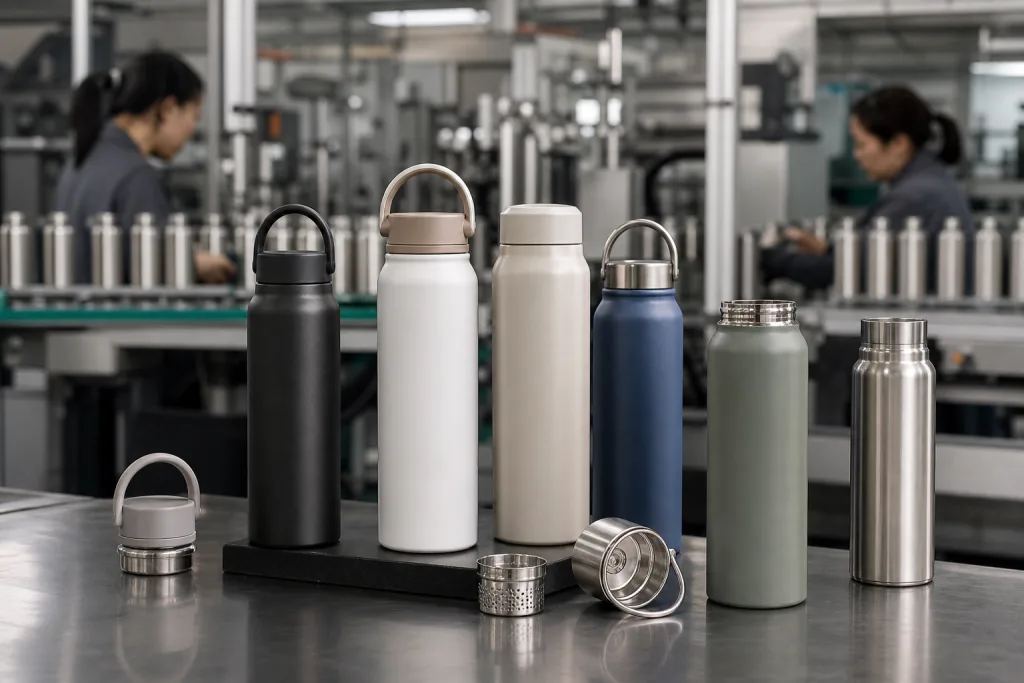
Key Takeaways
- A standard 500 ml customized tea bottle usually lands at USD 2.90-5.80 FOB China at 1,000-5,000 pcs, depending on material, infuser, and logo process.
- Most canteen factory MOQs start at 500 pcs for stock colors, but truly customized canteen programs with new lids or molds often begin at 3,000-5,000 pcs.
- Normal lead time is 7-10 days for pre-production samples and 25-40 days for mass production after sample approval and deposit.
- Decoration, packaging, and compliance testing can add 8%-25% to total project cost, which matters more than chasing a USD 0.10 lower bottle price.
You usually start with two numbers: target cost and ship date. Then the PO gets messy fast. Tea infuser type, 304 stainless grade, lid leak rate, logo method, carton count, test reports, and whether your launch date survives 18 days on the water from Zhejiang plus port delay. We’ve seen a “cheap” quote flip after a 6-cavity mold charge, a carton count drop from 24 pcs to 20 pcs, or decoration scrap hit 3% on the line.
If you buy custom drinkware for retail, gifting, or distributor programs, this is the wrong question to ask: “What’s your best price?” You need numbers you can budget against and dates we can run. That means MOQ tiers, tooling triggers, 7-day samples, 30-day production windows, AQL 2.5 inspection points, and shipping options from a canteen manufacturer in China that can actually hit them. QC pulled the sample last month because the buyer flagged a 0.8 mm logo shift, and that is exactly why unit price alone tells you almost nothing.
What drives tea bottle pricing
The base cost of a customized tea bottle usually comes from four buckets: body material, construction, decoration, and packaging. For most B2B buyers in Europe and North America, the common spec is still 450-550 ml, usually in single-wall borosilicate glass or double-wall 18/8 stainless steel. A simple glass unit with a tea infuser and one-color logo can start around USD 2.10-2.80 FOB Zhejiang at 3,000 pcs. A vacuum stainless version with powder coating, laser mark, and a full tea basket usually sits around USD 3.60-5.80 FOB at 1,000-3,000 pcs. On our line, carton spec changes the quote faster than some buyers expect; moving from a plain white box to a 350 gsm color box is not a small jump.
Material choice moves cost fast. Borosilicate glass looks clean on shelf and works well for tea programs, but breakage risk means heavier inner boxes and stricter drop testing—often 76 cm drop tests with 1A carton standard for export packs. Stainless steel 304 inside and outside costs more up front, yet it cuts damage claims in transit. If you ask for 316 stainless on the inner wall for better corrosion resistance with fruit tea or acidic beverages, add roughly USD 0.25-0.45 per unit. Copper-coated vacuum insulation can add another USD 0.18-0.30. Some buyers focus only on unit price; this is the wrong question to ask if 2% breakage lands back on your side.
The lid and infuser set is where quotes start drifting. A standard PP or Tritan lid with silicone seal is low cost. A stainless cap, bamboo top, magnetic tea strainer, or two-stage infuser pushes up both material and assembly cost. Buyers new to custom drinkware often miss the hidden number: labor minutes. A bottle with three separate filter parts may cost only USD 0.20 more in components, but total factory cost can rise USD 0.35-0.50 because assembly, leak testing, and packing take longer. We run 100% leak tests on this type with an air-pressure fixture, and QC pulled the sample more than once because the silicone ring sat 1 mm high after manual assembly.
If you also source a custom canteen, customizable growler, or customized drinkware line from the same canteen supplier, ask for shared components. A common lid diameter like 58 mm or 65 mm helps spread tooling cost across more SKUs. We have seen buyers save USD 1,200-2,000 in mold cost just by keeping the same thread and gasket across two bottle bodies. A practical canteen manufacturer in Zhejiang will tell you early whether your design can use an existing thread and gasket instead of opening a new mold. We have seen this go sideways when the buyer flagged a new lid shape, but the PO still showed the old neck finish.
MOQ tiers and where price moves
MOQ is not a penalty the factory made up. It comes from how we buy 304 stainless tube, how the powder-coating line is scheduled, how the screen plate is burned, and how many bottles fit a master carton without wasting space. On our line, one color change on the coating oven can eat 40-60 minutes before good pieces start coming out. For a customized tea bottle built from an existing mold, typical MOQs in China look like this:
- 300-500 pcs: stock bottle, stock color, laser logo or one-color silk screen
- 1,000 pcs: custom color on body or lid, standard gift box, mixed sizes sometimes possible
- 3,000 pcs: full customized drinkware program with Pantone coating, custom hangtag, instruction sheet, barcode labels
- 5,000 pcs and up: new mold development, private lid structure, or retail-grade packaging automation
The first price break is usually the real one. We see the biggest drop between 500 and 1,000 pcs, then another step at 3,000 pcs; after that, the math gets flatter. A 500 ml stainless customized tea bottle might quote at USD 4.90 FOB for 500 pcs, USD 4.20 for 1,000 pcs, and USD 3.75 for 3,000 pcs. At 10,000 pcs it may only fall to USD 3.45. That last USD 0.30 looks nice on a spreadsheet, but we've seen this go sideways once stock sits 4 months in a rented warehouse and cash is tied up. Last month a buyer pushed for 10,000 pcs, then cut the color assortment after pre-production sample approval; the savings disappeared fast.
This matters most for canteen distributors and distributor drinkware buyers running seasonal programs. If you ship corporate gifting for year-end campaigns, a 1,000 pc MOQ with a faster repeat cycle is often the safer play, even at a higher unit cost. We run orders like this in 12 days vs 18 days for larger customized packing because the line stays simpler and the carton print does not need a separate check. If you are building a core retail line, 3,000-5,000 pcs is usually the cleaner balance between FOB price and inventory risk. Chasing the lowest unit cost is the wrong question to ask.
Ask your canteen suppliers one direct question: is the MOQ based on the bottle, the color, or the logo artwork? Say it that plainly. Some canteen vendors in China quote 1,000 pcs but mean 1,000 pcs per color per print position. We had one PO where the buyer typed "2 logo" instead of "2 colors," and the whole costing changed after artwork review. QC pulled the sample, the buyer flagged it, and launch economics changed in one email.
Logo, finish, and packaging extras
Decoration is where quotes go off track fast. On customized tea bottle jobs, we usually run silk screen, heat transfer, laser engraving, digital print, or powder coating with a logo pass on top. A one-color silk screen on a straight-wall bottle may add only USD 0.05-0.12 per unit at 3,000 pcs, but only if the logo sits clean and the screen mesh count matches the artwork. Laser engraving is often USD 0.08-0.18. Full-wrap heat transfer or digital print can run USD 0.25-0.60 depending on coverage and rejection rate. The wrong question is “which logo method looks best.” Ask which method survives production yield and your target price.
Surface finish changes cost and risk. Plain stainless or clear glass is still the cheapest route. Matte powder coating generally adds USD 0.20-0.45, and on the line we usually check coating thickness in μm before approving the lot. Rubber paint or gradient coating adds more and can affect compliance if coatings are not properly controlled for REACH-related substances. We have seen EU buyers flag this after color approval, which is late. If you sell into the EU, ask for substrate and coating declarations early, not after mass production starts.
Packaging often decides whether the product feels premium, but it also kills margin fast. A plain export box with divider may cost USD 0.12-0.20. A color retail box with E-flute structure is more like USD 0.28-0.65 depending on print coverage and insert type. Add molded pulp, booklet, sticker set, FNSKU labels, or PDQ display, and the pack cost can exceed the logo cost. We ship plenty of Amazon orders, and barcode placement is a common miss; QC pulled the sample once because the FNSKU sat 6 mm over the fold line. For Amazon or club-channel programs, carton drop requirements and barcode placement need to be confirmed before printing. Print first, argue later? The math doesn’t work.
Typical add-on costs buyers should budget
- Custom color matching to Pantone: USD 30-80 per color for setup or drawdown approval
- New logo screen or print plate: USD 20-60 per artwork
- Private label gift box design adjustment: USD 80-200
- New lid or infuser tooling: USD 2,000-8,000
- Third-party lab test for food-contact items: USD 300-1,200 per SKU set
If your wider range includes a custom growler, customizable canteen, or customized canteen, request a package matrix from the canteen supplier. Good canteen manufacturers in Zhejiang will break the quote into bottle cost, decoration cost, and packaging cost, often with MOQ notes like 1,000 pcs for box print and 3,000 pcs for custom coating. That prevents confusion when you compare one canteen custom quote with another, and it helps when the buyer flagged a PO typo or mixed two box specs into one line item.
The sample-to-shipment calendar
Lead time on a customized tea bottle is manageable once you split it by stage. The wrong question is “What’s your lead time?” as one number. We’ve seen buyers hear “35 days” and assume door-to-port, while the factory meant production only after artwork, Pantone color, sample approval, and deposit all cleared. On our side, the sales sheet usually has 6 boxes before the line even starts. For planning, use a calendar like this:
- Day 1-3: confirm specification, artwork files, quote, and target packaging
- Day 4-10: pre-production sample using existing mold and standard parts
- Day 11-15: sample review, revisions, final approval
- Day 16-20: deposit received, material purchasing, coating and print preparation
- Day 21-45: mass production and inline QC
- Day 46-50: final inspection, balance payment, booking
If you need a new mold, add 20-35 days for tooling and first article review. If you request third-party testing before shipment, add 5-10 working days depending on lab schedule. From August to November in China, coating and packaging usually slow first, not body forming. We run into this every year. A canteen factory with output around 600,000 units per month may still quote 35-45 days if your order needs a gift box with a 3 mm E-flute insert or logos in 2 positions. The buyer flagged this once as “factory capacity issue.” It wasn’t. The bottleneck was hand-pack assembly.
A realistic total timeline for an existing-model customized tea bottle is 5-8 weeks from approved sample to FOB shipment. With new tooling, count on 8-12 weeks.
Sea freight from Ningbo or Shanghai to Northern Europe often takes 30-40 days port to port. To the US West Coast, 18-25 days is common; East Coast can be 30-40 days. Air freight cuts transit to roughly 5-10 days, but the math doesn’t work for low-margin distributor canteen programs unless the shipment is under 500 cartons and launch delay costs more than freight. We ship both ways. Last season one PO had a carton mark typo, and that alone cost 2 days because the forwarder would not release labels until it was fixed.
If you work with canteen distributors or distributor growler accounts, ask the factory to state both production lead time and ready-to-ship date. Those are different dates. QC pulled the sample, the cartons passed drop test, and the goods still were not ready because booking was pending and the balance had not landed.
Quality checkpoints that affect schedule
Fast production means nothing if 600 pcs land with weak insulation, dusty logo print, or lids that seep after a 30-minute upside-down check. For customized tea bottle orders, the standard quality plan should cover incoming material inspection, first-piece sign-off, inline inspection on the line, vacuum or leak test, and final AQL inspection. Many buyers use AQL 2.5 for major defects and 4.0 for minor defects on drinkware. That is a solid baseline for retail and promotional programs. We’ve seen this go sideways when the supplier skips first-piece approval and starts full printing before QC pulled the sample.
For stainless vacuum bottles, ask how the canteen manufacturer verifies insulation. The common check is 95 degree C water, then record temperature drop after 6 or 12 hours with a digital probe. For tea bottles, also confirm infuser mesh consistency, thread fit, and silicone odor; on one run, the buyer flagged a sharp mesh edge at 0.3 mm burr height. For glass models, ask for thermal shock limits and the packaged drop-test method, not just “drop tested.” A responsible canteen factory in Zhejiang should give you internal SOP values and actual records, not just say “QC passed.” This is the wrong question to ask: “Do you inspect?” Ask for the spec, method, and fail point.
Compliance also shifts schedule. Buyers in Europe often need REACH and LFGB-related food-contact declarations depending on material and market, and lab booking can add 5 days. North American buyers may request FDA-related food-contact statements, California Proposition 65 review for coatings, and ASTM or CPSIA checks for kids-related items. If you sell a tea bottle under a kids range, testing scope changes at once. The math doesn’t work if you promise 12 days but the coating report alone takes 18 days.
Questions worth asking before you pay a deposit
- What is the leak-test standard: upside-down time, air pressure, or vacuum method?
- Will logo adhesion be tested by tape test, dishwasher simulation, or rub test?
- Who pays if packaging fails drop test after mass production?
- Can the canteen supplier send pre-shipment photos by carton number and pallet count?
Good canteen suppliers in China do not push back on these questions. They answer them because they know the expensive part of a quality failure is not the remake. It is the missed shelf date, chargebacks, and damaged trust with your customer. We ship plenty of repeat orders, and the buyer usually remembers the one pallet with mixed carton marks or the PO typo on lid color more than a 2% price saving.
How to compare China quotes properly
When you collect offers from canteen manufacturers, canteen vendors, or a canteen supplier network, force the same quote structure. If one price is FOB Ningbo with individual polybag and one-color logo, and another is EXW with gift box and laser logo, you are not comparing bottle cost. You are comparing two different jobs. We see this every month. A buyer flagged a “cheaper” quote last week, then found the PO missed the gift box and the unit price jumped by USD 0.18.
Use a simple quote sheet and lock the lines: material grade, capacity, wall construction, infuser material, lid material, logo method, packaging type, carton quantity, MOQ, sample charge, tooling fee, lead time, testing status, and trade term. This is the right starting point. Once the sheet is clean, the cheapest source often drops down the list. A supplier that is USD 0.12 lower but needs a 5,000 pc MOQ, 50% deposit, and 45 production days may cost you more than a Zhejiang supplier at USD 0.10 higher with 1,000 pc MOQ and 30 days. The math doesn't work if your stock turns slowly. On our side, QC pulled the sample and checked a 0.4 mm wall spec against the drawing before quoting, because loose specs are where quote comparisons go sideways.
This matters even more if your product family includes custom canteen, custom growler, customizable drinkware, or customized growler items. Shared packaging dimensions, common carton marks, and combined shipments usually cut more cost than pushing one SKU down by a few cents. For a distributor canteen or distributor growler program, consolidation can remove USD 300-800 in document, pallet, and local handling costs per shipment. We ship mixed loads like this out of Zhejiang often. A standard outer carton such as 45 x 45 x 38 cm across 2 SKUs makes the warehouse side cleaner and reduces mistakes at loading.
Also check whether the factory is the actual producer. A true canteen factory should speak plainly about tube thickness, neck forming tolerance, welding method, coating line capacity, and monthly output. If the sales rep cannot answer basic line questions, that is a bad sign. At BottleForge Industrial in Zhejiang, for example, project planning is based on actual line capacity and supplier lead times, not just a sales promise. On the floor, that means knowing whether the neck is held to ±0.3 mm after forming and whether the seam is done by laser welding or another method. Your launch date depends on details like whether silicone gaskets are made in-house or sourced from another city in China.
If a quote looks unusually low, ask what has been excluded. The missing items are usually test fees, replacement allowance for print defects, export cartons, or tray pack labor. We have seen low offers miss all four. One inspection file showed the buyer assumed export cartons were included, but the quote covered only bulk-packed inner trays, and the final bill moved fast.
Budget ranges by common buying scenario
You do not need the perfect cost on day one. You need a workable range. Below are standard FOB China planning ranges for a 450-550 ml customized tea bottle from an existing mold. We quote these against live runs, not guesswork, and the line usually checks bottle weight first—450 ml glass often lands around 380-420 g depending on the infuser set.
- Promotional program, 1,000 pcs: single-wall glass, infuser, one-color logo, plain box: USD 2.40-3.20
- Corporate gifting, 1,000 pcs: vacuum stainless, powder coat, laser logo, color box: USD 4.20-5.40
- Retail launch, 3,000 pcs: vacuum stainless, Pantone body, tea basket, printed gift box, barcode labels: USD 3.80-5.20
- Premium wellness line, 5,000 pcs: 316 inner wall, copper insulation, bamboo accent lid, molded pulp insert: USD 5.20-6.80
Lead time follows the spec load. Promotional runs on existing specs can ship in 25-30 days after approval if the logo is simple and the inner box stays plain. Retail-ready customized drinkware with color box and compliance paperwork usually needs 35-45 days; box proofing alone can burn 3-5 days if the buyer flagged barcode size or a typo on the PO. New-tool canteen customizable projects should be budgeted at 55-80 days including tooling, validation, and first production. We have seen this go sideways when lid tooling T1 comes out 0.3 mm off and the silicone seal fails the first leak test.
For a first PO, keep one part fixed and change the others. This is the right question to ask. Use an existing body mold, then change color, logo, and packaging. That gets you a market-ready customized tea bottle without paying for fresh tooling, mold sampling, and another round of carton fit checks. QC pulled the sample on one trial order last month because the new infuser sat 2 mm too high and scratched the inner wall. Once reorder volume proves out, then look at a new lid or a custom infuser. A family design across customized canteen and customizable growler products makes sense after the numbers are real.
If your launch window is tight, tell the canteen manufacturer your target ex-factory date before you talk unit price. We ship around peak export months with booking pressure every year, and time is often tighter than steel stock. Buyers who give the date, carton specs, and test requirements up front usually get firmer answers, cleaner production planning, and fewer last-minute changes. One buyer asked us to cut USD 0.12 per piece while holding a 28-day ex-factory target with a printed gift box—the math did not work.
Get a firm customized tea bottle quote and timeline
Send your capacity, material, logo method, target MOQ, and delivery date. We will reply with FOB pricing, sample plan, and realistic lead time from Zhejiang, China.
Frequently asked questions
What is a realistic MOQ for a customized tea bottle?
For an existing model, 500 pcs is realistic if you accept stock colors and simple logo decoration. The more common commercial MOQ is 1,000 pcs for custom color or custom box. If you need a new lid, unique infuser, or private mold, expect 3,000-5,000 pcs minimum. Some canteen manufacturers in China will quote lower, but check whether that MOQ is per order, per color, or per logo version. For buyers testing a new market, 1,000 pcs is often the best balance: the FOB price is much better than 500 pcs, but inventory risk is still manageable. If the project includes multiple SKUs, ask whether the canteen factory can split one MOQ across two colors or two capacities using the same packaging format.
How much should I budget per unit for a stainless customized tea bottle?
A usable planning number is USD 3.60-5.80 FOB China for a 500 ml double-wall 18/8 stainless customized tea bottle using an existing mold. At the lower end, that means standard lid, standard infuser, one-color logo, and plain export packaging at 3,000 pcs. At the higher end, it usually includes powder coating, better packaging, more complex tea filter parts, and lower order quantity such as 1,000 pcs. If you add 316 inner steel, copper insulation, bamboo cap detail, or retail gift box, budget USD 5.20-6.80. Freight, duty, and local delivery are extra. Always ask for bottle, decoration, and packaging listed separately so you can value-engineer without redesigning the whole item.
How long does mass production usually take after sample approval?
For an existing model from a Zhejiang canteen factory, mass production usually takes 25-40 days after final sample approval and deposit receipt. Simpler projects with stock components can finish in 25-30 days. Orders with custom coating, printed retail boxes, or multiple logo positions often need 35-40 days. If you require third-party lab testing before shipment, add about 5-10 working days. New tooling adds another 20-35 days for mold making and first article confirmation. During peak months in China, especially August through November, packaging and coating lines can extend schedules. To avoid confusion, ask for three dates: sample completion, production completion, and cargo ready date. Those are the dates that matter for your booking.
What tests or documents should I request for EU and North America?
For Europe, most buyers ask for food-contact declarations tied to the relevant materials, plus REACH-related declarations for controlled substances in coatings or components. Depending on market and product type, LFGB-related testing may also be requested. For North America, buyers typically ask for food-contact compliance statements, coating review for Proposition 65 exposure risk, and additional testing if the bottle is marketed for children. Beyond formal lab work, request practical factory records: leak test standard, insulation test data, and AQL inspection results. Third-party lab costs often range from USD 300 to 1,200 per SKU set depending on scope. If your packaging claims dishwasher safety or thermal retention hours, make sure those claims are supported before artwork is printed.
Is it better to customize an existing bottle or develop a new mold?
For a first order, existing mold is usually the better business decision. You can still get a strong customized tea bottle by changing color, logo, infuser finish, and packaging, while keeping tooling cost at zero or close to zero. That typically shortens development by 20-35 days and avoids mold fees of USD 2,000-8,000. New molds make sense when your volume is high enough to spread that cost, usually 5,000 pcs and up with repeat orders planned, or when your product needs a unique shape tied to brand identity. Many experienced canteen distributors start with an existing platform from China, prove sell-through, then invest in proprietary parts on the second or third PO.