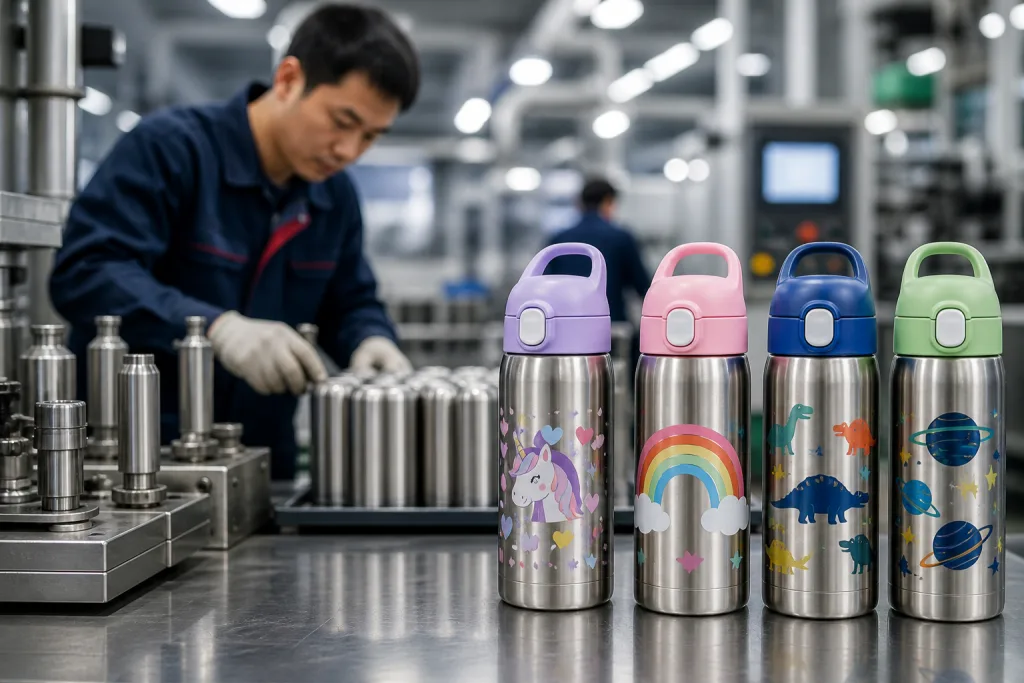
Key Takeaways
- For school use, 350-500ml bottles with 0.4-0.5mm single-wall stainless or BPA-free Tritan usually balance cost, weight, and durability best.
- A practical MOQ for custom kids water bottle programs is often 3,000-5,000 units per color, with 25-35 day production after sample approval.
- Silkscreen is typically USD 0.08-0.18 cheaper per unit than full-wrap transfer print, but print durability and artwork coverage differ a lot.
- Set QC at AQL 2.5/4.0 and test leak rate, drop resistance, odor, and logo adhesion before shipment, not after the container lands.
If you are buying a customized school water bottle for a district rollout, fundraiser, or retail program, finding a bottle is easy. Picking one that holds up is the real job. We have seen clean-looking pre-production samples fail after 200 open-close cycles on the hinge test, or lose logo adhesion after a cross-hatch tape check on the line. School buyers also push back on straw lids that look fine in photos but are a pain for staff to clean between uses.
Most mistakes start with four decisions: material, lid system, decoration method, and order structure. Start there. At our Zhejiang factory, we run cost reviews against actual use cases, and buyers often save 8% to 15% by cutting specs that do not matter in a classroom. A 3,000-piece district order needs different tooling and carton planning than an 80,000-piece North America import program from China, and this is where deals go sideways if the MOQ, print setup, or even a PO typo is missed.
Start with the four buying decisions
School buyers and kids-product importers often start with a quote request. Too early. First lock the four decisions that change almost every cost line: body material, lid style, branding method, and order plan. Once those are fixed, pricing gets real. On our side, the sales sheet and BOM usually settle after a 15-minute spec call, not before.
For a customized school water bottle, the first trade-off is body material. PP or Tritan plastic cuts freight and is easier for a 6-year-old to carry in a side pocket; a 450ml plastic bottle might sit around 120g, while stainless can land closer to 280g depending on wall thickness. Stainless steel gives better dent resistance and stronger shelf value, but the math doesn’t work for every school tender. We’ve had buyers push for steel, then pull back after seeing the carton weight on a 1,000-piece run. The second decision is lid design. Flip straw lids are easy for one-hand use, which schools like, but they carry more parts: straw, silicone seal, hinge pin, bite valve. That means more leak points. QC pulled the sample last month because one straw lid failed after a drop test at 1.0m, while the screw cap passed clean. The third decision is printing. A one-color school logo is low-risk and stable on the line. Full-wrap artwork sells better for retail or promo packs, but setup takes longer, and rejection can climb if registration is tight under 0.5mm. We’ve seen this go sideways when the buyer flagged color shift on a cartoon file that was approved from a phone screen. The fourth decision is order structure: one design in volume, or 6 SKUs in smaller runs. This is the wrong question to ask last, because MOQ, carton mix, and print cost all move with it.
Here is the practical method we use in Zhejiang, China when a buyer is new to this category. In the factory, this is usually the point where we mark up the PO and circle the typo on lid color or straw material before sampling starts.
- School district replacement program: prioritize leak control, simple cleaning, and low reorder MOQ.
- Promotional giveaway: prioritize landed cost and logo visibility.
- Retail/import program: prioritize shelf appeal, packaging, and compliance paperwork.
- Distributor stock item: prioritize color flexibility and steady lead time.
A children water bottle distributor and a school procurement office may buy the same 450ml bottle, but they should not spec it the same way. We ship both types. The bottle might match, yet the lid test standard, inner box, and artwork approval process usually do not. Let the usage case decide the bottle, not the catalog photo.
Pick material by age, budget, and abuse level
Material choice is where a bulk kids bottle project stays on budget or drifts fast. For school-age users, we usually run three main options: Tritan, PP, and single-wall stainless steel. Each one fits a different age band, target price, and abuse level on the line and in the classroom.
Tritan is clear, light, and looks cleaner at retail than basic PP. That matters when the buyer wants the logo sharp and centered; on a 450ml body with 2.0-2.5mm wall thickness, screen print registration is easier to control. We ship a lot of children water bottle customizable programs in Tritan because it feels more premium in hand. Unit FOB from China for a basic custom kids bottle in Tritan can be around USD 1.45-2.20 at 5,000 pieces depending on lid complexity and packaging.
PP is usually the lowest-cost route for bulk school water bottle needs. It is lighter, practical, and less polished in appearance. Some buyers push back on that, but if the school cares about function and replacement cost, the math doesn't work for a premium body. On simple models, QC mostly watches gate marks and color consistency near the handle base. FOB can drop to around USD 0.95-1.50 for simple models.
Single-wall stainless steel 18/8 is a tougher option for older children. A 0.4-0.5mm body is common, and dent resistance is usually better than buyers expect after desk drops. It holds less odor than some plastics, but it is heavier; we had one buyer flag a sample at 212g because their target was under 200g. FOB often starts around USD 2.10-3.40.
What we usually recommend
- Ages 4-7: 350-420ml, lighter body, easier-grip lid, lower bottle weight under 180g if possible.
- Ages 8-12: 400-500ml, stronger hinge or screw cap, wider color range.
- District programs with frequent replacements: Tritan or PP.
- Longer-life retail programs: Tritan or stainless.
If you are comparing children water bottle manufacturers, ask for the empty bottle weight, wall thickness, and resin grade, not just the material name. This is the right question to ask. Two bottles can both be called Tritan and still perform differently because one is 2.0mm and one is 2.5mm, or because the cap thread was cut rough and the line saw leaks at 0.03 MPa air test.
For many school orders, over-specifying the bottle adds cost without adding useful service life. We've seen this go sideways. A 450ml bottle that survives desk drops and backpack use is enough; you do not need an outdoor expedition bottle for a classroom.
Lid design decides complaints and returns
If one part drives most after-sales claims on a custom school water bottle, it is the lid. Not the bottle body. Schools ask about leaks, cleaning time, and cracked parts after a 90cm desk drop. Importers watch return rate by carton. Spend your time on the lid first; arguing over Pantone shades before that is the wrong question.
The common options are screw cap, flip-top straw, and push-button flip lid. A screw cap has fewer parts, lower defect risk, and better seal repeatability on the torque test bench at 0.8-1.2 N·m. Younger kids do need two hands, and some buyers flagged that on classroom use trials. A flip-top straw lid is easy for kids and popular for custom logo kids bottle programs, but we’ve seen this go sideways at the hinge, the straw barb, and the silicone seal seat. A push-button lid looks good on a retail shelf, but the tooling stack is more complex, spring fit matters, and there are more moving parts for QC to watch on the line.
For children water bottle custom orders, ask suppliers for these test points before approval:
- Leak test at inverted position for 30 minutes.
- Drop test from 80-100cm with water fill at least 80% full.
- Cycle test for lid opening and closing, ideally 2,000-3,000 cycles on hinged lids.
- Straw pull-force and bite-valve fit consistency.
- Odor check after 24 hours sealed with warm water.
About 7 out of 10 supplier samples pass casual use, then mass production shifts because the silicone changes from 50 Shore A to 60 Shore A or the hinge pin fit opens by 0.15mm. QC pulled the sample, but the shipment was not built to the same spec. That is why approval needs a signed sample, material declaration, and critical dimensions locked on the PO. We have even seen a PO typo change a straw length by 5mm.
For schools, simpler is usually better. A well-made screw lid with carry loop creates fewer complaints than a complicated spout, and the math works over a full school term. For children water bottle wholesale or distributor channels, a straw lid can still be the right choice, but only if replacement parts and spare seals are available with a clear MOQ, often 1,000 sets. At BottleForge Industrial in Zhejiang, our kids bottle line runs about 300,000 units per month, and the models with the lowest warranty issue rate are usually the ones with the fewest lid components.
Branding methods and artwork trade-offs
A customized school water bottle usually sells on the logo first. Then the bottle has to survive actual school use. Decoration choice hits unit cost and complaint rate at the same time. We have seen buyers chase USD 0.10 savings, then the line gets claims back because the logo scuffed after 3 days in a backpack with keys.
For most bulk children water bottle orders, the common options are silkscreen, heat transfer, water transfer, pad print, and laser marking on stainless models. Silkscreen is still the best-value option for simple 1-2 color school logos. We run it fast on the line, setup is straightforward, and coverage stays clean if the artwork is not too fine. Expect around USD 0.05-0.12 per color per position depending on artwork size and quantity. If the stroke drops under 0.2 mm, QC pulled the sample more than once for broken edges. Heat transfer fits multi-color graphics and mascot artwork better. Cost is higher, often by USD 0.08-0.18 per unit, and production is slower because each piece needs tighter positioning.
Laser marking on stainless is permanent and looks premium, but the visual effect is subtle. This is the wrong question to ask if the bottle is for a kindergarten event, because kids respond to bright graphics, not a soft silver mark. For younger children, bright print usually performs better than understated branding. A children water bottle promotional project for a district event should favor visibility. A private-label retail program should favor finish durability and packaging appeal. We ship both types, and the buyer pushback is predictable on each side.
Artwork questions to settle early
- Do you need dishwasher-resistant print, or only hand-wash durability?
- Will every school use the same logo, or do you need variable artwork by campus?
- Is student name personalization required?
- Do you need barcode labels, FNSKU, or retail inserts?
If you are a children water bottle vendor supplying multiple schools, split-SKU artwork becomes the hidden cost fast. Five logos at 1,000 pieces each are usually less efficient than one logo at 5,000 pieces, even if total volume is the same. The math doesn't work once you add separate screen charges, carton marking changes, and packing line slowdowns. We had one PO with a campus code typo last season, and 24 master cartons had to be relabeled before loading.
For children water bottle customized orders from China, ask for an adhesion test standard in writing. We usually recommend logo tape test verification and a rubbed-surface check after curing. On our floor, that means a 3M tape pull after the ink is cured, not a quick thumbnail check. This is basic discipline. We have seen this go sideways when the buyer flagged peeling print but nobody had agreed on the test method before mass production.
MOQ, lead time, and landed cost reality
The cheapest quote on page one is often built on a setup you are not buying. We see this every week. A children water bottle factory may price a low FOB on one body color, one lid color, one logo, bulk packing, and zero compliance testing. Then the buyer adds a retail box, barcode label, straw assembly, and 4 mixed colors on one PO, and the number jumps. We’ve even had a PO come in with “bulk pack” on line 3 and “window box” in the remarks—then the math doesn’t work.
For a typical custom kids water bottle program from Zhejiang, China, practical MOQ is usually 3,000 pieces per model for basic color/logo work and 5,000 pieces if you need custom mold colors, gift box packaging, or more complex decoration. Sample lead time is often 7-12 days for pre-production approval. Mass production usually runs 25-35 days after deposit and artwork confirmation. In peak season, add 7-10 days. On the line, color chips and logo position usually get signed off with a 0.5 mm tolerance, and that approval date matters more than buyers expect.
Landed cost should be calculated from these pieces, not just unit FOB:
- Tooling or mold color setup charges, especially if you want a custom Pantone match on lid parts
- Logo screens or transfer plate charges; one extra print position means one extra setup
- Inner bag, egg-crate, or retail box packing, plus carton drop-test requirements if retail is involved
- Third-party testing for REACH, CPSIA, LFGB, or ASTM depending on market
- Inspection cost under AQL standard, often after QC pulled the sample at final packing
- Ocean freight, duty, and delivery to your warehouse
If you buy children water bottle bulk for schools in North America, ask whether the supplier can apply FNSKU labels or carton pallet rules if part of the shipment goes through an e-commerce channel. We ship orders where 60% goes to a school distributor and 40% goes to FBA prep, and the carton marks are different. If you are a children water bottle distributor in Europe, confirm whether the packaging and material declarations match your importer-of-record requirements. This is not paperwork for later. We’ve seen this go sideways because the buyer flagged the label language after production was finished.
A realistic planning rule: do not approve artwork later than 45 days before your warehouse need date if the order is shipping by sea. That is the safe window. If the carton size changes by even 8 mm after sample approval, booking and pallet count can change too. For urgent school calendar launches, air freight can save the date but destroy the margin. Most buyers are better off simplifying packaging or cutting one lid color instead of paying emergency freight.
Compliance and QC for children use
Kids bottle buying is not about looks alone. You are buying an item children use every day, often in school, and complaint loops are fast. We have seen one lid leak video in a class WhatsApp group turn into a 3,000-piece claim by noon. Compliance paperwork and QC on the line matter as much as unit price.
For Europe, buyers usually ask for REACH and, based on the material and sales channel, LFGB-related testing from a recognized lab. For North America, the test matrix often includes CPSIA-related checks plus category-specific requests. If the bottle has small removable parts, lanyards, or soft spouts, tighten the risk review. This is not the place to save 2 cents. A children water bottle manufacturer should show material declarations, prior test reports, and traceability by production lot; on our side, that usually means carton mark, molding date, and PO number tied back to the batch sheet.
On factory control, ask for BSCI or an equivalent social audit, and ask whether the site runs documented QC procedures or just talks about them. Buyers ask this late; that is the wrong question to ask late. Inspection should not stop at visual defects. For bulk kids bottle orders, the checks that catch most trouble on the line are:
- Leak testing by sample rate per batch, often 0.2 MPa air-pressure testing on selected pieces
- Cap thread fit and torque consistency, checked with a torque gauge instead of hand feel
- Print adhesion and color accuracy, especially after logo rub testing
- Odor inspection after sealing, because QC pulled the sample more than once and found trapped smell inside the straw set
- Carton drop and barcode readability, including scan checks after a 76 cm drop test
We generally advise AQL 2.5 for major defects and 4.0 for minor defects on school bottle orders. Major defects include leaks, cracked lids, wrong logo, sharp edges, missing parts, or failed function. Minor defects include slight color deviation or light cosmetic marks outside the main display area. If you are working with children water bottle manufacturers in China for the first time, book a pre-shipment inspection before balance payment. The math does not work the other way: a $280 inspection is cheaper than reworking 1,200 bottles after arrival because the buyer flagged a logo size that was 2 mm off.
The right children water bottle supplier will not promise zero defects. No serious factory says that after running 10,000 pieces on one line. You want a supplier that sets the defect standard clearly, controls the process, and fixes issues before the goods ship from China.
How to choose your final supplier
Once you cut the list of children water bottle suppliers down to 3 or 4, stop comparing catalog pages. Compare proof. A capable children water bottle manufacturer should answer technical questions in plain language, send a specification sheet with wall thickness and lid material, and show where the cost sits by part, print, and packing. If the reply stays loose, the production on the line usually stays loose too. We have seen this go sideways after a buyer approved a photo but never got a 2D drawing with a 0.3 mm logo position tolerance.
Your final supplier scorecard should cover five points: product fit, compliance readiness, communication speed, production stability, and flexibility on repeat orders. Ask how many units per month they run, whether spare parts can be supplied, and what their reorder MOQ is after the first run. Ask for numbers, not nice wording: 80,000 units per month means something, "large capacity" means nothing. Some factories look good on the first PO but get hard to work with when you need 1,500 replacement bottles six months later. That is the wrong time to learn their spare straw MOQ is 5,000 pcs.
For school district buyers, I would put extra weight on consistency and replacement support. One cap leak rate issue in a 2,000-piece delivery becomes a headache fast, and QC pulled the sample too late if that shows up only at receiving. For importers and children water bottle distributors, I would put extra weight on packaging execution and schedule control. We ship plenty of orders where the bottle is fine but the buyer flagged the mailer drop test or barcode placement. If you are buying children water bottle wholesale under your own brand, ask for color master retention and artwork recordkeeping so repeat POs match prior lots. We keep signed color chips and AI files by PO number because "match last order" is not a usable instruction on a factory floor.
A good supplier in Zhejiang or elsewhere in China should be willing to confirm these points in writing:
- Approved sample reference number
- Material specification and color code
- Logo size, position, and print method
- Packing method and carton dimensions
- Inspection standard and claim window
- Lead time with production milestone dates
This sounds basic. It is also where 7 out of 10 custom made kids bottle projects get messy. The buyers with the fewest issues are usually not the ones chasing the lowest unit price; they are the ones who lock the specification early and leave less room for interpretation. We have seen a single PO typo on carton mark text hold packing for half a day, so the math does not work if the supplier is still guessing at details after deposit.
Need the right school bottle spec, not just a quote?
Send your target volume, age group, market, and logo file. We will recommend bottle type, MOQ, compliance path, and a realistic landed-cost structure.
Frequently asked questions
What is a normal MOQ for a customized school water bottle?
For most standard models, a realistic MOQ is 3,000 pieces per design for basic logo printing and stock colors. If you need custom color matching on body and lid, individual retail boxes, or multi-color artwork, MOQ often moves to 5,000 pieces. Some children water bottle suppliers in China will offer 1,000-2,000 pieces, but that usually means fewer color choices, higher unit cost, or mixed leftover components. For repeat orders, the MOQ can sometimes drop if the same mold, color, and artwork are reused. Always ask whether MOQ is per model, per color, or per print design, because those are not the same thing and they affect the final quote more than many first-time buyers expect.
Which material is best for a custom kids water bottle for school use?
For most school programs, Tritan and single-wall stainless steel are the safest practical choices. Tritan is lightweight, clear, and usually costs less, often around USD 1.45-2.20 FOB at 5,000 pieces depending on lid style. Stainless steel 18/8 is stronger and more premium, usually around USD 2.10-3.40 FOB, but it is heavier for younger children. PP can be cheaper, sometimes under USD 1.50 FOB, but it looks more basic. If the users are ages 4-7, weight matters a lot, so a 350-420ml Tritan bottle is often the most balanced option. For older students or retail programs where durability matters more, stainless becomes more attractive.
How long does production take for bulk school bottle orders from China?
If the bottle model already exists and you only need custom logo and color, sample approval usually takes 7-12 days. Mass production is typically 25-35 days after deposit, artwork confirmation, and sample sign-off. During peak periods, especially before back-to-school and holiday seasons, add 7-10 days. If you need new tooling, expect another 20-30 days before pilot samples are ready. Shipping time is separate. Sea freight to Europe or North America can add several weeks depending on route and customs. A practical planning rule is to freeze the order at least 45-60 days before your warehouse date. Buyers who wait too long usually end up paying for air freight or simplifying packaging under pressure.
What compliance documents should I ask from a children water bottle manufacturer?
Ask for material declarations first, then market-specific test reports. For Europe, buyers commonly request REACH-related documentation and, depending on the product positioning, food-contact testing through a recognized third-party lab. For North America, requests often include CPSIA-related checks and other category-specific documentation. Also ask for production lot traceability and whether the factory has a social audit such as BSCI. If the bottle uses straws, bite valves, or detachable parts, review those parts carefully because they create extra risk. Do not rely on an old generic test report. Make sure the report covers the same material, same lid structure, and current production version. A mismatch there causes problems during customs review and customer claims.
What QC standard should I use for bulk kids water bottle orders?
A practical inspection standard is AQL 2.5 for major defects and 4.0 for minor defects. Major defects should include leaks, cracked lids, missing seals, sharp edges, incorrect logos, failed function, or wrong assembly. Minor defects usually cover small cosmetic issues such as light scuffs or slight color variance outside the main visible area. For kids bottles, ask the inspector to focus on leak testing, cap fit, hinge action, odor, print adhesion, and carton labeling. If your shipment is 10,000 pieces or more, a pre-shipment inspection is worth the cost. It is much cheaper to stop a problem in China than to sort returns after arrival. Make sure the approved sample is referenced during inspection, not just the purchase order text.