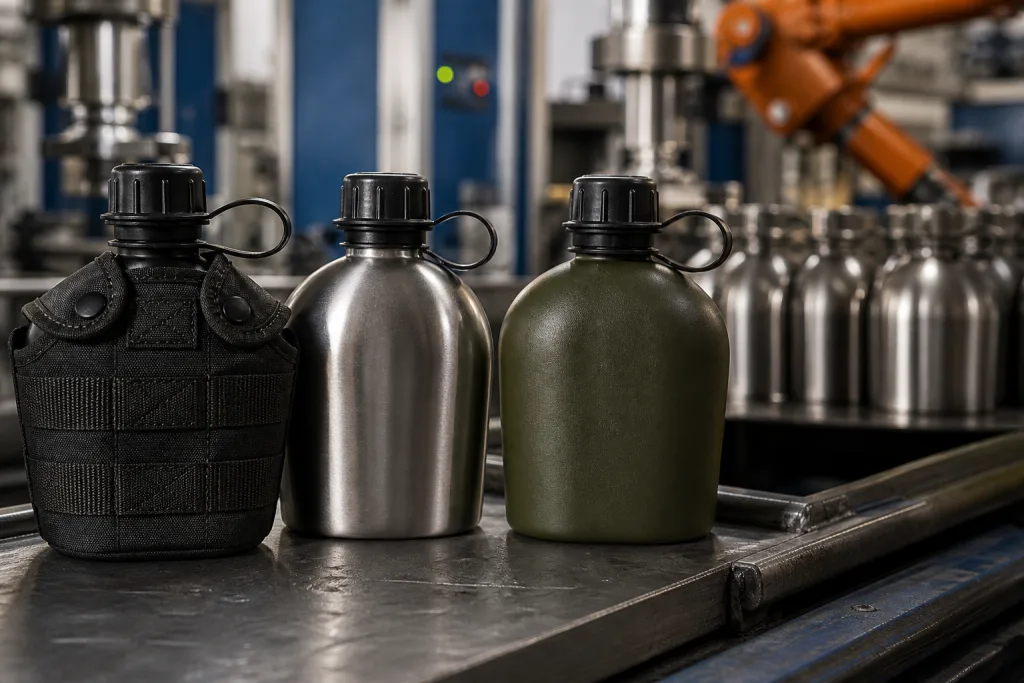
Key Takeaways
- Most leakage claims trace back to thread and gasket mismatch; call out gasket Shore hardness, torque range, and 1.0 m drop testing on every PO.
- For powder-coated steel canteens, specify 18/8 stainless, 0.5 mm body wall, coating adhesion to ASTM D3359 4B minimum, and salt spray targets.
- A practical OEM MOQ in Zhejiang, China is often 3,000-5,000 units per color, with sampling in 7-12 days and production in 30-45 days.
- Use AQL 2.5/4.0 plus REACH, LFGB or FDA, and migration testing; that combination prevents most customs, compliance, and retailer chargeback issues.
You usually do not lose money on a customized military canteen because the price was too high. You lose it because the RFQ left holes. A canteen looks simple until the first pilot run lands with liner odor after 48 hours, caps leaking after a 1.2 m drop test, logos scratching off in carton transit, or webbing coming out 2 Pantone shades off from the approved swatch. Then the ship date slips. Rework starts burning cash. The buyer flagged it and starts asking whether the supplier understood the actual use case.
If you are buying from Zhejiang or wider China for military surplus channels, outdoor brands, workwear programs, or canteen promotional orders, picking the bottle shape is the easy part. The real job is building a spec sheet that blocks common factory failures before tooling starts on the line. We have seen this go sideways over a 0.3 mm cap thread tolerance, a PO typo on strap color, or a missing salt-spray requirement for metal trims. That applies whether you need a classic customized canteen, a canteen custom gift set, or a full custom drinkware line from one canteen manufacturer.
Where military canteens actually fail
New buyers usually start with shape, cap style, and logo method. Fair enough. That is not where most claims start. A customized military canteen usually fails in six spots we see on the line: leakage, taste and odor, coating wear, strap or pouch breakage, dimensional drift, and missing paperwork. QC pulled a sample last month that looked fine in the master carton, but after a 1.2 m drop test and 72 hours on its side, the cap seeped at the gasket. Good-looking stock still fails after 30 days in field use.
Split the use case first. This is the right question to ask. A canteen built for outdoor retail is not the same item we ship for institutional resale, military surplus, or a 5,000-piece promotional order. Outdoor retail buyers sometimes accept a lighter body to save 80 to 120 g per unit. Institutional buyers usually push us on replacement caps and lower claim rates. A Europe buyer may flag REACH files and textile color fastness before approving bulk. A North America drinkware buyer usually asks for FDA-contact paperwork, drop resistance, and carton barcode setup; we have even seen a PO with the SKU typo carried all the way to outer carton print.
In Zhejiang, China, plenty of drinkware plants can make a canteen shell. Fewer can run the full package: bottle, cap, gasket, strap, cover, print, drop test, and carton fit. We have seen this go sideways. A 2 mm neck variance sounds small until the outsourced cap supplier builds to a different tolerance and the buyer flagged leaks on arrival. So judge the canteen manufacturer as a system integrator, not only a vessel maker. Ask one direct question: what parts are made in-house and what parts are outsourced? If the cap comes from one vendor, the strap from another, and the pouch from a third, failure ownership gets blurry fast.
- Body material mismatch leads to dents, off-taste complaints, or corrosion spots after salt-spray or storage tests.
- Cap and gasket mismatch causes slow leaks in transit; we check gasket compression in mm, not by guesswork.
- Decoration mismatch leads to logos scratching off after rub testing, then retailer returns hit fast.
- Textile mismatch causes broken buckles, frayed 25 mm webbing, or shade variation between production lots.
The fix is simple. The sales sheet is not enough. You need a tighter spec with tolerances, test points, textile callouts, and packing details before the line starts.
Leak paths you should design out
Leakage is the small defect that burns the most money on a customized canteen. One slow seep can soak a master carton, wrinkle labels, and contaminate adjacent packs on the pallet. The root cause is usually not “a bad cap.” On the line, we see stack-up problems between neck finish tolerance, thread profile, cap shrinkage after molding, gasket compression, and closing torque. QC pulled one sample last month with only 0.25 mm thread flash, and that was enough to start a leak path.
For a canteen customizable program, lock the neck standard on the drawing or send a controlled drawing with tolerance by mm. If the canteen manufacturer wants to run a proprietary neck, ask for cap interchangeability data across at least 3 production lots, not one bench sample. HDPE and Tritan do not react the same under heat and torque; we’ve seen HDPE relax after a 50°C hold while Tritan kept shape but showed different thread feel at capping. For stainless bodies, thread roll quality and weld-area distortion need checking with a thread gauge after forming. If you are buying a canteen customized with a wide mouth, gasket seating is where the line goes sideways first. This is the wrong question to ask: “Is it leak proof?” Ask where the leak path starts.
Minimum leak-control points to write into the PO
- Cap torque: for screw caps, define a closing range such as 0.8-1.2 N·m, and state the torque tool used on the line.
- Gasket material: food-grade silicone, Shore A 50-60, with migration compliance, plus a gasket drawing or cross-section size.
- Vacuum or pressure test: 100% air-pressure check or inverted water test before packing; write the hold time, such as 10 seconds, into the PO.
- Drop test: filled bottle, 1.0 m on base, side, and corner, 3 drops total, with no leakage after impact.
- Heat exposure: 24 hours at 50°C to check cap deformation and post-test leakage; we usually recheck torque after conditioning.
If your canteen supplier only writes “leak proof,” that is sales language, not a quality standard. Put the test method, sample size, and pass/fail rule in the PO. AQL alone will not protect you here; the math doesn’t work when 12 leaking pieces can damage 200 units in one export carton batch. For major retailers, buyers often use AQL 2.5 for major defects and classify any leak as major or critical depending on channel. We ship against that kind of language all the time, and it removes arguments later.
Practical rule: if a vendor cannot send a torque spec, gasket drawing, and leak test record before mass production, you are not buying a controlled product yet. We’ve seen buyers approve color swatches first and chase leakage after tooling—bad sequence.
This applies across formats: custom canteen, customizable canteen, and even a customized growler or customizable growler if the closure system follows the same development logic. Different body shapes, same failure points. The buyer flagged this before on a PO with “silicon” typed instead of “silicone,” and that small miss turned into the wrong gasket material at sampling.
Material choices that create complaints
Canteen complaints get tagged as “quality problems” all the time, but a good share start with the spec sheet. Pick the wrong substrate for the sales channel, and the factory can run exactly to your PO while you still eat returns. We’ve seen this go sideways when a buyer approved the look sample, then flagged odor retention after 30 days in warehouse stock.
For a classic military-style canteen, the usual body materials are HDPE, Tritan, aluminum, or 18/8 stainless steel. HDPE is the low-cost option and takes drop impact well; on our line, the molded body usually hides scuffs better than clear material, but it holds odor more easily and the shelf feel is cheaper. Tritan gives you better clarity and a cleaner premium look, though for a military program it often feels off-theme. Aluminum is light and forms well in deep draw, but this is where buyers ask the wrong question: not “is aluminum good,” but “what liner system is inside, and what did QC pull on migration after curing?” Stainless is durable and sells as premium, but the math changes fast once body weight moves up by 40–80 g per unit.
For B2B buyers, translate material choice into complaint pattern. That is the part that matters after shipment.
- HDPE: odor retention after first use, stress whitening around the shoulder, visible gate marks near the base, and color variation between production lots; we check this against the master chip under a light box.
- Aluminum: liner odor, coating pinholes, denting, and print adhesion failure; one common finding is a pinhole near the bottom radius after curing if the coating film is uneven.
- Stainless steel: weld discoloration, uneven powder coat, denting in transit, and weight complaints; buyers like the feel in hand, then push back when carton weight jumps 2 kg over the lighter option.
If your market is Europe, ask for REACH and LFGB readiness when relevant. For North America, ask for FDA-contact declarations and any required state-level chemical disclosures. A supplier already shipping customizable drinkware or customized drinkware for retail chains should know migration testing and heavy metal limits for coatings and decorations. If they answer in broad sales language and skip the test method, press harder.
A workable steel spec for a premium customized military canteen is 18/8 stainless, body wall 0.5 mm, cap with PP outer and silicone seal, powder coat 60-80 microns. For aluminum, ask which internal liner system is used and whether odor and acetic acid migration were tested after curing. In Hangzhou and Yongkang, you can find 20 factories that say yes to all materials; half of them will not show the actual test setup unless you ask directly, and sometimes the PO even carries a typo on liner code that starts the whole complaint chain.
Decoration failures hurt brand credibility
Decoration is where buyers misread the risk. The pre-production sample looks clean on the desk, then the trouble shows up later: abrasion on the line, dishwashing, sunscreen contact, or cartons scraping in transit. We have seen a customized military canteen pass the first approval, then fail after a simple 3M tape pull and 20 dry rubs. This product takes harder abuse than a fashion tumbler, so the logo method has to match that use case—silk screen on curved walls, pad print on recessed areas, laser marking on 304 stainless, heat transfer, powder coat with overprint, or embossed patches on pouches.
On canteen promotional orders, buyers often chase the cheapest print method to land at USD 3.20-4.80 for basic plastic or USD 6.50-9.50 for steel, FOB Ningbo. Fair enough. But if you skip adhesion and rub testing, the math doesn't work. We run cross-hatch checks before mass production, and QC pulled the sample more than once because the ink edge lifted at 1 mm squares. For outdoor and institutional channels, this is the right question to ask: what wear level is acceptable after actual use, not just at packing.
Spec the decoration like this
- Color standard: Pantone reference with acceptable Delta tolerance or signed master chip. If the buyer flagged a shade shift before, keep that signed chip at the line, not only in the sales file.
- Adhesion: ASTM D3359 cross-hatch, 4B minimum for coated parts where applicable. Use the right cutter spacing and record the result by SKU.
- Abrasion: dry rub and wet rub cycles, such as 50/20 minimum depending on method. If the logo sits near a webbing buckle or pouch seam, ask for more cycles.
- Dishwasher statement: say clearly whether the item is hand-wash only or tested for top-rack cycles. We have had POs approved with this line missing, and the complaint came back fast.
- Logo position: signed artwork with dimensions from seam, base, or handle reference points. Use mm, not “centered visually,” because that wording goes sideways on a curved canteen body.
If you are building a canteen custom line for distributor canteen programs, consistency on the second and third reorder matters more than a perfect first batch. Ask your canteen vendor to keep a retained golden sample plus the actual ink or powder coat batch references. We ship reorders 6 months apart, sometimes 12, and this file control prevents the usual argument that the new lot looks darker under store lighting. Basic work. It saves time.
The same logic applies across your broader custom drinkware range. If one factory also supplies custom growler, distributor growler, or travel mugs, it should manage decoration records by SKU and PO, not by memory. We have seen a PO typo flip logo position from left-hand carry to right-hand carry, and the buyer caught it only at final inspection.
Soft goods and hardware fail quietly
A lot of military-style canteens ship as a set: pouch, sling, buckle, carabiner. Buyers still spend 90% of the discussion on the bottle and treat the textile set like free trim. We’ve seen this go sideways. In field claims, the first failure is often the pouch seam or strap edge, not the vessel, and that soft-goods part is often outsourced to a second workshop the canteen factory does not fully control.
If your customized canteen includes a cover, lock the spec down. Ask for fabric weight, webbing width, stitch count, and hardware material. “600D polyester” by itself is the wrong question to ask. You need GSM, coating type, and color fastness. If the pouch has MOLLE-style webbing, call for bartack reinforcement and a pull test; on our line, QC pulled the sample at 120 N and found the bartack spacing was off by 3 mm. If there is a snap, define cycle life. If there is a plastic buckle, define low-temperature brittleness expectations.
- Fabric: 600D polyester or nylon, with GSM tolerance and coating description.
- Webbing: width 25 mm or 38 mm, tensile target, shade standard, and fray resistance.
- Thread: bonded polyester where higher abrasion resistance is needed.
- Buckles: POM or nylon, with fit check and pull test.
- Stitching: minimum SPI or bartack locations on load-bearing points.
For Europe, textile parts often trigger extra chemical and labeling review. For North America, the retailer’s packaging manual can be tougher than the bottle spec. We ship sets where the hangtag wording gets checked before the canteen body. Last season, one buyer flagged a PO typo on fiber content before approving bulk pack. A supplier that actually runs complete-set production will catch these points early. A vessel-only vendor usually won’t.
When evaluating canteen vendors or canteen suppliers in Zhejiang, ask for one real report: strap load test, buckle cycle test, or color fastness result. Better yet, ask for the failed sample too. If they cannot show it, assume the textile set is being treated as low-control trim with no serious line follow-up. That might pass for low-cost canteen promotional business at 1,000 pcs MOQ. It does not hold up in repeat outdoor retail programs.
Sampling, AQL, and shipment control
The fastest way to overpay for a customized military canteen is simple: you sign off the sample too early, then wait until the goods are packed to inspect. We’ve seen this go sideways. You need stage gates, not one blanket approval. Most steady canteen factories in Zhejiang can run this if the PO is clear and the spec sheet is signed.
A normal path on our side looks like this: artwork mockup in 1-2 days, stock-shape logo sample in 3-7 days, molded or color-correct pre-production sample in 7-12 days, then mass production in 30-45 days after deposit and approval. MOQ is commonly 3,000 units for simpler plastic models and 5,000 units for new-color or more complex steel sets, though shared tooling can lower that. On the line, a color chip delta or a lid thread mismatch of 0.3 mm can stop approval fast. A mid-size canteen manufacturer may produce 300,000-500,000 units per month across drinkware lines, but this is the wrong question to ask. Capacity sounds good on paper; a loose approval flow still creates rework and delay.
Control points that actually matter
- Pre-production sample: approve one physical sample with signed spec sheet and carton details. We usually tape the approved sample card to the line table so printing, pantone, and accessory count stay aligned.
- Inline inspection: check first-run printing, thread fit, and pouch assembly before 20% output. QC pulled the sample at 8% on one order because the buyer flagged a cap fit issue after only 50 cycles.
- Final inspection: AQL 2.5 major, 4.0 minor is common; raise standards for leaks and sharp edges. For canteens, we treat leak risk tighter than cosmetic scuffing because the math doesn’t work once field returns start.
- Carton drop: test export cartons at the loaded weight you will actually ship. If the packed master is 14.5 kg, test at 14.5 kg, not an empty carton from the sample room.
- Barcode control: verify FNSKU, EAN, or retailer labels before full packing starts. We have seen one PO with a single digit typo on the outer mark hold up 1,200 cartons.
Do not rely on one generic QC report. Ask for photos by lot, torque records, leak test records, and packaging checks. If your order includes multiple SKUs or colorways, require inspection by variant, not by total order quantity. We ship plenty of mixed orders, and one weak colorway can fail faster under rub test or show print drift first. That one variant will drag the whole launch.
If you are shipping FOB Ningbo or Shanghai, lock pallet standards and carton marks before production ends. A 10 mm overhang or the wrong pallet wrap spec is enough for warehouse deductions in Europe and North America, and the buyer usually catches it after the vessel sails.
What to send before asking quotes
If you want pricing you can actually use, do not send only a reference photo. We see most quote delays for one reason: the factory has to fill in blanks on material, weight, cap, print, and pack-out. Then 3 suppliers quote 3 different products and the math does not work. A clean RFQ cuts that out. On our side, sales usually checks a 12-point RFQ sheet before we even send the spec to the line.
For a customized military canteen RFQ, include body material, target volume, target weight, insulation or non-insulation, cap type, decoration method, packaging style, compliance market, and whether the set includes pouch or strap. Also state your order split by color and destination. A canteen distributor ordering 10,000 units across 5 colors is a different production problem from a brand ordering 10,000 units in one color. Same total qty, different setup loss, carton mix, and label count. We have had buyers send a PO with the color ratio missing, and the sample room had to stop until that was fixed.
- Target price and trade term: EXW or FOB.
- Estimated annual volume, not just first PO.
- Compliance destination: EU, UK, US, Canada.
- Required tests: REACH, LFGB, FDA, CA Prop 65, ASTM where relevant.
- Packaging: color box, hang tag, polybag, master carton count, pallet rule.
- Labeling: country of origin, warning labels, barcode type, FNSKU if needed.
For reference, a basic customized canteen in plastic with simple one-color print may land around USD 2.20-4.20 FOB China at volume, while a stainless set with pouch can move into USD 6.50-11.00 depending on steel weight, coating, and trim complexity. Tooling for a new shape can range widely, often from a few hundred to several thousand USD depending on body and cap complexity. The wrong question is “what is your best price?” Ask what weight, wall thickness, and pack spec the quote is built on. We have seen a 304 stainless sample come in 38 g lighter than target, and that price gap showed up later. If a canteen supplier gives a firm quote without clearing these points first, they are not moving fast. They are guessing.
That is the real buyer discipline in custom drinkware. You are not buying one approval sample off the bench. You are buying repeatability lot after lot, whether QC pulled the sample in August or the line runs the reorder 9 months later.
Send your canteen spec before the quote
Share your target material, capacity, decoration, compliance market, and packaging. We will review failure points, MOQ, and lead time before sampling starts.
Frequently asked questions
What is a realistic MOQ for a customized military canteen?
For B2B orders from China, a realistic MOQ is usually 3,000 units for a standard plastic canteen with basic logo decoration, and 5,000 units for a stainless or more complex set with pouch, strap, or custom color parts. If you need new tooling, some canteen manufacturers will ask for 5,000-10,000 units to amortize setup cost. Shared molds can reduce MOQ, but you still need to check minimums by color, often 500-1,000 units per colorway. If your program is for a canteen distributor with several SKUs, ask whether the factory can combine variants under one master PO. That can help you hit MOQ without overbuying one design.
Which material is best for a military-style custom canteen?
There is no single best material; it depends on channel and claim risk. HDPE is cost-effective and impact-tolerant, often good for value programs around USD 2-4 FOB China, but it can retain odor more easily. Aluminum is light and traditional-looking, but liner quality is critical. 18/8 stainless gives the best premium feel and durability, especially at 0.5 mm wall thickness, but the cost is higher and shipping weight increases. For Europe and North America, ask your canteen supplier for food-contact compliance records, odor testing, and decoration adhesion data. If the item includes hot-fill or high-heat exposure, material behavior under temperature matters just as much as appearance.
How long does production take after sample approval?
For a standard customized military canteen without new tooling, expect 7-12 days for a proper pre-production sample and 30-45 days for mass production after approval and deposit. If your order includes custom pouch sewing, multiple logo methods, or compliance testing before shipment, 40-50 days is safer. New tooling can add 15-25 days depending on cap and body complexity. During peak season, some Zhejiang factories quote longer, especially if they run several customized drinkware lines in parallel. Ask for a line reservation date, not just a shipment date. A factory with 300,000+ units monthly capacity can still miss your schedule if artwork, pantone signoff, or carton approval is delayed.
What QC tests should I require before shipment?
At minimum, require leak testing, torque verification, drop testing, visual inspection against a signed golden sample, and packaging checks. For many buyers, final inspection at AQL 2.5 major and 4.0 minor is standard, with leakage treated as a major defect or higher. If the canteen has coating or print, add adhesion and rub tests. If it includes pouch or strap, ask for stitch inspection and a basic pull test on load points. For EU or US programs, include applicable REACH, LFGB, FDA, or migration paperwork before shipment. If the order goes to retail or FBA, confirm barcode readability and carton markings before full packing starts.
Can one factory handle canteens, tumblers, and growlers together?
Sometimes yes, but you need to verify scope. A capable canteen factory in Zhejiang may also produce custom drinkware categories like sports bottles, travel tumblers, and custom growler lines, with shared capabilities in metal forming, injection parts, powder coating, and decoration. That can simplify sourcing and improve packaging consistency across a program. But do not assume every factory controls every category equally well. Ask what is made in-house, what is outsourced, and what monthly capacity is available by category. If you are a distributor growler or distributor drinkware buyer building a mixed line, request category-specific QC reports and samples rather than one generic company brochure.