Key Takeaways
- Typical MOQ for a customized kids water bottle is 3,000-5,000 pcs; full-color molded projects can start higher.
- For school use, PP or Tritan bodies with PP/ABS lids are common; stainless steel is better for insulation but costs 30-60% more.
- Ask for REACH, LFGB, FDA, and CPSIA-related documentation depending on destination and age grade.
- A real bulk kids water bottle lead time is usually 25-40 days after sample approval, not counting shipping.
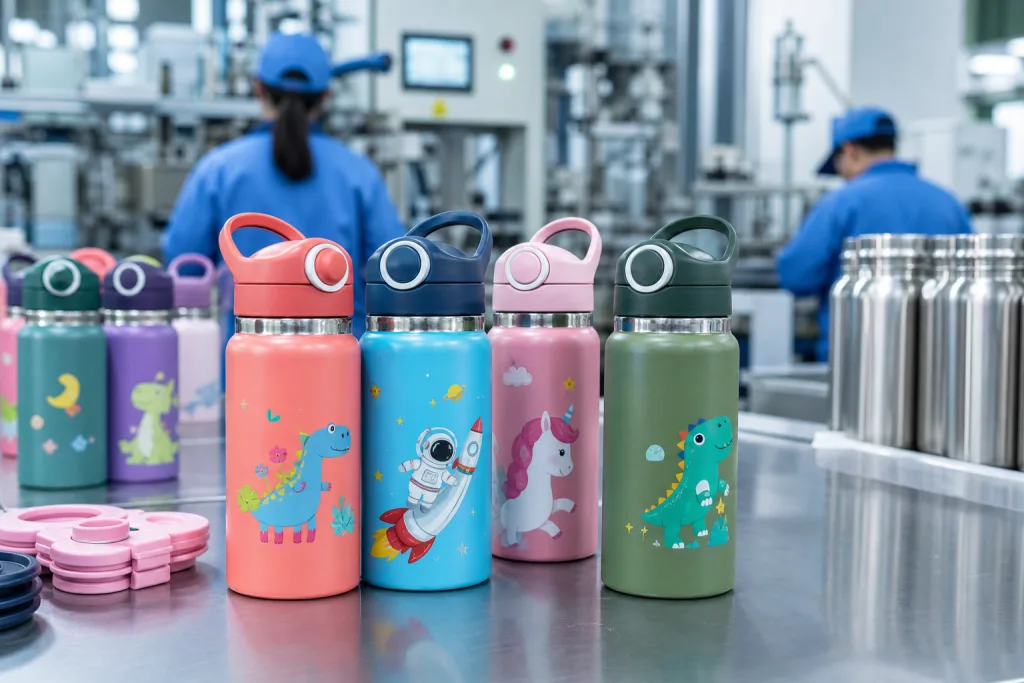
If you are sourcing a customized kids water bottle for a school district, distributor program, or retail line, the artwork is not the main risk. The product spec is. We have seen a lid leak after a 1.2 m backpack drop test, and that one issue cost more in claims and rework than a $0.20 unit-price saving ever could. The same goes for a bottle body that cracks at the shoulder radius or a Pantone match that drifts across 10,000 units because the line did not lock the master sample.
We run children water bottle bulk orders in Zhejiang and ship to Europe and North America every week, so the buyer pattern is familiar. They ask for a safe bottle, easy cleaning, a clear MOQ, and an honest ship date. Fair asks. This is where weak suppliers get exposed. A solid children water bottle manufacturer should hand over material data, test reports, and lead times tied to line capacity, not sales talk. On our floor, QC pulled the sample if the straw fit went out by 0.3 mm. That is the level you want. In China, the factories that handle this well usually run 20,000-50,000 units/month, and repeat orders stay stable if you lock the resin, color, and packaging spec early. If you leave those open, we have seen this go sideways fast.
What buyers should decide first
Before you compare children water bottle suppliers, decide the job first. This is the wrong question to skip. A custom school water bottle for grades K-5 is not built like a giveaway for a sports camp. On one PO last season, the buyer wrote “kids promo bottle” and meant two different uses in the same line item. School use usually comes down to safety, cleaning time, and replacement rate after 90 days on campus. Camp giveaways are more about logo exposure and landed cost per piece. If you lock the use case first, you stop over-specifying parts and the math works better.
Start with four points: age group, daily use environment, target selling price, and decor method. For example, a 450-550 ml bulk school water bottle with a flip-top straw is often easier for kids than a screw-top lid, because smaller hands miss the thread start and QC pulled that issue on a 32-piece sample check. For bus bags and travel-heavy programs, a locking lid matters more than a fancy shape; we’ve seen this go sideways when a nice-looking cap pops open after a 1.2 meter drop test. If the bottle is for retail, buyers usually ask for a cleaner surface finish, like a more even powder coat around the shoulder radius. For school procurement, durability beats looks most of the time.
- Age 3-6: lighter body, often under 220 g, simple open/close lid, soft bite straw optional
- Age 7-12: 450-650 ml, carry handle, leak-resistant lid that survives line pressure testing
- Retail/gift: custom logo kids bottle with premium print or sleeve; the buyer usually flags color mismatch first
- Program orders: children water bottle bulk with replacement-friendly parts, and MOQ on spare lids should be clear up front
Good children water bottle factory teams in Zhejiang ask these questions in the first 10 minutes. If they do not, treat that as a warning sign. We run into this with trading teams that quote fast but never ask how the bottle gets cleaned, dropped, or packed on the line.
Materials that actually work
Material choice affects safety, complaint rate, and landed cost. For a customized kids water bottle, the common options are PP, Tritan, AS, and stainless steel. PP is the budget pick and works for lightweight bulk orders starting at 3,000 pcs, though buyers often say it feels too plain on shelf. Tritan stays popular for one simple reason: clear body, better drop resistance, and fewer odor complaints from school use. Stainless steel makes sense if you need insulation. It also adds weight and cost, so the math does not work for every promo project.
Do not buy from a label print. Ask the children water bottle manufacturer for resin grade, wall thickness, and test reports. On our line, QC checks body thickness with an ultrasonic gauge before mass production. For a 500 ml Tritan bottle, wall thickness around 1.5-2.0 mm is common. For stainless steel, 18/8 (304) inner and outer walls are standard in better factories; 0.4-0.5 mm wall gauge is normal for a practical school bottle. We have seen quotes win on price and lose later because the bottle body came in 0.1 mm light. If a vendor will not state thickness, you are buying blind.
What to request on the RFQ
- Material: Tritan, PP, 304 stainless steel, or aluminum
- Lid type: flip-top, straw, direct-drink, or screw cap
- Capacity: 400 ml, 500 ml, 650 ml, or custom
- Test basis: REACH, LFGB, FDA, CPSIA, BPA-free declaration
For Europe, LFGB and REACH documents are the first papers buyers ask us for. For North America, buyers usually request FDA food contact and CPSIA-related compliance if the product is for children. Last season one buyer flagged a PO typo that listed "TRITON" instead of Tritan, and the lab held the file until we corrected it. A solid children water bottle supplier sends the paperwork fast and matches every report to the exact SKU, lid, and straw set.
Lids, lids, and more lids
Most leak claims start at the lid, not the bottle body. Start the children water bottle customizable project with the closure. That is the right sequence. For younger users, we usually run a flip-top lid with a silicone seal because kids can open it fast and shut it with one hand, and QC pulled fewer pinch-point issues on that style during line checks. A straw lid works if you want easier sipping, but it needs stricter cleaning. For school districts, a screw-top direct drink cap usually survives abuse better than a spring-loaded mechanism; more moving parts means more failure points, and we’ve seen this go sideways after one semester.
Ask the children water bottle vendor for cycle-test and drop-test records. A practical target is 1,000 open-close cycles and 1.2 m drop tests on edges and base. Ask to see the actual report, not a sales slide; on our side the line uses a hinge-cycle rig, and the buyer flagged one batch before because the spring force drifted after 800 cycles. If you are sourcing bulk children water bottle units for classroom use, also ask about spare seals, replacement buttons, and whether lid parts can be changed without scrapping the full bottle. That cuts replacement cost and keeps the program alive after the first semester.
Buyers often focus on print and ignore the closure. In kids drinkware, the closure is the product.
For a custom children water bottle going into retail or promotional channels, a color-matched lid and handle can lift shelf appeal without changing the core mold. Simple win. We often match against a Pantone chip and check the handle gate mark before approval, because that small cosmetic point gets noticed fast. If you need children water bottle promotional packs, keep the lid design simple. Complicated lids eat margin, raise assembly time on the line, and create QC risk. This is the wrong place to get fancy.
Printing and branding choices
Branding on a custom kids water bottle is not just about looks. It has to hold up through dishwashing, backpack rub, and kids dropping it on the classroom floor. The right print method depends on the artwork and the bottle material. On our line, silkscreen is the standard pick for 1-2 spot colors because the unit cost stays low and the mesh screen setup is simple. Laser engraving works on stainless steel and gives a permanent mark, but some curved body styles do not sit well in the fixture, so this is the wrong question to ask if the bottle shape is not confirmed first. Heat transfer and UV print carry finer detail, but both need tighter control on curing time, alignment, and adhesion test results.
If you are comparing custom logo kids bottle options, ask for actual decoration life in numbers. A print that survives 50 dishwasher cycles is not the same as one that starts fading at 10, and we have seen buyers approve the nicer-looking sample first, then push back after wash testing. For bulk kids bottle orders, a clean 1-color logo often lasts longer and gives better margin than a full-wrap graphic. In Zhejiang factories, buyers sometimes send artwork with 4 tiny colors on a 45 mm logo area, then flag the quote as too high. The math does not work. Keep the print spec tight, measurable, and matched to the bottle surface.
- Silkscreen: best for 1-3 colors, low cost, good for children water bottle wholesale, and easy to control with Pantone-matched ink
- Laser: permanent on stainless, strong for premium school program bottles, but only if the body fits the engraving jig
- UV print: detailed graphics, higher setup control, and QC usually pulls an adhesion sample before mass run
- Heat transfer: flexible, but check wear resistance with tape test and dishwasher test before approval
If your program needs a children water bottle customized with names, numbers, or class codes, variable data printing can work, but it adds sorting and QC steps. We ship these jobs with carton-by-carton checks because one wrong class code on the PO can turn into a rework claim. Build that into your timeline.
MOQ, pricing, and lead time
Let’s get into the numbers procurement will ask for first. A standard customized kids water bottle in Tritan or PP usually starts at 3,000 pcs MOQ per color or per design. For stainless steel, an existing mold can bring MOQ down to 1,000-3,000 pcs, but new tooling changes the math fast. We run into this every month: the bottle body MOQ is one number, the silk screen print is another, and a custom window box can push the final MOQ again. On the line, even a 2 mm logo shift on the print sample can force a redo, so this is the wrong question to ask if you only ask about bottle MOQ.
Factory pricing moves with material, lid structure, and decoration method. A simple PP bulk school water bottle usually lands at USD 1.10-1.80 FOB China. A Tritan model with a better lid is often USD 1.80-3.20 FOB. Stainless steel insulated versions can reach USD 4.50-8.50 FOB or more. Custom packaging, paper inserts, and color boxes add USD 0.15-0.60 per unit, and buyers do flag that delta. We have seen a PO where the buyer typed “matte box” instead of “mailer box,” and that small packaging change added enough cost to break the target for a school program.
Lead time is usually 7-12 days for samples and 25-40 days for production after approval. If you need a new mold or custom shape, expect 45-60 days before mass production starts. A Zhejiang factory with 20,000+ units/month capacity can still miss the ship date if artwork approval comes late. QC pulled the sample, approved the seal fit, then the buyer changed bottle color, lid color, and carton layout after the PO—we’ve seen this go sideways. The fastest way to lose your production slot is late approval, not factory speed.
What to check before you pay
Procurement needs a hard checklist before deposit. This is where a real children water bottle factory pulls ahead of a trader. We’ve seen buyers wire 30% on a neat PDF, then QC pulled the sample and found the straw hardness was off spec. Ask for these before you release money:
- Material declaration with grade and food-contact statement
- Third-party test reports for REACH, LFGB, FDA, or CPSIA-relevant items
- Sample photos showing print placement and lid assembly
- AQL inspection standard, usually 2.5 major / 4.0 minor for consumer drinkware
- Carton drop test plan and inner-packaging method
- Replacement-part policy for seals, straws, and lids
For school district buyers, ask if the bottle supports name labeling or class identification. A 12 mm x 60 mm name area is enough for most school sticker systems, and it cuts mix-ups during distribution. For importers and children water bottle distributors, ask whether the factory can keep the same cap mold, gasket, and bottle base across reorders. This is not a small point. The buyer flagged one reorder with a cap fit change of 0.3 mm, and the old replacement lids no longer matched. Consistency saves requalification cost.
Check whether the supplier is a real children water bottle factory or a middle layer. In Zhejiang, both can quote in 24 hours. Only one usually controls molding, printing, and packing under one roof. Ask how many lines they run, what leak test they use, or who signs off final packing. If they cannot explain the QC line, the answer is obvious. Frankly, this is the wrong question to ask too late.
How to write a better RFQ
A clean RFQ gets better quotes and fewer mistakes. Sending only a logo with “need children water bottle wholesale” gives you a loose price range and starts trouble on the line. Write the spec like you are releasing it to production: bottle size in mm, target fill volume, artwork file type, sales channel, and compliance target. The buyers who do this best usually send a one-page brief, and QC pulled fewer corrections from those files than from the two-line RFQs we see every week.
Your RFQ should include:
- Product type: children water bottle custom, children water bottle promotional, or retail program with shelf requirements
- Capacity and dimensions, such as 350 ml with bottle height and diameter in mm
- Material and color Pantone code, for example 304 stainless body or PP lid with Pantone reference
- Logo method and artwork area, including silk screen, heat transfer, or UV print size
- Packaging: polybag, kraft box, color box, or retail window box with barcode position
- Destination market and compliance requirements, such as FDA or LFGB if already required
- Target order quantity and repeat forecast, for example 5,000 pcs trial order and 30,000 pcs annual plan
If you need a custom school water bottle for a district roll-out, state whether it is 1 SKU or 4 house colors. That changes setup, carton mix, and print loss on the line. If you are a children water bottle distributor, tell the factory your annual volume target. We ship one-time 5,000-piece buys and 50,000-piece programs, and the pricing is not close. This is the wrong question to ask if you only compare unit price; the better question is total program cost, because the math does not work the same once molds, spare straws, and repeat runs are included.
When you talk to a children water bottle supplier, ask for the sample charge, tooling charge if any, and the exact incoterm written on the quote. We have seen buyers send a PO with FOB Ningbo typed as FCA by mistake, and that small typo turned into a long email chain. FOB China is the cleanest baseline for most importers. Once that is fixed, landed cost is a math problem, not a guess.
Send your kids bottle spec for a real quote
We’ll review materials, MOQ, print, and compliance fast, then give you a practical FOB China price and lead time.
Frequently asked questions
What is the usual MOQ for a customized kids water bottle?
For standard molded bottles, MOQ is usually 3,000-5,000 pcs per design or color. If you use an existing mold and simple 1-color print, some children water bottle manufacturers can start at 1,000-2,000 pcs. New mold development pushes the number much higher, often 5,000-10,000 pcs before the tooling cost makes sense. For school programs, the better question is not only MOQ but whether the factory can repeat the exact same lid, gasket, and print position on the next order.
Which material is safest for school use?
For a bulk school water bottle, PP and Tritan are the most common because they are light, durable, and easy for children to handle. Tritan is usually the better choice if you want a clearer, tougher bottle with a more premium feel. For hot-cold retention, 304 stainless steel is strong, but it adds weight and cost. Ask for REACH and LFGB documentation for Europe, and FDA-related food-contact paperwork for North America. Avoid any supplier who will not state the material grade in writing.
How much should I budget per unit FOB China?
A simple PP children water bottle wholesale order may be around USD 1.10-1.80 FOB China. A Tritan custom kids bottle often lands around USD 1.80-3.20 FOB. Stainless steel insulated models are commonly USD 4.50-8.50 FOB depending on capacity, print, and packaging. Add USD 0.15-0.60 for custom boxes or inserts. If you need multiple colors, variable names, or special lids, cost rises quickly. Always ask for pricing by 5,000 pcs and 10,000 pcs so you can see the scale break.
What tests should I ask for before shipment?
At minimum, request material compliance documents, leak testing, and a sample inspection report. For export to Europe, ask for REACH and LFGB-related support. For North America, ask for FDA food-contact declarations and any CPSIA-relevant documentation if the item is for children. Good children water bottle suppliers also provide AQL inspection under 2.5 major / 4.0 minor, plus drop test or cycle test records. If the factory cannot show these, you are taking a quality gamble.
How long does production usually take?
After sample approval, a standard customized kids water bottle order usually needs 25-40 days for production. If you change mold details or order a new custom shape, expect 45-60 days before the first mass shipment. Sample lead time is often 7-12 days. In Zhejiang factories with 20,000-50,000 units/month capacity, the schedule can still slip if artwork approval comes late or if you change carton text after the PO. Lock the spec early and ask for a written production calendar.