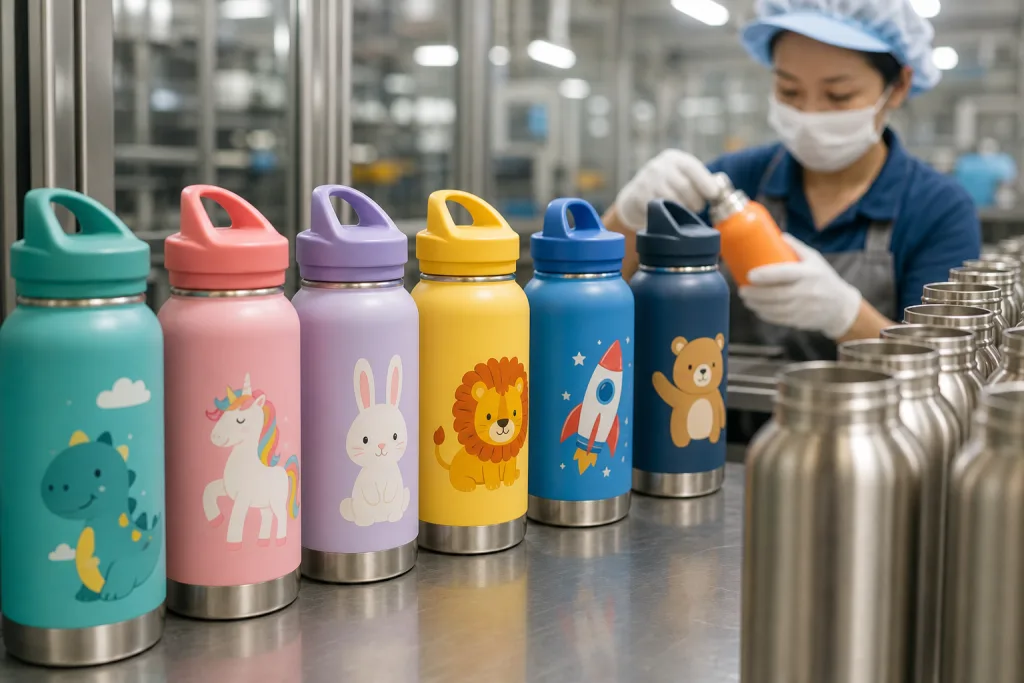
Key Takeaways
- For a 12 oz to 16 oz customized kids drink bottle, realistic MOQ is usually 3,000 to 5,000 units per colorway, with sampling in 7 to 12 days
- A safe starting spec is 18/8 stainless steel body, 0.4 mm inner wall, 0.5 mm outer wall, PP lid, and LFGB or FDA-grade silicone straw parts
- Bulk lead time from Zhejiang, China is typically 30 to 45 days after sample approval and 30% deposit, plus 5 to 10 days for ocean-ready booking
- Use AQL 2.5 for major defects and AQL 4.0 for minor defects, with 100% leak testing and drop testing on packed cartons before shipment
You do not buy a kids bottle the way you buy a generic office tumbler. The failure points stack up fast: bite valves leak at 15 kPa, straws pick up mold if the cleaning brush cannot pass through, lids crack after a 1.2 m drop test, and decoration starts rubbing off after a few dishwasher cycles. If your customer is a retailer, school program, museum shop, or promotional buyer, one weak part can turn a simple PO into returns, chargebacks, and compliance emails. We have seen this go sideways over one silicone valve that looked fine at sampling, then failed on the line after 300 open-close cycles.
The practical way to control that risk is to walk one order from spec sheet to final inspection. This is how experienced buyers work with a canteen factory in Zhejiang, China: lock the bottle spec, test plan, packaging method, and acceptance standard before sampling starts. QC pulled the sample, measured straw OD at 8 mm, and caught a lid fit issue before mass production; that is the stage where price, lead time, and actual quality control get easier to manage. Frankly, vague quality promises are the wrong question to ask.
Start with the end customer
Take a common buyer brief. You are sourcing a customized kids drink bottle for a back-to-school program in Europe. The target spec is a 14 oz insulated bottle, flip straw lid, soft-touch carry handle, two colorways, and a retail box. The look needs to sit above a low-cost canteen giveaway, but the landed target still has to stay under USD 4.80 per unit at 5,000 pieces. We see this on the line all the time, and the math gets tight fast once you add a box insert and two lid colors.
This is the wrong question to ask first: price. Start with use case. Is the bottle for children aged 3 to 6, or 7 to 12? Is it going into school bags, sports kits, gift sets, or museum retail? Does the child need one-hand opening? Does it need to fit a lunch bag with a 70 mm side pocket? If the end use is fuzzy, your canteen manufacturer or canteen supplier will quote a bottle that looks fine in photos and then fails in daily use. We have seen buyers flag leaks after drop tests because the lid hinge was picked for cost, not for how a six-year-old actually opens it.
For kids drinkware, lock these six points before you ask for a formal quote:
- Capacity: 12 oz, 14 oz, 16 oz are the most practical sizes.
- Material: single-wall Tritan, single-wall stainless, or double-wall vacuum stainless.
- Drinking method: straw, spout, or screw cap.
- Age band: preschool, primary school, or teen.
- Sales channel: retail, e-commerce, school contract, or canteen distributor program.
- Compliance market: EU, UK, US, or Canada.
At BottleForge Industrial in Zhejiang, China, buyers often ask for a custom canteen or customizable drinkware concept first and only later realize the lid matters more than the bottle body. That part is normal. QC pulled the sample more than once here and found the bottle body passed, but the straw bite valve needed another revision after 500 open-close cycles. Define the child use case first, then choose the structure. After that, a canteen customizable project is faster to quote and harder to get wrong.
Build the specification before artwork
Now turn the idea into a purchase spec. This sheet keeps the buyer, the canteen vendor, and the line on the same page. For a customized kids drink bottle, it should read like an engineering document, not a mood board. We’ve seen this go sideways over one missing line on a PO—same artwork, different lid structure, full remake discussion.
A solid baseline for a vacuum kids bottle is:
- Body: 18/8 stainless steel outer and inner
- Wall thickness: 0.5 mm outer, 0.4 mm inner
- Insulation: double-wall vacuum, copper coating optional
- Lid: PP with food-grade silicone seal and straw parts
- Capacity tolerance: plus or minus 3%
- Powder coating: 60 to 80 micron dry film thickness
- Logo method: silk screen, heat transfer, laser, or UV print
Leave any one of those open, and 2 factories will quote 2 different builds and both call them “same spec.” They are not the same. A 0.3 mm inner wall saves some cost, but the bottle dents faster in a 60 cm drop test. A cheaper lid resin may pass incoming inspection, then crack after 3,000 hinge cycles. QC pulled samples like that before, and the buyer flagged it only after pilot use.
Where buyers usually overspend
They ask for custom parts too early. This is the wrong question to ask at sampling stage. A fully customized canteen lid mold can cost USD 3,500 to USD 9,000 depending on complexity. If you are testing a program, start with an existing lid platform from the factory and customize decoration, bottle shape, color, and packaging first. We run projects this way all the time. It keeps MOQ lower and avoids a 20 to 30 day tooling delay; in practice that often means 12 days for pre-production samples vs 18 days once a new mold is in the queue.
A custom drinkware order becomes stable when the body, lid, logo method, packaging, and test standard are all named on one signed sheet.
Artwork comes after the physical spec. That order matters. Whether you are buying customized drinkware, a customizable canteen, or a customizable growler for a line extension, the same rule applies. If the spec is loose, the math doesn’t work—nice rendering, wrong bottle, and no one agrees what was approved.
Quote the order like a buyer
Once the spec sheet is locked, quote it the way buyers do so the numbers are apples to apples across canteen suppliers. Send one RFQ template and make every factory fill the same fields: EXW price, FOB Ningbo or Shanghai price, MOQ, sample charge, sample lead time, production lead time, carton size, gross weight, test standards, and included packaging. We run into this all the time—one buyer asked for “best price” from 7 factories, then found 3 of them had quoted without straws, boxes, or drop-test coverage.
For the scenario above, a realistic China quote range at 5,000 units might look like this:
- 14 oz vacuum stainless kids bottle with standard straw lid: USD 2.95 to USD 3.85 FOB
- One-color silk screen logo: included or plus USD 0.05 to USD 0.08
- Full-wrap heat transfer print: plus USD 0.18 to USD 0.35
- Plain white box: included or plus USD 0.06
- Custom retail box: plus USD 0.18 to USD 0.40 depending on board grade and finish
If one canteen vendor lands at USD 2.45 and the rest sit near USD 3.20, don’t clap yet. Ask what got stripped out. On the line, the gap is often 0.1 mm thinner steel, a cheaper silicone seal, no individual polybag, no third-party testing, or a loose leak standard that would not pass a proper upside-down check for 30 minutes. We’ve seen this go sideways. QC pulled the sample, turned the lid, and the buyer flagged seepage around the straw port on day one.
Ask about factory scale too, because scheduling lives or dies there. A factory in Zhejiang producing 600,000 to 1,000,000 units per month can usually slot in a repeat PO in 12 days vs 18 days for a smaller workshop, assuming the carton mark and artwork are already signed off. Typical MOQ for a customized kids drink bottle is 3,000 units for existing molds, while some decoration methods or packaging formats push MOQ to 5,000 units. This is the wrong question to ask if you ask only headcount; ask monthly output, number of vacuum lines, and whether they run automatic leak testers.
If you also buy adjacent items like custom growler, customized growler, or distributor drinkware assortments, ask whether the supplier can consolidate SKUs in one container. That saves more freight than shaving USD 0.03 off one bottle line. We ship mixed loads like this often, and one buyer even had a PO typo that read 4,000 growlers instead of 400—better to catch that before the booking goes out.
Sampling is where problems show up
After quoting, push to samples fast. This stage is not for looks alone. For B2B buyers, it shows whether the supplier runs the job with discipline or just talks well on email. A solid canteen supplier will lock Pantone, logo size in mm, assembly drawing, packaging mockup, and test points before the pre-production sample hits the line. We usually confirm artwork position off a 2D drawing first, because we have seen a PO typo shift a logo 8 mm and turn a simple sample into a remake.
Normal timing in Zhejiang, China is 3 to 5 days for stock samples, 7 to 12 days for custom decorated samples, and 15 to 20 days if a new tooling insert is required. Sample charges for a customized kids drink bottle typically run USD 50 to USD 150 for decorated samples, sometimes refundable against bulk order. If a factory promises a custom printed sample in 2 days, ask what they are skipping. The math does not work once the screen, curing time, and packing check are included.
What should you check on the sample?
- Leak test: invert for 2 hours, shake for 30 seconds, and inspect around hinge and straw port. QC pulled samples before where seepage only showed after 40 minutes.
- Odor: fill with warm water for 30 minutes and smell lid and straw after emptying. This catches silicone and plastic parts that were packed too soon after molding.
- Handle strength: hang 5 kg static load for 1 hour if the bottle has a carrying loop. We usually hang it on a simple load hook at the bench.
- Coating adhesion: cross-hatch or tape test on painted area after full cure. If the coating is not cured, the sample tells you nothing.
- Drop risk: 3 drops from 80 cm on base, side, and lid with packed sample for children-focused retail use. The buyer will blame the bottle first, not the carton.
- Cleaning access: confirm straw can be removed and reassembled without tools. If an adult needs a pick or pliers, that design will get complaints.
A lot of buyers accept a clean-looking sample and skip abuse testing. That is the wrong call. Kids bottles get dropped, dragged, and chewed. If the hinge pin walks out, the straw bites too soft, or the lid spring snaps after 200 cycles, you need that bad news before deposit, not after. We have seen this go sideways from one small inspection finding: a loose pin with 0.3 mm side play.
This is also where decoration gets real. On custom drinkware projects, silk screen is usually the low-cost option, but a kids bottle with a full character wrap often needs heat transfer or digital print. Buyers push back on print cost here all the time, then flag the sample because the seam looks weak on curved shoulders. If the artwork includes metallic accents, ask whether the finish survives 20 dishwasher cycles or whether hand wash only must be printed on the insert. We ship plenty of hand-wash-only items, but if retail says dishwasher safe on the color card, fix that before bulk.
Compliance and QC cannot be vague
For children's drinkware, vague promises are useless. Put the exact requirement in the PO and write the pass/fail rule next to it. We ask buyers to list the target market first, then the standard: FDA or LFGB for food contact, REACH for the EU where relevant, plus physical safety tests that match the product design. If the item is sold in the US to children, confirm any applicable CPSIA-related labeling or testing with your compliance team before mass production. This is not paperwork for later. We have seen a PO approved with the barcode panel size missing by 2 mm, and the buyer flagged it only after samples were sealed.
On the manufacturing side, ask the canteen factory what they run on the line, not what certificates are framed in reception. Good questions are:
- Do you run 100% vacuum inspection on insulated bodies?
- Do you run 100% leak testing after lid assembly?
- What is the AQL standard for final random inspection?
- Can you support BSCI, ISO 9001, or retailer social audit requirements?
- Do you keep incoming material records by lot for steel, plastic, and silicone?
Ask for the actual method. For example, is leak testing done with 0.03 MPa air pressure, or is someone just turning bottles upside down on a tray for 30 minutes? The second one is the wrong question to ignore.
A practical outgoing inspection plan for a customized kids drink bottle is AQL 2.5 for major defects and AQL 4.0 for minor defects. Critical defects should be zero tolerance. Major defects include leakage, sharp burrs, missing parts, incorrect barcode, failed vacuum, or readable logo defects on front panel. Minor defects include small paint specks on hidden areas or slightly uneven carton tape. QC pulled the sample from one order last month and found a silicone straw cut 1.5 mm short; assembly still worked, but the sip flow was weak and that counts as a defect, not a suggestion.
If you are a canteen distributor or distributor canteen buyer supplying major retail accounts, arrange a pre-shipment inspection when 80% to 100% of goods are packed. Check packaging drop resistance too. A bottle can pass assembly inspection and still fail in transit because the insert card, divider, or carton strength was underspecified. For export from China, 5-ply cartons are common; heavier sets may need 7-ply export cartons. We ship enough of these to say this plainly: the math doesn't work if you save $0.06 on packaging and lose 8% of units to crushed corners.
From deposit to shipment day
After sample and price approval, the job moves to production. A standard China order flow is 30% deposit, signed PI, approved artwork, approved pre-production sample, mass production, inspection, balance payment, and shipment. We usually see one delay here: the PO artwork file arrives with one lid color code missing, and the line stops for confirmation. If you buy FOB from Zhejiang or nearby ports, put vessel booking and document cut-off on the calendar from day one. Miss the SI cut-off by 4 p.m., and the cargo rolls to the next vessel. Buyers blame the factory for this all the time, but this is the wrong question to ask; first check who missed the booking window.
Typical production timing for 5,000 to 10,000 units of customized drinkware is 30 to 45 days. Add custom gift boxes, two inserts, or four-color display cartons, and the schedule usually goes to 50 days because the packing line waits on printed materials. We run spot checks with a Pantone book and carton burst tester, and packaging is often the slow part, not bottle assembly. In peak season from August to November, add another 7 to 10 days unless your canteen manufacturer reserved line capacity earlier. We've seen this go sideways when a buyer confirms the box only after steel mold sampling.
What you should lock on the PO
- Unit price and Incoterm: EXW, FOB, or DDP if agreed
- Tolerance: color, capacity, weight, and print position
- Packaging standard: inner bag, tissue, box, master carton, drop test level
- Markings: barcode, FNSKU, suffocation warning, country of origin
- Spare parts: 1% extra lids or straws for after-sales support
That last point gets missed a lot. For kids bottles, spare straws and seals are cheap insurance. On one 8,000-piece order, QC pulled the sample and found 26 silicone seals cut a little thin at 1.2 mm instead of 1.5 mm. Adding 1% replacement parts may cost less than USD 0.03 per shipped unit but can save a full claim. The math works. The same logic applies across customized canteen, customizable growler, and distributor growler programs.
If you work with multiple canteen distributors in North America or Europe, plan carton labeling and pallet standards early. EUR-pallet and North American pallet patterns are different, so pallet count and warehouse handling cost change fast. One buyer flagged this only after the PO was signed because the outer carton mark showed the wrong warehouse code. We ship both formats from Zhejiang, China, but only if the spec is clear before the master carton size is locked.
What separates a stable supplier
After the first PO, you usually know what you bought: a stable supplier or a polished sample room. Stable canteen manufacturers call out risk early. They will tell you your logo stroke is under 0.18 mm for silk screen, your matte coating will rub against a zinc-alloy handle on the shake test, or your target price is below the test standard you asked for. We have seen buyers push for all three at once, and the math does not work. A fast yes is easy. A useful no saves the order.
For long-term buying, judge a canteen factory on five plain points: reply speed, drawing accuracy, sample consistency, document control, and claim handling. Fancy catalogs mean little. What matters is whether the bulk bottle matches the golden sample within the agreed tolerance, and whether corrective action lands fast when QC pulled the sample and found a 2 mm logo shift or a PO typo on lid color.
A dependable canteen manufacturer in China should be able to show you:
- Repeatability: same color and logo position over multiple POs, not a cap print drifting 1.5 mm left between March and April runs
- Traceability: production date and lot code tied to materials, so the line can trace a silicone straw issue back to one resin batch
- Capacity: enough lines to support replenishment inside 25 to 35 days for repeat SKUs, with a real line plan instead of one shared machine for 12 customers
- Problem solving: written 8D or corrective action after defects, not a phone promise after AQL 2.5 inspection found dented bases
- Range support: ability to grow from kids bottle into custom canteen, custom drinkware, or even custom growler lines under one vendor setup, using the same packaging team and export docs desk
If you are building a private-label range, the right supplier is not just a canteen vendor. They sit inside your daily operations. This is why buyers keep coming back to drinkware clusters in Zhejiang, China: decoration shops, mold shops, packaging suppliers, and forwarders sit within a short truck run, sometimes 12 km apart. We ship faster when the carton printer, laser marking shop, and assembly line are local. You do not need the biggest supplier. You need one that quotes cleanly, runs consistently, and lets QC report the bad news without sanding it down.
That is the real buyer test. A customized kids drink bottle order should feel boring by the time it ships. If final inspection still feels exciting, something upstream was left loose—usually the artwork approval, seal structure, or drop-test standard.
Need a quote for your kids bottle program?
Send your target size, lid style, artwork, quantity, and market. We will review feasibility, MOQ, testing needs, and a realistic FOB China price.
Frequently asked questions
What is a realistic MOQ for a customized kids drink bottle?
For an existing bottle and lid mold, MOQ is usually 3,000 units per style, sometimes split into 2 colors with a minimum of 1,000 to 1,500 units each. If you need a custom retail box, printed straw instruction card, or full-wrap transfer, practical MOQ often moves to 5,000 units. A fully new lid mold can push the first order higher because tooling amortization has to be covered. In Zhejiang, China, some factories offer lower trial quantities, but the unit price can rise by 12% to 25%. If your program is new, start with an existing platform and customize decoration, packaging, and accessories first.
How much should I budget per unit for a kids bottle order?
For a 12 oz to 16 oz stainless vacuum kids bottle, most B2B buyers should budget around USD 2.95 to USD 3.85 FOB China at 5,000 units using an existing lid platform. Add USD 0.18 to USD 0.40 for a custom retail box and USD 0.05 to USD 0.35 depending on logo method. Tritan or single-wall plastic options can be lower, often USD 1.20 to USD 2.20 FOB, but they serve a different market position. If your quote is far below the market band, ask about steel grade, wall thickness, seal material, inspection level, and whether testing is included.
What tests matter most for kids drink bottle quality control?
The highest-value checks are leak testing, odor testing, drop testing, coating adhesion, and assembly fit. For insulated bottles, add vacuum performance and condensation checks. A practical factory standard is 100% leak testing and 100% vacuum check, then final random inspection at AQL 2.5 major and AQL 4.0 minor. For packaged goods, run drop tests on export cartons as well, usually from 60 cm to 80 cm depending on pack weight. If the bottle includes a carry handle, ask for a 5 kg static load test. These tests catch most costly field failures before the goods leave China.
How long does production usually take after sample approval?
For a standard customized kids drink bottle using existing molds, plan on 30 to 45 days after pre-production sample approval and deposit payment. A simple silk-screen logo and plain box is often closer to 30 days. Full-wrap decoration, custom color matching, or printed retail packaging can stretch timing to 40 to 50 days. During peak season, especially August through November, add 7 to 10 days as a buffer. Sample lead time is separate: normally 7 to 12 days for custom samples. If you need third-party lab testing before shipment, add another 5 to 10 working days.
How do I choose between a canteen supplier, trader, or direct factory?
Start by looking at your order complexity and internal bandwidth. A direct canteen factory is usually better if you want tighter price control, faster engineering feedback, and repeat orders above 5,000 units. A trader or canteen vendor can still be useful if you need mixed products, such as kids bottles, tumblers, and a customized growler in one consolidated shipment. Ask who controls tooling, who handles corrective actions, and who signs the quality standard. The best choice is the one that gives clear specs, stable lead times, and real inspection records. In China, plenty of capable suppliers exist, but the reliable ones answer technical questions with numbers, not slogans.