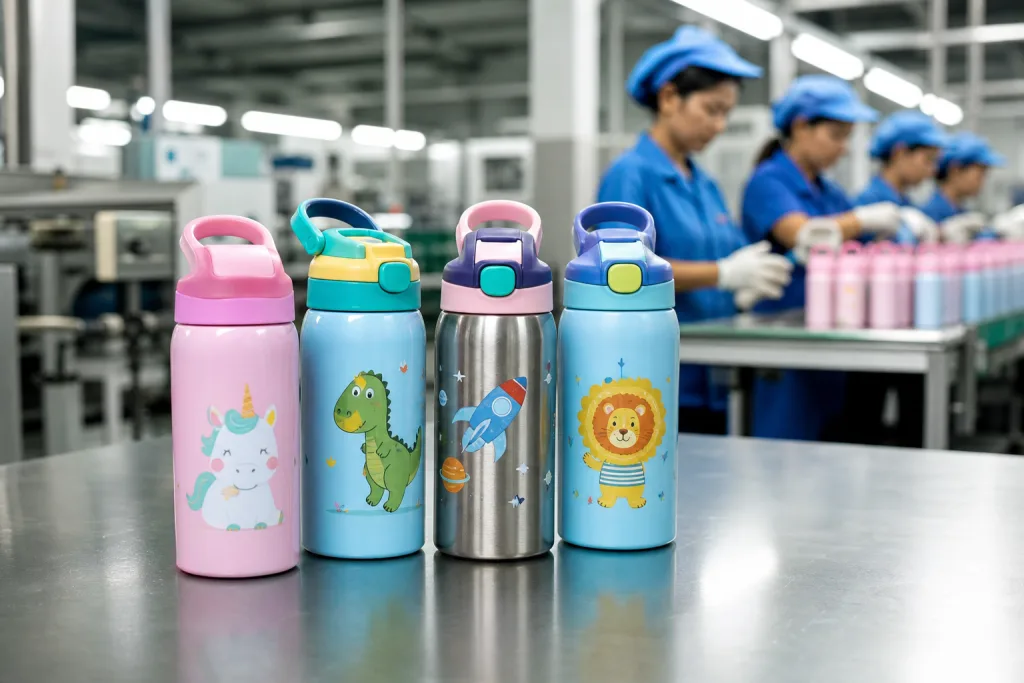
Key Takeaways
- A customized kids bottle should specify material, lid torque, and leak test criteria before sampling.
- For bulk kids bottle orders, MOQ often starts at 3,000-5,000 units per color and lead time is 25-35 days.
- PP and Tritan bodies need different wall thickness targets: 1.8-2.2 mm for PP, 2.0-2.5 mm for Tritan.
- Reject rates above 2% usually come from cap fit, print abrasion, or inconsistent assembly, not the bottle body.
Most failures in a customized kids bottle program do not start at the port. They start on the spec sheet. If you want a custom kids bottle line that holds up to school use, 200 dishwasher cycles, and distributor margin pressure, buy like a factory team, not like someone flipping through a catalog. In Zhejiang, we have seen the whole project swing on a 0.3 mm wall thickness callout, a cap torque range of 0.8–1.0 N·m checked with a torque meter, and an MOQ the line can actually run. This is the wrong question to ask: “What is your lowest price?” Ask what the spec controls first.
We run children water bottle custom programs for school districts, importers, and children water bottle distributors that need stable quality on 50,000-unit orders, not nice-looking pre-production samples. A serious children water bottle manufacturer should quote material grade, leak test standard, print abrasion result, and pack-out details without guessing; QC pulled the sample, the buyer flagged a lid fit issue, and we corrected the thread tolerance before mass production. If a supplier cannot explain how a 50,000-unit order is controlled from injection molding to carton drop test, with AQL checkpoints and carton weight limits, the math doesn't work. You are not buying bottles. You are buying returns.
Where kids bottle programs fail
The first failure is basic: the buyer signs off on a nice-looking sample and skips the real use case. A bulk school water bottle gets slammed in backpacks, dropped on canteen floors, run through hot wash cycles, and twisted shut by kids with one hand on the lid and the other on the body. On the line, the body is usually fine. The trouble starts at the cap seal, straw joint, print adhesion, and hinge pin.
In our Zhejiang factory, we keep seeing two mistakes from first-time buyers. One is picking a decorative lid and never checking gasket geometry with a caliper. The other is approving a narrow neck opening under 38 mm because it looks cleaner on the render, then the buyer flags it later because parents cannot get a brush inside. This is the wrong question to ask: don't ask what looks premium first, ask what still works after 200 open-close cycles. One leak in a classroom and a school district buyer can freeze the repeat PO fast.
Watch these failure points:
- Cap seal compression too low: target 15-25% gasket compression.
- Thread mismatch: cross-threading after 200-300 open-close cycles.
- Print wear: pad print begins to fade after 30-50 dishwasher cycles if not protected.
- Straw pull-out: weak retention in 1.5-2.0 kg pull tests.
If your children water bottle supplier cannot explain how each part fails on the bench, during drop test, and after wash cycling, they are not ready for bulk children water bottle business. We've seen this go sideways when QC pulled the sample, found hinge stress marks at the gate point, and the factory still said the design was "ok."
Choose the right bottle material
Material choice sets four things fast: drop life, odor, carry weight, and unit price. For a custom children water bottle, buyers usually compare PP, Tritan, and stainless steel; glass only comes up for older kids, and we rarely run it on the line for school programs because breakage claims are a headache. For ages 3-6, PP and Tritan win for a simple reason: low weight. A 350 ml school bottle that lands under 120 g gets fewer complaints from parents. School orders also push impact resistance hard. We have had buyers flag cracked shoulders after a 1.2 m drop test, so this is the wrong place to chase a fancy material story. Stainless steel works if you need temperature retention for 6-8 hours, but it lifts unit cost and the lid structure gets trickier because thread fit and gasket compression have less tolerance.
Practical spec ranges
- PP body: 1.8-2.2 mm wall thickness, lighter, lower cost, good for everyday school use.
- Tritan body: 2.0-2.5 mm, clearer appearance, better premium feel, usually adds 15-30% to material cost.
- Stainless steel: 0.4-0.5 mm inner shell gauge for common kid-size insulated bottles.
Do not let a children water bottle manufacturer hide behind the word “BPA-free” alone. BPA-free is the floor. It does not tell you odor level after molding, drop performance, or whether the straw and seal set match the body resin. If you sell into North America or Europe, ask for food contact compliance and supporting declarations for REACH and FDA-related materials as needed. QC pulled one sample last month where the PO said “Triton” instead of “Tritan,” and that typo alone would have caused a long argument if the resin grade was not listed. For a children water bottle custom program, match the material to the user age and use case. The premium-sounding option is often the wrong buy.
If the bottle is for kindergarten, light weight and leak control matter more than premium gloss.
Prints that peel or wash off
We see kids bottle promo orders fail for a simple reason: the artwork was quoted like decoration, not like a wear surface. Kids drag bottles across desks, throw them into sports bags, and parents scrub them hard at the sink. If your custom logo kids bottle runs with low-grade ink or weak surface prep, the complaint starts in 2 to 4 weeks. That is not a branding issue. It is line control. On our side, QC pulled the sample once because the flame treatment was uneven on a PP body, and the ink scratched off with a thumbnail.
For a custom made kids bottle, the print method needs to match the material and the abuse level. Screen printing is the low-cost option for 1 or 2 colors, but the curing window matters; we check oven temperature and dwell time, not just the final look. Heat-transfer graphics look bright, but abrasion is where buyers get pushed back by end users. Laser engraving fits stainless steel well and is the wrong question to ask for most plastics. If you are building a custom school water bottle program, ask for an abrasion test: 50 cycles with a wet cloth, then 20 cycles with neutral detergent. If the logo smears or lifts, do not approve the sample. We have seen buyers sign off on a glossy pre-production sample, then the line ships 5,000 pcs and the math does not work after returns.
In Zhejiang, plenty of factories print fast; fewer hold the same result from first run to repeat run. Ask for color tolerance within Delta E 2-3 and PMS references if shade matters to your brand. A children water bottle customizable order should also lock print placement tolerance, because a 3 mm shift on a 350 ml bottle is easy to spot from one shelf away. The buyer flagged this on one PO last season because the mascot eye sat 2 mm high, and once you see it, you cannot unsee it.
Lids, straws, and leak points
Leaks kill school programs fast. On the line, most failures start in the lid set: a silicone gasket sitting 0.5 mm off groove, a weak ultrasonic weld, a flip-top hinge pin with play, or a straw cut wrong by 2-3 mm. If you buy from a children water bottle manufacturer, ask for a lid-specific QC plan, not a generic final inspection sheet. The bottle body and closure have to be checked as one system. This is the right question to ask.
For flip-top lids, test the hinge for 3,000-5,000 cycles and ask what fixture they run on. For straw lids, confirm the straw stays seated after repeated tugging; QC pulled the sample on one order after 20 pulls because the barb was undersized. For screw caps, specify torque limits so the cap seals without forcing a child to use two hands; we usually check this with a torque meter, in kgf·cm, not guess by feel. A good factory in China or Zhejiang should be able to show you leak testing at inverted room temperature for 30 minutes, plus a drop test from 1.2 meters onto a hard surface.
Do not load a children water bottle bulk program with extra parts. Every added spring or button gives the line one more failure point, and we have seen this go sideways after mass production starts. One buyer flagged a push-button lid after the first shipment because sand from playground use jammed the lock. If your users are younger than 8, the simplest lid is often the safest and cheapest over a 12-month sales cycle.
Sizing for schools and retail
The wrong capacity creates inventory pain fast. We see school buyers lock one size by grade band, while importers and children water bottle distributors usually split the line for retail. For elementary school, 350-500 ml is the range that moves. For older kids and sports programs, 600-750 ml is the common ask. A full bottle that weighs too much gets left in the classroom. On our drop-test bench, the bigger issue is simpler: once a bottle body gets too tall for small hands, usage falls.
If you are placing a children water bottle wholesale order, start with the use case. Ounce conversion is the wrong question to ask. A 450 ml custom children water bottle fits lunch bags and side pockets better than a 750 ml bottle; we have had buyers flag 750 ml samples because the base would not clear a standard school bag pocket by 8 mm. The larger bottle still sells for summer programs and outdoor retail. School districts usually want one standard size because replacement stock is easier to run and reorder. Retail buyers push the opposite way. They want a size family that shares one cap family and one print style, so the shelf looks matched and the spare parts stay manageable.
Our factory planning rule is simple: one mold family can support 2-4 SKUs if the neck finish and lid system stay the same. That cuts tooling cost and gives you a cleaner path to a 3,000-unit MOQ per SKU without dead stock. We run this math before sampling because we have seen it go sideways. QC pulled the sample on one mixed-closure project last season, and the PO even had a cap code typo, so replacement planning broke before mass production started. A children water bottle supplier that pushes every SKU into a different closure system is building future inventory waste.
Compliance before first shipment
Compliance is not the pretty part of the sale, but it stops POs cold. For North America and Europe, your custom children water bottle program needs food-contact declarations, heavy metal limits, and packaging compliance checked before we ship the first carton. If the bottle has paint, coating, silk print, or decorative trims, ask for testing against applicable REACH restrictions and the target market rules. We have seen this go sideways over a 2 mm painted logo ring. If your importer or school buyer asks for documents after cargo lands, you are late.
For a children water bottle distributor, the paperwork needs material descriptions, test reports, and batch traceability tied to the exact build. This is the wrong question to ask: “Do you have a report for something similar?” QC pulled the sample, checked the BOM, and matched lid, straw, gasket, and body resin before release. A molded PP cup and a Tritan bottle do not share the same compliance file, even if the shell shape looks the same on the line. We have even seen a PO typo swap 304 stainless for PP on an attachment page.
We recommend a document pack that includes:
- Material declaration by component
- Leak test record and drop test criteria
- Carton pack-out count and gross weight
- Factory audit evidence such as BSCI if your buyer requires it
That is standard control for a serious children water bottle factory, not a special favor. We run this pack before first shipment, often at MOQ 3,000 pcs, because the math does not work if the buyer flags missing files after departure.
MOQ, lead time, and factory control
Commercial misses happen as often as product defects. We’ve seen a buyer sign off on a nice customized children water bottle, then hit the wall on MOQ or timing and miss back-to-school. In our Zhejiang plant, a custom logo kids bottle usually runs at 3,000-5,000 units per color, with 25-35 days for mass production after sample approval and deposit. If the lid has 3 parts instead of 2, or the gift box needs a separate drop test, add 7-10 days. This is the wrong question to ask late.
Factory capacity is not a brochure claim. Ask what each line runs per day, not just the monthly total. A steady children water bottle manufacturer should handle 200,000-400,000 units per month across several drinkware lines, with incoming QC, in-process checks, and final AQL inspection. On our side, QC pulled the sample once because the color masterbatch tag did not match the PO suffix, and that kind of lot-mix issue turns into a replacement mess for school programs. If a factory cannot show lot traceability by carton or line, we’ve seen this go sideways.
FOB Zhejiang pricing moves a lot by material and decoration. A simple PP custom children water bottle may start around USD 0.80-1.40 per unit at bulk scale, while premium Tritan or insulated builds cost more. Do not buy on piece price alone. The math doesn’t work if a cheaper quote brings 4% defects, weak print adhesion, or cap leakage found at 0.2 MPa air test. For bulk children water bottle programs, the better question is not “what is the cheapest?” It is “what ships on time, passes inspection, and reorders cleanly?”
Send your spec sheet, not just a logo
We can quote your bulk children water bottle program with MOQ, lead time, and QC points that make sense for schools and distributors.
Frequently asked questions
What MOQ should I expect for a customized kids bottle?
For most custom children water bottle programs, expect 3,000-5,000 units per color and per design. If you want multiple lid colors, printed names, or special packaging, the MOQ can rise to 8,000 units. A factory in China may quote lower on a sample order, but that is not the real production number. For school district tenders, one SKU with one lid family usually gives the cleanest pricing and the lowest risk.
Which material is best for bulk school water bottle orders?
For younger students, PP is usually the best value because it is light, tough, and easier to price at volume. Tritan is better if you want a clearer premium look and can absorb a 15-30% material premium. Stainless steel works for insulated use, but it adds weight and cost. If the buyer is a children water bottle distributor, the best material is the one that matches the age group and the refill behavior, not the fanciest spec.
How do I test a custom kids bottle for leaks?
Ask the children water bottle manufacturer to run inverted leak tests for 30 minutes at room temperature, then a drop test from 1.2 meters. For straw and flip-top lids, add open-close cycle testing: 3,000 cycles is a practical baseline, 5,000 is better for retail programs. Also inspect gasket compression and cap torque. If the bottle leaks under moderate hand pressure, it will leak in a backpack.
What certifications should I request for Europe and North America?
Request food contact declarations, REACH-related compliance where applicable, and material test reports tied to the exact product structure. For a custom children water bottle, the paperwork should match the body, lid, gasket, and decoration method. If your buyer wants extra assurance, ask for BSCI or similar factory audit documents. Do not accept generic reports that reference a different bottle shape or resin grade.
How long does production take for children water bottle custom orders?
After sample approval and deposit, a standard bulk kids bottle order usually takes 25-35 days. Complex lids, multiple print colors, or customized packaging can push that to 35-45 days. If tooling changes are needed, add another 10-20 days depending on mold complexity. For seasonal retail launches, you should place orders 60-90 days before shelf date so you have time for inspection and freight.