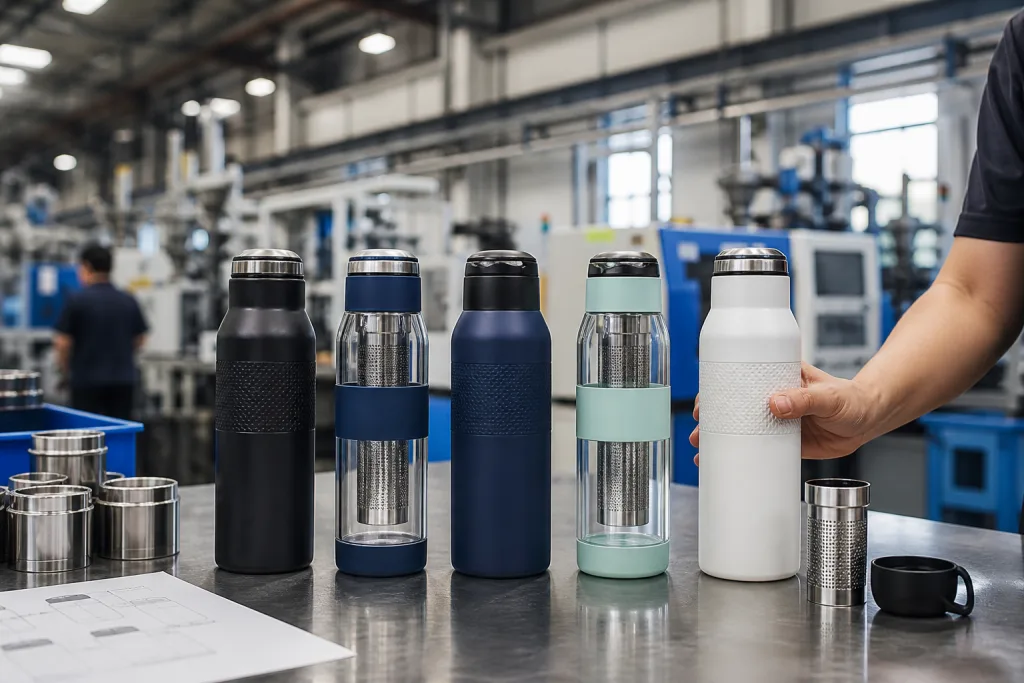
Key Takeaways
- Start RFQs with bottle material, capacity, infuser type, logo method, and packaging; missing specs can shift unit cost by USD 0.25-0.80
- Typical MOQ for a custom logo infuser bottle is 1,000 pcs, while fully custom made infuser bottle projects with new tooling often start at 3,000-5,000 pcs
- Sampling usually takes 7-12 days for existing models and 20-35 days for new molds; bulk lead time is commonly 25-40 days after deposit and approval
- Put leak test, AQL 2.5, REACH or FDA contact requirements, carton drop standard, and spare-part tolerances directly into the PO
You already know the consumer pitch: people want hydration with fruit or tea, and they want a cleaner wellness look than a low-grade promo bottle. The hard part starts at sourcing stage, not marketing. We’ve seen custom infuser bottle projects go sideways before the line even runs. A loose RFQ, the wrong basket depth, or one missing PO item like “spare gasket 1 pc/set” can turn a nice sample into leakage claims, a launch slipping 12 days to 18 days, and margin getting squeezed.
If you are building a hydration startup or scaling a wellness brand, the right sourcing process is boring on purpose, specific to the mm, and easy to repeat. This is how serious buyers in Zhejiang work, and this is the wrong category for guesswork. At BottleForge Industrial in Hangzhou, Zhejiang, we run infuser bottle lines up to 450,000 units/month, with MOQ usually 1,000 to 3,000 pcs depending on mold, decoration, and packaging. QC pulled samples last month where the infuser tube sat 2 mm off-center, and that small miss was enough for the buyer to flag fit and finish right away.
Start with the right RFQ
If you want accurate pricing for a customized infuser bottle, do not send one reference photo and ask for “best price.” We quote a bottle, not a guess. A usable RFQ gives the factory enough detail to price tooling risk, assembly time, and test requirements, not just resin, steel, or glass. This applies whether you are buying a custom fruit infuser bottle for retail, a bulk tea infuser bottle for a subscription box, or a bulk infuser bottle for distributor channels. We have seen POs with “650ml?” typed on one line and no lid spec at all; that is where cost drift starts.
Your RFQ should state the exact bottle type because the infuser structure changes cost fast. A Tritan body with a full-length fruit basket does not quote like a borosilicate bottle with a short stainless tea basket. Lid geometry, gasket count, and handle design change assembly time and leak rate on the line. We run leak tests with a vacuum fixture, and QC pulled one sample last month where a 1.5 mm gasket sat proud and failed after 20 cycles. China factories can turn quotes in 24 to 48 hours, but only if the technical brief is clear. Asking for a fast quote without the build detail is the wrong question to ask.
PO line items to define at RFQ stage
- Body material: Tritan, borosilicate glass, 18/8 stainless, PP lid, silicone gasket
- Capacity: 450 ml, 650 ml, 750 ml, 1,000 ml
- Wall thickness: glass 2.8-3.2 mm, Tritan 0.8-1.2 mm typical
- Infuser type: full fruit cage, short tea basket, bottom chamber, removable center tube
- Decoration: 1-color silkscreen, 2-color print, laser mark, wrap label
- Packaging: polybag, white box, kraft box, color box, PDQ tray
- Compliance: FDA/LFGB, REACH, BPA-free declaration, ASTM if relevant to age use
- Target Incoterm: FOB Ningbo, FOB Shanghai, or EXW Zhejiang
If you are a startup, ask for pricing at 1,000 pcs, 3,000 pcs, and 5,000 pcs. That shows where the cost breaks are. On one factory-direct infuser bottle program we shipped, unit price dropped USD 0.18-0.45 between 1,000 and 5,000 pcs from print setup spread and tighter packing per master carton. A common carton here is 24 pcs at a 6.5 kg limit, so the math changes once the packout is fixed. If a supplier only gives you one quantity, push back.
Choose the bottle architecture first
Buyers lose weeks on logo position before they lock the bottle they plan to sell. That is backwards. For a customized tea infuser bottle or customizable fruit infuser bottle, structure affects user complaints far more than artwork. Start with the use case and get specific: office tea drinking at a desk, 750 ml gym hydration, one-hand commute use, gift packing, or retail shelf display. On our line, the first thing we check is not print size. It is how the bottle opens, seals, and cleans.
For wellness brands, the options are simple if you look at the numbers. Tritan is lighter, usually carries a lower landed cost, and works better for active use; a 700 ml Tritan body often comes in around 180-220 g, which matters for e-commerce freight. Borosilicate glass gives a cleaner premium feel, though it needs stronger inner packing and we have seen this go sideways in parcel shipping when buyers try to save on the 3 mm EPE sleeve. Stainless outer shells make sense if insulation is part of the sales pitch, but once you add a tea infuser and insulation, the math doesn't work for impulse pricing in most retail programs.
For most hydration startups, the safest first SKU is a 650-750 ml Tritan custom logo infuser bottle with removable fruit basket, carry loop, and single-color print. It is easier to launch, test, and reorder.
Here is where architecture changes your PO in a real factory run:
- Mouth diameter: 45-55 mm is easier for fruit filling and cleaning; below 45 mm, buyers start complaining they cannot drop in lemon wedges without cutting them first
- Thread style: coarse threads reduce cross-thread complaints in mass production; QC pulled the sample on one 5,000 pcs order and found fine-thread caps were mis-starting after repeated torque tests
- Seal system: single silicone ring vs double seal under cap and infuser seat; if the channel depth is off by even 0.3 mm, leakage claims show up fast
- Infuser perforation: tea mesh holes need tighter tolerance than fruit cages; fruit baskets can run with larger slots, but tea infusers get flagged if fine leaves pass through
- Base shape: round is simpler; square or faceted raises mold cost and carton inefficiency, and we usually ship fewer pieces per master carton
If you are buying fruit infuser bottle bulk for retail chains, ask the supplier for leakage data by structure, not just by sample. This is the right question. In Zhejiang, a capable factory should be able to tell you if the design passed upside-down testing for 24 hours, shake testing, and repeated opening cycles, with actual findings from the line. For a custom tea infuser bottle, ask whether the basket twists into the lid or clips into the body. Twist-lock parts usually last longer; clip-in designs are cheaper, but the buyer flagged one PO last year after the tabs loosened before 2,000 open-close cycles.
Quote samples like a real PO
Once the architecture is chosen, get strict at sample stage. We see 2 common delays here: the buyer sends a loose brief, and the line treats the sample as a normal mock-up instead of a pre-production build. For a customizable infuser bottle, the sample request should read like a small PO: item code, Pantone, logo size in mm, and packing notes down to barcode position. One missing line can cost 3 days. Last month a buyer flagged a lid color shift because the PO said “cream white” with no chip reference.
For existing mold items, sample cost is often USD 30-100 per piece depending on decoration and packaging mock-up, and sample lead time is usually 7-12 days in China. If you need a custom made infuser bottle with a new lid or infuser basket, 3D print verification can take 5-7 days, mold making 15-25 days, and first molded samples another 7-10 days. New-tool projects below 3,000 pcs are usually poor economics unless your retail price supports it. This is the wrong place to chase the lowest MOQ; the math doesn't work if tooling is spread over a small run and QC pulled the sample with fit issues at the thread start.
PO line items to lock during sample approval
- Color reference: Pantone code or approved physical chip
- Logo size and position: for example 35 x 70 mm centered 25 mm above base
- Print adhesion standard: 3M tape test after curing
- Assembly notes: infuser basket removable, gasket hardness, handle fold angle
- Packaging dimensions: box size, insert material, barcode position
- Sample sign-off method: physical golden sample, dated and photographed
If you plan to sell a custom fruit infuser bottle on Amazon or DTC, ask for a transit-ready packaging trial early. A color box can look fine on the meeting table and still crush in parcel handling; we've seen this go sideways after a 76 cm drop test on the corner. Ask for carton specs, inner pack quantity, carton gross weight under 12-14 kg if possible, and corner drop performance. Good Zhejiang factories usually have burst-strength data from the carton tester and basic drop records on file, but they will not send them unless you ask.
Test what will actually fail
Testing is where first-time buyers lose money. They either pay for lab work that never touches a real claim, or they skip the checks that drive returns. For a bulk fruit infuser bottle or bulk tea infuser bottle, we see the same failures on the line: cap leakage, odor trapped in the gasket, neck cracks starting at the thread, logo wear after 200 rubs, and basket fit drifting by 0.5 mm. This is the wrong question to ask: “What tests do you offer?” Ask what failed on the last 3 orders and test that.
Ask for a testing plan tied to your channel, not a generic checklist. Retail distribution cares about shelf look, barcode scan rate, and cartons surviving normal stacking; we usually run a carton compression check after a 1.2 m pallet stack trial. E-commerce is tougher because parcel drops are rough and buyers complain fast, so cap torque consistency matters more; one buyer flagged a 2 mm liner shift that caused slow leaks after 12 days in transit. Distributor infuser bottle programs often need broad compliance paperwork because the reseller does not want a customs stop or retailer hold in Europe or North America. We have seen this go sideways over a typo on a PO label.
- Leak test: 100% air pressure or vacuum check if available, plus random upside-down water test for 2-24 hours
- Drop test: filled bottle and packaged bottle separately; define height such as 80 cm or 100 cm
- Dishwasher note: if not dishwasher safe, say it clearly on packaging and insert
- Migration/compliance: FDA or LFGB contact suitability, REACH where applicable
- Temperature shock: important for glass if consumers may add hot tea then cold water
- Print durability: rub test and tape adhesion after cure
At PO stage, write the inspection standard into the order file. Typical export terms are AQL 2.5 major / 4.0 minor, but premium wellness kits usually need tighter cosmetic control on front logo areas; QC pulled the sample on one run because the silk print sat 1.5 mm low and the buyer rejected it. Define critical defects in plain language: leakage, sharp edges, cracked glass, wrong barcode, missing gasket, strong odor. If you source from China without that detail, you are not buying a standard—you are buying factory habit. Sometimes habit is fine. Often the math does not work.
Build the bulk PO correctly
After the sample is signed off, the bulk PO needs to read like a production contract, not a sales memo. We see this all the time on the line: the bottle is fine, but the PO is missing carton marks, spare gasket qty, or overrun terms, and then the buyer flags it at packing. On one order, the PO even had the wrong item code typed in one line, and QC pulled the sample to confirm which lid assembly we were supposed to run.
For a typical custom infuser bottle order from Zhejiang, buyers use 30% deposit and 70% balance against inspection or copy documents, with FOB Ningbo or FOB Shanghai most common. Repeat orders with an existing mold and standard packaging usually run 25-35 days. If you add a new color box, one more paper insert, or mixed-SKU assorted packing, the line often shifts to 35-40 days. This is the wrong question to ask: “What is your fastest lead time?” Better question: “What is your confirmed lead time after artwork approval and carton proof sign-off?”
PO line items buyers should not skip
- SKU code and description: exact capacity, material, infuser version, and lid finish; 500 ml vs 550 ml sounds small, but it changes the packing spec
- Order quantity tolerance: state +/- 5% if allowed, or write no tolerance; if this line is blank, the math goes sideways at shipment booking
- Decoration standard: approved artwork revision, print position, and curing method; for silk screen, we usually check adhesion with a cross-hatch tape test
- Spare parts: extra gaskets at 1-2%, replacement infusers at 0.5-1%; for one 10,000-piece PO, that means 100-200 spare gaskets, not “some extras”
- Packaging bill: bottle, insert, leaflet, box, master carton, barcode label; if the insert is 157 gsm instead of 200 gsm, list it
- Carton marks: customer item number, country of origin, PO, carton range; we usually stencil this on the outer carton side panel, 70 mm text height for easy warehouse scan
- Inspection timing: pre-shipment after 100% packed, before balance payment; if inspection happens at 80% packed, mixed cartons get missed
- Document set: invoice, packing list, test reports, declaration, COO if needed; ask for the exact file names if your broker is strict
If you are a distributor tea infuser bottle buyer or selling through distributors fruit infuser bottle channels, ask for neutral backup packaging too. We ship split packs like this often: 3,000 pcs in branded retail boxes and 2,000 pcs in plain carton pack from the same PO. That saves relabeling later, and we've seen this go sideways when the buyer leaves the split ratio off the order.
Plan packaging and channel fit
The same customizable tea infuser bottle makes money in one channel and turns into a claims problem in another. Packaging is not decoration. It drives fulfillment cost, breakage rate, pallet count, and retail compliance. We still see wellness brands approve the unboxing first, then ask why the carton cube is 0.092 m³ and why QC pulled dented corners after a 76 cm drop test.
For DTC and marketplace orders, build for protection first and lock down barcode placement on the line. For store retail, the pack has to sell off the shelf and still leave margin after freight. For distributor infuser bottle programs, simple packs usually move faster: a neutral insert, a multilingual caution note, and a carton count that warehouse staff can read at a glance. A custom logo infuser bottle in a rigid gift tube looks premium, sure, but the math often doesn't work once the buyer flagged shipping cost per unit at 5,000 pcs MOQ.
- Common retail pack: 1 pc in color box, 24 pcs per master carton
- Common value pack: 1 pc in white box, 36 pcs per master carton
- Amazon/FBA prep: FNSKU placement, suffocation warning if polybagged, outer carton labels
- EU labeling: food contact icon, importer details, country of origin if required by your market
A workable target for a factory fruit infuser bottle in a standard retail box is a master carton gross weight under 15 kg, with drop performance that survives cross-border handling. If you sell glass, ask for EPE or molded pulp support at the base and shoulder; cap-only protection is the wrong question to ask. For Tritan, ask whether nested dividers cut carton volume without scuffing the bottle body—we've seen this go sideways when divider clearance was under 2 mm and the first sample looked clean, then scratched after truck vibration. Small pack changes save real freight on a bulk infuser bottle program. We ship cartons every week, and 12 days vs 18 days on replenishment gets expensive fast when the pack is too bulky.
Manage the first reorder carefully
Your first production run is not the finish line. It is the trial run that gives you usable data. Once the customized infuser bottle hits the market, track return reasons by SKU and by lot number. We’ve seen buyers skip lot tracking on a 3,000-piece order, then spend 2 weeks guessing which cap batch caused the issue. The first reorder is usually where margin gets better without changing what the customer sees on shelf.
Watch the numbers that matter: defect rate, reorder lead time, and accessory complaints. If the bottle sells but customers say cleaning is hard, widen the mouth by 3-5 mm on the next revision and check it with the go/no-go gauge on the line. If leakage complaints pile up on one cap color, ask whether that resin batch or gasket hardness changed; QC pulled a sample once and found the silicone was 3 Shore A off spec. If your custom made infuser bottle is moving mainly as a fruit item, keep the full-length basket. Saving USD 0.12 on the tea basket version is the wrong question if the sell-through data says fruit use is driving repeat orders.
For reorders, ask the factory for a production review. A decent China supplier should tell you where scrap happened, whether print yield came in 4% low, and whether packaging slowed the line from 1,200 pcs per shift to 950. This is where the clean cost-down work sits, and we ship better programs when the buyer asks for this meeting. A 24-piece carton might move to 30-piece if your warehouse accepts the drop test result. A printed insert might go to one-color. A laser logo can replace a screen print if abrasion claims keep showing up in inspection photos.
For distributor fruit infuser bottle or distributor tea infuser bottle buyers, consistency matters more than chasing the last cent on first cost. Keep the approved golden sample, approved carton photos, and inspection report in one file, even if the PO had a typo on the lid color code the first time. We’ve seen this go sideways after a 6-month gap. When you reorder later from Zhejiang or another part of China, you want the factory building the same item from records and samples, not from memory.
Get your customized infuser bottle quote built correctly
Send your target capacity, material, logo file, packaging idea, and quantity tiers. We will map the RFQ, sample path, MOQ, and bulk lead time clearly.
Frequently asked questions
What is the normal MOQ for a customized infuser bottle?
For an existing model with a standard mold, MOQ is usually 1,000 pcs per color for a custom logo infuser bottle. If you want custom packaging plus mixed bottle colors, many factories in China will still work at 1,000-2,000 pcs total, but color split rules apply. A fully custom made infuser bottle with a new lid, infuser basket, or body mold is different. Expect 3,000-5,000 pcs minimum, sometimes higher if the tooling cost is significant. For startups, the most practical route is to begin with an existing factory infuser bottle structure, add logo and packaging, then move to custom tooling after you validate sell-through.
How much does a bulk fruit infuser bottle usually cost?
On an FOB China basis, a Tritan fruit infuser bottle bulk program often lands around USD 1.80-3.20 per unit for standard 650-750 ml sizes, depending on lid complexity, print method, and packaging. Borosilicate glass versions usually run higher, often USD 2.40-4.50, because of material and protective packing. A simple white box can save USD 0.20-0.60 versus a printed retail box with insert. If you add a custom tea infuser basket, carry strap, or gift tube, cost goes up fast. Ask for pricing at 1,000, 3,000, and 5,000 pcs so you can see the real breakpoints before committing.
How long does sample and bulk production take?
For an existing customizable infuser bottle model, pre-production samples usually take 7-12 days after artwork and color are confirmed. If packaging mock-ups are included, add 3-5 days. Bulk production for repeatable existing models is commonly 25-35 days after deposit and sample approval. New mold projects are slower: around 15-25 days for tooling, then 7-10 days for first molded samples, then another 30-40 days for mass production after final sign-off. In Zhejiang, lead time can also move during peak gifting seasons. If your launch is date-sensitive, build in at least a 2-week buffer for inspection, booking, and document handling.
What tests should I require for a custom tea infuser bottle?
Require the tests tied to real customer complaints. At minimum, specify leakage testing, assembly fit check, and decoration adhesion. For glass bottles, add thermal shock attention and packaged drop testing. For Tritan or plastic bodies, focus on thread fit, odor, and cap seal consistency. If the item contacts food or drink, request relevant FDA or LFGB suitability and REACH awareness for your market. Put AQL in the PO; many buyers use AQL 2.5 major and 4.0 minor. Critical defects should include leaking, cracks, sharp edges, missing gaskets, wrong logo, and wrong barcode. If you sell through Amazon or DTC, packaged drop testing matters more than shelf-only retail.
Should a startup choose factory direct infuser bottle or use a trader?
If you can manage specifications, approvals, and inspections clearly, factory direct infuser bottle sourcing usually gives you better visibility on lead time, engineering feedback, and real MOQ limits. That is especially useful when you want to build a custom fruit infuser bottle program and later optimize packaging or spare parts. A trader can still help if your order mix is small, spread across many SKUs, or if you need a single export window for different products. The important point is not the label. It is whether the party quoting you can answer technical questions about wall thickness, gasket material, leak standards, and production timing in China without guessing.