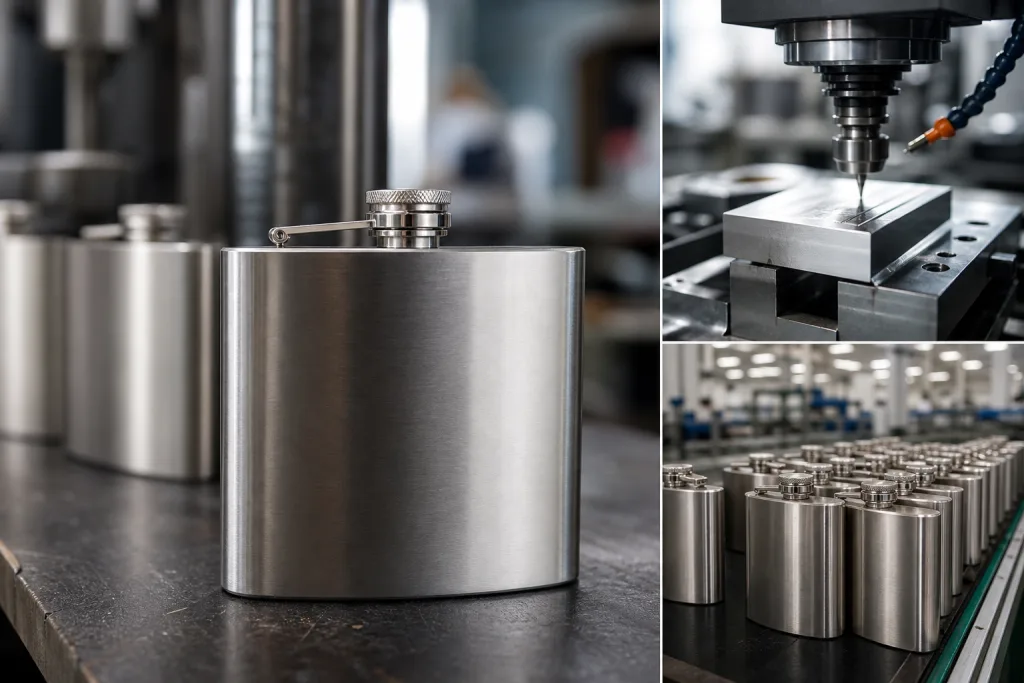
Key Takeaways
- For most B2B orders, 8 oz 304 stainless customized hip flask is the safest default, with MOQ usually 1,000 pcs and FOB China pricing around USD 1.55-2.40.
- Wall thickness matters more than many buyers expect: 0.5 mm can dent in transit, while 0.6-0.7 mm usually gives a better balance of feel, yield, and claim rate.
- Laser engraving is low-risk for logos under 2 colors, but UV print or screen print needs adhesion testing to 3M tape and 24-hour cure control.
- A realistic production window in Zhejiang, China is 7-12 days for samples and 30-40 days for bulk, assuming packaging is confirmed before mass production.
You are not buying a hip flask for yourself. You are buying margin, fewer claims, and a product that gets through customs, retail handling, and end-user abuse without coming back. A customized hip flask looks simple on the screen, but 0.1 mm on wall thickness, a rough weld seam, a loose cap hinge, or the wrong decoration method can turn a clean launch into a returns problem. We see buyers in Zhejiang and across China chase $0.12 off unit price, then lose it on leak rate, coating adhesion, and carton efficiency; last month QC pulled a sample with paint rub after 20 tape pulls, and the buyer had to rework the whole lot.
The harder part is fit. A 6 oz flask for a tourist gift shop is not the same SKU as a premium corporate set, and it should not be sourced the same way as a custom canteen or customizable growler. If you also buy canteen customized lines, custom growler programs, or broader customized drinkware, use the same factory logic: lock the use case first, then talk cost. This is the wrong question to ask at the start—"what is your best price?" We ship plenty of projects where the buyer first flagged MOQ, then changed to gift-box packing, and the math no longer worked at 500 pcs.
Start with the spec table
If you need to compare suppliers fast, start with a spec table, not brochure photos. For a customized hip flask, the cost drivers and claim risks are body material, nominal capacity, wall thickness, seam construction, cap structure, finish, decoration, and packing style. We run quotes on this in 24-48 hours when the RFQ is clean. If the buyer sends “hip flask, 8 oz, logo” and calls it done, the math does not work.
- Material: 201 stainless is cheaper, but it is the wrong call for a premium alcohol-contact item. 304 stainless is the export standard. For gift sets with cups and funnel, keep every wetted part on the same spec.
- Capacity: 4 oz, 6 oz, 8 oz, and 10 oz are common. 8 oz sells best for most orders.
- Wall thickness: 0.5 mm for promo pricing, 0.6 mm for a solid mid-range build, 0.7 mm when the buyer wants a heavier hand feel.
- Cap: The attached screw cap with riveted arm is still the standard. Check hinge play and torque consistency. QC pulled the sample on a batch where the cap loosened after 12 turns.
- Surface: Mirror polish, brushed satin, powder coat, matte paint, leather wrap, or plating for gift sets.
- Decoration: Laser engraving, silk screen, UV print, embossed badge, debossed wrap, or retail sleeve branding.
- Packing: Polybag + white box, color box, window box, magnetic set box, or PDQ display.
For buyers who also source custom canteen, customizable canteen, or customized growler programs, this same comparison method works. A canteen manufacturer or canteen supplier may offer flasks too, but do not assume a vacuum bottle line knows small flask welding or cap threading. We have seen that go sideways. Ask for defect photos by product type and the latest AQL records.
Typical export range: 1,000 pcs MOQ per design, 30,000-50,000 units/month capacity for flask lines, AQL 2.5 for major defects and 4.0 for minor defects.
Material and construction head to head
Most buyer mistakes happen here. On paper, every quote looks close. A customized hip flask in 201 stainless can save about USD 0.08-0.18 per unit versus 304, depending on size and finish. We’ve seen buyers chase that gap, then the first salt-spray report comes back ugly. For Europe and North America, 304 is usually the safer call. It sells better too.
304 vs 201 stainless
304 stainless: better corrosion resistance, stronger premium perception, fewer odor complaints after filling tests. For a plain 8 oz body, FOB China is often USD 1.55-2.10 before premium packaging. QC pulled the sample after a 24-hour water hold and the cap stayed clean; that’s the kind of result buyers can show their retail team.
201 stainless: lower cost, fine for low-end promotional runs, but less forgiving if users store liquid for long periods or if finishing is uneven. It fits orders driven by price, not by gift value. One buyer flagged a PO typo on the finish code, and the line caught rust spots on the brushed panel before packing. That saved a headache.
0.5 mm vs 0.7 mm wall
0.5 mm: cheaper and lighter, useful for canteen promotions, event giveaways, or mail-friendly kits. The tradeoff is dent resistance. A corner hit in the outer carton can leave a mark fast. This is the wrong question to ask if the flask is going to retail shelves.
0.6-0.7 mm: better hand feel, lower transit dent rate, better perceived value for retail and corporate gifting. Cost usually rises by USD 0.10-0.22 per unit. We run 0.7 mm on higher-end orders because the buyer pushed back on “cheap feel” during the sample check, and they were right.
Check the seam and neck area. On flasks, the body weld and shoulder shaping decide both looks and leak performance. Ask for cross-section photos or 3D leak-test records. A 1.5 mm misalignment at the shoulder can turn into a cap issue later. Buyers often compare whether a canteen customizable bottle should be single-wall or vacuum insulated, but with flasks that is the wrong debate. What matters is whether the shoulder draw stays stable and the cap thread starts cleanly without cross-threading. Get that right, and the reorder follows.
Decoration methods and logo risk
Decoration is where you win margin—or get hit with claims. A customized hip flask usually sells better with clean branding. Big logos wrapped around the body look busy, and we’ve seen this go sideways on gift-channel orders. The right process comes down to print area, MOQ, and where you sell: promo, retail shelf, or online set. If you source customized drinkware across categories from a canteen supplier or canteen distributors, lock one approval flow for all SKUs. Same sign-off sheet, same sealed sample, same PO notes. We once saw a PO typo switch a flask logo from centered to “as per bottle,” and the line copied the wrong jig.
Laser engraving
Best for brushed or powder-coated stainless. Low risk. Clean result. For 1-color branding, this is usually the safest call, and that’s not sales talk; the claim rate is simply lower. Setup cost sits in the middle, and per-unit add-on can drop to USD 0.05-0.12 at 3,000 pcs. On our line, we check focal length before mass run because a 0.3 mm shift can soften small text on a curved flask shoulder. If you want a premium look without arguing about ink shade, pick laser.
Silk screen printing
Good for bold spot colors on flat areas. The unit cost is sharp, but adhesion is the whole game. Ask for alcohol rub test results, 3M tape test, and curing records from the same batch, not a sample from last month. QC pulled the sample more than once and found edge break on fine serifs after 20 rubs because the oven temp log was off by 8°C. On curved flask bodies, thin lines distort more than on a custom canteen or sports bottle. Buyers often ask for 0.2 mm lines here; this is the wrong question to ask. Ask what line width still holds after production, packing, and transit.
UV printing
Good for multi-color logos or short-run graphics with more detail. It presents well. It does not forgive a bad coating stack. Abrasion risk is higher than laser, especially on corners and raised areas, so get cross-hatch adhesion data and abrasion feedback before you approve artwork. We run spacing tests in the gift box cavity because if flasks rub during drop test, the logo is the first thing the buyer flags. For gift box sets sold online, add protective film or leave cavity spacing. Even 2 mm more clearance can cut scuffing fast.
Leather wrap or badge application
Perceived value goes up, but so do failure points. More handwork. More sorting. Adhesive aging, edge lifting, and batch color shift all need checks. We use a roller press after badge placement, and if the edge sits proud by 1 mm, it will show after carton compression. This option works for premium corporate gifting and barware bundles. For a low-cost canteen distributor assortment, the math doesn’t work. Labor climbs, rework climbs, and consistency gets harder across 5,000 pcs.
For any method, approve against a sealed golden sample and written tolerance: logo position within plus or minus 1.5 mm, Pantone tolerance if applicable, and no visible scratches at 50 cm inspection distance. Factories in Zhejiang that produce 500,000+ units of custom drinkware per month usually have mature print lines, but flask curvature still needs its own jig and visual standard. We ship plenty of standard bottles off shared fixtures; flasks are different. The body curve changes how the logo reads, so the line should check first-off samples under the same light box used for final inspection.
Use-case fit by buyer type
A head-to-head comparison only makes sense if it matches your sales channel. We’ve seen one 8 oz flask sell cleanly in a museum shop and stall out in a promo bid because the spec was 0.6 mm when the buyer wanted a cheaper 0.5 mm shell.
Promotional buyers
For canteen promotional pricing or event merchandise, stay with 6 oz or 8 oz, 201 or entry-level 304, 0.5 mm wall, laser logo or 1-color print, and white box packing. Target FOB China cost: about USD 1.20-1.85 depending on finish and quantity. On our line, this is usually the 0.5 mm body with a simple laser mark fixture and a 500 pcs MOQ per size. A canteen vendor with broad low-MOQ programs can work, but check flask leak records first; QC pulled a sample last season with a cap thread issue after drop testing, and that is the kind of miss promo buyers remember.
Retail and gift shop buyers
Use 8 oz 304, 0.6 mm wall, brushed or powder coat finish, laser logo, and branded color box. This is the balanced spec for souvenir, outdoor, and lifestyle retail. Expect FOB around USD 1.75-2.60. We ship a lot of this build because it holds margin without making the shelf price awkward. The buyer usually flags color consistency, so we keep powder coat against the approved swatch and watch logo position within about 1.5 mm. If you also stock custom growler or customized canteen lines, this flask fits as an add-on with the same finish language.
Corporate gifting buyers
Go 8 oz or 10 oz, 304, 0.7 mm wall, premium finish, and gift set packing with cups and funnel. Unit cost can move to USD 2.80-5.50 depending on box construction. Packaging quality matters almost as much as the flask body. Frankly, buyers ask the wrong question when they only compare flask cost; the box drives damage rate, presentation, and freight. We’ve seen rigid box inserts cut complaint rates versus loose cup packing, and the line checks lid fit before final pack because one crushed corner can spoil a full gift set.
Distributor programs
If you are a canteen distributor, distributor canteen buyer, or distributor growler importer building a broad assortment, do not open too many flask variants. Two body sizes and three standard finishes are enough for most markets. Too many SKUs hurt carton efficiency and reorder planning; the math doesn’t work once you split production across six slow colors and two box styles. We usually run one plain stock shell for fast-turn decoration and one premium boxed version for higher-margin channels, which keeps carton counts cleaner and replenishment simpler.
The same logic applies whether you buy from canteen manufacturers, a canteen factory, or a general custom drinkware exporter in China. Fewer, better-defined SKUs usually beat a wide catalog with mixed specs, mixed caps, and one PO typo that turns satin into sandblasted.
Compliance, quality, and packaging details
For North America and Europe, treat a customized hip flask as a food-contact item from day one, even if the end user only pulls it out a few times a year. The wrong question to ask is whether the flask looks low-risk. Buyers need the paper trail. Ask for material declarations, food-contact test support aligned with REACH where relevant, and packaging compliance records. If the item is for US retail, check California Proposition 65 risk on coatings, inks, and decorative accessories. We have seen buyers approve a matte black finish, then flag the hangtag ink after the lab review.
Quality control should not stop at a pre-shipment glance. Put these points into your purchase order:
- Leak test: 100% vacuum or air-pressure leak test where possible, plus random inverted liquid test for 2 hours.
- Cap torque: define opening and closing range so caps are not too loose or too tight. On our line, QC pulled the sample and checked torque after capping because a 2 mm liner shift was enough to cause seepage.
- Surface inspection: no sharp burrs on mouth, shoulder, or cap edge; no exposed weld marks on visible surfaces.
- Coating test: cross-hatch or tape adhesion, alcohol rub test for printed logos, and color consistency by batch. Buyers often push back on logo rub resistance after seeing the first gold print.
- AQL: common export plan is AQL 2.5 major / 4.0 minor.
Packaging is where 1 good flask project out of 3 starts losing margin. A flask in a thin color box shows up with crushed corners and body scratches, and then everyone argues over whose fault it was. If you sell online, ask for drop-test-ready packaging, at minimum stronger E-flute or insert support. For Amazon FBA or similar channels, confirm barcode placement, FNSKU labeling, and carton weight limits before the first sample round. We ship small gift sets every week, and the math does not work if the supplier packs like they are still loading bulky sports bottles. Check pack-out photos and master carton dimensions carefully. One wrong PO line on barcode position can force a full relabel.
Factories in Zhejiang, China often move fast once artwork is approved, but reworking packaging after production starts can easily add 5-7 days and extra repacking cost. We have seen this go sideways after the buyer flagged a 62 kg master carton as too heavy for the warehouse and the whole pack-out had to be rebuilt.
MOQ, tooling, and lead time reality
You do not need huge volume to launch a customized hip flask. You do need realistic math. For standard flask bodies with standard finishes, MOQ is often 1,000 pcs per design and 500 pcs per color if the factory already has the tooling. We run these on existing body sets, so the line starts faster and cost stays cleaner. A fully custom mold can push MOQ to 3,000-5,000 pcs and add USD 600-2,000 in tooling, depending on body shape and cap changes. If you want a new shoulder curve or a cap thread change by 0.3 mm, that is where the budget moves. This is the wrong question to ask: “Can you do any shape at 1,000 pcs?” Usually, no.
Lead time in Zhejiang is usually straightforward if the specification is fixed early. If the buyer changes logo position after the first sample, we have seen 12 days turn into 18 days fast:
- Sampling: 7-12 days for standard body with logo mockup and color reference.
- Pre-production sample: 5-7 days after artwork and packaging confirmation.
- Mass production: 30-40 days for 1,000-10,000 pcs, longer if gift boxes or hand-applied wraps are involved.
If you combine flasks with custom canteen, customized canteen, or customizable drinkware in one shipment, ask the factory to split critical-path items. We ship mixed orders like this every month. Flask bodies may be ready before color boxes, while a customizable growler or custom growler line might depend on separate cap sourcing. QC pulled one order last season where the flask was packed and ready, but the outer carton print still had the old PO typo. Mixed shipments save freight, but we have seen this go sideways when the slowest SKU controls the ETD.
On payment terms, new buyers usually see 30% deposit and 70% balance before shipment. That is standard. For established accounts, some China exporters will move to OA support through trade insurance or staged terms. Do not push too hard on payment before you have stable quality history. The math does not work if you save another USD 0.03 and then argue over 200 leaking units after drop test. Better to negotiate clear remake liability for leakage and decoration defects than to squeeze another USD 0.03 from a canteen manufacturers group quote.
When comparing canteen distributors, canteen suppliers, or a general canteen manufacturer that added flask production, ask one direct question: how many flask units did you ship in the last 12 months? Ask for one number. Ask for one recent SKU photo from the line. If the buyer flagged this as too direct, I would still ask it. The answer tells you more than a catalog ever will.
Get a flask spec review before you place
Send your target price, artwork, and channel. We will recommend the right customized hip flask spec, MOQ, packaging, and China lead time within 24 hours.
Frequently asked questions
What is the best default specification for a customized hip flask?
For most B2B buyers, the safest starting point is an 8 oz body in 304 stainless steel, 0.6 mm wall thickness, attached screw cap, brushed finish, and laser logo. That spec balances cost, durability, and presentation. In Zhejiang, China, the usual MOQ is 1,000 pcs per design, with FOB pricing around USD 1.75-2.40 depending on finish and box style. If your channel is pure promotion, you can reduce cost with 0.5 mm wall or a simpler white box. If your channel is gift retail, stay with 304 and invest a little more in the carton and insert. Most buyer complaints come from weak packaging and poor cap threading, not from the main body shape.
Is 201 stainless acceptable, or should I insist on 304?
304 is the better commercial choice for Europe and North America, especially if the flask will be sold as a premium gift or kept in contact with alcohol for longer periods. 201 can work for low-cost promotional orders, but the savings are usually only about USD 0.08-0.18 per unit on common sizes. That is not much if a higher complaint rate damages your launch. If you still use 201, ask for clear material test records and run your own corrosion and sensory checks. For a canteen promotional project, a lower grade may sometimes be acceptable, but for a customized hip flask the perceived quality difference matters more because the item is small, hand-held, and gift-oriented.
Which logo method gives the lowest risk for returns?
Laser engraving is usually the lowest-risk option. It resists abrasion better than screen print or UV print and works well on brushed stainless or powder-coated surfaces. At 3,000 pcs, the added cost is often just USD 0.05-0.12 per unit, which is cheap insurance against logo wear complaints. Screen printing is still fine for simple bold art, but you should require a 3M tape test and alcohol rub test. UV print looks attractive for multi-color branding, though it needs tighter handling and better pack protection. If you are building a distributor drinkware line with repeat reorders, laser makes inventory management easier because color variance and adhesion issues are reduced.
How should I inspect hip flask quality before shipment?
Use a basic but disciplined inspection plan. Set AQL at 2.5 for major defects and 4.0 for minor defects. Check 100% leak testing if the factory has the equipment, then add random liquid inversion tests for 2 hours. Inspect cap fit, thread start, weld area, burrs on the mouth, coating consistency, and logo position tolerance within plus or minus 1.5 mm. Review both unit-level defects and packaging defects because dented corners and scratched bodies often come from poor inner packing. If the order includes gift boxes, inspect insert fit and drop resistance. A flask may pass body QC and still fail on shelf if the box crushes in transit from China.
Can I source hip flasks from the same supplier that makes my custom canteen or growler?
Sometimes yes, but do not assume capability transfers automatically. A canteen factory may be excellent at vacuum bottle production yet average at small flask welding, shoulder forming, or cap hinge assembly. Ask how many flask units they shipped in the last 12 months, what their leak-test method is, and whether they can show recent AQL reports for flask orders specifically. If you already buy custom canteen, customizable growler, or other customized drinkware from one Zhejiang supplier, there may be freight and communication advantages in combining lines. Just qualify the flask program on its own merit. Shared sourcing only helps if the defect rate stays low and lead time remains predictable.