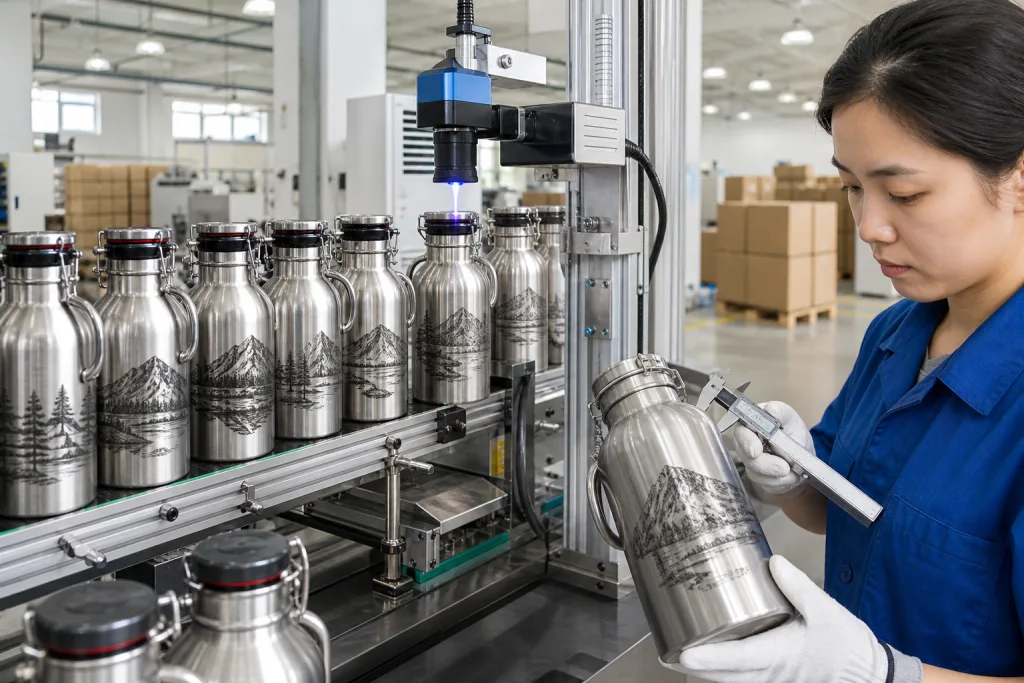
Key Takeaways
- A useful RFQ for a customized growler needs 8 items: capacity, material, finish, logo, lid, packing, target price, and MOQ.
- For stainless growlers, a realistic MOQ is 500-1,000 pcs per SKU; sample lead time is usually 7-12 days and bulk lead time 25-35 days.
- Lock wall thickness, steel grade, and coating spec in the PO; for example, 18/8 stainless with 0.5 mm body and 0.6 mm bottom.
- Ask for AQL 2.5/4.0 inspection, REACH-compliant materials, and carton drop-test details before mass production starts.
If you are buying a customized growler for retail, promotions, or channel sales, the hard part is not finding a factory in China or Zhejiang. The hard part is getting the spec right before you send money. A growler looks simple, but your margin can disappear fast if the mouth size is off by 2 mm, the coating fails salt spray, or the artwork gets approved from a blurry mockup instead of a real sample.
The best buyers treat a custom growler like any other industrial purchase: define the spec, ask for a clear quote, lock the sample, and put the same details into the PO. That is the right sequence. We see orders go sideways when a buyer sends a logo file and assumes the line will sort out the rest. At BottleForge in Hangzhou, Zhejiang, we run up to 500,000 units per month, and QC pulled the sample on a 40 oz growler last week because the laser mark sat 3 mm too low. Clean orders come from a usable brief, not just a logo.
Start With the Buyer Brief
I’m tightening the buyer brief copy and keeping the HTML intact. Next I’ll rewrite the prose with sharper factory-side language, concrete details, and no AI filler.Most sourcing problems start with one vague line: “Need customized growler, please quote.” That is not a brief. A canteen manufacturer, canteen supplier, or canteen factory in China cannot price cleanly if you do not spell out what you want to sell. We run into this on the line all the time, and the math does not work until the buyer gives us the full spec.
For a B2B custom growler program, the RFQ should cover the basics below:
- Capacity: 32 oz, 64 oz, or 128 oz
- Material: 18/8 stainless steel, glass-lined, or double-wall vacuum
- Finish: powder coat, matte paint, brushed steel, or electro-polish
- Logo method: silkscreen, laser engraving, or heat transfer
- Lid: screw cap, swing top, or insulated cap
- Packing: bulk pack, white box, or retail box with barcode
- Target market: distributor growler, promotional set, retail SKU, or hospitality use
If you are also buying a canteen customizable line, use the same rule. A canteen distributor does not win on artwork alone; it wins on repeat orders and stable QC. We have seen a PO typo on cap size turn into a 12-day delay, while the same job with a clean drawing moved straight to sampling. In Zhejiang, the factories that ship fastest are the ones that can turn your brief into a drawing, a cost sheet, and a tooling plan without guessing.
If the buyer brief is weak, the quote is fantasy. If the brief is clean, the price is usually close to final.
Ask for a Real RFQ Quote
I’ll rewrite the section in-place, keep the HTML structure untouched, and tighten the prose so it reads like a buyer-side sales engineer wrote it.Once the brief is locked, ask for an RFQ that splits out every cost line. Do not take a flat number with no backup. A real quote from a canteen manufacturer or canteen vendor should show unit price, MOQ, sample fee, tooling fee, packing cost, and freight terms such as FOB Ningbo or FOB Shanghai. If you source from a canteen factory in Zhejiang, FOB is the cleanest base for comparison across different canteen manufacturers and canteen suppliers. We run this check on the line all the time; the buyer flagged it after one PO missed the packing charge.
For a standard custom growler in 304 stainless with single-color print, a fair factory range is USD 3.20-5.80 per piece at 1,000 pcs, depending on size and packing. A double-wall vacuum version usually lands at USD 5.50-9.50 per piece. Laser marking often costs less than full wrap print, and it holds up better when the line is busy. That is the right trade-off if you are building a distributor drinkware line or a canteen promotional campaign. We have seen the math go sideways when a buyer asks for a premium look but wants the lowest print cost.
Ask the supplier to confirm:
- Steel grade and thickness, such as 0.5 mm body / 0.6 mm bottom
- Coating thickness if powder coated, usually 60-80 μm
- Carton spec, inner count, and drop-test requirement
- Compliance documents, including REACH and FDA-related material declarations where relevant
That detail saves you from a cheap quote that turns expensive after three revision rounds. QC pulled the sample once and found a 0.3 mm wall on a job that was supposed to be 0.5 mm; the PO typo was the whole problem.
Approve the Sample Before You Scale
Sampling is where custom canteen orders get won or burned. A sample is not a keepsake; it is the build sheet in your hand. If the supplier sends a canteen customized sample with the right logo but the lid torque is off, the weld seam is thin, or the Pantone match misses, do not sign off “for now.” We had a buyer do that once; QC pulled the sample, and the line still had to stop on day 3. Fix it before mass production. In Zhejiang, some factories will push hard on speed because the quote looks sharp. That saves nothing if you lose 10 days later.
For a customized drinkware sample, lead time is usually 7-12 days with no new tooling, or 12-18 days if you need a new cap, emboss, or molded shape. Check it against a written list, not a memory.
- Volume tolerance: ±5% is normal for 500 ml and 750 ml drinkware
- Leak test: no seepage after 24 hours upside down
- Coating adhesion: no flake after tape test
- Logo placement: within 2 mm if the art is placement-sensitive
- Odor: no strong plastic or coating smell after washing
If you are running a customizable canteen or customizable growler program, ask for one pre-production sample and one sealed golden sample. Keep the golden sample signed and dated. We ship against that unit when the bulk lot comes in. The buyer flagged a PO typo on the cap color once, and that single line saved a 3,000-piece headache. This is the wrong question to ask if someone says, “Can we just approve and fix it later?” No. Use the sample as the standard, or you will be sorting problems at the packing table.
Write the PO Like a Spec Sheet
I’m rewriting the prose in place and keeping the exact HTML structure. I’ll tighten the language, add a few concrete factory-floor details, and keep the tags untouched.A PO for a customized growler should read like a manufacturing instruction, not a buying note. We see this go sideways on the line all the time: the PO says “same as sample,” but the sample is not attached, not signed, and not broken down line by line. A good PO kills interpretation.
Use line items such as:
- Product name and model code
- Capacity and dimensions
- Material: 304 stainless steel, BPA-free lid, silicone gasket
- Finish and logo method
- Color code: Pantone or physical swatch reference
- Packing method and carton quantity
- QC standard: AQL 2.5 major, 4.0 minor
- Documents required: packing list, commercial invoice, test report, and origin details
Add commercial terms too. Write 30% deposit and 70% balance before shipment, or 20% deposit for repeat orders, and state the ship date and exact port. Last month QC pulled a sample with a 2 mm logo offset because the PO left out the artwork version. The math does not work if the PO is vague, even for a strong canteen vendor in China.
For a first order, put the sample number, photo, and approval date into the PO. We also ask buyers to note the carton mark or a PO typo, because one wrong digit can send the wrong cap color into production and you will spend a week sorting it out.
Control Production and QC
Once the deposit lands, we run material buying, print setup, and pre-production sign-off. A real canteen factory sends a production schedule, not a vague “in process” reply. For a normal customized canteen or custom growler order, the bulk lead time sits at 25-35 days after sample approval. If the artwork is layered, the lid is new, or you want a special coating, plan on 5-10 extra days. We had a buyer flag a PO typo on the coating code once, and that cost 2 days before the line could start.
QC needs three gates: incoming material check, inline inspection, and final random inspection. One end-of-line look is how orders go sideways. If you are buying from a canteen manufacturer in Zhejiang, ask for photos or video at each checkpoint. For orders above USD 10,000, third-party inspection is the safer play. We usually work to AQL 2.5 for major defects and 4.0 for minor defects on consumer drinkware. QC pulled a sample last week with a 0.8 mm lid gap; that kind of thing leaks after one carton drop test.
Pay attention to the common failure points on customized drinkware:
- Logo shifts on curved bodies by 1-2 mm
- Paint scratches from rough stacking in cartons
- Lid leaks from weak gasket compression
- Tool wear causing size drift on the neck or base
A good canteen promotional item has to survive transit and shelf handling, not just a photo shoot. This is the wrong question to ask if someone says “the print looks fine.” If your factory is in China and the product is going to North America or Europe, ask for REACH-related declarations and the market-specific packaging marks before we ship. We once caught a carton mark mismatch on a North America order, and the buyer would have eaten the delay at port.
Ship Cleanly and Reorder Fast
I’ll keep the tags and structure intact, tighten the prose, and make it sound like a factory-side sales engineer wrote it. Next I’m rewriting each paragraph with concrete shipping details, cleaner freight wording, and a stronger reorder workflow.The shipping step decides whether the job feels smooth or messy. For a customized growler order, lock down carton count, pallet size, drop test target, and whether you need FNSKU or retail barcode labels for Amazon-style fulfillment. We had one buyer flag a 2 mm carton gap on the PO, and QC pulled the sample before the line packed 1,200 units. If you sell through retail or wholesale, put the same SKU on the carton, inner pack, and master label. That small change saves time at the warehouse.
Freight terms matter too. FOB works for most first orders because you can check freight on your side. If you want the factory to handle the full move, ask for DDP only after you trust the supplier’s lane. We run the same 3-step packing check on every export lot: carton compression, pallet wrap, then photo approval before loading. A canteen distributor or canteen suppliers network can also speed reorders if the factory keeps one tooling setup and one approved color chip on file.
Once the first batch sells, reorder from the golden sample, not from memory. Update your buyer file with these three numbers: final unit price, actual defect rate, and true lead time from deposit to cargo ready. We tracked one growler program at 12 days versus 18 days after the buyer changed the carton spec, and the math got ugly fast. If you bought canteen custom or custom drinkware from a Zhejiang factory and the numbers held, you now have a repeatable supply base instead of a one-off shipment. That is how distributors canteen and distributors growler programs scale without chaos.
Send your spec, get a clean factory quote
If you need a customized growler or broader custom drinkware program, send the brief. We’ll turn it into a clear RFQ, sample plan, and PO.
Frequently asked questions
What MOQ should I expect for a customized growler?
For a standard stainless customized growler, MOQ is usually 500-1,000 pcs per SKU. If you need a new mold, special lid, or unique shape, the factory may ask for 3,000 pcs or a tooling fee of USD 300-1,500. For repeat orders, some canteen manufacturers in China will accept 300 pcs if the artwork and tooling are already in place. Smaller MOQ usually means a higher unit price, often 10-20% above the 1,000 pc tier.
How long does sampling and bulk production take?
Sampling normally takes 7-12 days for a simple custom growler and 12-18 days if you need new tooling or a new lid. Bulk production is commonly 25-35 days after sample approval. Add 5-10 days if the coating is special, the order is large, or you need retail packing. For a Zhejiang factory, a clean order with no artwork changes can ship faster than a messy one with repeated revisions.
What should I check on the sample first?
Check the things that cause returns: leak resistance, logo placement, coating adhesion, and dimension accuracy. For stainless drinkware, look for a body thickness around 0.5 mm and a bottom thickness around 0.6 mm if you want a stable feel. Test the cap torque and gasket fit. Also smell the inside after washing; a strong odor is a red flag. If the sample passes, sign and date it as the golden sample.
What price range is realistic for custom drinkware?
A basic customized growler in 304 stainless may land around USD 3.20-5.80 per piece at 1,000 pcs. A double-wall vacuum version often sits around USD 5.50-9.50, depending on finish and lid. Laser engraving can be cheaper than full-color wrap printing and usually looks cleaner for premium channels. Packing, carton labeling, and compliance testing can add another USD 0.20-1.20 per unit, so always ask for a line-by-line quote.
How do I protect myself in the PO?
Put the approved sample number, logo file version, color code, material grade, AQL level, packing spec, and delivery term into the PO. Do not leave “same as sample” without attaching the sample photo and approval date. For international orders, specify FOB port, deposit terms, and required documents such as commercial invoice, packing list, and any REACH or material declarations. This is the simplest way to avoid disputes with canteen suppliers or canteen vendors later.