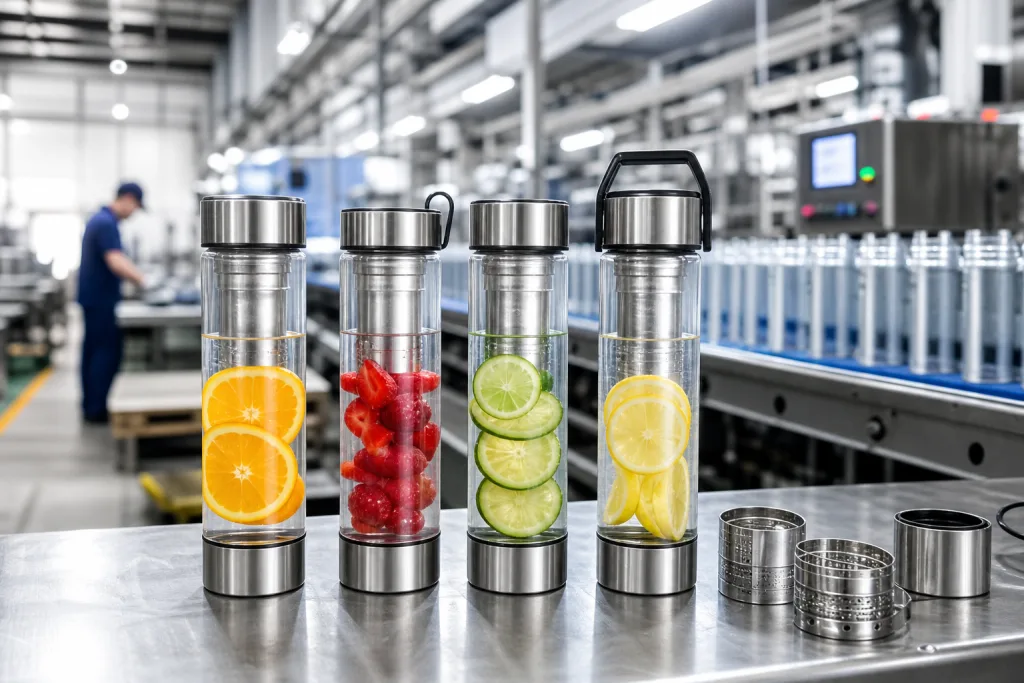
Key Takeaways
- Most customized fruit infuser bottle orders land at 3,000-5,000 pcs MOQ and 25-45 days lead time.
- Decoration changes cost more than body color; custom logo printing can add $0.06-$0.35 per unit.
- A Tritan body with PP lid and silicone seal usually fits the best balance of cost and retail appeal.
- For EU and US markets, ask for REACH, LFGB/FDA food-contact documents, and AQL 2.5 inspection terms.
If you are sourcing a customized fruit infuser bottle for a wellness brand or hydration startup, the first problem is not design. It is cost creep. A bottle that looks simple on screen picks up cost fast once you add a Tritan body, silicone seals, a fruit chamber, a custom logo, and retail packaging. We see this on the line all the time: a 0.8 mm wall change, a new silk-screen color, or an insert tray in the gift box can move the quote by 12% to 20%. In Zhejiang, factories do not all build quotes the same way, so two “same” samples can land far apart once mold status, decoration method, and carton plan get broken out. This is the wrong question to ask: “What is your best price?” The better question is what is included and what is still floating.
The other trap is lead time. A factory direct infuser bottle order can move in 25 days or slide past 45 days if you need new tooling, a fresh logo screen, or compliance tests. We have seen buyers lose a week over a PO typo on lid color, then another 3 days after QC pulled the sample and found the fruit basket fit was tight by 1.5 mm. If you sell into Europe or North America, you also need REACH, FDA food-contact declarations, and decent batch control, not just a pretty sample. The practical buyer question is simple: what should a bulk fruit infuser bottle really cost, what MOQ makes sense, and how do you avoid paying for mistakes you can predict now? We ship these orders every season, and we have seen this go sideways when the sample is approved before the packing spec is locked.
What actually drives unit cost
For a customized fruit infuser bottle, unit cost usually comes down to four items: resin, tooling, decoration, and packing. A factory fruit infuser bottle in PP can start around $1.05-$1.45 FOB at 5,000 pcs, while a Tritan body with a better lid system is more often $1.85-$3.20. Add a stainless-steel spring strainer or a more complex insert, and you are usually adding $0.12-$0.28. The fruit chamber itself is cheap. The fit around it is not. On our line, QC pulled samples over a 0.3 mm mismatch between the basket and neck, and that is where scrap starts to eat the margin.
Tooling decides whether your custom made infuser bottle stays on budget or gets expensive fast. A simple logo plate or print screen may cost nothing for the mold, but a new lid cavity can run $3,000-$12,000 depending on steel grade and complexity. We have seen buyers ask for a custom body shape and a unique cap on a 3,000 pc trial order; the math doesn't work. In Zhejiang, many factories keep standard molds ready, which is why a customizable infuser bottle using existing tooling is much faster and cheaper than a fully bespoke unit. We run stock neck finishes every week, so an existing mold can move from sample to ship in about 12 days vs 18 days for a fresh cavity tune-up.
Decoration is where buyers overpay by accident. A custom logo infuser bottle with one-color silk screen might add $0.06-$0.15. Laser engraving on a stainless band is often $0.20-$0.35. Wrap print or full-sleeve graphics can add $0.18-$0.45 plus setup. If your hydration brand is still validating sell-through, start with a customizable fruit infuser bottle using stock tooling and controlled branding. You can always spend on molds later. We ship plenty of first orders at 2,000-5,000 pcs with a single Pantone print because the buyer flagged setup cost on shrink-sleeve artwork, and that pushback is usually right.
MOQ tiers that make sense
MOQ should match your sell-through plan, not whatever the factory throws out on Monday morning. For a bulk fruit infuser bottle with stock body and lid tooling, 1,000-2,000 pcs is standard if you stay with one color and a basic silk-screen logo. For a customized tea infuser bottle or a fruit-infuser combo with extra parts, 3,000 pcs is the line most factories run without fighting setup loss. Ask for special Pantone colors, custom box artwork, or a unique insert tray, and 5,000 pcs is usually where the math starts to work. We’ve seen this go sideways when a buyer wants 1,200 pcs with a new EVA insert cut to 2 mm tolerance.
- 1,000 pcs: good for a pilot launch, but unit price is usually 12%-20% higher and QC pulled more print variation on small logo runs.
- 3,000 pcs: the normal sweet spot for a custom infuser bottle, especially if the line runs one lid color and one mesh spec.
- 5,000+ pcs: a better fit for distributor fruit infuser bottle programs, with lower FOB pricing and cleaner packaging allocation.
If you are a distributor, ask for a tiered quotation for fruit infuser bottle bulk and bulk tea infuser bottle as two separate lines. The tea version often uses finer mesh—say 0.35 mm instead of a coarser screen—and that adds assembly time. Your program should also spell out carton packing by master carton count, usually 24 or 36 pcs per carton, so your warehouse is not relabeling every case after arrival. This is the wrong question to skip. In Zhejiang, the better factories will show the MOQ gap in the quote instead of burying it in packaging charges or a vague line item the buyer flagged later.
Lead time from sample to shipment
Lead time is a chain, not one number. For a normal customized infuser bottle order with existing molds, we run 5-7 days for sampling, 10-15 days for material prep, 15-25 days for production, then another 3-5 days for packing and final inspection. That puts the real total at 25-35 days after sample approval. If the buyer wants a custom fruit infuser bottle with new tooling, add 18-30 days for mold making and trial runs. The math does not work any other way.
Ask for a day-by-day plan: sample confirmation by day 7, pre-production material check by day 12, first inline inspection by day 18, finished goods ready by day 28 or 35. A factory direct infuser bottle supplier in Zhejiang should give monthly output too. We ship 100,000-200,000 units/month across several bottle programs when the line is stable. One buyer once pushed back on this and wanted “urgent” retail stock in 14 days; the PO had a carton typo, and QC pulled the sample before packing. That is the wrong question to ask if you need repeat orders for Amazon replenishment.
Do not approve a launch date until you see both the sample clock and the carton clock. We’ve seen this go sideways because the printed box missed a barcode scan at the line, not because the bottle was late.
If you sell into North America, add 5-10 days for ocean booking, document review, and compliance follow-up. For EU orders, REACH declarations and material traceability should be ready before the container leaves China, not after. We check this with the batch card and the 304 stainless lot number on the packing list, because waiting until the cargo is on the water costs days fast.
Materials that change retail value
For a customizable tea infuser bottle or customizable fruit infuser bottle, the material call usually comes down to PET, PP, or Tritan. PET is the low-cost pick for promo orders starting at 3,000 pcs, but it marks up faster on the line and buyers in wellness retail often flag the surface after a fingernail scratch test. PP fits lids and infuser parts well because it is light, stable, and easy to mold with tighter thread control. Tritan is the stronger retail choice. It stays clearer, handles hot-fill and cold shock better, and supports a higher shelf price without the bottle looking cheap.
Wall thickness changes the hand feel more than first-time buyers expect. A 2.5 mm to 3.0 mm wall on a clear bottle feels solid; a 1.8 mm body feels hollow. You notice it fast. On one run, QC pulled the sample and the 1.8 mm bottle flexed too much at the grip area, even though the drawing looked fine. For a custom made infuser bottle aimed at wellness brands, a Tritan body with a silicone gasket and PP infuser insert is a practical spec. For a bulk infuser bottle built for low-cost promotions, keep the structure simple and spend money on the cap seal, because decorative extras do not fix leakage. This is the wrong place to save 0.03 USD.
Ask the factory for food-contact paperwork and test references before sampling moves to final approval. For Europe, REACH and LFGB are the usual checkpoints. For the US, FDA food-contact declarations are the minimum conversation. If your distributor tea infuser bottle will be sold as a reusable hydration product, ask for dishwasher cycle data, leak testing, and drop testing from 1 meter. We run leak checks with a negative-pressure tester, and we have seen lids pass appearance inspection but fail after 30 wash cycles because the gasket groove was cut 0.2 mm shallow. Real buyers look at how the bottle performs after 30 washes, not how it looks in a white-background photo.
Printing, packaging, and branding math
Branding decides whether a custom logo infuser bottle looks like a promo giveaway or a shelf-ready item, even with the same base bottle. One-color silk screen is still the safest pick for a distributor fruit infuser bottle: the setup is simple, waste stays low, and we can hold repeat placement within about 1.5 mm on the line. If the artwork has thin strokes or gradient fills, pad printing or wrap UV print fits better, but the math doesn't work for every project because unit cost climbs and QC pulled the sample more than once for edge blur on small type. A factory tea infuser bottle with a smooth cylindrical body is easier to print than a textured body; that is just how the fixture sits.
Packaging is part of landed cost. Not an afterthought. Standard polybag and white box may add only $0.08-$0.18 per unit. A printed color box can add $0.20-$0.55 depending on paper stock and finishes. If you need Amazon-ready units, FNSKU label placement, warning text, and carton marks should be locked before mass production starts; we have seen one PO held up because the buyer flagged a carton mark typo after 5,000 boxes were already folded. That rework hits fast when your bulk fruit infuser bottle lands at a 3PL.
- Basic retail pack: bottle + insert + one-color box, usually starting from a 1000 pcs MOQ.
- Mid-tier pack: printed box, barcode, hangtag, instruction sheet, with box drop testing often checked at 76 cm.
- Distributor pack: master carton labeling, pallet plan, EAN/UPC, plus test reports the consignee asks for before we ship.
For hydration startups, I usually tell them to spend first on clean decoration and leak-proof packing, not on soft-touch lamination or foil stamping. This is the wrong question to ask early on. If the customer returns the bottle because the lid drips after a tilt test, the box does not matter.
How to compare factory quotes
When you request quotes for a customized fruit infuser bottle, do not compare unit price alone. Ask the supplier to break out bottle body, lid, insert, print, carton, and testing on separate lines. We see this every month: one quote looks $0.18 cheaper, then the buyer adds color box, drop test, and compliance, and the total lands higher. A solid factory infuser bottle quote should show FOB port, sample fee, lead time, and whether the price is based on 3,000 pcs or 5,000 pcs. If the line uses a 5-layer export carton instead of a plain brown box, that cost needs to be visible.
Check the assumptions behind the number. This is the wrong question to skip. Is the bottle quoted with a standard cap or a custom logo infuser bottle cap? Is the insert removable, or fixed with a different tooling setup? Is the price for one color or multiple colors? Does the factory include AQL 2.5 final inspection, or only a self-check? If you are buying bulk tea infuser bottle units for distribution, ask whether the mesh basket is 18/8 stainless or plated steel. QC pulled the sample on one order and found plated mesh after a PO note was typed as “same as last cap,” so yes, this matters. That difference changes both cost and warranty risk.
For China sourcing, especially from Zhejiang, ask for factory photos, line capacity, and defect control details. Ask how many bottles they run per day, not “do you have capacity.” A serious supplier should be able to explain routine defect rates below 2% and show how they check lid torque, seal compression, and sample retention. On our side, torque is checked with a digital torque tester, and silicone seal compression is usually watched within a 0.3 mm window on approved samples. If they cannot answer those points, the quote is incomplete no matter how good the price looks. We have seen this go sideways.
Buying plan for startups and distributors
If you are a startup, start with a smaller batch and treat it as a validation run. We usually suggest 1,000-2,000 pcs for a customized infuser bottle, enough to test sell-through, review quality, and leakage on the line without tying up cash in dead stock. QC pulled the sample on one 1,500 pc run last month and found cap torque drifting past spec after the third packing hour. If you are a distributor, the target shifts to 5,000 pcs or above. Then you negotiate on colorway count, print repeatability, and carton efficiency, not just unit price. Distributor tea infuser bottle programs live or die on consistency. Novelty is secondary.
A practical sourcing plan is simple. Pick one body style, one cap, and one decoration method. Keep the first order to two colors max; we have seen 4-color launches go sideways because the buyer flagged shade variation that started with a Pantone typo on the PO. State the sales channel clearly: retail, gym promo, or private label wellness. This matters because the drop test, insert copy, and master carton spec change. Then lock the inspection standard before deposit. A factory direct infuser bottle supplier in China should give you sample lead time, production lead time, and replacement policy in writing. If they cannot, this is the wrong question to skip.
Here is the rule. If the bottle is for e-commerce, spend on branding and packaging. If it is for wholesale, spend on consistency and carton control. We ship both, and the math does not work if you save $0.12 on the bottle and lose 18 cartons to leakage claims. One leak is enough. On a custom tea infuser bottle, that claim cost usually lands harder than the extra insert, the better seal ring, or the 5-layer export carton.
Get a factory quote that matches your launch
Send your target MOQ, artwork, and market destination. We will price the bottle, decoration, and packing separately so you see the real landed cost.
Frequently asked questions
What is a realistic MOQ for a customized fruit infuser bottle?
For stock tooling, 1,000-2,000 pcs is realistic if you accept simple color and print. For a true customized fruit infuser bottle with custom cap or insert, expect 3,000 pcs. If you want lower FOB pricing and cleaner factory scheduling, 5,000 pcs is the point where most Zhejiang factories become more competitive. Below 1,000 pcs, the unit price usually rises 12%-20% because setup and packing labor are spread over fewer units.
How much does a custom fruit infuser bottle cost FOB?
A basic PP bottle may start around $1.05-$1.45 FOB at 5,000 pcs. A Tritan custom fruit infuser bottle with silicone seal and one-color logo usually lands around $1.85-$3.20. Add $0.06-$0.15 for silk screen, $0.20-$0.35 for laser engraving, and $0.20-$0.55 for printed boxes depending on paper and finish. New tooling can add $3,000-$12,000 one time.
How long does production take in China?
If molds already exist, sample approval often takes 5-7 days and mass production 15-25 days, so total lead time is usually 25-35 days. If you need new tooling for a custom made infuser bottle, add 18-30 days before production starts. From Zhejiang to an overseas warehouse, plan extra transit time: about 18-30 days by sea to North America and 25-40 days to parts of Europe, depending on port and routing.
Which material is best for a bulk tea infuser bottle?
For entry-level retail, PP and PET are cheaper, but Tritan is usually the better choice for a bulk tea infuser bottle aimed at wellness buyers. Tritan costs more, but it gives better clarity, a more premium hand feel, and better resistance to cracking. Ask for 2.5-3.0 mm wall thickness on the body, silicone gaskets, and food-contact documents such as FDA declarations for the US or REACH/LFGB for Europe.
What factory checks should I ask for before shipment?
At minimum, ask for incoming material confirmation, inline checks, and final AQL 2.5 inspection. For a customized infuser bottle, also request leak testing, lid torque checks, drop test results from 1 meter, and carton drop testing if you are shipping retail units. If you sell as distributor infuser bottle stock, ask for photo inspection of printed logo alignment, color tolerance, and finished carton counts before balance payment.