Key Takeaways
- A realistic MOQ for customized drinkware is often 300-1,000 pcs per SKU, depending on decoration and material.
- For stainless steel canteen custom projects, wall thickness usually sits around 0.4-0.6 mm; thinner saves cost but raises dent risk.
- FOB China pricing can move by 8-15% when you change lid type, finish, or packaging.
- AQL 2.5 for major defects and 4.0 for minor defects is a common final inspection target for export orders.
You have probably seen this order go wrong before: the sample looked fine, the mass run missed the logo, the lids came in loose, and the freight quote ate the margin. That is why buying customized drinkware is less about “finding a supplier” and more about controlling each decision point. If you are ordering for retail, corporate gifting, Amazon, or distributor stock, you need to know what gets locked at quote stage, what gets checked before production, and what fails at final inspection.
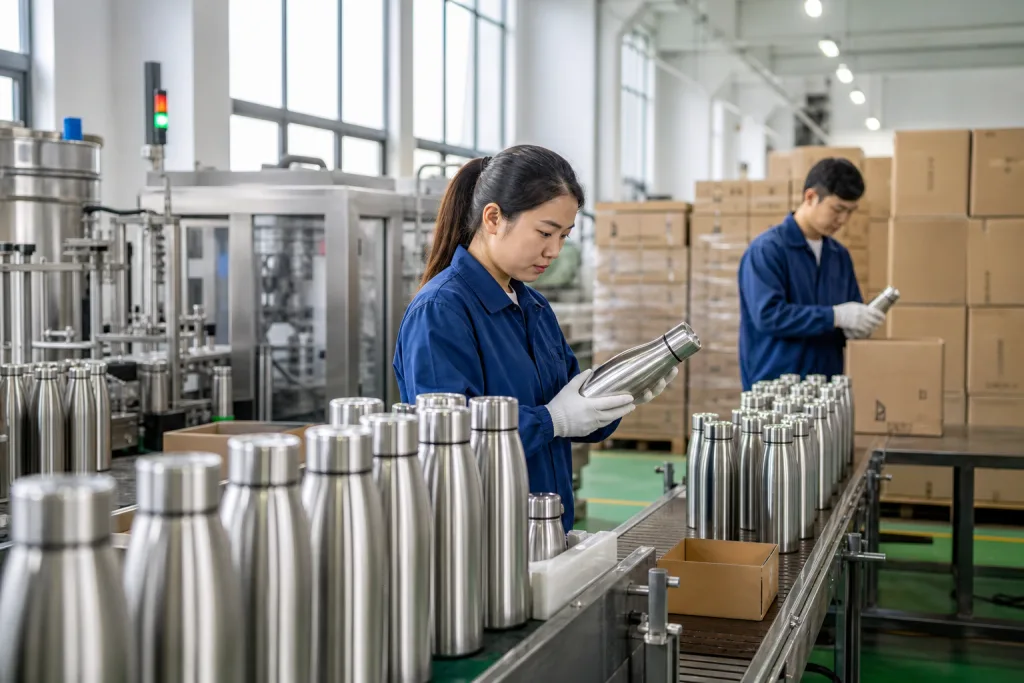
We handle this every week in Zhejiang, and the pattern stays the same. The buyers who get clean results treat the job like an engineering task: material first, decoration second, packing last. A solid canteen factory in China should show capacity, a real MOQ, and a QC plan before you send artwork. At BottleForge Industrial in Hangzhou, we run 300,000 units per month across stainless and plastic drinkware, and our 25-35 day lead time starts after sample approval. That gives you a benchmark, not a promise.
Start With the Use Case
I’ll keep the HTML structure intact and rewrite the prose to sound like a factory-side sales engineer, with more concrete buying details and less fluff.The cleanest customized drinkware order starts with one question: what job is the product doing? A distributor drinkware program for a promo campaign has different requirements than a retail custom growler for e-commerce or a canteen promotional item for a trade show. Skip this step and you pay for features you do not need, or you ship a bottle that fails after a few rough handlings.
Take a real buyer case: 5,000 pcs of a 750 ml custom canteen for a North American client. For event giveaway use, we run single-wall stainless at 0.4 mm with a plain screw cap. For retail, the same canteen customizable program usually needs a double-wall body, powder coating, and a gift box; our line has quoted that change at USD 0.70-1.80 per piece before freight. One buyer flagged the channel after QC pulled the sample and saw the lid torque was fine, but the packaging was wrong for shelf display. A canteen supplier in Zhejiang should ask about channel, target price, and use case before quoting. If they do not, they are guessing.
Practical buyer checklist:
- Retail, promo, or industrial use
- Required capacity: 500 ml, 750 ml, 1 L
- Target FOB price and landed cost
- Decoration type: silkscreen, laser engraving, UV print
- Packaging requirement: bulk pack, color box, mailer
That first page of the spec sheet is where the order gets saved or lost.
Lock the Core Specs First
I’ll rewrite the section with tighter buyer-seller language, keep the HTML exactly as-is, and make the specs feel like something a factory rep would actually quote.Buyers usually open with logo placement. That is the wrong order. Start with body material, wall thickness, lid system, then finish. For customized drinkware, those four items move performance and unit cost more than artwork ever does. A canteen factory in China will quote 18/8 stainless, 304 stainless, Tritan, and aluminum on different lines, and the gap can be USD 0.40-1.20 per piece before printing. We run into this every week. On a metal bottle, 0.5 mm holds up better in transit than 0.35 mm, especially when cartons get bumped three or four times on the way to Europe or North America.
If you are ordering a canteen customized for sports or outdoor retail, the lid matters as much as the bottle. We’ve seen a buyer push back on a “simple cap” and then the leak rate blew past the target. A leak-resistant lid with a silicone gasket usually adds about USD 0.12-0.35 each, depending on tooling and mold detail. A custom growler with a wide mouth and swing-top closure can add more, because the closure drives assembly time and failure risk. That is why canteen manufacturers in Zhejiang often ask for a drawing or a sample photo before they quote. QC pulled the sample on one run and found the hinge gap was 0.8 mm off; that kind of miss changes the price fast.
Do not accept vague wording like “premium finish” or “good quality.” Ask for measurable points:
- Wall thickness: 0.4 mm, 0.5 mm, or 0.6 mm
- Steel grade: 304 or 316 where needed
- Leak test requirement: 100% inversion test or sample-based
- Temperature retention: 6, 12, or 24 hours
- Drop test height: 0.8 m, 1.0 m, or 1.2 m
That is how you compare a canteen factory quote to a canteen vendor quote without getting trapped by a low sticker price. The math does not work any other way.
Quote It Like a Real Order
I’ll rewrite the section in place, keeping the HTML tags and structure intact while making the prose sound like a factory-side sales engineer wrote it.Pricing for customized drinkware is never one number. It is product cost, decoration, packaging, and freight, all on one sheet. We quote that way at the line because a buyer who wants clean margin needs to see where the cents move. Laser engraving usually adds USD 0.10-0.30 per piece; full-color UV print sits around USD 0.20-0.60, depending on print area and curing time. A one-color silkscreen can be cheaper than a photo-wrap, but only when the artwork is simple and the setup fee is spread across enough units.
The wrong question is, “What is the lowest price?” The math does not work like that. On a custom canteen lid, a new mold can land at USD 800-3,500, and a one-off logo plate or special box insert can add another USD 150-600. We have seen this go sideways when the buyer changed packaging three times on a 500 pcs MOQ. One PO came in with the lid code typed as “LID-05O” instead of “LID-050” — QC pulled the sample, caught it, and saved a rework loop. That is why we want one locked spec sheet, one artwork set, and one approved sample before the line starts.
Good FOB pricing is boring. If a supplier cannot tell you why one lid costs USD 0.18 more than another, you do not have a quote; you have a guess.
Ask for a line-by-line breakdown and keep the currency clean. For export orders, FOB Ningbo or FOB Shanghai is standard in China, and inland freight can swing more than buyers expect. On a 5,000 pcs canteen program, a USD 0.25 shift per unit turns into USD 1,250 fast. We ship those orders every week, and the buyer usually flags the freight line first, not the decoration line.
Sample Before You Approve
I’ll rewrite just this section, keep the HTML structure intact, and make the copy sound like a factory-side sales engineer wrote it. Then I’ll return the finished HTML only.Sampling is where the risk drops fast. A solid canteen factory in Hangzhou should send a pre-production sample that matches your final spec, not a “similar” piece from another line. If you asked for a customized canteen in matte black powder coat with a centered 35 mm logo, QC pulled the sample and we check logo position, coating evenness, and lid threading against the drawing. If the sample lands with an off-center print and the supplier says mass production will be better, that is the wrong question to ask.
For B2B buyers, sample approval should cover at least four checks:
- Visual: logo sharpness, color match, surface defects
- Functional: leak test, closure torque, fit of accessories
- Dimensional: height, diameter, capacity tolerance
- Packing: unit box, master carton, barcode, FNSKU if needed
If you sell through Amazon, FNSKU labels and carton marks need to be locked before the line starts, not after packing. If you ship distributor canteen orders, the outer carton count and label language matter just as much. We saw a buyer flag a PO typo on carton marks once, and it turned into 3 days of rework. A canteen vendor that handles those details saves you from warehouse pain later. In Zhejiang, the stronger factories will send video, sample photos, and a signed approval sheet before mass production starts. Use that process. It beats fighting over a 5,000-piece mistake.
Run QC Before the Truck Moves
I’ll rewrite the section in-place, keep the HTML structure intact, and tune the copy to sound like a factory-side sales engineer with concrete QC details.Final inspection is not paperwork. For customized drinkware, we set the QC plan by risk, not habit. AQL 2.5 is a normal line for major defects, and AQL 4.0 is common for minor defects on export orders. If the order is retail-facing, we push harder on print ghosts and scratches than on bulk promo stock. For a 5,000-piece run, that difference saves rework at the loading bay.
A solid pre-shipment check usually covers 3%-8% of cartons, based on order size and the supplier’s past record. The inspector should verify:
- Logo placement and print consistency
- Leakage under inversion and pressure
- Odor, especially on plastic components
- Carton drop integrity and inner protection
- Quantity accuracy and accessory count
On our line, QC pulled the sample with a torque meter and a 1 m drop test, because that is where weak closures show up. If you buy from a canteen manufacturer in Zhejiang, ask whether they run internal QC and a third-party check. We accept that request all the time. The buyer flagged a PO typo once, and it saved a bad carton mark before the truck moved. For a custom growler or customizable growler going retail, I would put more weight on closure torque and surface scratches; the math does not work if you ship shelf defects.
Ship only after the signed report matches your approved sample and packing spec. Otherwise you are loading a problem, not a shipment.
Protect Margin on Shipping
Freight can wipe out the USD 0.18–0.35 per piece you fought for on factory price. Customized drinkware is dense, and cartons do not stack cleanly when the insert tray or gift box is wrong by even 5 mm. We have seen a canteen custom order move from 0.62 cbm to 0.91 cbm per 1,000 pcs after the buyer chose oversized color boxes for retail display. Looks nice. The math does not. If your order ships from China to the U.S. or Europe, that extra volume can add USD 220–480 per pallet before anyone talks about port charges.
Ask the canteen supplier for carton dimensions, gross weight, and pallet count before you approve packaging. For a 5,000 pcs order, a box change from 48 pcs per carton to 24 pcs per carton can increase carton count, labor, and freight handling all at once. We run a tape measure over the master carton on the line, then QC pulls the packed sample and checks gross weight on a 150 kg floor scale. A distributor drinkware buyer should calculate landed cost with packaging included, not park it in a separate freight tab. Check compliance too: REACH for the EU, food contact declarations where applicable, and packaging marks for the destination market. A canteen distributor who imports regularly will already know that Chinese factories can provide test reports, but you still need to confirm the exact SKU and lot number on the paperwork; one PO typo on “750ML-BK” versus “750ML-BLK” can slow customs for 3 days.
China still offers real scale advantage, especially when you need repeatable output from a canteen factory rather than a one-off artisan run. The advantage only holds if your carton count, pallet plan, and Incoterms are fixed early, not after the forwarder asks for the booking sheet. We ship cleaner when the buyer locks the packing spec before mass production starts. A good export plan is not glamorous; it is just cheaper.
Send your spec, get a real quote
Share your capacity, logo file, packing target, and destination. We’ll turn it into a priced, QC-ready customized drinkware plan.
Frequently asked questions
What MOQ should I expect for customized drinkware?
For most customized drinkware, a practical MOQ is 300-1,000 pcs per SKU. Simple silkscreen projects can sit near 300-500 pcs, while custom mold lids or special packaging often push higher. If you want a canteen customized with a unique cap or a custom growler with new tooling, expect the MOQ to rise because setup cost must be spread across volume. For Zhejiang factories, 500 pcs is a common entry point for export programs, but the final number depends on material, logo method, and carton spec.
How much does a custom canteen usually cost?
A basic custom canteen in stainless steel may start around USD 2.20-3.80 FOB China at higher volumes, while a double-wall insulated version can move into USD 4.50-8.50 or more depending on finish and lid. Decoration adds cost: laser engraving might add USD 0.10-0.30, and complex print can add USD 0.20-0.60. If you change packaging to a color box or add inserts, budget another USD 0.20-0.80 per unit. For accurate pricing, the canteen supplier needs capacity, artwork, and destination market before quoting.
What QC standard should I ask for?
For export customized drinkware, ask for AQL 2.5 on major defects and 4.0 on minor defects as a baseline. Then define what counts as major: leaks, broken lids, wrong logo placement, wrong color, or missing accessories. For a canteen manufacturer in China, request pre-production sample approval, in-line checks, and a pre-shipment report with carton photos. If the order is for North America or Europe, also ask for REACH or food-contact documentation where relevant.
Can I mix styles in one order?
Usually yes, but only if the base structure is the same. You can often mix colors or logo versions within one customized drinkware program, but mixing a canteen custom model with a different lid family often means separate tooling, separate setup, and separate MOQ. For example, a 3,000 pcs order may be split into three colors at 1,000 pcs each, but a canteen vendor will likely charge extra if each color needs a different print screen or powder-coat batch. Ask early, because split runs affect production scheduling and carton labeling.
How do I choose between a canteen factory and a canteen supplier?
If you need tight control, choose the canteen factory. If you need sourcing across multiple product lines, a canteen supplier or canteen distributor can help manage breadth, but you may lose transparency on cost and QC. For recurring custom drinkware orders, factory-direct pricing and direct engineering support usually win. In Zhejiang, many factories handle design, sampling, production, and inspection in one place, which reduces miscommunication. For a buyer managing 5,000-20,000 pcs per season, direct factory contact is usually the cleaner path.