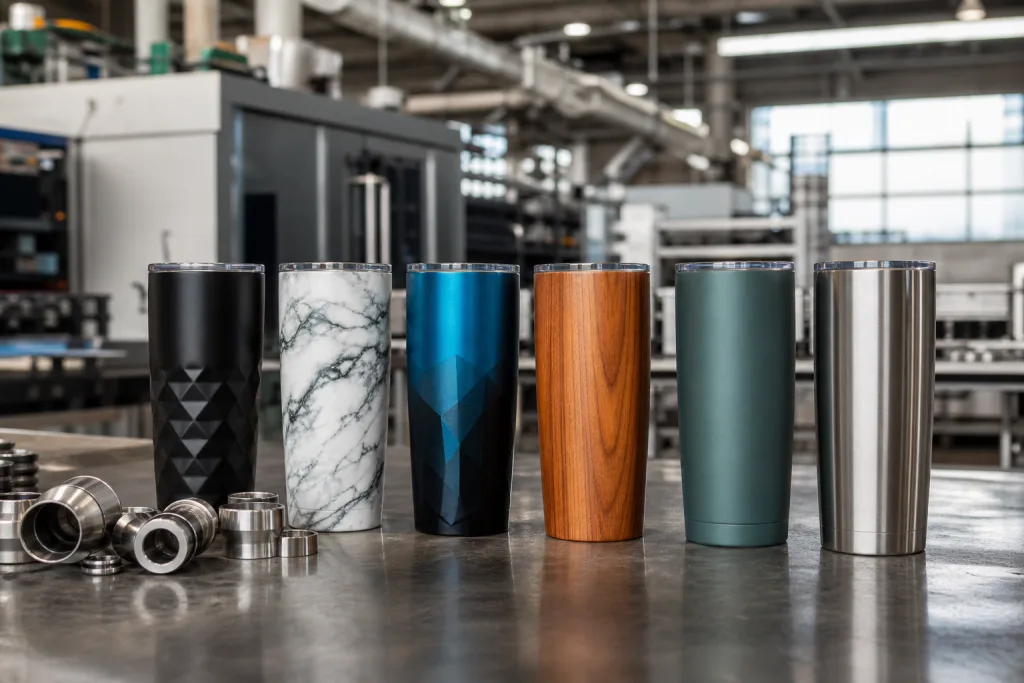
Key Takeaways
- Most customized coffee tumbler failures start in the spec sheet; define capacity tolerance, 304/18-8 grade, wall thickness of 0.4-0.5 mm, and leak standard before sampling
- For branded orders, printing and coating defects often create more claims than insulation defects; require color tolerance, logo position tolerance of ±1.5 mm, and cross-hatch adhesion testing
- A realistic MOQ for a bulk coffee travel mug is 1,000-3,000 pcs per color, while new mold lids usually add USD 1,500-4,000 and 20-30 days
- Use AQL 2.5 for major defects, 4.0 for minor defects, plus REACH and LFGB or FDA contact testing to reduce claim rates below 1%
You are not buying a photo sample. You are buying 2,000 to 20,000 units that must seal, print cleanly, survive a 1.2 m carton drop, and land on shelf looking like your brand promised. This is where customized coffee tumbler orders usually go sideways. We have seen lids leak on one side after torque test, powder coat rub through at the carton divider, and laser logos drift 3 mm off-center because the fixture pin wore down on the line. Then the bulk travel tumbler order stops being a simple sourcing job.
For coffee brands and corporate-gift buyers, start with quality engineering, then talk marketing. That is the safer way to buy from Zhejiang, China. If you know the failure modes, you write tighter specs, approve the right pre-production sample, and cut rework before it starts. At BottleForge Industrial in Zhejiang, China, our travel tumbler line runs about 300,000 units per month, with typical MOQ from 1,000 to 3,000 pieces per SKU and lead times of 25 to 40 days. We run PP samples against the actual jig, not a hand-made mockup. Small detail, big difference. If a buyer asks only for the best price first, that is the wrong question to ask.
Where tumbler projects usually break
Most buyers start from the look: matte black body, engraved logo, 20 oz capacity, sliding lid. Fair enough. Projects break later, on the stuff missing from the first RFQ. A coffee mug custom made for retail or promo can look fine on a quotation sheet, then turn into claims after delivery because nobody locked lid torque, wall thickness, or carton drop standard at the start.
The most common failure modes are predictable:
- Leakage: lid fit too loose, silicone hardness inconsistent, vent hole design poor.
- Heat retention misses: vacuum loss, thin inner wall, poor copper coating process.
- Print defects: color drift, weak adhesion, off-position logo, ghosting on curved surfaces.
- Packaging damage: rim dents, scratched powder coat, lids cracking in master cartons.
- Compliance gaps: stainless grade undocumented, BPA-free claim unsupported, migration testing missing.
If you are a coffee mug distributor, a coffee mug supplier, or a brand buyer, convert the design request into numbers. This is the right question to ask. Ask your coffee mug manufacturer for a full specification sheet, not just a sales quote. That sheet should spell out material, true brimful capacity in ml, dimensions in mm, finish, decoration method, test method, packaging drop standard, and acceptance criteria. On our side, QC pulled samples before mass run because a PO once said “black mate” instead of “black matte,” and the buyer flagged the sheen after 200 pcs.
A simple rule. If the requirement cannot be checked with a ruler, scale, torque gauge, or test report, it is still vague. “Good seal” is vague. “No leakage after 90° tilt for 30 minutes and no dripping after 10 inversion cycles” is usable on the line. “High quality print” is vague. “Pantone match within visual standard under D65 light, logo position ±1.5 mm” is usable. About 20 coffee mug manufacturers in China can make acceptable samples. Far fewer hold the same result when an order jumps from 500 samples to 5,000 retail units. We’ve seen this go sideways. The gap is usually spec discipline up front, not factory talk.
The lid is the highest-risk part
On a customized coffee tumbler, the stainless body is usually the easy part. The lid is where complaints start. On the line, buyers usually choose slider lids, flip lids, screw lids, or press-in lids for a bulk coffee travel mug, and each one fails in its own way. We check lid fit with a go/no-go gauge at the cup mouth because a 0.2 mm drift is enough to turn a good sample into a return case.
Common lid failure modes
- Press-in lid leaks: body mouth diameter tolerance runs too wide, so gasket compression is uneven.
- Slider lid splash: the design is not fully leakproof, even if the buyer expects it to be.
- Flip lid hinge breakage: PP grade is too brittle, especially below 0°C during winter shipping. QC pulled one sample last January with a cracked hinge after cold-drop testing.
- Straw opening seepage: fine for cold drinks, bad for hot coffee on the commute.
You need to separate three claims with your coffee mug OEM manufacturer: spill-resistant, splash-resistant, and leakproof. This is the wrong question to skip. We have seen corporate-gift buyers ask for “leakproof” and then pick a standard slider lid that will not pass an inversion test for 30 minutes. The buyer flagged it only after sample review, and by then the PO typo had already listed the lid as "sealed slider."
For commuter use, ask for a lid test plan with a 10-cycle open-close function test, 1-meter drop test in retail pack, 30-minute side-tilt test, and inversion test if the lid is sold as leakproof. Short list. Clear result. If the project is for coffee mug promotional products, state whether occasional splashing is acceptable. If the item is for e-commerce, especially Amazon FBA, tolerance needs to be tighter because one small seepage mark can trigger a one-star review. We have seen this go sideways on packs under 12 pcs/carton when the insert could not hold the tumbler upright.
Material matters too. We usually recommend food-contact PP or Tritan parts with silicone seals at 50 to 60 Shore A hardness. Ask for spare gasket approval at sample stage, not after mass production starts. If your coffee mug factory direct source changes a gasket tool or swaps the silicone vendor after approval, the fit can shift enough to cause field leaks. The math doesn't work if you save a few cents on the gasket and then ship replacements for 2,000 units. That is why we keep one retained golden sample in China and ask the buyer to keep one in the office; it is simple insurance.
Insulation claims fail quietly
Buyers often assume double-wall vacuum means the same insulation from every factory. It doesn’t. We’ve seen 3 suppliers quote the same 18/8 stainless body, then miss the hot-hold target because the line was unstable. Vacuum level, copper plating coverage, weld consistency at the bottom seam, and wall thickness all change the result.
For a standard 20 oz travel tumbler, a workable baseline spec is 304 stainless inside and outside, inner wall thickness 0.4 mm, outer wall 0.45-0.5 mm, and a tested heat retention result such as water from 95°C remaining above 60°C after 6 hours at room temperature 20-25°C. Put that into the PO. Simple. Some premium models can do better, but the key is pass/fail criteria you can test on the floor with a digital thermometer and time log. “Keeps coffee hot for hours” is sales copy, not a production spec.
The risky part is that insulation failures are usually invisible. A vacuum defect may hit only 2% of units in one lot, so 200 pieces in a 10,000-unit order can slip through packing if nobody checks during production. We run vacuum inspection on the line, not just after cartons are sealed. One common check is to heat the body and watch for abnormal exterior temperature rise, which points to vacuum loss. QC pulled the sample, marked the body, and logged the result by station. That’s the basic control.
If your project is a coffee mug private label retail item, ask whether the factory uses 100% vacuum inspection or statistical inspection. For higher-value SKUs, 100% inspection is worth the cost; the math doesn’t work any other way once returns start. Ask about the body base too: is there a hidden evacuation nub, and is it protected from impact? We’ve seen this go sideways after drop testing from 80 cm, where a dented base weakened vacuum on marginal units. One buyer flagged it only after Amazon complaints showed up.
Good tumbler sourcing is not chasing the lowest FOB Ningbo price. It is buying a process that delivers the same thermal result on unit 50 and unit 5,000.
In Zhejiang, China, reputable factories can provide internal test records, but most buyers forget to ask until after sampling. Ask for the actual log sheet, not a promise. A supplier directory gives you 20 names; that’s all. The real work starts when you compare test records, inspection frequency, and whether the factory caught its own defects before shipment.
Decoration defects cost more than steel
For 7 out of 10 coffee-brand orders we quote, decoration gets more attention than the steel body. A coffee mug custom or coffee mug customizable project lives or dies on the logo the second someone grips the cup. We’ve seen fully functional tumblers downgraded over a 0.8 mm logo shift while the 304 stainless body passed leak test on the line.
Choose the print method by end use, not by the lowest unit price. This is the wrong question to ask.
- Silkscreen: fits simple 1-2 color logos at a lower cost, but if oven curing is off by 10°C or dwell time runs short, the print scratches fast.
- Laser engraving: wears well, looks clean, and works best on powder-coated bodies; the tradeoff is limited color effect, and some buyers flag the mark as too subtle on dark navy.
- Heat transfer: works for multicolor graphics, but on tapered bodies the alignment needs control; QC pulled the sample last month for a 2 mm skew at the seam.
- 3D digital print or wrap: strong shelf impact, higher cost, and a tighter process window, especially when humidity in the print room climbs past 65%.
For a bulk coffee mug or coffee mug in bulk purchase, ask your coffee mug factory to put decoration standards in writing. We run this on the PO and artwork sheet: logo position tolerance of ±1.5 mm, rotation tolerance on seam-sensitive art, cross-hatch adhesion test requirement, and a rub test standard such as 50 dry rubs and 20 wet rubs without visible failure. For powder coat, define texture, gloss range, and color reference. Matte black shifts between batches if the powder supplier changes lot; we had one case where the buyer flagged two cartons because the 60° gloss meter read 6 GU on one lot and 9 GU on the next.
A common miss on coffee mug custom made orders is approving artwork on a flat mockup and skipping the real curved vessel check. That goes sideways. Narrow text near the bottom radius can distort, and metallic inks can change tone on textured finishes. If you are a coffee mug distributor or one of several coffee mug distributors serving corporate accounts, ask for a decorated pre-production sample made from mass-production tooling and finish, not a hand-made showroom sample. We’ve even seen a showroom piece pass with centered art, then the line sample showed a seam offset because the wrap fixture was set 1.2 mm off.
Price it realistically. Basic logo decoration on a standard travel tumbler may add USD 0.18 to 0.60 per piece depending on method and colors. The math doesn’t work if you buy a weak print at USD 0.10 and scrap 800 units after packing. We ship plenty of coffee mug promotional orders against event dates, and once the cartons are booked, rework is usually dead on arrival.
Packaging is part of product quality
Buyers leave packaging to the end, then ask why the rim came in dented or why the powder coat rubbed through. On a bulk travel tumbler order, packaging is part of product quality, not a side task. We’ve seen a 304 stainless body pass final inspection, then fail after 18 days at sea because the box spec was wrong. Bad pack-out ruins a good cup.
Start with the sales channel. This is the first question, and buyers often ask the wrong one. Corporate gifting, retail shelf, and e-commerce do not use the same protection standard. A plain white box works for pallet delivery into one warehouse if the load stays stacked and wrapped. It usually fails in parcel shipping. If you are buying coffee mug private labeling for online sale, ask for carton burst strength, insert material, and drop test standard in writing on the PI. Typical options are E flute mailer boxes, corrugated structures with molded pulp inserts, or PP bag plus egg-crate divider for bulk pack. On our line, the buyer flagged corner crush on a 1.5 mm insert that looked fine on paper but did not hold in courier handling.
Common failures include:
- Body-to-body abrasion in master cartons without individual bagging
- Lids cracking because carton stacking compresses them during sea freight
- Handle or straw accessories puncturing the inner box
- Barcode labels applied on shrink film instead of saleable box
For Amazon or other marketplace fulfillment, your coffee mug manufacturer needs to know FNSKU placement, suffocation warning rules for polybags, and carton weight limits. If they do not, you pay a China rework warehouse to relabel the shipment. We’ve seen that add 5 days vs 1 day for direct shipment, and QC pulled the sample after relabeling with scuffed boxes from repeated handling. The math doesn't work.
Packaging specs should state inner pack quantity, master carton dimensions, gross weight target, drop standard, and palletization rules. We usually keep export cartons under 18 kg because the line handles them faster and crush risk drops. For a 20 oz tumbler, 24 pcs or 36 pcs per master carton is common, but lid shape, finish type, and logo decoration decide the final count. A glossy painted body with a soft-touch coating needs more separation than a standard spray finish.
This is where a factory with real export experience earns its place. The supplier should run a transit simulation or at least do a practical carton drop check before the first container ships from Zhejiang. We use a simple corner-drop check from 76 cm for some programs, and it catches weak insert support fast. If the factory says, “we always pack like this,” we’ve seen this go sideways.
Compliance paperwork can still sink shipment
A customized coffee tumbler is a food-contact item. Paperwork can stop the shipment as fast as a leak test failure. Buyers in Europe and North America should reject vague claims like “food safe” or “BPA free” if the supplier cannot show test scope, report date, and which parts were tested. We’ve had buyers send a PO with only “food grade” typed on line 8. That is not enough.
The exact compliance path depends on market and material, but your baseline checklist may include REACH screening, LFGB or FDA food-contact testing, and where relevant, California Proposition 65 review. For children’s items you would add more. For standard travel tumblers, the file lives or dies on migration results and material declaration. If your coffee mug supplier sends a report that covers the body only, not the lid, gasket, or straw, the file is incomplete. QC pulled a sample last month and the silicone seal measured 2.2 mm, but the test report listed stainless steel parts only. That file would fail a buyer review.
You should also ask about factory system controls. This is not the wrong question to ask. ISO-style traceability, incoming material records, and social audit status such as BSCI are not product tests, but they cut sourcing risk. For lot inspection, define AQL before production. A common plan is AQL 2.5 for major defects and 4.0 for minor defects, with critical defects at zero tolerance. On the line, major defects for tumblers usually mean leakage, sharp edges, wrong logo, vacuum loss, or obvious contamination. We run vacuum hold checks with a pressure gauge, and the buyer flagged one batch because the logo Pantone was off by one shade even though the sealing result passed.
Lead times should account for testing. A normal repeat order on a standard customized coffee tumbler may ship in 25 to 35 days from deposit and artwork approval. A new development with custom lid, package, and external lab testing may require 40 to 55 days. Lab booking alone can cost 5 to 7 days if the sample misses the pickup cutoff. If a coffee mug supplier list shows only low prices and says nothing about documentation turnaround, be careful. We’ve seen this go sideways: production finished in 28 days, but the shipment sat 12 more days waiting for a corrected report.
Realistic MOQ matters too. For a standard bulk coffee travel mug with existing mold and one-color print, MOQ is often 1,000 pieces. For unusual finishes, mixed colors, or custom accessories, effective MOQ may rise to 2,000 or 3,000 pieces because setup loss and material minimums increase. The math doesn’t work at 500 pieces if the spray line needs a full color batch and the straw supplier packs in bags of 1,000. That is normal manufacturing math, not a sales trick.
How to write a purchase spec that works
Send a purchase spec, not just a logo file and a target price. That is how we cut surprises. This matters whether you are working with a coffee mug manufacturer, a coffee mug supplier, or comparing several coffee mug manufacturers in China.
Your spec should include:
- Product basics: capacity, dimensions, net weight, 304/18-8 stainless requirement, wall thickness, lid material.
- Performance: leak standard, heat retention target, dishwasher warning if hand wash only, drop requirement.
- Decoration: method, Pantone reference, position drawing, size, orientation, durability tests.
- Packaging: unit pack, insert type, carton quantity, barcode placement, pallet rules.
- Quality plan: AQL level, golden sample control, pre-production sample approval, in-line and final inspection points.
- Compliance: required reports and whether reports must reference the final BOM.
For first orders, ask for three checkpoints: an undecorated construction sample, a decorated pre-production sample, and production photos or video from the first mass-run batch. We run this all the time. If the order is 5,000 pieces or more, third-party pre-shipment inspection in China is worth it. QC pulled the sample, found a 1.2 mm lid gap, and the buyer flagged it before shipment. That saves a lot more than a cheap inspection fee on a bad coffee mug promotional order for 200 corporate recipients.
Price expectations need numbers. A standard 20 oz double-wall stainless customized coffee tumbler with common lid and one-color logo usually lands around USD 3.20 to 5.80 FOB China, depending on volume, finish, and packaging. Add premium lids, gift boxes, or full-wrap graphics and the number goes up. Tooling for a custom lid or unique bottom design can add USD 1,500 to 4,000 plus 20 to 30 days. The math does not work any other way. We have seen buyers send a PO with “20oz tumlber” typo and then argue about the lid budget later.
If your supplier answers these questions fast and with numbers, you are probably dealing with a real coffee mug OEM manufacturer. If the replies stay vague, move on before the deposit stage.
Get a tumbler spec review before you place
Send your artwork, target price, and use case. We will flag the likely failure points, MOQ, and lead time before production starts.
Frequently asked questions
What MOQ should I expect for a customized coffee tumbler order?
For an existing travel tumbler mold with one standard lid and one-color logo, MOQ is usually 1,000 pieces per size or colorway. Many projects settle at 1,000 to 3,000 pieces because powder coat color minimums, print setup, and carton efficiency all matter. If you want mixed body colors under one order, some factories in China allow color splits of 250 to 500 pcs each after the main MOQ is met. A fully custom lid or body shape is different: expect tooling of about USD 1,500 to 4,000 and a practical MOQ of 3,000 to 5,000 pcs. If a supplier offers 200 pcs on a custom-made stainless tumbler, check whether they are using stock leftovers or charging a very high unit cost.
How can I tell if a travel tumbler lid is really leakproof?
Ask for the test method, not the sales claim. A true leakproof lid should pass a defined inversion or shake test, not just a side-tilt test. We recommend specifying no leakage after full inversion for 30 minutes, plus 10 open-close cycles before testing. For commuter coffee use, also ask for a 1-meter packaged drop test because impact can shift seals. Many slider lids are only splash-resistant, which is fine for desk use but not for a bag. Request the exact lid material, silicone hardness of about 50-60 Shore A, and a retained golden sample. On first orders above 2,000 pcs, a third-party pre-shipment check in China should include lid function and leak sampling from packed goods.
What is a realistic lead time for bulk coffee travel mug production?
For a repeat order using an existing mold, standard powder coat, and simple logo, production is commonly 25 to 35 days after deposit and final artwork approval. A first order usually takes longer because samples, packaging confirmation, and decoration approval add time. Plan 35 to 45 days for a new custom-logo program, and 40 to 55 days if you need a new mold, gift box development, or external lab testing. During peak season, especially before Q4 gifting, add 7 to 10 days buffer. Sea transit from Zhejiang or Ningbo area to Europe or North America is separate. If your deadline is fixed, lock the artwork and carton details early; packaging changes often delay shipment more than steel production.
Which tests and documents should I require from a coffee mug manufacturer?
At minimum, ask for food-contact compliance documents that match the final bill of materials: body, lid, gasket, and any straw or handle parts. For Europe, REACH and LFGB are common checkpoints; for the US, FDA-related food-contact documentation is standard, and some buyers also review Proposition 65 exposure risk. On quality control, define AQL levels, such as 2.5 major and 4.0 minor, with zero tolerance for critical defects like sharp edges, contamination, or major leakage. Request internal vacuum inspection records, decoration adhesion test results, and carton drop verification. Factory system documents such as BSCI or ISO-style traceability do not replace product testing, but they help show the supplier in China can control lots consistently.
What FOB price range is normal for a custom stainless coffee tumbler?
For a standard 20 oz double-wall stainless travel tumbler with 304 steel, common press-in or slider lid, powder coat finish, and one-color logo, a normal FOB China range is about USD 3.20 to 5.80 depending on order volume, wall thickness, decoration method, and packaging. Plain white-box packing sits at the lower end; gift boxes, laser engraving, or full-wrap graphics increase cost. Premium leakproof lids, copper-coated vacuum structures, or retail-ready packaging can push pricing above USD 6.00. Be careful with very low offers. If a quote is 15% to 25% below the market range, the compromise is often hidden in thinner steel, weaker coating, lower-grade lids, or reduced inspection.