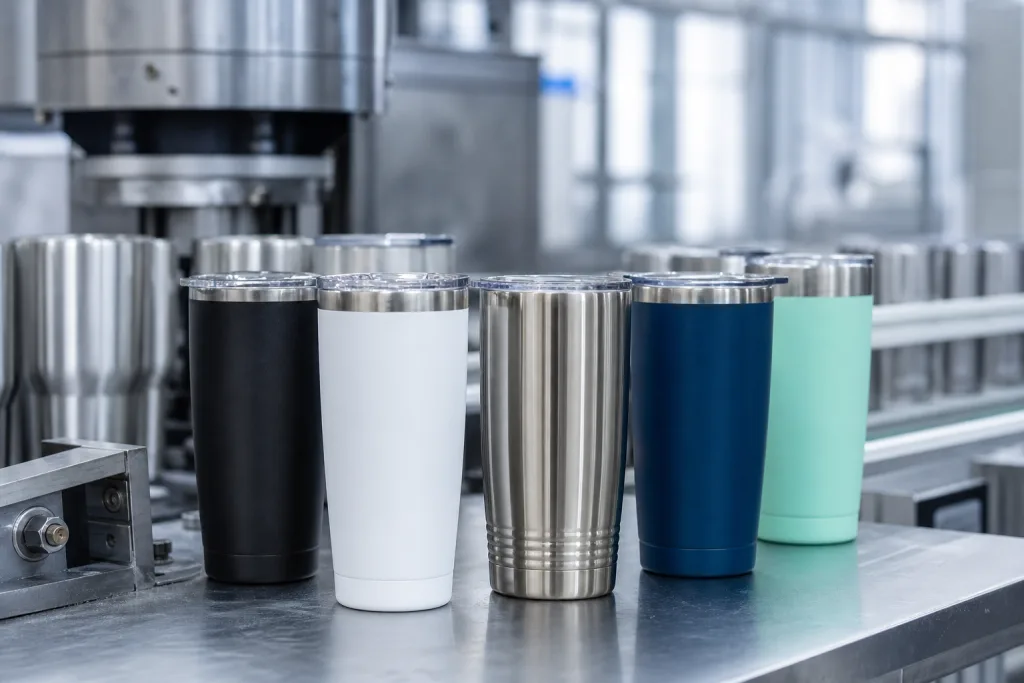
Key Takeaways
- A 0.1-0.2 mm change in wall thickness can affect dent rate, weight, and coating performance on a bulk coffee travel mug order.
- For custom logo work, keep print position tolerance within ±1.5 mm and approve a physical golden sample before mass production.
- Leak testing should be 100% inline for screw lids and at least AQL 2.5 final inspection with upside-down hold tests of 30 minutes.
- For China sourcing, realistic MOQ is often 500-1,000 pcs for stock molds and 3,000+ pcs for new molds or custom lid tooling.
You can source a customized coffee mug from almost any supplier directory. That part is easy. The pain starts after artwork approval, when a lid leaks in transit, the Pantone shifts by 1-2 shades, the handle angle feels off, cartons crack in a 1.2 m drop test, or a bulk travel tumbler lands with odor complaints. These are not random failures. They come from vague specs, loose tolerances, and the bad assumption that every coffee mug manufacturer in China runs the same line.
If you buy for a coffee brand or corporate gift program, you need to think in failure modes. At BottleForge Industrial in Zhejiang, China, we see the same problems on private label and promo jobs: wrong steel grade, weak coating adhesion, logo drift by 2 mm, and packaging designed for shelf photos instead of parcel networks. QC pulled the sample, checked the lid torque with a simple gauge, and found the issue before the PO was locked. Our MOQ is 1,000 pieces per color, lead time is 25-35 days, and monthly output is 600,000 units. This is the wrong question to ask if you start with price only; the math does not work.
Where customized mug projects fail
A buyer usually starts with style and price: 20 oz travel tumbler, powder coat, one-color logo, gift box. Then the RFQ goes out to a coffee mug factory, a coffee mug distributor, or three coffee mug manufacturers from a coffee mug supplier list. Quotes land between USD 2.85 and USD 4.60 FOB Ningbo, and the low number looks clean. The catch is simple: the quotes are not built on the same spec.
A customized coffee mug can look the same in photos while running different steel, different vacuum control, different lid resin, and different QC standards. One line quotes 304 inner and outer walls with a 0.4 mm body and food-grade silicone. Another line slips in 201 outer wall, thinner stock, and a generic AS lid. We saw this on a 5,000 pcs PO last month; the buyer flagged the lid fit after QC pulled the sample with a caliper at 0.1 mm gap. Both items still get called a coffee mug custom made product. That is the wrong way to buy it.
For coffee mug promotional products and corporate gifting, cosmetic consistency matters. For coffee brands, heat retention, drink comfort, and logo durability matter more because repeat purchase lives or dies on use. If your PO says customized coffee mug, matte black, logo included, the factory will fill in the blanks to protect margin. We run that line every week; a missing Pantone code on the artwork sheet can turn into a 2 mm logo shift and a rework charge.
- Material ambiguity: 18/8 stainless is requested, but only the inner wall is 304.
- Performance ambiguity: no target for hot holding, leak rate, or coating adhesion.
- Artwork ambiguity: no Pantone reference, print size, or seam avoidance zone.
- Packaging ambiguity: retail gift box approved, master carton compression never checked.
That is why a bulk coffee mug order should be treated like an engineered product, not a merch line. In Zhejiang, the good factories are not always the cheapest on day one. They are the ones willing to lock dimensions, tolerance, test standards, and inspection criteria before deposit. We've seen this go sideways when the buyer ignored a 1.5 mm lid tolerance and the leak test failed on day 3.
Material shortcuts show up later
The first failure usually starts with a material swap. We see it on both travel tumblers and a standard customized coffee mug: the sample looks right, then mass production gets costed down. For a bulk travel mug or bulk coffee tumbler, do not approve a spec that says only stainless steel. That is too loose. Lock the full build, down to wall thickness and lid resin, before the first sample hits the line.
What to lock before sampling
- Body material: 304/18-8 stainless for inner wall, and ideally outer wall too
- Body thickness: common range 0.35-0.5 mm per wall
- Lid material: Tritan, PP, or AS, with food-grade silicone gasket
- Surface finish: powder coating thickness typically 60-80 microns
- Base pad: silicone or TPR, bonded or press-fit
For Europe, ask for REACH compliance declarations in writing. For North America, food-contact testing should match FDA or the state rule your buyer flagged on the PO. If the item is for children, ASTM and CPSIA move up the list fast. We have seen odor complaints traced back to a cheap straw resin more than once, and QC pulled the sample only after a hot-water soak test exposed it.
The second hidden issue is corrosion resistance. A coffee mug factory direct quote can save USD 0.12-0.25 per unit by switching the outer wall to 201 stainless. Some suppliers will argue that the outer wall never touches the drink, so it is fine. For daily commuting, gym bags, and a wet dish rack, the math does not work. Rust usually shows first at the uncoated thread area, the base edge, or the weld transition, sometimes within 12 days instead of 18 days in a salt-spray check.
Ask your coffee mug OEM manufacturer for a written BOM with steel grade by component. If they hesitate, treat that as a warning sign.
Weight gives you another fast check. A 20 oz vacuum bulk travel tumbler with 304/304 construction often lands around 290-360 g depending on profile. If one supplier’s sample is 40 g lighter than the rest, that is not clever engineering. We have seen this go sideways. It usually means thinner stock, lower-grade material, or both, and a digital bench scale on the inspection table will catch it in 10 seconds.
Lids fail more than bodies
Most bulk travel mug returns do not come from the 304 stainless body. They come from the lid. Buyers often spend 2 weeks on Pantone and logo position, then the first complaint is a drip from the sip port. That is where leakage, drink feel, user safety, and online reviews get decided. A private label mug can live with a slight color shift. It does not live long with a leak complaint rate above 2%.
We see 3 lid failures on the line all the time:
- Thread mismatch: lid and body threads run too loose or too tight because molding shrinkage and neck rolling tolerance were not held, often inside a spread wider than 0.3 mm.
- Seal instability: silicone gasket hardness or section size is off, so the cup passes day 1 and starts leaking after repeated use; QC pulled samples last month with gaskets cut 0.5 mm undersize.
- Slider weakness: press-fit slider or magnetic closure loosens after heat exposure or dishwashing, and the buyer flagged it after a 70°C wash test.
For a coffee mug custom order, state the lid claim first: splash-resistant or leakproof. This is the right question to ask. They are not the same product. We ship plenty of tumblers sold as travel mugs that are only safe upright on a desk. If your channel includes commuters, tote-bag use, or corporate gifting where the mug ends up in a laptop bag, use a screw-lid leakproof design and require a 100% inline leak check.
A workable protocol is simple: fill test at room temperature, invert for 30 minutes, then shake for 10 cycles. On final random inspection, use AQL 2.5 for major defects and AQL 4.0 for minor cosmetic issues unless your brand standard is tighter. For threaded lids, lock the opening torque range on the PO in N·m. We have seen this go sideways when the PO only said “easy open.” Too low, leakage goes up. Too high, end users complain they cannot open it.
Do not ignore drink aperture size. An 8-10 mm opening cuts splash, but many buyers say it feels pinched for coffee. Above 14 mm drinks better, yet spill risk goes up fast in a moving car. We usually run sample lids with different sip-port inserts before mass production because the math does not work if you want wide-flow drinking and low spill risk from the same lid. If you are buying coffee mug promotional products for office use, a simple slider is often enough. If you are building a coffee mug private labeling line for retail, test the exact use case and write the packaging claim with care.
Coating and logo problems multiply fast
Cosmetic defects snowball fast in drinkware. A 0.8 mm logo shift on 20 samples turns into cartons of rejects once the line runs 30,000 pcs. First-time buyers often miss this and assume a sample-level pass rate means bulk will be fine. It won’t.
On powder-coated travel tumblers, we usually see four repeat issues: orange peel texture, weak coverage on sharp edges, batch-to-batch color drift, and poor adhesion around the bottom radius. Deep black, navy, and pastel colors give us the most pushback because they show every flaw under inspection. Ask for a sprayed panel or an approved production sample checked under D65 light, not a screen mockup. QC pulled this before: same Pantone, different gloss, and the buyer flagged it at once.
Logo work fails in different ways. Silkscreen is the budget choice for 1-2 solid colors, but text under 1.2 mm line thickness will fill or break on the mesh. Laser engraving lasts, and the detail is clean, but the mark color shifts with coating chemistry and laser power settings; on one black powder coat it looks silver, on another it comes out bronze. Heat transfer works for gradients and full wrap graphics, but seam matching needs tight control. We run a jig for this. If the artwork crosses the seam, this is the wrong question to ask: “Can you make it look perfect?” Better ask what seam offset in mm you will accept.
Spec points worth writing into the PO
- Print position tolerance: ±1.5 mm
- Pantone reference: solid coated code, not just a photo
- Logo size and orientation: centered to seam or opposite seam
- Adhesion test: cross-hatch tape test, no peeling beyond agreed grade
- Scratch standard: define acceptable mark length, for example under 3 mm on non-logo areas
For a coffee mug custom made as a promotional giveaway, you can allow wider cosmetic tolerance than for specialty coffee retail. Write that into the PO in plain terms. A promo order might accept 3 mm light handling marks on the base area; a retail order usually won’t. If you leave this vague, your coffee mug supplier grades one way, your team grades another way, and the claim starts after shipment.
One practical point from Zhejiang factories: textured powder coat hides weld witness and clamp marks better than smooth gloss. We’ve seen this go sideways on dark colors, especially glossy piano black, where every rub line shows under a 6000K light box. If you want the lowest defect rate on a bulk coffee tumbler, matte texture is usually the safer call. The math doesn’t work for gloss if you are chasing both low price and near-zero cosmetic rejects.
Insulation claims need real numbers
Buyers often ask a coffee mug manufacturer for good heat retention. That wording is too loose to buy against. On our line, vacuum insulation quality comes down to weld integrity, vacuum level stability, neck design, and process control at the sealing station. If the target is not measurable, QC cannot reject a weak lot fairly.
For a 20 oz double-wall stainless bulk travel tumbler, use a benchmark the factory can actually test: hot water at 95 degrees C filled to nominal capacity, after 6 hours remaining above 60 degrees C in a room around 20-22 degrees C. For cold retention, ice water should still show visible ice after 8-12 hours depending on lid design and fill ratio. We run this with a calibrated probe thermometer inserted through the lid opening. The exact number matters less than both sides signing off on the same method.
One failure mode buyers miss is external sweating or a warm spot on the body. We have seen QC pull the sample and find a hot ring 18 mm below the shoulder after hot fill, which usually points to weak or uneven vacuum integrity. The cup might still pass a same-day desk test. That is the wrong question to ask. Field performance drifts after repeated use, so sampling should include destructive checks on a few units from pilot production, not just showroom samples.
Ask your coffee mug factory direct source how they verify vacuum. Some factories use water immersion and temperature differential checks, and the better ones log neck weld consistency by lot with records tied to the sealing machine. Last month a buyer flagged 1 lot because the base temperature spread was 4 degrees C wider than the approved sample. Fair point. If the answer from the factory is vague, your coffee mug bulk order is running on luck.
Do not overspec blindly. Higher insulation performance often means a heavier body, a narrower drink opening, or a lid that costs more and is harder to assemble on the line. We have had buyers ask for 12-hour heat retention and then reject a 0.3 kg weight increase and a cupholder fit issue on a 74 mm base. The math doesn't work. For corporate gifts, users often care more about one-hand use and cupholder fit than 12-hour heat retention. For a coffee brand selling premium merchandise, your customer may expect both. Match the spec to the actual use, and you avoid paying for performance nobody notices.
Packaging breaks after approval
Buyers sign off on the look, then the claims start: crushed corners from Amazon FBA, split seams from parcel carriers, dented lids after retail handling. We see it on the line when a promo mug program jumps from event handout volume to e-commerce volume without a new pack spec.
A gift box can look sharp on the table and still fail in the carton. The insert is loose by 3 mm, the board is 350 gsm when the load needs more, or the height kills pallet stacking. For a bulk coffee mug shipment from China, the master carton matters more than the unit box. We normally run 5-ply for heavier vacuum tumblers, and we keep carton gross weight under 15 kg so the warehouse team can move it without strain.
For parcel channels, ask for drop testing on the packed unit, not just carton compression. If your order needs FNSKU labels, barcode scan windows, or kitting for straws and brushes, lock that into the packaging spec before mass production. We had one buyer flag a PO typo on the label format after approval; the rework in a 3PL warehouse in Germany cost more than the box upgrade.
- Unit box fit: keep movement tight and stop lid scuffing
- Master carton: set burst strength or edge crush where needed
- Inner dividers: use them for painted finishes to cut rub marks
- Pallet pattern: state Euro pallet compatibility if you ship that way
This is where a coffee mug distributor and a coffee mug manufacturer split. Distributors watch SKU movement. Factories watch outbound loading and carton count. The math does not work unless you put the pack-out standard in writing. In Zhejiang, we can adjust fast if the carton drawing, the insert thickness, and the print file are clear before plates are made.
Inspection has to match the risk
The last failure mode is weak QC planning. We hear “please do inspection” on plenty of POs, then the buyer never states what to check, at which stage, or which standard the line should hold. That is where projects drift. A final random inspection alone does not cover a coffee mug customizable project with several risk points, especially custom lid color, wrap print registration, and gift box pack-out. We have seen QC pull the sample at final inspection and catch a 2 mm artwork shift that should have been stopped on first output.
A practical control plan for a coffee mug supplier looks like this:
- Pre-production: approve BOM, Pantone, artwork position drawing, and golden sample
- During production: check body dimensions, coating adhesion, print registration, and lid fit on first output
- Inline: 100% visual check and 100% leak test for leakproof SKUs
- Final inspection: AQL sampling for cosmetics, count, barcode, pack-out, and function
If you are sourcing from a coffee mug factory in China for the first time, ask for process photos and inspection records by lot number. Ask for the lid torque reading too if the SKU is leakproof. Better still, tie mass production approval to a sealed sample kept by both sides, with the PO number written on the carton and signed across the tape. This sounds basic. It saves arguments later. European buyers often ask for BSCI audits, and we ship those records often. For quality systems, ISO-style document control matters more than the certificate hanging in reception; the wrong revision on an artwork file is enough to send 3,000 units off track.
Lead time also needs to match the job. A coffee mug private label order with stock mold, standard lid, and one-color print may take 25-35 days after deposit and artwork approval. A coffee mug OEM manufacturer developing a new lid or body mold may need 45-60 days just for tooling and pilot validation. If a supplier promises 20 days on a fresh mold project, the math does not work. Something gets skipped: curing time, print adhesion cross-hatch testing, or packaging proofing. We have seen this go sideways when a buyer pushed for an early vessel date and the insert card still had a typo from the first PO file.
The buyers with the fewest surprises are usually not the hardest negotiators. They write a cleaner spec and lock the failure points early. This is the right question to ask first: what can fail, and where will you check it? Once that is clear, the line runs cleaner, and your customized coffee mug project has a better shot at shipping right the first time.
Spec your customized coffee mug before you commit
Send your target size, lid type, logo method, quantity, and market. We will review likely failure points and quote a practical factory plan.
Frequently asked questions
What MOQ should I expect for a customized coffee mug or travel tumbler?
For a stock tumbler mold with standard lid and one-color logo, MOQ is usually 500-1,000 pieces per color. At our Zhejiang, China facility, 1,000 pcs is the normal starting point for stable pricing and production efficiency. If you need custom body color, special gift box, or mixed decoration methods, the practical MOQ can move to 2,000 pcs. A fully new mold or custom lid tool often starts at 3,000-5,000 pcs plus tooling cost. If a coffee mug supplier offers 100 pcs on a fully custom travel tumbler, check carefully whether they are using stock inventory, digital decoration, or simply quoting a sample-stage price that will change later.
How much does a bulk coffee travel mug usually cost from China?
A realistic FOB China range for a 16-20 oz stainless vacuum travel tumbler is about USD 2.80-5.50 depending on steel grade, wall thickness, lid complexity, coating, and packaging. A simple bulk travel mug with stock powder coat and one-color silkscreen may land around USD 3.10-3.60 at 3,000 pcs. A coffee mug custom made with Tritan lid, laser mark, retail gift box, and tighter QC can be USD 4.20-5.20. New mold tooling is separate. Be careful with very low quotes. Savings of USD 0.20 can disappear fast if you get leaks, print rejects, or repacking charges in Europe or North America.
Which tests matter most before I place a bulk coffee tumbler order?
Start with the tests tied to actual customer complaints: leak, heat retention, coating adhesion, odor, and drop resistance of the packaged unit. For leakproof travel mugs, require a 30-minute upside-down test and shake test on production samples. For insulation, define a method such as 95 degrees C water filled at room temperature and check remaining temperature after 6 hours. For coating, use a cross-hatch tape test and basic scratch evaluation. If your market is the EU, request REACH-related declarations for relevant materials. For retail programs, run carton drop and compression checks too. These five checks catch most expensive failures before mass production.
Should I buy from a coffee mug distributor or a coffee mug factory direct?
It depends on your order size and tolerance for project management. A coffee mug distributor is useful if you need mixed SKUs, low volume, domestic warehousing, or faster replenishment. A coffee mug factory direct approach is usually better once you reach 1,000-3,000 pcs per SKU and want tighter control over BOM, print method, and packaging. Factory direct also helps on coffee mug private labeling because you can lock details like 304/304 steel, 0.4 mm wall thickness, and print tolerance early. The trade-off is that you need a clearer spec and stronger QC process. In China, the best result often comes from working directly with the factory while using your own inspection protocol.
What lead time should I plan for a coffee mug private label launch?
For a stock model with approved artwork, plan around 25-35 days for production after deposit and sample sign-off, plus shipping time. In peak season, especially before Q4, add 7-10 days buffer. If you need a custom lid, new body mold, or complex gift packaging, development can add 20-30 days before mass production even starts. Physical pre-production samples typically take 7-12 days in Zhejiang, China. Do not compress timing by skipping packaging proof or pilot sample review. The most common delays happen when buyers approve appearance first and only later discover leak issues, barcode placement mistakes, or carton sizing problems.