Key Takeaways
- A 500 ml customized canteen usually starts at 1,000–3,000 pcs MOQ and 25–35 days lead time after sample approval.
- Target wall thickness at 0.6–0.8 mm for aluminum and 0.5–0.7 mm for stainless steel to avoid denting and distortion.
- For export to Europe and North America, ask for REACH, LFGB where relevant, and an AQL 2.5 / 4.0 inspection plan.
- A practical FOB price for a basic custom canteen often lands around USD 1.20–3.80 depending on material, print, and lid type.
You are not buying a water bottle with a logo. You are buying a spec sheet, a production slot, and a shipment you can defend when the sample lands five days late or the cartons fail a 1-meter drop test. A customized canteen order goes sideways fast when the brief is loose: wrong capacity, weak coating, lid mismatch, or artwork that looked fine on screen and turned blotchy on aluminum. We run these jobs in Zhejiang every week. Good factories keep the line clean; weak suppliers still send a quote with no real engineering behind it.
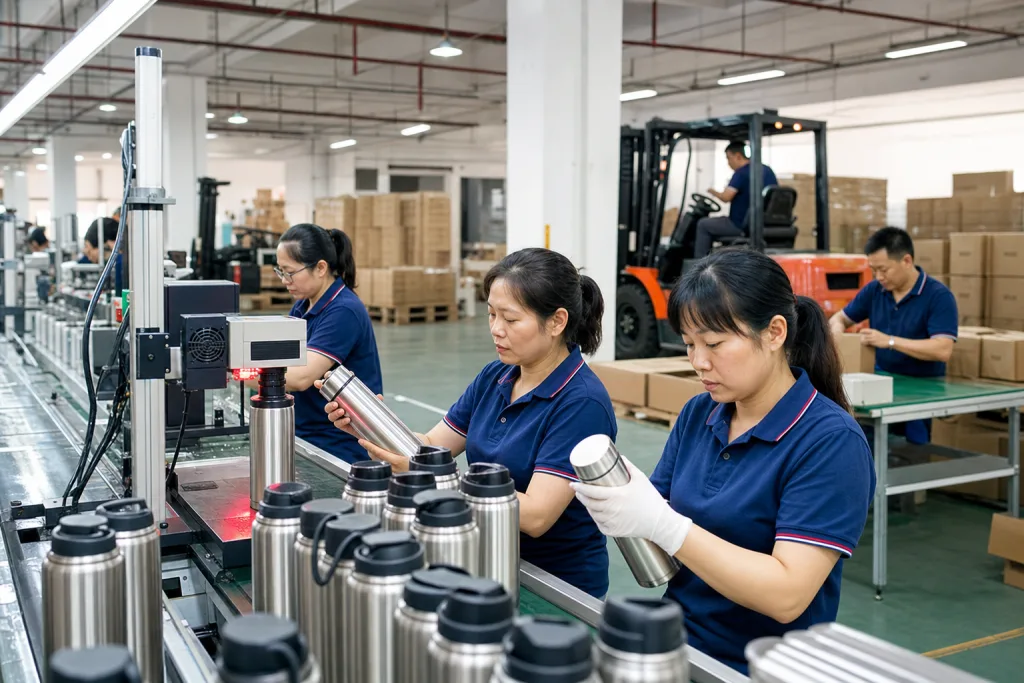
So let’s walk one order end to end: a 500 ml metal canteen custom project for a European distributor, from RFQ to first inspection, then packing and loading. QC pulled the sample on the bench, checked the lid torque, and flagged a 2 mm print shift before it became a buyer complaint. You will see what to ask a canteen manufacturer, how to compare canteen suppliers, and where the QC points actually matter. This is the right way to buy customized drinkware.
Start with the actual use case
I’ll rewrite this section to sound like a factory-side sales engineer, keep the HTML untouched, and strip the AI-ish phrasing while adding a few concrete shop-floor details.The cleanest customized canteen order starts with one question: who is buying it, and where will it live? A school promo piece, an outdoor retail SKU, and a military-style canteen are not the same job, even if the shell looks close. For this case, we run a 500 ml canteen for a European distributor’s sports campaign. The spec is clear: matte powder coat, one-color logo, leak-proof lid, and carton branding for retail shelves.
That brief already sets the build. For a mass promo run, the math points to lower unit cost and fewer moving parts. For retail, we watch the finish, color tolerance, and box strength much harder. QC pulled the sample on a lid torque check at 1.8 N·m, and the buyer flagged the cap gap on the first round. A good canteen supplier should ask about channel, market, and whether this is a canteen custom giveaway or a SKU that needs to sell again next season. This is the wrong question to ask: “Can you just make it cheaper?” Cheaper for what use?
Put the RFQ in plain numbers: 500 ml or 17 oz, material, lid type, print method, carton count, and whether each unit needs a polybag or gift box. We ship faster when the first brief is clean. If the PO has one typo on the capacity line, like 550 ml written where the sample is 500 ml, the line stops. In our Hangzhou factory, that mistake can cost 12 days, not 18. Give usable specs on day one, and the sample round stays short.
Lock the spec before quoting
I’ll keep the HTML intact and rewrite only the prose, tightening the sales-engineer tone while keeping the headings and list structure unchanged.Price quotes without a proper spec sheet are guesswork. For a customized canteen, the core spec needs to cover material, wall thickness, finish, dimensions, lid structure, logo method, and packing. If you are comparing canteen manufacturers in Zhejiang or anywhere else in China, make sure they are quoting the same build. A stainless model and an aluminum model are not the same item, and unit price alone tells you nothing useful.
For this order, the buyer picked 304 stainless steel with a 0.6 mm body, single-wall construction, a screw lid with silicone seal, and matte powder coating. That setup keeps the canteen light enough for field carry and still holds up better against dents. If you want a heavier premium version, you can go to 0.7 mm wall thickness or a double-wall body, but the tooling, weight, and cost all move with it. We run this kind of check on the scale every day; a 20 g swing across 10,000 pcs is real freight money, not a rounding error.
- Material: 304 stainless, 201 stainless, or aluminum
- Thickness: 0.5–0.8 mm depending on use
- Finish: powder coat, spray paint, brushed, or bare metal
- Print: silk screen, laser engraving, UV print, or emboss
- Packing: polybag, eggcrate, gift box, or retail box
We’ve seen buyers chase the fastest quote and regret it later. If a canteen vendor cannot explain the spec, that is a problem, not a shortcut.
Sample the bottle, not the artwork
Buyers often chase logo layout first and product function second. That order is wrong. For a customized canteen, we run a physical sample first to prove the lid seals, the coating holds up in hand, and the body feels right at the neck and base. Artwork comes later. If the body flexes, the cap leaks, or the coating chips at the shoulder, the print is dead on arrival.
The sample stage needs three checks. First, open-and-close testing on the lid thread or bayonet fit; we usually run 50 cycles on the bench with a torque meter. Second, leak testing with the bottle inverted for 24 hours at room temperature. Third, abrasion testing on the print and coating with a scuff pad, especially for outdoor or sports use. If your canteen custom design uses a silicone carry strap, inspect the lug area with calipers and a pull test. A weak lug does not wait for end users; it breaks in carton movement.
“If the sample only looks good in photos, you do not have a product. You have a rendering.”
Ask for one pre-production sample with final color and final logo, not a soft proof. We ship that sample only after the mold is confirmed, and a solid canteen manufacturer should turn it in 5–10 days. If they quote 20 days for a simple logo sample, the line is either jammed or the shop is missing hands. The buyer flagged it for a reason.
Price it like a landed cost
I’ll rewrite the section in place, keep the HTML exactly as-is, and tighten the sales language so it reads like a factory-side buyer note.Unit price matters, but landed cost is what tells you if the order makes sense. For a 500 ml customized canteen, a normal FOB China range is around USD 1.20–1.80 for a basic aluminum body with one-color print, USD 1.60–2.80 for stainless steel, and USD 2.80–3.80 for a retail-ready spec with gift box packaging. The final number moves with MOQ, lid structure, coating layers, and freight terms. On our packing line, a 2 mm carton change has changed the whole quote more than the print itself.
Do not let a canteen distributor throw out a low piece price and stop there. Ask for carton size, gross weight, pallet count, inner pack count, and whether the goods ship FOB Ningbo, FOB Shanghai, or EXW from Zhejiang. If you are shipping to the U.S. or Canada, carton efficiency hits air freight hard. We saw one buyer push back on a USD 0.08 saving on factory price, then the carton grew 12% and wiped it out. That math does not work.
Use the quote sheet to compare line by line:
- MOQ: 1,000, 3,000, or 5,000 pcs
- Sample fee: refundable or not
- Lead time: 25–35 days after approval
- Tooling: existing mold or new mold charge
- QC: in-house check plus third-party inspection
A straight canteen supplier will split these out. If they hide everything in one line and dodge the details, you will pay for it later in delays or rejects. QC pulled a sample once and found a lid gap of 0.6 mm; the buyer flagged it before shipment, which saved us a messy claim.
Run QC where failures happen
I’ll rewrite the section in place, keeping the HTML tags and structure unchanged while making the prose sound like a factory-side sales engineer. Then I’ll do a quick pass to ensure the style constraints are met.QC is not a final-box exercise. On a customized canteen, the misses show up on the line: forming, coating, assembly, and packing. We run inline checks at each station, then a pre-shipment inspection to AQL 2.5 for critical defects and 4.0 for minor defects. That is the rule we use when a buyer wants a clean export lot, not a story after the cartons are sealed.
At incoming material stage, confirm steel grade or aluminum alloy with mill documentation if the order value justifies it. We have seen a buyer flag a PO typo on 304 stainless as 403, and that kind of slip changes the whole check. During forming, check body diameter, mouth tolerance, and neck alignment with calipers and a go/no-go gauge. After coating, inspect orange peel, dust nibs, thin spots, and color drift under standard light. After assembly, test torque on the cap and verify the silicone ring is seated correctly. For laser-marked products, inspect legibility and burn depth. For printed canteens, check registration and ink adhesion with tape pull if required.
A sensible QC checklist for this order includes:
- Leak test: 100% on random sample from each lot
- Drop test: 1.0 m to hard surface for retail cartons
- Coating test: cross-hatch or rub resistance
- Dimension check: caliper verification against approved drawing
- Package check: barcode, FNSKU if needed, carton marks, and quantity count
If you sell through Amazon or a warehouse program, tell the factory early. FNSKU labels, master carton marks, and carton weight limits should be set before production starts, not patched after packing. The math does not work the other way.
Choose the right supplier type
Not every canteen vendor does the same job. A canteen factory is the right call when you need control over tooling, coating, and assembly. A distributor works better for a 300-piece mixed order or when you need quotes from 3 factories in 2 days. If you need a true canteen customizable product with repeatable quality, you usually want the factory, or a tightly managed export partner in Zhejiang or another strong manufacturing base in China.
For first-time buyers, the safer path is usually a direct canteen manufacturer with export experience, BSCI or similar social compliance, and a QC team that can send reports in English. We run into this on the line all the time: the buyer flagged a PO typo on the capacity, and the whole approval cycle slipped 4 days. That matters when your procurement team needs documents for sign-off. A distributor can help with language and consolidation, but ask who owns the mold, who approves artwork, and which site does final inspection. If nobody can answer that, the risk is still hidden.
There are also category overlaps. A custom growler program may use the same coating booth and logo method, but the closure, capacity, and shelf position are different. A distributor drinkware buyer might bundle canteen customized orders with thermos or tumbler SKUs to fill one container. That can work if the factory has the drawings, 2 separate QC records, and a clear packing list. One time QC pulled the sample because a 65 mm cap spec was copied onto the wrong SKU. The math doesn't work when buyers assume one spec sheet fits every item.
Pack for the market, not the warehouse
Packaging is part of the product. For giveaways, a canteen promotional item can go out in a polybag and bulk carton. For retail, that same canteen custom SKU needs a pack that survives shelf handling, barcode scans, and e-commerce sorting. Europe and North America also push packaging into duty math, shelf display, and damage claims. We’ve seen a good bottle lose the sale because the pack looked like a loose export job.
On this order, the buyer asked for 1 retail box per piece, 24 pcs per master carton, plus a moisture barrier inside the carton. That detail matters. Powder coating will pick up rub marks when the inner pack shifts under humidity and pressure, and QC pulled one sample with a ring mark after a 1.2 m drop test. Carton compression data is the right question once the order gets big. Keep the master carton weight under the limit your warehouse or 3PL wants, usually 12–15 kg, and don’t let a nice bottle ride in a weak box.
Final approval needs the artwork proof, master carton artwork, barcode placement, and packing list format. We run this check before the line closes, not after. A serious canteen supplier will send pre-shipment photos of the packed cartons, pallet layout if required, and a count summary before booking cargo. If you are working with a canteen distributor on a mixed container, label every SKU by carton and pallet. One typo on the PO can send 800 pcs to the wrong lane. Clean handoff beats a cheaper unit price.
Send your canteen brief for a fast quote
We’ll review the spec, flag weak points, and quote the right custom drinkware path before production starts in Zhejiang, China.
Frequently asked questions
What MOQ should I expect for a customized canteen?
For a standard customized canteen with existing tooling, MOQ is often 1,000–3,000 pcs. If you need a new mold, embossed shape, or special lid, expect 3,000–5,000 pcs. Smaller trial runs are possible, but the unit cost usually rises 15%–30%. A Zhejiang canteen factory with stable capacity can often support repeat monthly output above 200,000 units, which helps if you plan reorder cycles.
How long does a custom canteen order take?
A normal order takes 25–35 days after sample approval and deposit. If the print is simple and the factory has in-stock bodies, you may get 20–25 days. New tooling, complex coating, or seasonal congestion can push it to 40–50 days. For export, add 5–8 days for booking, inland transport, and documentation. Always confirm the lead time in writing with the canteen manufacturer.
What documents should I ask from a canteen supplier?
Ask for a quote with full spec, drawing or dieline, sample confirmation, material declaration, and inspection report. For Europe, REACH-related compliance is often relevant; for food-contact claims, ask whether the material and coating meet the destination market’s requirements. If the canteen is promotional drinkware, also request packing details, carton dimensions, and HS code guidance. A good supplier in China should provide these without delay.
What is a realistic FOB price for a custom canteen?
For a simple aluminum custom canteen with one-color print, FOB China can be around USD 1.20–1.80. Stainless steel versions often sit around USD 1.60–2.80, while better finishes, extra sealing parts, or retail boxes can push prices to USD 2.80–3.80. Prices move with MOQ, coating complexity, and lid design. If a quote looks far below that, check what is missing before you approve it.
How do I QC a canteen customized order before shipment?
Use a pre-shipment inspection based on AQL 2.5 for major defects and 4.0 for minor defects. Check leak performance, cap torque, logo accuracy, coating adhesion, dimensions, and carton count. For export, inspect random samples from each lot and verify master carton marks and label data. If you sell online, also confirm FNSKU placement, barcode scanability, and inner pack protection. This is the point where small mistakes become chargebacks.