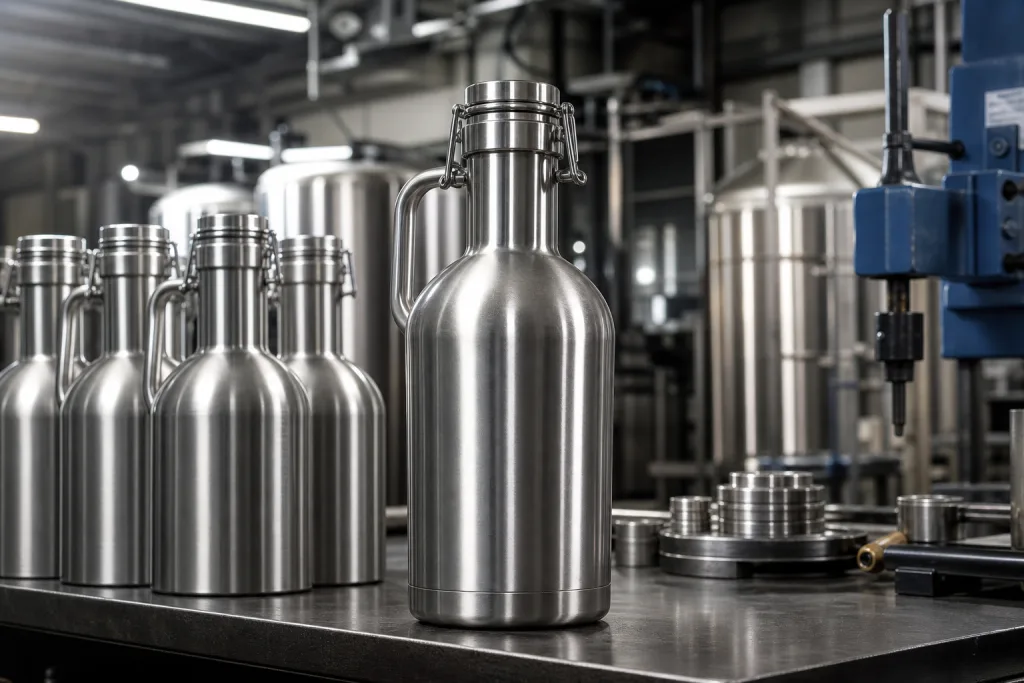
Key Takeaways
- Typical customized beer growler factory pricing runs USD 3.20-7.80 at 500-3,000 pcs
- Most custom growler projects need 18-35 days production after sample approval
- Laser logo adds about USD 0.15-0.35; full-wrap printing can add USD 0.40-0.90
- AQL 2.5 inspection, REACH-compliant coatings, and 304 stainless are the usual baseline
If you are sourcing a customized beer growler, don’t treat it like a basic water bottle. Wrong starting point. A 64 oz stainless growler with powder coat, a laser logo, and a swing-top cap follows a different cost build than standard custom drinkware. The lead time is usually 7 to 14 days longer once you add tooling, pressure testing, and packaging approval. On the line, even a 0.2 mm logo position shift can trigger a rework call if the buyer flagged a tight visual standard.
In Zhejiang, we quote these jobs every week for brand owners, distributors, and canteen distributors who want a landed cost they can trust, not soft estimates. The wrong question is “can you make it?” A capable canteen factory in China can make it. The real issue is how MOQ, decoration method, coating spec, and packing level move the USD 3.20 to USD 7.80 factory price band, and whether the schedule still works without air freight. We’ve seen this go sideways over one PO typo on the carton mark or a last-minute insert card change, and then the math doesn’t work.
What drives growler cost
A customized beer growler is not priced by volume alone. The cost usually starts with the shell material, then the finish, lid, logo process, and packing. If you want a 64 oz / 1.9 L stainless model in 304 steel, the base cost will sit above an 18 oz promo bottle because the shell uses more metal and carries more weight on the line. On mid-range export models, wall thickness is usually 0.4-0.5 mm. Push that to 0.6 mm and the handfeel is better, dent resistance is better, and your raw material cost jumps right away; our micrometer check on the shell will show that difference fast.
The lid system moves price more than buyers expect. We see this every month. A screw cap with silicone seal costs less than a swing-top or a pressure-retaining closure, and the assembly time is shorter too. If you want a true insulated custom growler, double-wall vacuum construction can add USD 1.20-2.40 per unit, depending on gauge, surface finish, and whether the factory in Zhejiang is running a standard shell or opening a new mold. Decoration also changes the quote fast: one-color silkscreen is the low-cost option, while laser engraving gives a cleaner look with no ink but needs more setup on the line. Last month QC pulled the sample because the PO logo was 2 mm off-center, and that sort of issue turns a cheap print job into rework.
- Base shell: USD 1.60-3.20
- Cap/lid system: USD 0.35-1.10
- Decoration: USD 0.15-0.90
- Packing: USD 0.20-0.60
For distributor drinkware programs, lock the spec before you ask for price. This is the right place to be strict. A canteen manufacturer can often save you 8-12% by reusing an existing bottle body, but only if your branding size and closure match the tooling already sitting in the canteen factory. We have seen this go sideways when a buyer wants a stock body, then changes to a wider neck after sampling; the math doesn't work, and the tooling change wipes out the saving.
MOQ tiers that actually work
MOQ is where a lot of buyers burn a week. A custom growler can start at 300 pcs if you take a stock shape and a one-color logo, but once the buyer flagged a custom lid, Pantone powder coat, or retail box, the floor moved to 500-1,000 pcs. New mold? 3,000 pcs is the honest number. We’ve seen 500 pcs turn into a pricing mess on the line.
This is the breakdown we run with canteen suppliers in China, and QC pulled the sample before packing:
- 300-500 pcs: stock body, basic logo, 20-25 days
- 500-1,000 pcs: custom canteen finish, better box, 25-30 days
- 3,000+ pcs: full customization, lower unit price, 30-40 days
If you are a canteen distributor or growler buyer selling into retail chains, 1,000 pcs is usually the cleanest tier. It gives room for packaging, color matching, and sampling without paying the low-run penalty. For promotional orders, we often keep common growler bodies in stock in Zhejiang, and that trims 5-7 days off the schedule. The math does not work if you try to force a premium setup into 300 pcs.
Ask your canteen vendor for MOQ by “body + lid + print + box,” not one flat number. That is where the real cost sits.
Check whether MOQ is per color or per total order. A custom program with 3 colors at 300 pcs each is not the same as 900 pcs of one color, and the second option is almost always cheaper on setup and labor. We had a PO with a missing comma on the color count once; the buyer paid for it.
Lead time from sample to shipment
Lead time for customized beer growler projects is usually 18-35 days after sample approval, but split sample time from mass production time or the schedule gets muddy fast. A standard mock-up or digital proof is often ready in 1-3 days. Physical sample making takes 5-10 days if the factory already has the body shape and the CNC fixture is on hand. If you need a new mold, add 15-25 days before the first sample even exists. This is the wrong question to ask: “What is your total lead time?” Ask each stage instead.
Production timing changes with decoration and packing complexity. Plain body plus laser logo is fast. Powder coating with two-stage masking, silicone sleeve, and retail carton with barcode label takes longer because we run coating, printing, and packing one line after another, not all at once. A Zhejiang canteen factory running 60,000 units per month can usually keep a basic custom drinkware order moving, but line booking still matters. We’ve seen this go sideways when a buyer flagged a 2 mm logo shift after pre-production sample approval.
Typical schedule:
- Spec confirmation: 1-2 days
- Sample and approval: 5-10 days
- Mass production: 15-25 days
- Inspection and booking: 2-4 days
- Ocean shipment to North America or Europe: 18-35 days port to port
If you need FOB China terms, ask for the production completion date and the vessel cut-off date separately. That avoids the usual confusion. We ship against cut-off, not against your internal sales meeting date. In China, a week disappears fast if artwork changes after sampling; QC pulled the sample, the buyer revised the PO, and the line had to wait for updated barcode text. A canteen manufacturer will not recover that time unless you approve faster.
Decoration choices and their price gap
On a customized growler, decoration is a cost call and a wear test, not just branding. For most canteen custom orders, one-color silkscreen is still the low-cost option. We run it fast on the line, and it works well if the logo has clean edges and no tiny reversed text. Laser engraving holds up better in daily use, so premium distributor canteen programs ask for it often, but it will not reproduce gradients or full-color art. UV print gives you more artwork freedom, but the upcharge is real, and stainless needs tighter surface prep. QC pulled samples last month where poor wipe-down left pinholes under the ink.
Expect these rough deltas on a 500-1,000 pc order:
- Silkscreen: USD 0.15-0.30
- Laser engraving: USD 0.18-0.35
- Heat transfer or UV print: USD 0.35-0.90
- Embossed or debossed tooling effect: quote separately
If you sell into outdoor retail or brewery channels, matte powder coat with a laser logo usually looks like a higher-ticket piece without adding much cost. We ship a lot of this combo. It hides handling marks better than gloss, which matters in cartons of 24 where neck-to-body rub is common. For canteen distributors and distributor drinkware buyers, returns usually come from surface scratches, not the logo process. This is the wrong question to ask if the coating choice is still open.
One practical rule: do not ask for a detailed logo on a small 64 oz side wall until printable area is confirmed. We have seen this go sideways. A canteen supplier in Zhejiang will get you a cleaner result if line thickness is at least 0.3 mm and text stays above 4 pt. The buyer flagged one PO last season because the artwork file said 3 pt, and the sample looked filled in after curing.
Materials, lids, and compliance
For export orders, 304 stainless steel is still the default on customized beer growlers. For EU and North America programs, that choice saves time. We see look-alike lower grades on RFQs every month, and this is the wrong question to ask if the buyer only compares price per piece. For beverage contact, ask for the mill cert, coating compliance file, and migration test support up front. REACH, LFGB where needed, and food-contact declarations should sit in the quote pack from day 1, not after the PO is signed. On our line, QC checks wall thickness with a digital caliper in mm before polishing starts.
Lid choice changes the drinking feel and the freight risk. Swing-top lids sell well for brewery shelves and gift sets, while threaded caps pack faster and usually give fewer leak claims after 28 days on water freight. We have seen this go sideways: the body passed drop test, but the gasket compression was off by 0.5 mm and the buyer flagged seepage. For a true customizable growler, the weak point is the seal, not the steel body. Ask for leak testing at 1.0 bar, or at minimum an inverted water check during assembly. A solid canteen manufacturer will show the test method before mass production, not after QC pulled the sample.
Useful material choices:
- 304 stainless: balanced cost, common export spec
- 316 stainless: better corrosion resistance, higher price
- Silicone gasket: better sealing and odor control
- Powder coat: stronger scratch resistance and tighter color control
For custom canteen and customized drinkware programs, compliance files matter as much as the pre-production sample. Ask for test reports, QC flow, and batch traceability by lot number. If a vendor cannot send those documents, we would not treat them as an export supplier. In Zhejiang, buyers ask for this every week because customs, retailers, and Amazon-style channels push the same requirement. We ship files with the approval sample; one missing PO typo or carton code mismatch can hold a booking for 3 days.
Packaging and landed cost math
Buyers often stare at the ex-factory price, then get hit by the real bill: packaging, carton strength, and freight. This is where margin disappears. A customized beer growler is bulky, and if the drop test fails on a 5-ply carton, the savings on unit price mean nothing. Standard export cartons usually add USD 0.20-0.40 per unit. A printed retail box with insert can add USD 0.35-0.80, and if you need barcode stickers, polybags, and master carton markings for FBA or distributor intake, budget another USD 0.10-0.25.
For distributor canteen and distributor growler programs, the landed-cost formula is simple: factory price + inland charge + export packing + inspection + ocean freight + duty. On a 1,000 pc order, a difference of USD 0.45 at factory level becomes meaningful once freight and duty are applied. We run this math on the line with buyers all the time, and this is the wrong question to ask if you only compare bottle cost. Last month a buyer flagged a PO typo on carton marks, and that small fix still cost less than moving into full retail-box packing. That is why a canteen supplier in China will often recommend a standard box if your retail team does not need shelf-ready packaging.
Typical landed-cost impact by packaging level:
- Bulk export pack: lowest cost, best for wholesale, usually with dividers in a master carton
- Single retail box: +8-15% total cost, often after adding an insert and barcode label
- Gift set packaging: +15-25% total cost, especially once magnets, foam, or sleeve printing are added
If you are selling through a canteen distributor channel, keep packaging consistent across sizes. Fewer picking mistakes. We’ve seen this go sideways when 64 oz and 128 oz growlers share the same outer artwork and warehouse staff ship the wrong SKU. A custom drinkware line with mixed pack styles often creates more problems than it solves, and the math doesn't work once relabeling labor starts.
How to brief a factory in China
If you want a clean quotation from a canteen factory, send a complete brief on day one. Short wins. Vague does not. Put in the size in ounces or milliliters, target material, lid type, logo method, Pantone color, carton requirement, and ship-to market. If you know the sales channel, say it plainly. An event growler and a retail growler do not pack the same way; one buyer asked for a 5-layer mailer carton, the other accepted a standard 24 pcs master carton.
Your RFQ should answer these points:
- Capacity: 32 oz, 64 oz, or custom
- Material: 304 or 316 stainless
- Finish: matte, gloss, or brushed
- Decoration: silkscreen, laser, UV
- MOQ target: 500, 1,000, or 3,000 pcs
- Compliance: REACH, LFGB, food-contact declaration
A canteen manufacturer in Zhejiang will quote faster if the artwork is vector and the size tolerance is written down, such as ±1.0 mm on body height. If you send only a screenshot, the line stops and sales has to ask basic questions again. We have seen this go sideways: the buyer flagged logo size on a PO because the original file was a phone image, and QC pulled the sample twice before approval. Good canteen manufacturers and canteen suppliers still help, but they add revision hours into the price. That is not a penalty. It is factory math.
For buyers running multiple SKUs, a custom canteen or customizable drinkware program works better when lids and cartons are standardized. One common lid across three bottle bodies cuts setup time on the capping station and usually trims reorder lead time, like 12 days vs 18 days on repeat runs. This is the right question to ask. Chasing a new lid for every SKU looks flexible on paper, but the math does not work once MOQ and spare parts stock hit the table.
Request a growler quote built on real numbers
Send your size, logo, MOQs, and target market. We’ll quote the cost and lead time clearly, with no guessing.
Frequently asked questions
What is the usual factory price for a customized beer growler?
For a 64 oz stainless customized beer growler, typical factory pricing is USD 3.20-7.80 at 500-3,000 pcs. A basic 304 body with one-color logo and simple cap is usually near the low end. Add powder coating, swing-top closure, or retail box, and the price moves up fast. In China, the biggest jumps come from decoration and lid quality, not the steel itself. If you want a quote that makes sense, ask the canteen supplier to separate body, lid, print, and packing costs.
What MOQ should I expect from a canteen manufacturer?
For stock-shape custom drinkware, many factories in Zhejiang can start at 300-500 pcs. Once you want a special lid, color match, or new packaging, 500-1,000 pcs is more realistic. If the project needs new tooling or a fully customized growler body, 3,000 pcs is the cleaner MOQ. For canteen distributors and distributor drinkware buyers, the 1,000 pc tier is often the best balance of price and risk.
How long does production usually take?
If the body shape already exists, sample approval and production together usually take 18-35 days. A sample can take 5-10 days, and mass production 15-25 days after approval. If you request a new mold or a custom canteen shape, add 15-25 days before samples. From China to Europe or North America, ocean transit is often another 18-35 days port to port. So plan on 5-8 weeks total before stock reaches your warehouse.
Which logo method is best for a custom growler?
For a customized beer growler, silkscreen is the cheapest and works well for simple logos. Laser engraving is more durable and usually looks premium, especially on matte stainless. UV print is better for color artwork, but it costs more and depends on the surface finish. On a 500-1,000 pc order, expect USD 0.15-0.35 for silkscreen or laser, and USD 0.35-0.90 for more complex print. If your logo is small or detailed, ask for a print-area mock-up first.
What compliance documents should I ask for?
For export to Europe and North America, ask for food-contact declarations, REACH-related material support, and test reports if your channel requires them. If the product uses coatings or paint, confirm the finish is suitable for beverage contact. Many buyers also request AQL 2.5 inspection records and batch traceability. A serious canteen factory in China should be able to provide these without delay. If they cannot, treat that as a sourcing risk, not a paperwork issue.