Key Takeaways
- 304 stainless flasks at 6 oz to 8 oz usually start at MOQ 1,000 pcs, with FOB China pricing around USD 1.45-2.60 depending on coating and logo method.
- For leak risk, ask for 24-hour upside-down testing at 100% inspection on cap seating, plus AQL 2.5 final inspection before shipment.
- Laser engraving adds almost no per-unit setup waste, while silk screen is cheaper above 3,000 pcs but less durable on heavy abrasion.
- Typical lead time from Zhejiang is 25-35 days for repeat flask orders and 35-45 days for new mold or new gift-box development.
You are not buying a flask for yourself. You are buying margin, compliance, repeat orders, and fewer headaches after the PO is paid. A customized alcohol flask looks simple, but the wrong cap thread, steel grade, coating, or decoration method shows up later as leakage claims, logo failure, and carton damage. We’ve seen a 6 mm cap mismatch turn into a full claim on a 10,000-piece order. That is expensive once the cartons are already on the water from Zhejiang, China.
Most buyers also compare flasks against broader custom drinkware lines like a custom canteen or custom growler. The choice is not about shape alone. It comes down to use case, retail price band, and whether your canteen distributor or distributor drinkware channel needs a gift item, a rough promo piece, or a barware accessory. QC pulled the sample on this kind of job because the buyer flagged a PO typo on the coating code. Buy on specs first, fit second, factory promises last.
Spec table buyers should start with
If you compare a customized alcohol flask the same way you compare a tumbler, you miss the specs that drive cost and complaints. A flask has constant hand and lip contact, a threaded neck, and often a decorative outer finish. Start with a spec table, not a mood board. This is the wrong question to ask first. On the line in Zhejiang, most flask orders we run fall into four builds:
- Classic curved flask: 6 oz or 8 oz, 304 stainless steel, 0.4-0.5 mm wall, captive cap, single-wall, pocket shape.
- Gift-box flask set: flask plus funnel and cups, usually 6 oz to 8 oz, higher packaging cost, stronger Q4 retail fit.
- Powder-coated flask: same body structure but with matte coating, better grip, stronger premium positioning.
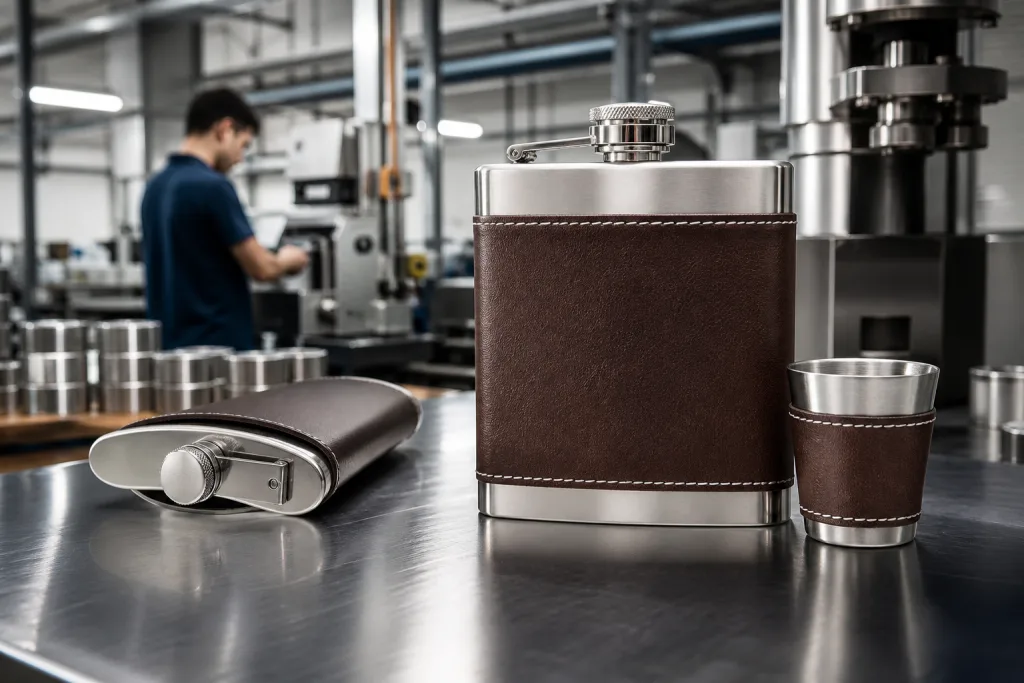
- Wrapped flask: PU or leather-look wrap, better perceived value, but more assembly points and higher defect risk.
For B2B buying, put the numbers side by side: material grade, body thickness, cap construction, decoration method, packaging type, test standard. We like to see 18/8 stainless for body and cap shell, a food-contact silicone seal, and neck-thread torque checked with a torque meter, not by hand feel. Last month QC pulled the sample because the cap backed off after 40 open-close cycles. If a canteen manufacturer or canteen supplier gives you only capacity and logo area, that quote is half blind.
At BottleForge Industrial, a normal flask MOQ is 1,000 pcs per design, and monthly line capacity for small metal drinkware runs above 300,000 units across related categories. That number matters. A factory that ships a custom canteen, customizable canteen, or customized growler might still place flasks on a separate polishing and assembly line with different workers, fixtures, and yield. We have seen buyers assume one line does all metal bottles, then get stuck when the flask neck polish radius was off by 0.3 mm. Ask which line makes your order.
Use-case fit starts with structure: a slim 6 oz gift flask sells differently from an 8 oz powder-coated promo flask, even if the logo area looks similar on paper.
Flask versus canteen versus growler
Buyers often bundle a customized alcohol flask inquiry with canteen custom or customizable drinkware jobs because the customer wants a “metal lifestyle” line. Fine. These items do not swap one-for-one. A flask is for pocket carry and gifting. A customized canteen is an outdoor bottle. A custom growler is a fill-and-carry vessel with a different cap and pressure check. We run all three on the line, and QC pulled the sample with a 0.2 mm lid gap on the growler before it left the packing table.
Where each product fits
- Customized alcohol flask: Best for corporate gifting, souvenir retail, hospitality merch, wedding programs, and liquor brand accessories. Typical retail sits at USD 9.99-24.99, and the buyer usually asks for a gift box plus 1-color logo. A PO typo on one 6 oz order once turned “brushed” into “brusthed”; we caught it before print.
- Custom canteen / canteen customizable: Better for wellness, outdoor, commuting, and general promo use. It reaches a wider age group, moves in larger repeat runs, and stays away from age-restricted positioning. On most jobs we see MOQ 500 pcs, sometimes 1,000 pcs if the cap is a special mold.
- Customizable growler / customized growler: Better for brewery, taproom, and refill programs. Usually 32 oz or 64 oz, with heavier carton specs and a harsher drop test. One buyer pushed for the same mailer box used on flasks; the math did not work, and the corner crush failed at 80 cm.
If you are a canteen distributor, distributor growler, or distributor canteen serving multiple channels, do not push a flask into a hydration brief. This is the wrong question to ask. Flasks are usually single-wall, non-insulated, and built for small-volume carry. They do not replace custom drinkware used at a desk or gym all day. A canteen customized order also gives you more print area and more add-ons, like straws, paracord handles, or wide-mouth lids. We ship samples with a 24-hour leak check on the cap, and that catches a lot of weak tooling before mass production.
If your customer wants a compact branded item under a landed cost target of about USD 3.50-5.50 with a box, a flask can beat a custom canteen on gift appeal. That is why some canteen vendors and canteen distributors in Europe add flasks as seasonal SKUs, not core stock. Treat it as barware-adjacent drinkware with real factory controls, not as a simple bottle variant. We've seen this go sideways when a buyer asked for “same as bottle, just smaller”; the 304 stainless spec was fine, but the hinge tolerance was not.
Materials, finishes, and logo durability
The standard body material for a customized alcohol flask is 304 stainless steel. For North American and European programs, that is still the safe default. 201 stainless can cut roughly USD 0.08-0.18 per unit on some sizes, but the math often does not work once rust claims start. We have seen buyers save 10 cents and then lose the account over neck staining after a salt-spray check. Ask your canteen factory or canteen manufacturer to confirm steel grade on both body and neck, not body only; QC pulled samples before where the PO said 304 body, and the neck ring came in mixed grade.
Wall thickness normally runs 0.4 mm for price-sensitive builds and 0.5 mm for a more rigid hand feel. On paper, 0.1 mm looks minor. In hand, it is not. On the line, a drop gauge test shows 0.5 mm holds shape better, and dent complaints drop fast in parcel shipment. If your order is e-commerce focused, especially with parcel handling, 0.5 mm is worth discussing. For finish, buyers usually pick mirror polish, brushed satin, spray paint, powder coat, or PU wrap. The practical trade-off is below:
- Mirror polish: lowest finish cost, classic look, shows fingerprints and scratches fast. We buff this on a cloth wheel, and any small drag mark shows up right away.
- Brushed finish: hides handling marks better, good for laser branding. A 180-220 grit line usually gives the cleanest look on flask panels.
- Spray paint: broad color flexibility, lower cost than powder coat, moderate chip resistance. Good option for short runs where the buyer flagged budget first.
- Powder coat: stronger abrasion performance, richer matte look, usually adds USD 0.18-0.35 per unit. We run cross-hatch adhesion checks here because thin corners are where failures start.
- PU wrap: premium feel, but bonding consistency and edge finishing need tight QC. This is where projects go sideways if glue spread and edge trim are not controlled to the mm.
For logos, choose based on real use, not artwork preference. This is the wrong question to ask first: “Which logo looks best on screen?” Ask what happens after 6 months in a pocket. Laser engraving is clean and durable, usually with low setup cost and no color registration risk. Silk screen works for spot-color designs when your order is above 3,000 pcs, but it wears faster with pocket friction; we have had buyers come back after coin-rub marks showed on the first pilot lot. UV print holds detail, though adhesion needs tape testing, and QC should check curved shoulder areas, not just the flat panel. If you are a canteen vendor or canteen supplier managing a larger customized drinkware range, do not force one decoration method across all SKUs unless the test result supports it. A logo process that works on a custom growler may fail on a curved flask shoulder with the same artwork size.
Caps, seals, and leak control
Most complaints on customized alcohol flask orders are not about the body. They start at the cap: fit, seal compression, and thread pitch. We see this on the line. A mirror finish will not save a weak closure, and this is the wrong place to save $0.03. Before you place a deposit, ask for the seal material, the exact leak test, and the cap torque range used in assembly. On one PO last quarter, the buyer flagged “same cap as approved sample,” but the liner had been changed from silicone to PE without a note.
The common closure is a screw cap with a hinged arm or captive cap bracket. The hinge looks good for gifting, but it also adds one more cosmetic checkpoint; QC pulled the sample twice last month for bracket alignment over 1.5 mm. The sealing system matters more. Food-grade silicone or PE sealing components are typical. Silicone usually performs better after repeat opening and temperature swing tests, especially on flasks shipped in winter containers and sold in summer. For a reliable production standard, request:
- 100% visual inspection of thread damage and cap seating during assembly
- 24-hour inverted leak test on a sampling plan, or 100% on premium programs
- AQL 2.5 final random inspection for major defects before shipment
- Carton drop test if gift boxes or accessory sets are included
If your project includes a funnel, cups, or presentation box, the defect map gets wider. The flask FOB can look fine on paper, then the math doesn't work after transit damage. We have seen accessory movement inside the box scuff painted surfaces and dent the shoulder radius by 2 mm during sea shipment. Ask your canteen manufacturer or canteen factory to run a packed-carton vibration and drop check. We ship this test with the full set inside, not an empty box, because we've seen this go sideways.
For buyers used to ordering a customizable canteen or customized canteen, flask leak claims are simpler and harsher. A bottle lid might drip after rough use and still pass customer tolerance. A flask that leaks into a jacket pocket is a fail. No gray area. Set the acceptance standard that way, and ask the factory to define pass/fail in writing before mass production.
MOQ, packaging, and landed cost math
Flasks get bought on unit price first. That’s the trap. The flask body can look cheap on the quote sheet, then the total jumps once you add handwork, box packing, and recheck on the line. For a plain 6 oz or 8 oz 304 stainless customized alcohol flask with one-color print and a white box, these FOB China factory ranges are common:
- Plain brushed flask: USD 1.45-1.85 at 1,000-3,000 pcs
- Powder-coated flask: USD 1.75-2.20 at 1,000-3,000 pcs
- Gift-box set with funnel/cups: USD 2.60-4.20 depending on insert and accessories
MOQ for a standard body is usually 1,000 pcs per color per design. That is the normal run size. Custom packaging often carries its own MOQ: printed gift boxes may start at 1,000 sets, while molded EVA or rigid book-style boxes add setup cost fast, and we’ve seen one 2 mm EVA insert change push a small program out of budget. New-tool body shapes usually need 3,000-5,000 pcs before the math works, plus mold charges. Repeat programs are often 25-35 days. New packaging or finish approval usually stretches that to 35-45 days.
For distributor drinkware, canteen distributors, and canteen suppliers building mixed containers, flasks pack tight in master cartons, so container loading is efficient. We ship these in compact cases all the time. Airfreight is different. A gift box can double the dimensional weight pain, and this is the wrong question to ask: buyers ask for flask size, but freight is billed on finished pack size. We had one buyer flag a rate jump after switching from a white box to a book-style gift box at 235 x 165 x 45 mm. Do your landed-cost math on the packed set, not the bare flask.
Watch the compliance cost too. If your customer needs REACH, LFGB, or California Proposition 65 screening on coatings or wraps, budget lab fees and extra days before booking cargo. QC pulled a powder-coat sample for migration testing on one order, and the hold added 6 days versus the original ship plan. A solid canteen supplier in China should quote those tests clearly, with timing. If they can’t, they are probably trading the item instead of running the line. That is not always a deal breaker, but you need to know who owns the quality claim if something fails after delivery.
Factory audit points that matter
Buyers often start with BSCI, ISO, or audit reports. Fair enough. For a flask project, that check is too shallow. You need to see whether the supplier controls metal forming, polishing, coating, decoration, and final packing on their own line. We’ve seen a bottle plant show a clean workshop, then send flask bodies to a 30-ton press shop two towns away in Zhejiang. Then the approved sample and mass goods stop matching. QC pulled the sample at 0.6 mm body thickness, but line output came back thinner.
Use this short audit list when speaking with canteen manufacturers, canteen vendors, or any canteen supplier offering a customized alcohol flask:
- Process ownership: Which steps are in-house: forming, welding, polishing, coating, printing, packing?
- Material traceability: Can they link stainless purchase lots to production dates?
- QC records: Do they keep leak test logs, coating adhesion results, and incoming accessory checks?
- Social/compliance baseline: BSCI or equivalent, plus ISO 9001 if available
- Lab coordination: Experience with REACH, LFGB, FDA contact materials, and ASTM transit tests when relevant
If you sell into Amazon or direct e-commerce, packaging control needs extra attention. This is where projects go sideways. Barcodes, FNSKU placement, suffocation warnings, carton marks, and carton weight limits should be written into the PO, line by line. We ship flasks in rigid boxes every week, and a clean gift box still gets rejected if the FNSKU sits 8 mm off spec or the carton prints 15.2 kg against a buyer cap of 15 kg. One buyer flagged a single typo on a PO carton mark, and the whole lot needed relabeling.
The right supplier answers with numbers, not soft talk: defect rate target below 1.5%, sample lead time 7-10 days, mass production 30 days, and written rework rules for logo or leak issues. Ask for the leak test standard too. On our line, for example, flasks go through 100% air-pressure leak check before packing. Anything vague becomes your problem later. That’s the wrong question to ask: not “Do you make flasks?” but “What do you record every day on the line?”
Compare flask specs before you place the PO
Send your target size, finish, logo method, and packaging brief. We will quote MOQ, FOB Zhejiang pricing, lead time, and compliance options clearly.
Frequently asked questions
What is the normal MOQ for a customized alcohol flask?
For a standard 6 oz or 8 oz stainless flask, the normal MOQ is 1,000 pcs per model per color. If you want only a logo change on an existing brushed body, some China factories can test 500 pcs, but the unit cost usually rises by 8%-15%. For custom color powder coating, printed gift boxes, or accessory sets, 1,000 pcs is the more realistic floor. A new body shape usually needs 3,000-5,000 pcs plus mold cost. If your broader program includes a custom canteen or customized drinkware line, mixed-SKU planning can help you fill a container, but flask MOQ is still set by its own tooling, coating, and packing setup.
Which logo method lasts best on a flask?
Laser engraving is usually the safest choice for durability. It does not chip like a surface print, and on brushed or powder-coated steel it gives a clean, premium look. Silk screen is cheaper on larger runs and works well for simple spot colors, but pocket friction and gift-set movement can wear it faster. UV print handles more detail, though you should ask for adhesion and tape test results. If the flask is part of a canteen promotional order or sold through a distributor drinkware channel with rough handling, choose laser unless the brand absolutely needs color. For most 1,000-3,000 pc programs, laser also keeps setup simpler and reduces color approval delays.
Do I need food-contact testing for a stainless flask?
Yes, if you are selling into Europe or North America, you should treat testing as part of sourcing, not an optional extra. At minimum, ask what steel grade is used and whether the seal, coating, and any wrap materials have supporting compliance data. Depending on market and customer, you may need REACH screening, LFGB-related migration review, FDA food-contact alignment, or California Proposition 65 checks for coatings and accessories. Testing cost is usually small compared with a failed shipment or retailer claim. A good canteen manufacturer in Zhejiang should explain what is already available and what needs fresh lab work for your exact decorated flask.
How long does production take after sample approval?
For a repeat flask with standard packaging, production normally takes 25-35 days after deposit and pre-production approval. If you add a new powder coat color, custom gift box, or accessory insert, 35-45 days is more realistic. Pre-production samples usually take 7-10 days for standard decoration and 10-15 days if packaging needs print proofing. During peak Q4 season in China, add at least 7 days buffer, especially if your order includes hand assembly. If you are combining the flask with a custom growler or customizable canteen project, align approvals early because the slowest packaging component often controls the ship date.
Is a flask better than a custom canteen for promotional programs?
It depends on channel and audience. A customized alcohol flask is stronger for gifting, souvenir retail, hospitality merch, and liquor-adjacent branding. A custom canteen or customizable drinkware item is usually better for wide promotional distribution because it fits more users, carries fewer age-related concerns, and offers bigger daily-use visibility. Price also matters. A simple flask can fit a compact gift budget, but once you add a rigid box, cups, and premium wrap, the landed cost may exceed a basic stainless canteen. If you are a canteen distributor serving corporate buyers, the flask is best used as a targeted seasonal or event product, not your default promo SKU.