Key Takeaways
- A practical MOQ for a customizable wine tumbler is often 1,000-3,000 pcs per color, while custom Pantone coating can push MOQ to 3,000 pcs.
- Lead time usually runs 25-35 days after sample approval, with repeat orders from Zhejiang factories often shipping in 20-25 days.
- 304 stainless steel with a 0.4-0.5 mm inner wall is the common B2B baseline; thinner steel cuts cost but raises dent and weld risk.
- AQL 2.5, REACH testing, and carton drop tests from 76 cm reduce claim rates and matter more than a low ex-works price.
You can source a customizable wine tumbler from 50+ factories in China by Friday. That part is easy. The harder part is knowing which spec line moves your landed cost, complaint rate, and reorder timing. Two 12 oz tumblers can look the same in a studio photo and still fail in different ways once QC pulled the sample for leakage, coating adhesion, carton drop, and logo position at ±1.5 mm.
If you are a procurement manager, brand owner, or distributor in Europe or North America, a nice mockup is not enough. You need to read the spec sheet like a buyer who has to answer for claims and late deliveries. In Zhejiang, we keep seeing the same mistake: the buyer signs off color and print first, then finds trouble later with wall thickness, lid mold fit, and missing compliance files on the PO. That gets expensive fast. We have seen this go sideways, and it is avoidable.
Start with capacity and geometry
The first line on a spec sheet is usually capacity: 10 oz, 12 oz, or 14 oz for a customizable wine tumbler. In our export orders to Europe and North America, about 7 out of 10 buyers settle on 12 oz because the hand feel is safer, the print area is usable, and the master carton count still works. A true 12 oz body usually lands around 350-360 ml brimful. Small detail, big headache. We have seen buyers flag a repeat PO because one lot filled 8-10 ml lower at the brim and the shelf comparison looked off.
Geometry matters as much as stated volume. Check top diameter, base diameter, and height. A typical 12 oz double-wall unit is around 87 mm top diameter, 72 mm base diameter, and 117 mm height. QC usually checks these with a digital caliper on the line, not by eye. These numbers drive three commercial issues:
- Lid interchangeability: if you plan a family range with a travel mug or custom canteen, shared lid diameters cut tooling cost and spare-part confusion. We run into this fast when a buyer wants one replacement lid to fit 2 SKUs.
- Carton density: a wider bowl shape looks premium, but master carton quantity can drop by 10-15%. The math does not work if freight is already tight and your MOQ is 3,000 pcs.
- Decoration area: curved bodies limit large wrap prints and make some artwork look compressed. On screen it looks fine; on the jig, the logo can pinch near the shoulder radius.
If you also buy broader custom drinkware lines such as a customizable canteen or customizable growler, standardizing mouth diameters across SKUs is a better conversation to have early with your canteen manufacturer. This saves trouble later. We ship plenty of repeat programs where distributors ask for replacement lids by diameter in mm, not by item name, and mixed standards slow everything down.
Ask for net weight and tolerance too. For a 12 oz vacuum tumbler, 210-260 g is common. Ask for a tolerance like +/- 5 g on the approved sample. If a quotation looks unusually cheap, check whether the body is lighter because the steel is thinner or the bottom structure is simpler. This is the wrong question to ask only after mass production starts. We have seen 228 g approved samples turn into 214 g bulk goods, and the buyer flagged the base feel right after opening the carton.
Steel grade is not a footnote
On paper, 9 out of 10 suppliers just write “stainless steel” and stop there. That is the wrong question to accept. For a customizable wine tumbler, the normal baseline is food-contact 18/8 or SUS304 on both inner and outer body. Some budget programs use 201 stainless on the outer wall to shave cost. We have run those orders. They are usually fine in dry use, but for branded drinkware sold in Europe or North America, 304 outside is the safer call because finish stability and corrosion complaints show up fast once the buyer flagged spotting on shelf samples.
Wall thickness is where buyer risk hides. On our line, QC checks body stock with a micrometer before deep draw. Common ranges are:
- Inner wall: 0.4-0.5 mm
- Outer wall: 0.4-0.5 mm
- Lid AS or SAN thickness: 2.0-2.5 mm
A 0.3 mm body might save USD 0.08-0.15 per piece on a large order. The math often does not work. It dents easier during transit, and we have seen more instability around the weld zone after vacuuming. If your end customer is a canteen distributor, or 6 canteen distributors running promo campaigns under one PO, cosmetic rejects start eating margin fast. Last season, QC pulled the sample on a thin-body lot after carton drop marks showed up on the shoulder ring.
Ask your canteen factory or canteen supplier for actual material declarations and, when needed, third-party test support for REACH, LFGB, or FDA-contact requirements depending on market. Serious Zhejiang export factories see this every week, so this request is standard. Ask for the mill paper, ask what is used on inner and outer separately, and check whether the PO says 304 or just “SS” — we have seen that typo turn into an argument after production. If a canteen vendor or the canteen vendors you are screening answer vaguely on steel grade, move carefully. We have seen this go sideways.
For most mid-market projects, paying a little more for consistent 304 steel is cheaper than managing returns, rust complaints, and one-star reviews later.
The same rule applies if you are sourcing adjacent lines such as custom growler, customized growler, or customized canteen products from China. Keeping one steel grade across the range makes QA cleaner and re-orders easier. We ship mixed SKU programs this way, and the inspection file is simpler when the whole range stays on 304 instead of splitting 201 outside on a few low-price items.
Vacuum structure and thermal performance
Double-wall vacuum construction separates a tumbler people reorder from a cheap shell that gets one PO and stops there. The spec sheet should state vacuum insulated or double-wall air insulated, plain and clear. For a customizable wine tumbler, vacuum is the baseline for retail shelves and gifting programs above 500 pcs MOQ. Air insulated units save a bit on unit price, but the hold time drops fast, and buyers notice it the first time QC checks the sample with a digital probe thermometer on the line.
Ask for a realistic heat and cold retention claim with test conditions written out. A common factory benchmark is:
- Hot: from 95 degrees C down to 45-50 degrees C after 6 hours
- Cold: below 10 degrees C after 6 hours under room conditions
These are not universal standards, so the method matters. We have seen suppliers quote strong numbers with no starting temperature, no fill volume, and no ambient room data. That is the wrong way to compare offers. You want 90% fill volume or 100% fill volume stated, room temperature like 23 degrees C called out, and the same cup size on each report, or the math does not work.
Bottom technology and buyer impact
Most vacuum tumblers use a sealed bottom with a vacuum point, then the factory covers or polishes that area after evacuation. Check whether the base stands flat on a glass table and whether the outer bottom includes a non-slip pad. We run a simple flatness check on the bench; if the wobble is over 1 mm, the buyer usually flags it. A silicone base pad cuts complaints about scratching in hospitality and wine club programs, but it adds material cost and one more assembly step.
If you are building a collection that includes canteen custom shapes, custom canteen bottles, and a customizable growler, keep the thermal claims aligned across the range. Buyers compare the full family, not one SKU by itself. We have seen this go sideways when a growler is sold at 12 hours hot hold and the matching tumbler is sold at 6 hours with no explanation. In a distributor growler program or distributor canteen catalog, spec consistency makes the line easier to sell.
For B2B, I would take a conservative tested claim over a flashy unverified one every time. Reliable performance with a written check sheet, sample photos, and a retention log from a canteen manufacturer in Zhejiang is easier to defend when your customer asks for proof. One buyer even sent back a PO because “vaccum” was typed on the report instead of “vacuum.” Small detail, big trust issue.
Surface finish decides brand perception
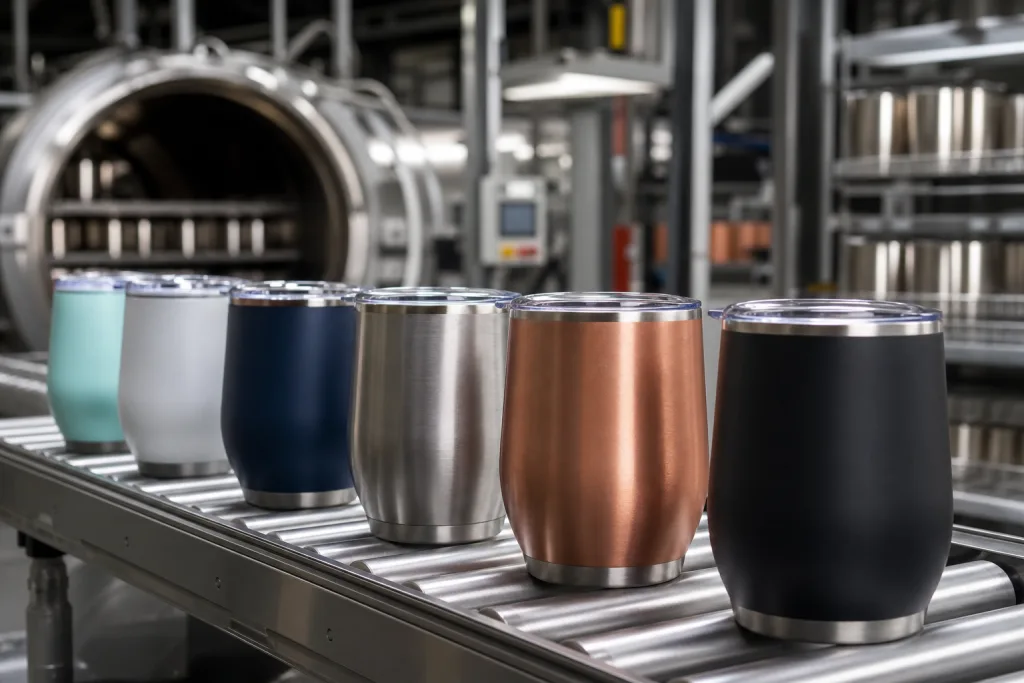
Most buyers ask about the logo first. Wrong starting point. On a customizable wine tumbler, the coating decides how the brand feels in hand before anyone notices the print. The common finish choices are powder coating, spray painting, electroplating, and special textures like rubberized or stone feel. We run powder coating as the commercial default because it holds up, controls cost, and keeps color steadier lot to lot. For standard colors, MOQ can start around 1,000 pcs. For a custom Pantone match, expect 3,000 pcs or higher depending on the line setup. On the line, film build usually sits around 60-80 μm; if that drifts, the buyer flags color shift and edge wear fast.
Ask about coating adhesion, hardness, and batch variation. Ask for the actual check, not a sales phrase. A good factory in China should know cross-hatch adhesion checks, pencil hardness, and basic abrasion standards from daily QC. We have seen QC pull the sample after a 3M tape test and catch flaking at the rim radius, which is where bad pretreatment shows up first. If you are buying canteen customizable items or broader customizable drinkware collections, using the same coating supplier across SKUs often gives tighter color continuity. This matters more than people think; 2 blue tumblers with a 0.5 shade difference look fine on paper and wrong on shelf.
Then check the decoration method:
- Silkscreen: low cost, solid colors, best for simple logos; we normally use a steel jig to hold body angle on the curved wall
- Laser engraving: precise, permanent, premium look on powder coat; good for buyers who do not want ink rub-risk
- Heat transfer: better for complex artwork, but more process-sensitive; seam position and temperature control decide yield
- 3D digital print: works for short runs like 300-500 pcs, usually higher unit cost
A typical price difference is USD 0.05-0.12 for one-color screen print versus USD 0.10-0.20 for laser, depending on size and quantity. That gap looks small until you price 10,000 pcs. If your target is a canteen promotional campaign, screen print is often enough. If it is retail or gifting, laser usually gives a cleaner result with fewer alignment complaints. We have seen this go sideways when a buyer wanted fine serif text under 1.2 mm in silkscreen—the math does not work on a curved tumbler.
Ask your canteen suppliers whether artwork placement uses jigs or manual visual alignment. Get a straight answer. On curved wine tumbler bodies, poor alignment shows fast, and a 2 mm tilt is obvious once the cup is filled and photographed. QC should check placement against a fixture, not by eye only. That matters whether you buy from a canteen vendor, a canteen factory, or one of several canteen manufacturers in Zhejiang.
Lids, seals, and use-case fit
Lids are where complaint rates start. We see it on the line. A standard wine tumbler usually ships with a push-on AS lid, sometimes with a slider, and buyers still mark it on the PO as “spill-proof.” Then QC pulled the sample, tipped it 45°, and the leak claim started. Most of these lids are splash-resistant, not spill-resistant, and that wording needs to be printed on your sales sheet and written clearly on the PO.
On the spec sheet, check:
- Lid material: AS, SAN, Tritan, or PP components, and whether the slider is the same resin or mixed material
- Seal material: food-grade silicone, with a quick check on odor and compression after fitting
- Closure style: open sip, slider, or flip, based on how the end user will actually carry it
- Fit tolerance: how tight the lid seats across production lots; we usually check lid seating by hand and gauge a rim variation down to 0.2 mm
If your customer wants commute use, a standard wine tumbler lid is often the wrong choice. That is the wrong question to ask. You may need a different top system or a travel tumbler body instead, because a wide-mouth wine tumbler format is not built for bag carry. We have seen buyers push for a wine tumbler shape plus leakproof use, and the math doesn’t work.
For B2B programs, the safer commercial call is to name the product honestly: a stemless insulated tumbler with splash-resistant lid. That one line cuts a lot of after-sales noise. The buyer flagged this before on a gifting order because the flyer said “travel friendly” while the sample dripped from the sip opening. If you supply chains or corporate gifting clients, accurate positioning matters more than adding one more feature line.
Request spare lid pricing too. Replacement lids often cost USD 0.28-0.55 depending on material and volume. We usually quote spare lids from 1,000 pcs MOQ, and that number should be settled before mass production, not after the first complaint batch ships. If you also buy customized canteen or custom growler items, shared accessories make spare-parts stock easier to manage. In China, this part gets skipped at first quotation, and later the service cost comes back on you.
Packaging, compliance, and order control
The last block on the spec sheet gets treated like paperwork. That is a mistake. Packaging and QC details decide whether the shipment moves cleanly or turns into a claim file. Standard packing for a customizable wine tumbler is usually 1 pc into a polybag and white box, then 24 or 36 pcs into a master carton, but we’ve seen this go sideways when the buyer added barcode labels after sample approval and the line had to stop. If you need color boxes, paper inserts, barcode labels, or Amazon FNSKU labels, lock them before sampling and print them on the PO without typos.
Carton quality is not a side issue. Ask for carton size, gross weight, and drop-test expectation in writing. A practical export standard is to keep master cartons under 15-18 kg and pass a basic drop test from 76 cm; on our floor, QC pulled the sample carton and checked corner crush before seal-up. If the project is for e-commerce, the math does not work with basic inner packing, and the divider or EPE protection usually needs an upgrade.
For compliance, the usual export documents can include:
- REACH for EU market chemical compliance
- LFGB or food-contact test reports where required
- BSCI or social audit records for retailer programs
- AQL inspection standard, commonly AQL 2.5
When you review suppliers in Zhejiang or elsewhere in China, ask who actually runs QC: the canteen manufacturer, a trading company, or an outside inspector. This is the right question to ask. A factory with 300,000-500,000 units monthly capacity should be able to explain in-line inspection, final random inspection, and weld leak checks without hand-waving; on stainless items, we usually run an air-pressure leak check and the buyer often flags lid fit before anything else.
Lead time sits on one line of the sheet, but it drives the whole order. For a new customizable wine tumbler order, 25-35 days after deposit and sample approval is normal. Sample lead time is often 7-10 days for a printed pre-production sample. MOQ usually starts around 1,000 pcs for existing colors and can rise fast with custom packaging or special finishes; one added EVA insert can push the MOQ from 1,000 pcs to 3,000 pcs because the packaging supplier sets the break.
If you are comparing a canteen supplier, canteen manufacturers, or canteen distributors for a broader range that includes customizable canteen, customized drinkware, and customized growler items, use one scorecard and keep it tight. Do not compare only piece price. Compare compliance readiness, accessory control, and how each supplier explains the spec lines that affect your business; we ship enough mixed programs to know a $0.12 saving disappears fast if the carton mark is wrong or the master carton comes in at 19 kg.
Get a spec-first quote for your wine tumbler project
Send your target capacity, finish, logo method, and packaging requirement. We will quote MOQ, lead time, and compliance options clearly from the start.
Frequently asked questions
What is a normal MOQ for a customizable wine tumbler order?
For a standard 12 oz vacuum customizable wine tumbler with existing mold and standard powder colors, MOQ is usually 1,000 pcs per color. If you need a custom Pantone powder coat, printed color box, or a special lid, MOQ often moves to 2,000-3,000 pcs. Laser logo can sometimes stay at 1,000 pcs, while complex wrap graphics may require higher minimums. In Zhejiang, some factories quote lower headline MOQs, but then add setup surcharges that make the unit price unattractive. Ask for the real breakpoints at 1,000, 2,000, 3,000, and 5,000 pcs so you can see where cost starts to normalize.
How much should I expect to pay for a custom wine tumbler from China?
For a 12 oz double-wall vacuum 304 stainless customizable wine tumbler, a realistic FOB China range is about USD 2.10-3.60 depending on steel thickness, coating, lid style, packaging, and logo method. A basic one-color screen print with white box sits near the lower-middle part of that range. Add laser engraving, gift box packaging, base pad, or custom color matching and the cost moves up. If a quote is well below market, check whether the factory reduced wall thickness to 0.3 mm, used mixed steel grades, or excluded testing and packaging details. Low price is only useful if the landed claim rate stays under control.
Which logo method is best for B2B custom drinkware programs?
It depends on channel and artwork. For canteen promotional and event-driven orders, one-color silkscreen is still the most cost-efficient option, often adding only USD 0.05-0.12 per piece at volume. For retail, hospitality, and premium gifting, laser engraving is usually the safer choice because it is permanent and gives a cleaner finish on powder-coated steel; budget around USD 0.10-0.20 extra. Heat transfer works for multi-color artwork but needs tighter process control on curved bodies. Ask for a pre-production sample on the actual tumbler finish, not on a flat panel, because curvature changes how logos look.
What compliance documents should European and North American buyers request?
At minimum, ask for food-contact material declarations and market-relevant test support. For EU programs, REACH is commonly requested, and some buyers also require LFGB-related food-contact testing depending on the product setup and importer policy. For North America, FDA-contact expectations are common. If you sell to chains or large distributors, BSCI or similar social audit records may also be needed. On the quality side, specify AQL 2.5 for final random inspection and ask for leak, coating, and carton-drop checks. A capable canteen factory in China should be able to explain which reports are current, which are item-specific, and how long updated testing will take.
How do I qualify a canteen manufacturer or canteen supplier for repeat orders?
Start with three things: consistency, communication, and process control. Ask whether the supplier is a direct canteen manufacturer or a trading company, then review monthly capacity, normal lead time, and defect handling. A useful benchmark is 300,000 units per month capacity, 25-35 days lead time for new orders, and a clear AQL process. Request the same SKU in two finishes or from two production lots if possible. Check weight consistency, lid fit, logo position, and carton condition. Also ask how they manage repeat Pantone matching and spare accessory supply. A good Zhejiang supplier will answer with numbers, tolerances, and photos, not just promises.