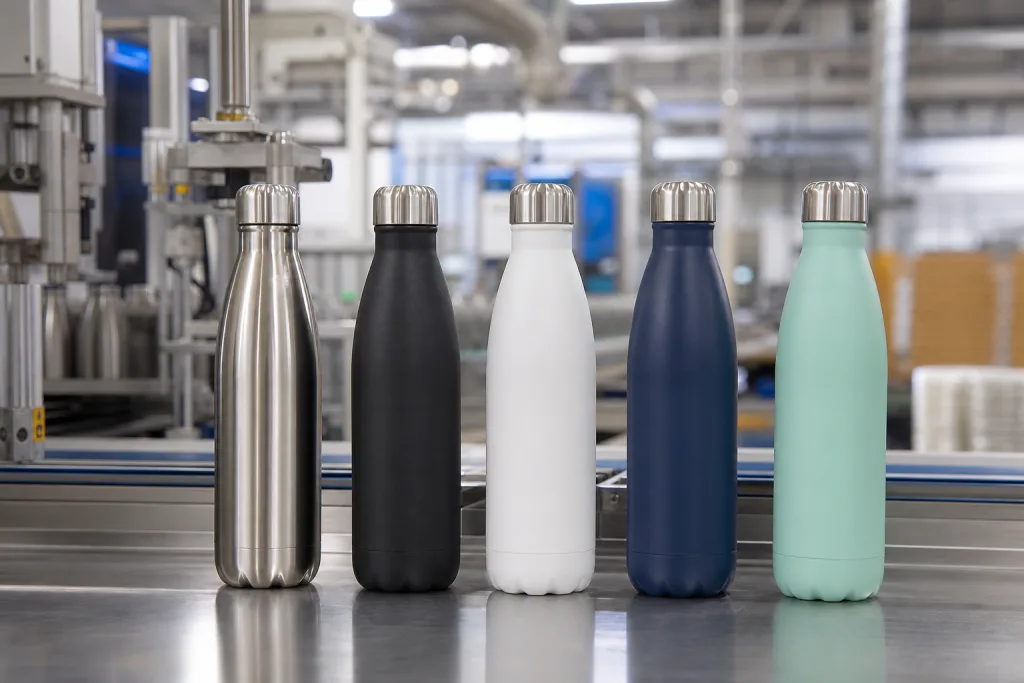
Key Takeaways
- Entry MOQ is usually 500-1,000 pcs per SKU for stock molds, while fully new molds often start at 3,000-5,000 pcs
- Basic single-wall plastic or aluminum customizable water bottles can start near USD 1.20-2.50 FOB, while double-wall 18/8 stainless models often run USD 3.80-7.50 FOB
- Normal production lead time is 25-35 days after sample approval and deposit, but custom packaging, color matching, or new tooling can push it to 45-60 days
- Decoration choices can change unit cost by 5%-25% and add 3-10 days, especially for wrap printing, powder coating, or laser engraving
You usually see the real cost of customizable water bottles after the first quote. On paper, USD 2.20 looks fine. Then silk screen setup, gift box changes, straw lid upgrades, FDA testing, and freight get added line by line. We’ve seen buyers miss a carton mark change on the PO and lose margin fast when the landed cost jumps to USD 2.80. If you buy for a brand, retail chain, or promotional program, that gap hurts, especially on 3,000 to 20,000 units with a fixed ship date.
At BottleForge Industrial in Hangzhou, Zhejiang, we run into this every week: a buyer asks for a custom canteen or customizable drinkware range, but the real issue is cost against lead time. This is the wrong question to ask if you only want the lowest unit price. The line might hold 2 extra days for a new lid mold, or QC pulled the sample because the logo position drifted 1.5 mm, and that changes the full quote. If you are comparing a canteen supplier in Zhejiang with other China offers, ask for numbers, not polished sales talk.
Where the bottle cost really moves
If you buy customizable water bottles every season, you already know the bottle body is only one line on the quote sheet. Cost usually moves in four places: material, structure, decoration, and packaging. On our side in Hangzhou, those are the numbers we check first before we send FOB pricing. If those four items are not pinned down, the quote looks good on paper and falls apart when the PO hits the line.
Material comes first. A 500ml single-wall aluminum custom canteen might sit around USD 1.50-2.30 FOB at 1,000 pcs. A 500ml single-wall Tritan bottle may land around USD 1.80-2.80. Move to double-wall 304 stainless steel vacuum insulation and the same capacity often shifts to USD 3.80-6.20. Larger 32oz or 40oz bodies, thicker walls, copper coating, or recycled content push it higher. Wall thickness is where new buyers get caught. 0.4mm versus 0.5mm stainless looks the same in a website photo, but QC pulled both samples before and the dent test told the story fast. The 0.1mm difference changes dent resistance, welding stability at the bottom seam, and raw material cost. This is the wrong question to ask: “Can you match the price?” The better question is which thickness the quote is built on.
Structure is next. A simple screw lid is cheaper than a straw lid, and a straw lid is usually cheaper than a multi-part flip lid with silicone spouts and carrying handle. Each extra seal, spring, or hinge adds assembly time and leak test work. On one 10,000 pcs order, the buyer flagged a lid price jump of USD 0.28, but that version used 7 parts instead of 3 and needed another leak check after assembly. We have seen this go sideways when a project carries three lid options under one bottle body. The price gap from lids is often bigger than the gap from changing shell color.
Decoration is where custom drinkware budgets drift first. We run into this on sample rounds all the time, especially when artwork looks simple on screen but slows the line down at print.
- 1-color silkscreen: usually the lowest-cost branded option, with simple setup and faster output
- 2-3 color print: adds setup and registration time; if the logo has tight alignment, the reject rate climbs
- Laser engraving: durable, clean, usually mid-range cost; good for 304 stainless when buyers want a permanent mark
- Powder coating: can add USD 0.25-0.60 depending on finish; matte is routine, but speckle or rubber finish costs more
- Full-wrap heat transfer or digital print: strong shelf appeal, but more reject risk; even a 1mm artwork shift gets kicked out in inspection
Packaging is the quiet cost driver. A white box may add only USD 0.10-0.18. A full-color retail box with insert, barcode, and multilingual compliance marks can add USD 0.35-0.90. That gap gets wider if the insert is die-cut tight or the export carton drop test fails on the first run. We ship plenty of distributor drinkware programs to Europe and North America, and buyers there often spend more time on the box spec than the bottle spec. The math does not work if packaging is treated as an afterthought, then upgraded after sampling.
Typical price bands by bottle type
You do not need exact factory costing on day one. You do need a price band that matches the line. We see buyers lose 2 to 3 weeks asking a canteen factory for a USD 2.00 target on a bottle that lands closer to USD 4.80 FOB once the sample room checks the spec sheet. That is the wrong question to ask. Below are working ranges for standard Zhejiang production using stock molds, common colors, and normal export cartons, usually packed after a basic drop check on the carton edge crush.
- 500-750ml single-wall aluminum: USD 1.20-2.50 FOB at 1,000-3,000 pcs
- 500-700ml Tritan or AS plastic sports bottle: USD 1.60-3.20 FOB
- 500ml double-wall stainless vacuum bottle: USD 3.80-6.20 FOB
- 20oz-30oz travel tumbler: USD 3.20-6.50 FOB depending on lid system
- Growler 32oz-64oz stainless: USD 6.50-12.00 FOB, sometimes higher with custom cap assemblies
If you are buying a customizable growler or customized growler for beer, coffee, or outdoor channels, capacity changes the freight math fast. A 64oz body uses more 304 stainless, takes a larger carton, and usually cuts carton efficiency by 15% to 20% versus a 32oz format. We ship fewer pieces per cubic meter, plain and simple. Your ex-factory cost may still look fine, but landed cost climbs faster than first-time buyers expect, and we have seen this go sideways when the buyer flagged ocean freight only after approval.
Stock colors usually keep you near the low end. Pantone matching, metallic paint, rubber finish, or speckled powder coat will push the quote up, and so will compliance work. If your market needs REACH review for coatings, LFGB or FDA contact testing, plus outer package drop tests, put that into the budget from day one. QC pulled one sample last month with a powder coat thickness reading of 78μm instead of the 60μm target, and that kind of detail affects retest timing. Testing alone does not always change unit cost much, but it does change the project total and can hold shipment release by 7 to 12 days.
For promotional programs, a canteen promotional order usually chases the lowest visible unit price. That works only if the spec stays tight: one body shape, one lid, one print position, one master carton mark. Once a canteen vendor starts adding gift boxes, 3 logo versions, and split deliveries to 2 warehouses, the math does not work. The line slows down, carton counts get messy, and even a small PO typo like “1,500 pcs black lid / 1,050 pcs white lid” can trigger a repack check before we ship.
You can reduce price, or you can reduce risk, but rarely both at the same time without adjusting the specification.
MOQ tiers and what they change
MOQ is not there to annoy you. It is how a canteen supplier controls scrap, setup hours, and line efficiency. For most customizable drinkware programs using existing molds, the workable MOQ is 500-1,000 pcs per SKU. At BottleForge Industrial, our monthly capacity is about 450,000 units across stainless, plastic, and mixed drinkware lines, but the line runs better when the order is concentrated. On a 500 pcs run, we still change silk-screen plates, mix ink, and set carton marks; that setup time does not shrink just because the PO is small.
Here is what usually happens by tier:
500-1,000 pcs
Good for testing a design or opening one new distributor canteen account. Also workable for a short campaign. Expect fewer body colors, tighter decoration limits, and fewer lid options. Unit cost is the highest in this tier because setup is spread across fewer pieces. We see this on the floor all the time: QC pulled the sample, the buyer liked the Pantone, then flagged the extra lid charge after learning the color masterbatch MOQ was 25 kg.
1,000-3,000 pcs
This is the range most B2B buyers should price first. The math works here. You can usually push for better decoration rates, flexible carton marks, and steadier color consistency from lot to lot. On stainless items, we can hold spray color difference tighter once the batch is big enough to run continuously instead of stopping and restarting the line. If you are supplying canteen distributors or running a distributor growler program, this tier usually gives the cleanest balance between risk and margin.
3,000-5,000 pcs and up
This is where pricing starts to move, especially on stainless steel vacuum bodies. If you want a customized canteen, custom growler, or customized drinkware item with unique mold details, this is usually the minimum level where tooling makes business sense. New cap molds alone may run USD 2,000-8,000 depending on complexity; body tooling can go higher. We have seen buyers ask for a new hinge detail at 3,000 pcs, then back off after seeing the mold trial cost and the 0.15 mm tolerance requirement on the cap fit.
MOQ also affects inbound materials. Silicone seals, custom color lids, and special straws often carry their own sub-supplier MOQs. This is the wrong question to ask if you only ask for finished bottle MOQ. Ask whether the 1,000 pcs applies to the assembled bottle only, or also to components, color batches, and retail packaging. We have seen this go sideways: buyer PO says “indvidual box” with a typo, bottle MOQ is approved, then the insert tray supplier comes back at 3,000 pcs and the landed cost jumps later.
Lead times from sketch to shipment
The lead time for customizable water bottles is not one number. It is 6 or 7 small clocks on the same PO, and if one slips by 3 days, the shipment slips with it. Buyers in Europe and North America usually get cleaner schedules by splitting the job into approval gates instead of asking us for one ship date on day one. On our side, the line does not move on guesses; even a 0.5 mm logo position check can hold the next step.
- Quotation and technical clarification: 2-5 days
- Artwork check and pre-production mockup: 2-4 days
- Sample making for stock mold item: 5-10 days
- New mold sampling: 15-30 days
- Mass production after sample approval and deposit: 25-35 days
- Retail box production if separate supplier is involved: 7-12 days
- Final inspection and booking: 3-7 days
In plain terms, a normal stock-mold custom drinkware order usually moves from approved sample to FOB shipment in about 35-45 days. A more complex canteen customized project with custom lid colors, gift boxes, and full-wrap print often lands at 45-60 days because two outside pieces usually slow it down: packaging and color approval. Add new tooling, and 60-90 days end to end is the safer number. We have seen this go sideways when a buyer wants a new cap mold and still asks for the same vessel schedule; the math does not work.
Seasonality changes everything. August to November gets tight fast because holiday and promo orders fill capacity in Zhejiang, and we start seeing booking delays of 5-8 days on standard lanes. Chinese New Year is the other pressure point. If your canteen distributor program needs March delivery, lock artwork and deposit before mid-December. Last year one buyer flagged a carton mark typo after New Year booking, and that small reprint cost them a full week.
Ask one direct question that buyers skip: when does lead time start? This is the right question. A disciplined canteen manufacturer will tell you lead time starts after sample approval, deposit received, and all packaging files confirmed. If a supplier promises 20 days but your barcode layout is still pending or QC pulled the sample with the wrong Pantone on the lid, that promise is not operationally real. We ship to this rule because loose start dates create arguments later.
The custom details that add days
Some specs look small on an email thread and then jam the line. This is where a practical canteen supplier earns trust: we say no early if the request will cost 4 days, instead of nodding and arguing later. The usual delay points are color control, packaging edits, and mixed-SKU packing notes. We have seen one PO held up because “24 pcs/ctn” was typed as “24 sets/ctn,” and the buyer flagged it only after carton die-lines were approved.
Pantone matching on plastic or powder coating gets treated like a quick approval. It is not. A customizable canteen with a PP lid, silicone ring, and coated stainless body will not read the same color on all 3 materials, even if the target chip is identical. On the floor we check under a light box, and QC pulled samples with a visible shift between the lid and body at delta tolerance buyers first said was “close enough.” Getting to an approved match usually adds 2-5 days and 2 or 3 sample loops. If the buyer wants zero shade variation across different substrates, this is the wrong question to ask.
Retail packaging is another place where schedules slip. For chain retail or Amazon FBA, customized drinkware often needs suffocation warnings, FNSKU labels, country of origin marks, and scan tests before we ship. Then the carton size has to fit pallet plans and still pass drop performance. Last month we had to remake an outer carton because it was 8 mm over the warehouse limit on one side. Not glamorous. Still, this is where projects stall.
Inspection standards need to be fixed before production starts, not after 5,000 pcs are packed. Most B2B buyers use AQL 2.5 for major defects and 4.0 for minor defects on finished drinkware. Leak testing, vacuum retention checks, print adhesion, and barcode scan tests should be written into the PO or quality appendix with actual criteria, like 24-hour leak check or 1-meter drop standard. If your canteen manufacturers will not sign off on measurable checks, you are relying on goodwill. The math does not work.
For EU and North American buyers, document readiness matters as much as the sample. Depending on the product and market, you may ask for BSCI audit status, ISO 9001 process records, REACH declaration, FDA or LFGB test reports, and ASTM-related package or performance references when relevant. A professional canteen factory in Zhejiang should not need 2 weeks to dig these out. We usually send the file set within 1 business day, and if one report is expired, the lab booking is the first thing we tell the buyer. If a factory is messy on paperwork, we have seen the same thing go sideways in production follow-up.
How to quote like a serious buyer
If you want fast, apples-to-apples quotes from canteen manufacturers, send a clean RFQ. Vague requests give you vague pricing. You do not need full engineering drawings, but you do need enough detail for the factory to cost the job without guessing on mold size, print pass, or carton spec.
Your RFQ should include:
- Capacity and target dimensions, for example 500ml, 70mm diameter, under 260mm height
- Material target: aluminum, Tritan, 18/8 stainless, recycled PP, and so on
- Single-wall or double-wall vacuum structure
- Lid type: screw, straw, flip, chug, bamboo cap, tethered cap
- Decoration method and print area
- Target MOQ by SKU and total order quantity
- Packaging requirement: white box, color box, PDQ, master carton marks
- Compliance market: EU, US, Canada, or mixed
- Trade term: FOB Ningbo, FOB Shanghai, or ex-works
- Required ship window
Send that, and a canteen manufacturer or canteen vendor can tell you where the design burns money and where the line runs clean. We see this every week. A 600ml body might quote better than a custom 550ml size because the factory already has that mold set on the rack. A customizable growler often makes more sense with a standard cap neck, say 58mm, so you skip tooling. We have also seen buyers cut USD 0.28 per unit just by changing from rubber finish to matte spray after QC pulled the sample and flagged dust pickup on the coating.
Good buyers ask for a cost split. This is the right question. Not every canteen suppliers team will open the full sheet, but most serious export factories in China can break out bottle, lid, decoration, packaging, and testing. Then you can adjust the parts that move the number. If you only ask “best price?”, you usually get a thin reply and no basis to compare 2 offers. We have even seen a PO typo turn 1-color print into 4-color print, and the buyer flagged the jump only after the PI came back.
For long-term distributor drinkware business, ask one more thing: price validity. Stainless steel and freight move fast, and the math does not work if your sales team presents an old quote 18 days later. In choppy raw material periods, 7-15 days is normal. Lock that point before you send pricing upstairs. On our side, we usually note the validity date right next to the FOB term so nobody misses it.
Get a workable bottle quote in 48 hours
Send your target quantity, bottle type, decoration, and ship date. We will map MOQ, FOB pricing, and lead time before you commit.
Frequently asked questions
What is the normal MOQ for customizable water bottles?
For stock molds, the normal MOQ is 500-1,000 pcs per SKU. A simple 500ml sports bottle with one logo color may be possible at 500 pcs, but vacuum stainless bottles are more commonly quoted at 1,000 pcs. If you want custom color lids, custom retail boxes, or multiple print versions, effective MOQ can rise because component suppliers have their own minimums. For a fully new mold project, expect 3,000-5,000 pcs as a practical starting point, sometimes higher for complex caps. Ask whether MOQ applies per color, per lid, or per full SKU. That detail changes the real buying commitment more than many first-time B2B buyers realize.
How long does production take after sample approval?
For a stock-mold item, mass production usually takes 25-35 days after approved sample, deposit, and packaging files are confirmed. If your order includes custom boxes from a separate packaging vendor, add around 7-12 days unless the factory coordinates both in parallel. More complex customized canteen projects with powder coating, multi-color print, or mixed packing often need 35-45 days. New tooling can push the total project timeline to 60-90 days. Buyers in Europe and North America should also allow booking and document time, plus ocean transit. If you need delivery before a promotion date, build at least a 2-week buffer into the plan.
What price should I expect for a custom stainless steel bottle?
A standard 500ml double-wall 18/8 stainless vacuum bottle commonly runs about USD 3.80-6.20 FOB China at 1,000-3,000 pcs. The lower end usually means a stock shape, standard powder coat, one-position logo, and plain box. The upper end usually reflects a larger body, premium lid, special finish, copper coating, or retail packaging. At 5,000 pcs or more, you may improve pricing by 5%-12% depending on the model and decoration. If your target is under USD 3.50 FOB, you will likely need to simplify the bottle, reduce packaging cost, or consider a non-vacuum structure. Asking for exact wall thickness and steel grade is smart, because those details affect both price and quality.
Which customization options add the most cost?
The biggest cost adders are usually premium coatings, complex lids, and retail packaging. A simple one-color silkscreen logo may add only a small amount, while powder coating can add roughly USD 0.25-0.60, laser engraving can add a moderate setup and run cost, and full-wrap decoration can add more due to reject risk and slower processing. Lids with straws, flip mechanisms, or carry handles often add more than buyers expect because of tooling, seals, and assembly time. Retail gift boxes can add USD 0.35-0.90 per unit versus a plain white box. If budget is tight, keep one lid type, one print area, and one standard carton configuration.
What quality checks should I require from a China canteen factory?
At minimum, require leak testing, vacuum retention checks for insulated bottles, logo adhesion checks, finish inspection, and carton verification. Many professional buyers specify AQL 2.5 for major defects and 4.0 for minor defects at final inspection. You should also confirm raw material grade, such as 18/8 stainless or Tritan, and request relevant compliance paperwork for your market, including REACH declarations and food-contact test reports where needed. If your goods go to Amazon or retail distribution, include barcode scan checks, drop test expectations for outer cartons, and labeling rules in writing. A reliable Zhejiang or China supplier should be able to align on these points before deposit, not after production is finished.