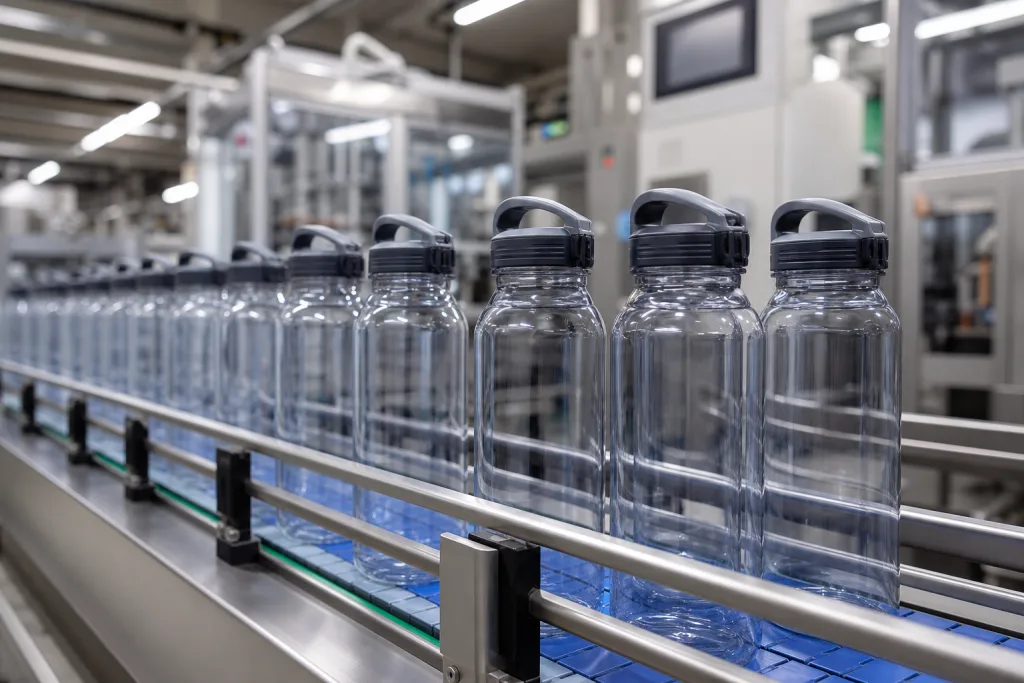
Key Takeaways
- For most B2B programs, a 650-750 ml Tritan bottle with 2.0-2.2 mm wall thickness gives the best balance of durability, weight, and FOB cost at USD 1.85-3.20.
- Screen printing works for 1-2 spot colors from MOQ 1,000 pcs, while wrap heat-transfer or full-body graphics usually need cleaner bottle geometry and tighter artwork tolerances.
- Leak performance depends more on lid structure and silicone compression than bottle body material; ask for a 100% vacuum or inverted leak check during packing.
- A practical first order from Zhejiang, China is often 3,000-5,000 pcs total across 2-4 colors, with 25-35 days production after sample approval.
You can buy a customizable tritan water bottle from 40+ factories in China, and 8 of them will show you near-identical photos on Alibaba. Then the bulk order lands and the trouble starts: haze after packing, strap anchors cracking at the pull test, logo print drifting 1.5 mm off center, or a lid leak rate your team rejects at inspection. We have seen QC pull a sample from the line that passed the golden sample and still failed after assembly. If you are a procurement manager or brand owner, the bottle is only half the buy. Repeatability is the other half.
For B2B custom drinkware, the right spec depends on your sales channel, target price band, decoration method, and how rough the end user will be on the bottle. A gym promo order at 3,000 pcs, a campus bookstore run, and a retail outdoor line should not share one spec sheet; this is the wrong shortcut. The useful comparison is not brand versus brand. It is bottle structure versus your actual use case, with hard numbers on MOQ, lead time, testing, and landed cost. We ship projects where 12 days vs 18 days changes the whole PO, and we have seen one typo on a color code throw off an entire cap match approval.
Start with the spec table
If you are comparing a customizable tritan water bottle across 3 to 6 suppliers, skip the catalog photos first. Build a working spec table from the quote. That forces the canteen manufacturer or canteen supplier to show where cost moves and where claims get soft. We see buyers miss this all the time on the line, then argue about a 2.0 mm body after the sample is already cut. Below is the comparison format experienced buyers actually run.
- Body capacity: 500 ml, 650 ml, 750 ml, 1000 ml
- Wall thickness: 1.6 mm economy, 2.0 mm standard, 2.2-2.5 mm heavy-duty
- Bottle weight: typically 95-110 g for 500 ml, 125-155 g for 750 ml
- Neck finish: wide mouth 55-63 mm or narrow mouth 38-45 mm
- Lid type: screw cap, flip straw, spout, carry loop, chug lid
- Decoration: silk screen, heat transfer, UV print, pad print, deboss on sleeve
- Compliance: REACH, LFGB, FDA, BPA-free declaration, color migration checks
- Packaging: bulk pack, white box, color box, PDQ, FNSKU labeling
For B2B custom drinkware, the body material is usually Eastman Tritan or an equivalent copolyester the buyer names on the PO. Ask the canteen factory to write the resin grade in the quote, not just “Tritan style” or “food grade plastic.” That is where claims go sideways. QC pulled a sample last month where the PO had “Trtian” typed instead of Tritan, and the supplier tried to slide in generic copolyester. In Zhejiang, China, a serious canteen vendor should also confirm whether lids are PP, ABS, or Tritan, because mixed-material lids change drop performance and dishwasher risk.
A clean starting point for costing is FOB Ningbo or Shanghai with accessories broken out line by line. If a canteen customizable project includes a silicone boot, tea infuser, strap, or shaker ball, list each one with its own price and MOQ. This is the wrong question to ask if you only want a single packed price, because the math doesn't work once revisions start. We ship projects where a strap color change adds USD 0.12, and a full-wrap print pushes lead time to 12 days vs 18 days depending on the artwork approval. A spec table keeps your canteen customized program under control.
Which bottle architecture fits
Customizable canteens should not share one build. The channel decides the structure. For a 3-month promo run, buyers usually push us on FOB, print area, and Pantone match on the cap; one PO even came in with “canten” typed on the header, but the target price was clear. Retail is different. Returns, drop performance, and lid consistency matter more than saving USD 0.18 per unit.
Best fit by channel
- Corporate promotions: 500-650 ml, 1.8-2.0 mm wall, screw lid, 1-color screen print. Lowest freight and easiest packing.
- Gym and sports: 650-750 ml, carry loop or flip spout, 2.0-2.2 mm wall, matte finish for grip.
- Outdoor retail: 750-1000 ml, heavy carry loop, 2.2 mm wall minimum, impact-resistant base design.
- School and campus: 500-700 ml, simple leakproof lid, fewer detachable parts, ASTM or CPSIA checks when children are involved.
We hear the same request from canteen distributors: “Make it a straw lid, it sells better on screen.” True, it photographs well. It also creates more after-sales trouble than a plain screw cap, and we’ve seen this go sideways on the line. QC pulled the sample on one run because the straw was 4 mm short and the gasket was half-seated after assembly. More parts means more variation in bite valve hardness, straw cut length, gasket placement, and hinge fatigue. If your canteen distributor channel sells online in Europe or North America, a 1% jump in complaints can wipe out the margin you thought you saved on the cheaper lid.
For a custom canteen in the USD 2-3 FOB range, the safest mainstream build is still a 650 or 700 ml body with a screw lid and TPE or silicone carry loop. We ship this spec every month because the math works. It fits corporate gifting, team merchandise, and distributor canteen programs without forcing special packing inserts or extra lid checks. If you are also sourcing a customizable growler or custom growler in the same container, keep the Tritan bottle SKU simple. This is the wrong place to add mechanism. Put the complexity in the stainless line, not in the bottle that lives under aggressive price control.
A bottle that looks more technical is not automatically better. For most B2B buyers, fewer lid parts means fewer claims.
Decoration choices change the economics
A customizable drinkware project usually breaks at decoration, not molding. We see it on the line all the time: the buyer approves the bottle shape first, then QC pulled the sample and the logo looked 6 mm too small, the Pantone drifted, or the print got scuffed after carton shake. For a customizable tritan water bottle, the decoration method has to fit the bottle radius, surface texture, and how rough the bottle will be used after delivery.
- Silk screen: the standard choice for 1-2 spot colors, with low plate cost, sharp logo edges, and MOQ usually 1,000 pcs per colorway.
- Heat transfer: works for multi-color graphics, but the surface needs tighter cleaning control, and the seam position can limit artwork placement.
- UV digital print: fits small runs and mixed SKUs, but adhesion testing is the first question. If the math doesn't work on rework risk, this method gets expensive fast.
- Laser engraving: not common on Tritan body; we usually run it on lid inserts or metal trim parts.
If you are a canteen custom buyer in promotions, screen print is still the practical option. It is cheaper, easier to hold in production, and less likely to fail rub tests if the curing temperature and time are locked first. Our normal check is a 3M tape test after full cure, plus a hand-rub test on 20 pcs per lot. Full-wrap artwork can look strong for canteen customized retail programs, but quote it straight. We ship projects where this adds USD 0.20-0.45 per unit depending on coverage, masking difficulty, and reject rate.
Ask your canteen manufacturer to define the printable panel in millimeters. “Large logo area” tells you nothing. You need numbers like 70 x 90 mm front panel or 210 x 80 mm wrap area, and you should also ask what fixture they use to hold the bottle during printing. On round bottles, logo levelness depends a lot on fixture repeatability; a 2 mm tilt is enough for the buyer to flag it.
In Zhejiang, China, lead time for a standard logo sample is often 5-7 days, while a new mold body can take 20-30 days for tooling plus sampling. For a canteen promotional order tied to a hard event date, pick an existing mold first. Then spend your time on print approval, barcode layout, and packaging details. We've seen this go sideways because of one PO typo on the barcode suffix, not because the bottle shape was wrong.
Lids, seals, and failure points
Most complaints we see on custom Tritan bottles are not body cracks. They come from lids that leak, carry loops that snap, or soft parts that smell after packing. On our line, QC pulled far more leaking cap samples than cracked bodies last quarter. So compare the closure system head-to-head; this is the right question to ask.
Common lid structures
- Single-piece screw cap: lowest cost, strongest leak control, and the easiest style for the line to hold steady from lot to lot.
- Screw cap with loop: still reliable if the loop anchor wall thickness is adequate, usually 2.5 mm or above on stress areas. We have seen buyers push for 2.0 mm to save resin, and the math doesn't work.
- Flip-top spout: easier for end users, but hinge wear shows up faster and the gasket seat has less room for error.
- Straw lid: strong sell-through in some retail channels, but it carries the highest claim risk once the straw, bite valve, and seal stack start interacting.
Ask for 3 tests at minimum: inverted leak test for 30 minutes, drop test from 1.0-1.2 m depending on package spec, and cycle test for hinged lids. We run hinge samples on a bench counter, not by hand, because hand-cycling gives you bad data. A sensible cycle target for a retail bottle is 3,000-5,000 open-close cycles. For promotional volume, 1,500 cycles may be acceptable if the target price is tight and expected use is shorter.
Silicone gasket hardness usually falls around 50-60 Shore A. Too soft, and the ring extrudes or twists during assembly. Too hard, and sealing gets inconsistent unless cap torque is controlled tightly; on one PO, the buyer flagged random leaks and we traced it back to uneven hand-tightening at packing. Ask the canteen supplier whether gasket installation is manual or fixture-assisted. Manual insertion still works, but we have seen this go sideways, so your AQL should reflect the wider variation window.
For incoming QC, 8 out of 10 buyers we ship to use AQL 2.5 for major defects and 4.0 for minor defects on mass-produced custom drinkware. Leak is always major. Strap flash, print pinholes, or slight color variation may be minor depending on your program. A factory that runs export orders should understand that language right away and answer with defect limits, sample size, and rework rules—not “we will control carefully.”
MOQ, lead time, and price bands
The biggest mistake we hear in China sourcing is “What’s your MOQ?” as if one number covers the whole project. It doesn’t. MOQ moves with bottle body color, lid color, decoration method, and packaging style. On the line, a simple shared-color bottle with a one-color silk screen runs differently from a custom Pantone lid with an inserted paper card. If you are speaking with canteen vendors or canteen manufacturers, ask which part is setting the MOQ. That question tells you fast if they know production, or if they are just forwarding a spreadsheet.
For existing molds, a normal MOQ for a customizable tritan water bottle is 1,000 pcs per SKU and 3,000 pcs total order. That is the common starting point. Some canteen distributors will split colors if the body and lid are standard stock, but once the buyer flagged custom Pantone matching, we usually had to move the practical MOQ to 2,000 pcs per color because the hopper clean-down and color loss make the math ugly. For new molds, expect mold cost from roughly USD 3,500 to USD 9,000 depending on complexity, plus 20-30 days for tooling. We’ve seen this go sideways when the PO says “new cap” but the 3D file actually changes the spout, hinge, and handle.
- 500-650 ml economy bottle: USD 1.35-1.95 FOB China
- 650-750 ml standard bottle: USD 1.85-3.20 FOB China
- Heavy-duty retail bottle with complex lid: USD 2.90-4.80 FOB China
Lead time for repeat orders is usually 20-30 days after deposit and artwork approval. For first orders with new packaging, plan 25-35 days. That extra week is normal. QC pulled the sample, carton drop test passed, then the buyer changed the insert card size by 12 mm and the packing line had to reset. In peak season, especially before summer promotions, Zhejiang factories can run tight. A plant with output around 600,000 units per month may still struggle if your order needs mixed decoration and hand-packed gift boxes.
If you are a canteen distributor or distributor growler buyer consolidating several categories, freight strategy matters. Tritan bottles cube out before they weigh out. So packaging design hits freight harder than most first-time buyers expect. Nesting is limited, and cutting gift box size by 8-10 mm can change container efficiency enough to matter on a 40HQ. Ask for carton dimensions, units per carton, and 40HQ loading quantity on day one, not after PO. We ship plenty of bottles where the unit price looked fine, then the outer carton came in at 68 cm and the freight cost ruined the quote.
Compliance and factory control points
If your market is Europe or North America, compliance sits in the product spec, not in a folder someone builds later. For a customizable tritan water bottle, lock the compliance file before mass production. We check the full BOM line by line: body resin, lid resin, color masterbatch, silicone seals, print ink, and any metal pin or handle part. This is where projects slip. We once saw a PO list “Triton” instead of “Tritan,” and QC stopped the sample before the line ran.
- Europe: REACH, LFGB where applicable, and migration testing based on final material structure
- US and Canada: FDA food-contact compliance references, plus CPSIA or ASTM checks if the product is for children
- Social and factory systems: BSCI, ISO 9001, and audit reports if your brand requires them
Do not accept an old generic test report on a “similar bottle.” Ask a direct question: does the report cover the same resin family, lid structure, and decoration method? If the bottle has printed graphics, the ink declaration has to match that exact setup. An undecorated sample report is not enough. We have seen buyers push back here, then lose 12 days waiting for a fresh declaration after artwork approval. The math does not work.
Factory control points should be short, specific, and on paper at the line. At BottleForge Industrial, a standard control plan in Zhejiang covers raw material confirmation, first-piece printing signoff, in-process leak checks every 2 hours, and final AQL inspection before export cartons are sealed. We run barcode verification and carton mark checks for Amazon FBA orders, and QC pulled one shipment last season over a 3 mm offset in the FNSKU label position. Those errors are expensive because they turn into pure rework.
When you compare canteen manufacturers in China, ask one practical question: what percentage of units get 100% leak testing? This is the right question. For a simple screw-lid Tritan bottle, some factories run 100% inverted testing during assembly with a leak rack; others only sample 5% to 10%. For complex lids, sampling is more common, and we have seen this go sideways. That difference matters more than a FOB gap of USD 0.08.
Use-case fit beats catalog variety
Buyers often ask for the widest catalog from canteen suppliers, canteen distributors, or a canteen factory. On paper, that looks efficient. On the line, it often sends you to the wrong bottle. We’ve seen buyers compare 40 shapes in one call, then stall over a 3 mm neck finish difference that actually affects cap fit. The better move is simpler: match one bottle architecture to one sales channel, then hold the spec.
If you sell into promotional distribution, stay with a standardized 650 ml body, 2.0 mm wall, screw cap, and 1-color screen print. Keep the FOB around USD 1.80-2.20, aim for MOQ 3,000 pcs, and use a bulk or white box pack. That math works. We run this type fast because the tooling is stable, and QC pulled the sample last month with print position held within 1.5 mm. If you sell into mid-tier retail, step up to a 700-750 ml body, heavier loop, soft-touch or matte finish, plus stronger package presentation. Budget USD 2.40-3.50 FOB with stricter AQL and drop-test standards. This is where buyers push for promo pricing with retail packaging, and the math does not work.
If your project sits beside a stainless custom growler, customizable growler, or distributor growler program, let Tritan cover the lighter, lower-cost everyday-use slot. Do not ask it to replace insulated steel. This is the wrong question to ask. A Tritan bottle and an insulated growler solve different jobs. Buyers who force one bottle to cover every use case usually end up with extra lid components, oversized print area requests, and weak margin. We’ve seen this go sideways after a PO typo changed a 2-piece lid into a 3-piece assembly, and the complaint rate followed.
The best canteen manufacturer for you is not the one showing 200 shapes. It is the one that keeps your chosen spec stable across repeat orders, documents compliance cleanly, and tells you straight when a design choice will raise claim risk. In China, especially in Zhejiang where supply chains are dense, you can find 20 canteen vendors in a day. Finding one that controls details is harder. We ship repeat programs where cap torque is checked with a digital torque tester every batch, because that is what keeps returns down, not another page in the catalog.
That is the real comparison: not bottle against bottle in a showroom, but spec stability against sales reality in your channel. Fancy assortment sells the first meeting. Stable production wins the second and third reorder.
Get a bottle spec checked before you place
Send your target price, capacity, lid type, and logo plan. We will review MOQ, compliance, and production risk from Zhejiang, China.
Frequently asked questions
What MOQ should I expect for a customizable tritan water bottle with logo?
For an existing mold, a normal starting point is 1,000 pcs per SKU and 3,000 pcs per order. If you need custom Pantone body and lid colors, practical MOQ often rises to 2,000 pcs per colorway because factories in China want stable injection runs and lower color-change waste. A simple 1-color silk screen logo is the easiest setup. Full-wrap heat transfer, custom gift boxes, or multiple lid combinations usually push MOQ higher. If you are a distributor drinkware buyer testing a new program, ask whether the factory can share one body color across several logos. That often helps you reach a workable first order without paying new mold cost.
Is Tritan good enough for retail, or only for promotional custom drinkware?
Tritan is suitable for both, but the spec must change by channel. For promotions, a 500-650 ml bottle with 1.8-2.0 mm wall thickness is common and cost-efficient. For retail, you should move to 2.0-2.2 mm walls, stronger loop geometry, better decoration adhesion, and stricter leak testing. The material itself can perform well, but a low-cost straw lid can still create returns. In practical terms, many retail buyers target FOB prices around USD 2.40-3.50 for a stronger 700-750 ml bottle. If your canteen supplier offers a retail-looking bottle under USD 1.70 FOB, check where they removed cost. It is usually the lid, gasket, wall thickness, or QC time.
Which decoration method is safest for long-term logo durability?
For most B2B orders, silk screen is still the safest choice when you want reliable logo performance at a reasonable price. It is best for 1-2 spot colors and usually works from MOQ 1,000 pcs. A properly cured screen print can pass basic tape and rub tests with low rejection rates. Heat transfer gives stronger visual impact for multi-color retail graphics, but it adds cost and demands better process control. UV digital print helps for small mixed-SKU runs, though adhesion must be verified. Ask your canteen manufacturer to confirm print cure time, fixture method, and test standard. Also request a signed logo position approval, because misalignment is a common mass-production dispute.
What compliance documents should I ask from a China canteen factory?
At minimum, ask for the material declaration for the bottle body, lid, gasket, and print ink, plus relevant food-contact test reports for your target market. For Europe, REACH and often LFGB-related testing are expected. For North America, buyers commonly request FDA food-contact references and additional checks when the product is intended for children. If your brand has social compliance requirements, ask for BSCI or similar audit status and ISO 9001 information. The key point is that the report should match the actual product structure you are buying. A generic report from a different lid or an undecorated bottle is not enough for a customized canteen program.
How long does production take, and when should I book inspection?
For an existing mold custom order, plan 25-35 days from deposit, artwork approval, and sample sign-off. Repeat orders often run in 20-30 days if components and packaging stay the same. New molds usually add 20-30 days for tooling and pre-production sampling. If your order includes custom gift boxes or multiple accessory packs, add buffer because hand-packing slows output. A practical inspection plan is pre-production sample approval first, then during-production inspection at 20-30% completion if the order is large, and final AQL inspection when 80-100% is packed. For leak-sensitive bottles, ask the factory whether they do 100% inverted leak checks before cartons are sealed.