Key Takeaways
- Typical MOQ for a stock customizable tritan bottle is 1,000-3,000 pcs per color, while a fully new mold usually starts at 5,000-10,000 pcs
- FOB China pricing for a 650ml Tritan bottle with one-color silkscreen is often USD 1.65-3.20 depending on lid, weight, and packaging
- Normal lead time is 7-12 days for pre-production sample and 25-40 days for mass production after deposit and artwork approval
- Ask for REACH, LFGB or FDA material declarations, leak test standard, AQL 2.5 inspection plan, and drop test data before PO release
You can source a customizable Tritan bottle from 20 or 30 factories in China and still land on the wrong neck finish, poor logo adhesion, or a cap that fails after a 1.2 m drop test. We’ve seen this go sideways. The quote looked complete, but the spec sheet missed the thread size, the silk screen cure standard, or even a 5 mm carton drop gap that QC pulled on the sample. For B2B buyers, finding a canteen supplier is easy. Filtering canteen manufacturers that actually understand compliance, decoration limits, and export carton details is the real job.
At BottleForge Industrial in Zhejiang, China, we hear the same buyer questions every week from procurement teams in Europe and North America: What is a realistic MOQ? How much should a Tritan bottle cost at 3,000 units? Which tests matter for retail versus canteen promotional programs? Last month, one buyer flagged a PO typo on cap color and it held the line for 2 days, so this is the wrong question to ask if the basic specification is still loose. If you are comparing a canteen factory, canteen vendor, or canteen distributor offer, this checklist-driven guide gives you a practical filter before you place tooling, approve samples, and ship 68 cm master cartons.
What exactly are you buying?
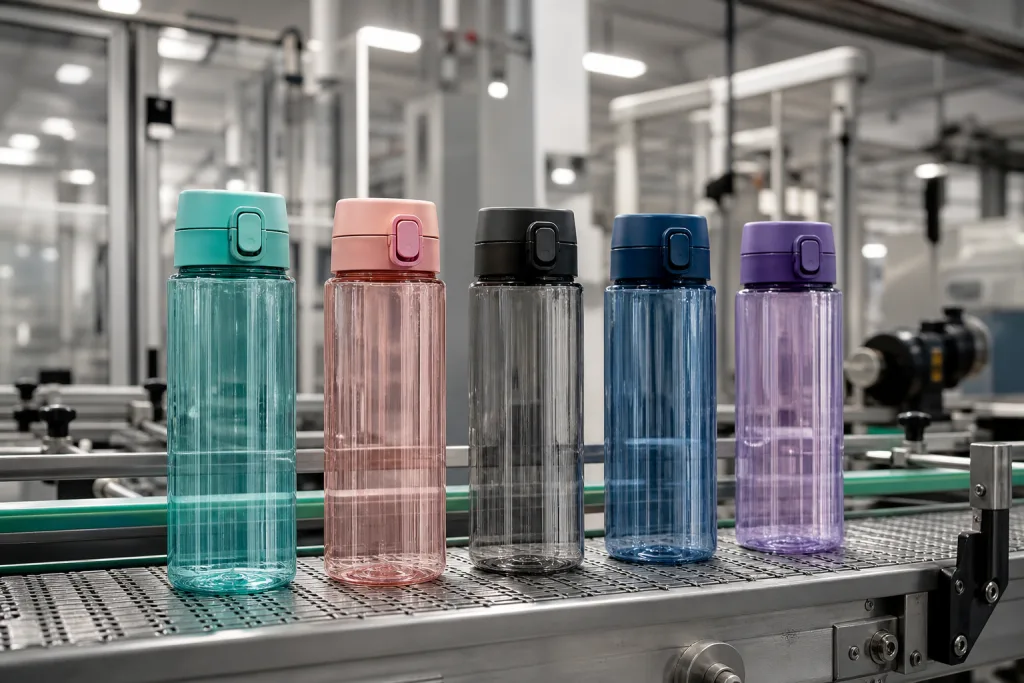
A customizable tritan bottle is not one SKU. It is a product family built from copolyester, usually Tritan, and the quote changes fast once you touch wall thickness, neck size, cap structure, or decoration. If your RFQ only says custom drinkware or custom canteen, the pricing you get back is apples to oranges. We see this every week: one factory prices a 155g body, another prices 210g, and both call it a 750ml bottle. One runs a PP lid with a TPE seal; another adds a stainless accent ring and carry loop, which means extra parts, extra assembly, and extra scrap risk on the line. The price gap can be 20% to 45% before anyone is doing anything shady. This is the wrong question to ask if you only want the lowest number.
Start with the basics you can control. On our side, QC usually pulls the first sample and checks body weight and mouth size with a digital scale and caliper before we release anything to the buyer.
- Capacity: 500ml, 650ml, 750ml, 1L
- Body weight: usually 140g to 260g depending on size and shape
- Wall thickness: commonly 2.0mm to 3.2mm for durable B2B retail programs
- Neck finish: wide mouth or narrow mouth, plus thread standard
- Cap style: screw lid, flip straw, chug spout, tethered cap
- Seal material: silicone or TPE, food-contact grade
- Decoration area: straight wall bottles print easier than heavily tapered bodies
If you are working with a canteen manufacturer in Zhejiang or elsewhere in China, ask for a specification sheet with bottle height, max diameter, unit weight, carton dimensions, and loading quantity by 20GP and 40HQ. A serious canteen factory already has that file ready, usually down to 1 mm and 0.1 kg on carton data. If they do not, problems show up later. We have seen carton mark approvals delayed over one PO typo, and we have seen freight plans go sideways because the quoted 40HQ loading qty was based on an old carton size.
One point buyers miss all the time: Tritan works well for lightweight, clear, impact-resistant customizable drinkware, but it is not the same thing as insulated stainless steel. If the end customer wants temperature retention for 6 to 12 hours, better odor resistance for coffee, or a premium shelf feel above USD 15 retail, you should look at a different platform. The math does not work if you expect Tritan to cover both use cases. For sports, school, gym, and canteen promotional campaigns, Tritan is usually the practical choice, and we ship plenty of these in 3,000 pcs to 5,000 pcs program lots.
Which specs belong on your RFQ checklist?
If you want clean quotations from multiple canteen suppliers or canteen vendors, write the RFQ like an engineering sheet, not a sales brief. Put the spec in black and white so 4 factories quote the same bottle, the same cap, and the same pack-out. We’ve seen one missing line on carton spec swing price by 6% after the first quote.
Minimum RFQ items
- Target market: EU, UK, US, Canada
- Compliance request: REACH, LFGB, FDA, BPA-free declaration, Proposition 65 if needed
- Capacity tolerance: for example 650ml plus/minus 3%
- Bottle material: Tritan TX1001 or equivalent approved grade
- Cap construction: PP lid + silicone seal + polyester strap
- Leak standard: 100% vacuum or upside-down test for 2 hours
- Decoration: 1-color silkscreen, 2-color print, heat transfer, or full-wrap sticker
- Packaging: polybag, egg-crate divider, white box, color box, or PDQ tray
- Inspection: AQL 2.5 major / 4.0 minor or your own standard
Procurement teams ask if they should combine customized canteen, customized drinkware, and even side items like custom growler in one sourcing file. Yes, but split every SKU line by line. This is where inquiries go sideways. A Tritan bottle factory may also quote a customizable canteen or customizable growler, but the mold cost, leak point, and carton drop result are not the same. We had one buyer send 3 bottle types under one PO note with the strap color typed wrong, and the quote round lost 2 days.
At our Zhejiang, China operation, we normally quote stock-shape Tritan bottles from a 1,000-piece MOQ per colorway, and most custom logo projects move faster if artwork is supplied in AI or vector PDF. Pre-production sample lead time is usually 7 to 12 days. On the line, QC pulled the sample and checked bottle weight on a 0.1 g scale before sign-off. If your supplier cannot confirm bottle weight, mold cavity count, and expected output per day, this is the wrong question to skip; you are not really buying from a disciplined canteen manufacturer, you are buying from a trading layer that may not control the schedule.
How much should it cost you?
Most buyers ask for unit price first. Fair enough. But this is the wrong question to ask before the spec is locked, because a 650ml Tritan bottle with a 58mm neck, lighter body, and one print pass prices differently from the same bottle with a loop lid and matte spray. For a stock 650ml customizable tritan bottle, common FOB China ranges look like this:
- Basic single-wall bottle, screw cap, no strap, 1-color print: USD 1.65-2.10 at 3,000 pcs
- Better body weight, carry loop, matte finish, 1-color print: USD 2.10-2.75 at 3,000 pcs
- Flip straw lid, extra mold parts, color box: USD 2.60-3.20 at 3,000 pcs
- Retail-ready gift box or multiple print locations: add USD 0.25-0.80
Tooling is separate. If you choose an existing mold from a canteen factory, there is usually no new mold charge, and we just confirm neck finish, cap fit, and bottle height on the sample table. If you need a fully canteen customized body shape, expect a new bottle mold from roughly USD 3,500-8,000. Complex lids go higher. New cap tooling can add another USD 1,500-4,000. We have seen this go sideways when a buyer changes the silhouette after 3D drawing approval. For a custom growler or customized growler with multiple components, the tooling burden is usually higher.
Do not ignore the hidden cost lines. QC pulled the sample once and found the logo shifted 2mm, which turned a simple approval into a reprint discussion:
- Sampling fee and courier
- Third-party testing, often USD 250-600 per SKU depending on scope
- Extra logo color charges
- Barcode labels, FNSKU, or carton mark changes
- Drop-test packaging upgrades
- Sea freight carton optimization
A reliable canteen supplier should spell out where the volume breaks start. A move from 3,000 to 10,000 pcs can cut unit cost by 8% to 15%, depending on bottle weight, decoration method, and whether we run screen print or heat transfer on the line. At a factory with 300,000 units monthly capacity, that jump is normal. At a small workshop, the math does not work, and the same quote can turn into a late shipment after the buyer flagged the lead time. If you are buying for a distributor drinkware program or a seasonal distributor canteen rollout, cost without a realistic ship window is not a real quotation.
Can the logo survive real use?
This is where first-time buyers get burned. The approval photo looks clean, then the logo fails after 20 dishwasher cycles, hand-sweat rub on the commute, or carton-to-carton scuffing in transit. We have seen QC pull a sample that passed the photo check and still lost ink at the shoulder radius after a simple dry-rub test. The right decoration is not a style question. It depends on bottle shape, body color, and how rough the end use will be.
For Tritan bottles, common decoration options are:
- Silkscreen: lowest cost, good for 1 to 2 colors, works best on straight wall areas; on our line we usually ask for at least 35 to 45mm of clean print height
- Heat transfer: more design flexibility, better for gradients or multicolor graphics; better choice when the buyer flagged fine text under 2mm
- Pad print: useful for small curved cap areas; we run this for cap tops and narrow side tabs where the jig has to hold position tight
- Digital print or sticker label: acceptable for short runs, less ideal for heavy abrasion; fine for 500 to 1,000 pcs promo jobs, weak for hard retail handling
- Laser engraving: generally used on metal parts, not on clear Tritan bottle bodies; this is for lids, rings, or stainless base parts
For most canteen promotional orders, one-color silkscreen is the cost-efficient choice. Still, a nice sample is not the right question to ask. Ask for the adhesion test standard. A practical requirement is cross-hatch adhesion after curing plus 50 rub cycles with a dry cloth and 50 with alcohol on printed areas, depending on your retailer's policy. If the bottle is meant for e-commerce, have the supplier run a packaged drop test from 76cm to 1m on corners and flat faces. We ship this test with actual master carton packing because the math does not work if the sample bottle is dropped loose.
If your end user expects dishwasher-safe decoration, say it at RFQ stage. Many low-cost logo offers assume hand wash only.
A capable canteen vendor or canteen manufacturer will tell you early if the artwork needs adjustment because of bottle taper, handle interference, or seam location. That is a good sign. We usually mark the seam line on the layout before sampling, and the buyer catches problems faster. The wrong supplier says yes to everything, then sends a pre-production sample with a compressed logo or an off-center print by 2 to 3mm. Whether you buy a customizable canteen, a Tritan bottle, or a customizable growler, decoration quality comes down to process control: fixture accuracy, curing time, ink compatibility, and incoming body cleanliness. We have seen this go sideways from something as small as dust on the bottle body before printing.
What compliance and QA should you demand?
For Europe and North America, compliance is not paperwork you file at the end. It is part of the bottle spec from day one. A canteen supplier should tell you, up front, whether your SKU needs REACH, LFGB, FDA food-contact declarations, CPSIA for children-focused products, or California Proposition 65 screening. If the bottle is sold as a kids item, ASTM-related mechanical safety points also come into play, especially small parts and strap pull force. On our side, QC will usually check strap retention on a pull gauge before we sign off the sample. If a supplier answers this in general terms, that is the wrong question to accept.
Ask for the following before deposit, or at least before production starts:
- Material declarations for Tritan body, PP lid, silicone seal, color masterbatch
- BPA-free statement tied to actual raw material grade
- Existing test reports or a fresh lab test plan under your SKU
- Factory audit status such as BSCI or ISO-style quality system controls
- Inspection plan with AQL level and critical defect definition
- Leak test method and frequency
- Drop test and carton compression data if shipping direct to retail or FBA
At BottleForge Industrial, we treat leakage, crack, wrong logo, and wrong color as high-risk defects. We ship export orders from Zhejiang every week, and the line normally runs in-line checks on cap torque, thread match, and print position, then final inspection by AQL. QC pulled the sample if cap torque drifted outside the set range on the torque meter, because that is where leaks start. Many buyers accept AQL 2.5 major / 4.0 minor, but premium retail programs often ask for tighter limits and 100% visual check on logo placement within 1 mm. We have seen this go sideways when the buyer flagged a color that matched the approved chip under office light but failed under store lighting.
If you work through canteen distributors or a distributor growler channel, do not assume they already cleared compliance for your exact version. A color change, different seal, or new print ink can trigger retesting. We have had buyers change only the strap Pantone and then get pushed into a new screening request because the masterbatch changed. That is why the best canteen manufacturers keep traceability by raw material batch, production date, and which line ran the order. We run batch records down to the resin lot and carton date code. If a supplier cannot tell you which line ran your order and when, a quality claim turns into 12 days instead of 3, and the math does not work.
How do you judge supplier fit?
Not every supplier fits every order. We’ve seen a big canteen manufacturer quote fast, then push back on a 1,000-piece mixed-color launch because their line was set for 10,000 units per color. A small workshop might say yes to custom work, but QC pulled the sample and found the carton mark missing on 2 of 6 boxes. Your channel decides the fit. This is the right question to ask.
If you sell to retail chains, ask these practical questions:
- What is your real MOQ by bottle color and by logo color?
- Can you mix 3 colors in one 3,000-piece order?
- What is your monthly output for Tritan bottles?
- Do you assemble caps in-house or buy from a partner?
- How many days from deposit to shipment in peak season?
- Can you support carton barcode, pallet spec, and retailer routing guides?
For Amazon or DTC programs, add questions on FNSKU labeling, suffocation warnings, master carton weight, and whether the bottle can pass common parcel drop expectations. We ship cartons under 15 kg for some accounts because the buyer flagged overweight handling fees. Ask for a real drop-test standard too, not a vague “pass.” We’ve seen this go sideways at 76 cm drop height with a loose lid fit. For a promo buyer or canteen distributor, speed and print flexibility usually matter more than premium packaging.
A simple rule: if a canteen vendor replies to every technical question with “no problem” in one email, slow down. Experienced suppliers in China usually ask back about shipping mode, wash-care claims, target price, and compliance region. We run into this every week. A serious factory will also ask whether you need side mark, barcode placement in 50 mm x 30 mm, or EU vs US testing. That means they are thinking ahead. In Zhejiang, plenty of factories are strong on production but weaker on follow-up and paperwork, so your evaluation should weigh manufacturing capability against project management discipline.
We advise buyers to score suppliers on five lines: price, speed, documentation, customization depth, and claim handling. Put numbers on it. For example, 12 days vs 18 days for repeat orders, 24-hour response vs 3-day response on claim emails, or 7 days vs 60 days to close a replacement case. A low unit price means little if nobody owns the issue after shipment. Whether you need canteen customized products, a customized drinkware range, or expansion into a distributor canteen network, pick a partner that still answers the phone after the container sails.
When should you choose Tritan or not?
Tritan is the sensible pick when you need a clear, light, impact-resistant bottle for daily hydration. We ship it for school programs, office use, gym chains, cycling kits, and promo orders in the 3,000 to 10,000 pcs range. If your target landed cost is tight and freight matters, a customizable tritan bottle is usually easier to scale than stainless steel. A 650ml Tritan bottle may weigh 160g to 220g; a double-wall steel item can be two to three times that. The carton math is plain, and this is the right place to compare.
Choose Tritan when you need:
- Transparent or translucent bottle aesthetics, with color matching checked against a Pantone cap chip on the line
- Lower freight cost per unit, especially when the buyer flagged the outer carton weight at 12 kg max
- Good impact resistance for active use, like bottles that survive a 1.2 m drop test better than brittle clear plastics
- Fast development from existing molds, often by changing the lid, handle, or 0.3 mm logo screen only
- Competitive pricing for customizable drinkware programs, starting from stock-body MOQ runs instead of fresh tooling
Do not choose Tritan because it is cheap. We have seen this go sideways when the PO asks for 12-hour cold retention, premium gifting, or a metallic finish; stainless is the better answer. If your program is for carbonated beverages, very hot fill, or rough industrial environments, confirm the exact performance requirement before committing. QC pulled the sample more than once for stress-whitening around the neck after pressure use. The same logic applies to adjacent items like a customized growler or custom growler; material selection must follow use case, not quote comparison.
For B2B buyers, the fastest route is usually simple: start with a stock bottle shape, change the cap color and logo, test the market, then open tooling after you have reorder data. We run projects like this in 12 days vs 18 days for a full new mold review, and the risk is lower. One recent PO even had the lid finish typed wrong, and we caught it before sampling because the stock option was already on file. It is not glamorous. It keeps margins intact before you commit to a fully canteen customized platform.
Send your Tritan bottle spec for a firm quote
Share capacity, logo file, target market, and packaging needs. We will reply with MOQ, FOB pricing, lead time, and compliance options from Zhejiang, China.
Frequently asked questions
What is the normal MOQ for a customizable tritan bottle?
For a stock mold, most factories in China will quote 1,000 to 3,000 pieces per color, with logo setup charged separately. If you need custom body color plus custom cap color plus retail box, the practical MOQ is usually closer to 3,000 pieces. For a fully new mold, expect 5,000 to 10,000 pieces as a starting point, sometimes more if the cap has several moving parts. Always ask whether MOQ is based on total units, per SKU, or per colorway. A quote saying 1,000 pieces can be misleading if the supplier actually means 1,000 per bottle color and 1,000 per cap color combination.
How long does production take after sample approval?
A realistic timeline is 7 to 12 days for a pre-production sample after artwork and color are confirmed, then 25 to 40 days for mass production after deposit. If you add new packaging, third-party lab testing, or peak-season congestion before Christmas, total lead time can push to 45 to 60 days. Ask your supplier to break the schedule into sampling, material purchasing, molding, printing, assembly, inspection, and booking. That matters more than a single promised date. In Zhejiang, China, factories with in-house assembly usually control lead time better than suppliers that outsource lids or printing.
Which tests should I request for EU and US markets?
For a Tritan bottle, common requests include REACH screening for the EU, LFGB where required by your customer, and FDA food-contact declarations for the US. You should also request BPA-free statements tied to the actual resin grade, plus leak testing, odor check, and basic drop testing in final packaging. If the bottle is for children, ask whether CPSIA-related requirements or additional mechanical safety checks apply. Lab cost often runs USD 250 to 600 per SKU depending on scope. Do not rely only on old reports from a different lid or color. A new seal material or print ink can change the risk profile.
What logo method is best for promotional versus retail orders?
For promotional orders, one-color silkscreen is usually the best balance of cost and speed. It keeps unit cost low and works well from 1,000 to 5,000 pieces if the print area is fairly straight. For retail, especially if the design uses multiple colors or finer graphics, heat transfer can look cleaner and more consistent, but it adds cost and time. Expect a simple one-color print to add around USD 0.05 to 0.12 per unit, while more complex decoration may add USD 0.15 to 0.40 or more. If the bottle is likely to be dishwashed, ask for written care instructions and decoration durability testing before you approve artwork.
How do I compare a factory, trading company, and distributor offer?
Compare them on total control, not just price. A factory usually gives you better visibility on mold status, output, and production timing. A trading company can still be useful if they manage communication well and combine several SKUs, but ask who owns quality claims and who arranges replacement if defect rate exceeds AQL. A distributor offer may be fastest for stock programs, but customization is often limited. Request the same checklist from all three: MOQ, unit weight, material grade, compliance documents, AQL standard, lead time, tooling status, and carton specs. If one quote is 15% cheaper but missing two of those items, it is not a true comparison.