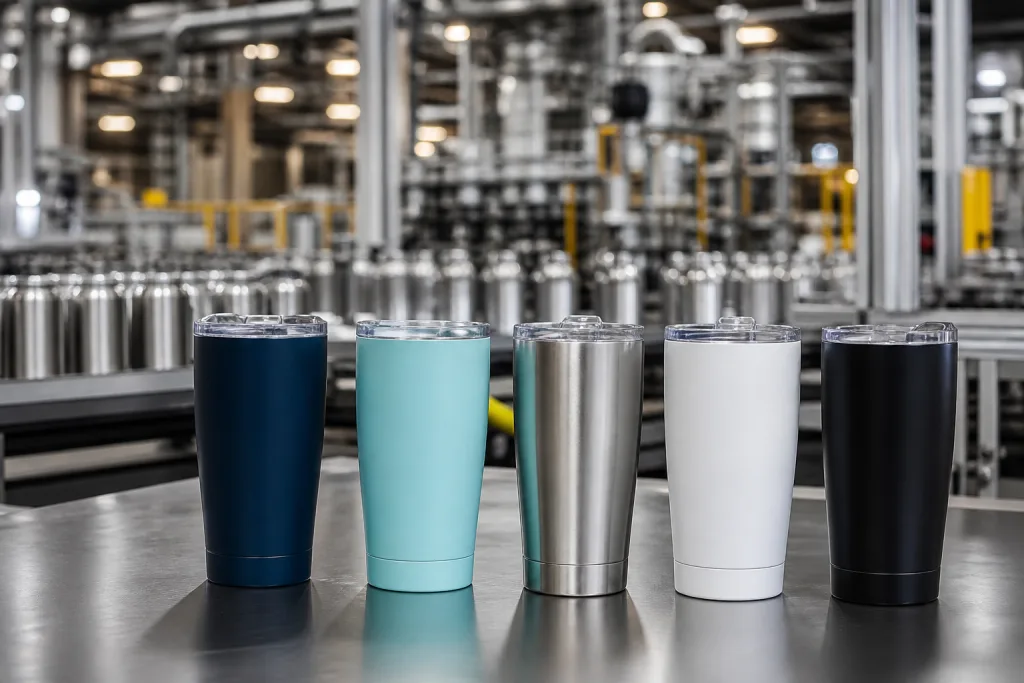
Key Takeaways
- A practical MOQ for a custom-color tumbler is usually 1,000-3,000 units, while logo-only orders can start around 500 units.
- FOB pricing for a 20 oz double-wall 304 stainless tumbler typically lands at USD 3.20-5.80 depending on lid, coating, and print method.
- Standard production lead time from Zhejiang, China is often 25-35 days after sample approval; new-tool lids can add 15-20 days.
- For retail and gifting programs, ask for AQL 2.5 inspection, REACH testing, and 24-hour leak testing before balance payment.
You can source a travel tumbler from 20 trading companies before lunch. The hard part is buying the right customizable travel mug spec: 304 stainless that matches the PO, printing that still looks clean after 300 dishwasher cycles, lids that do not seep after a 1.2-meter drop test, and a landed cost that still leaves room for margin. We ship this every week, and this is the wrong question to ask: “What’s your best price?” The better question is what fails first on the line. That matters if you run a coffee brand, buy for corporate gifting, or manage a distribution program in Europe or North America.
At BottleForge Industrial in Hangzhou, Zhejiang, we see the same pattern 3 to 4 times a week: a buyer asks for a quick quote on a bulk travel tumbler, then the real variables show up—steel grade, lid tooling, decoration method, testing scope, carton configuration, even a logo size off by 2 mm on the PO. China gives you options fast. Zhejiang usually gives you 12 days vs 18 days on repeat orders if the mold and artwork are locked. Still, sales talk is cheap. QC pulled the sample, found a loose slider fit at 0.3 mm over tolerance, and the buyer flagged leakage risk before shipment. You need a checklist that filters that out.
What are you actually buying?
When you request a customizable travel mug, you are not buying one SKU. You are buying a spec sheet with cost drivers on every line: body material, vacuum structure, lid style, surface finish, logo method, pack-out, and compliance. Leave those lines open and the quote spread gets messy fast. We see this every week. Two China factories can quote the same 20 oz tumbler at USD 3.40 and USD 5.90, and both numbers can be right because one shop priced a 0.4 mm outer wall with a plain white box while the other priced thicker steel, tighter color control, and drop-test packaging.
Start with the use case. A coffee shop loyalty program usually wants a clean coffee mug custom look, stable repeat orders, and a cost that still works at 500 pcs MOQ. A corporate-gift buyer usually asks for a better unboxing experience, because the buyer flagged scuffs on the last lid batch and did not want that fight again. A coffee mug distributor often wants one body shape that can run across 6 customers with only artwork changes. That is the wrong question to skip: who will use it, and how hard will they be on the cup?
- Material: 18/8 or SUS304 inner wall is the normal baseline for hot drinks, and QC usually checks the coil cert against the PO before the line runs.
- Construction: Double-wall vacuum is standard; single-wall is cheaper but poor for heat retention, and the math does not work if the end user expects 6-hour hot holding.
- Capacity: 12 oz, 16 oz, 20 oz, and 30 oz are the common commercial sizes, though the actual brimful volume often lands a few ml over nameplate size.
- Lid: Slider, flip, screw, or straw-compatible lids change complaint rates more than buyers expect; we have seen leak complaints swing on a 1 mm silicone fit issue.
- Finish: Powder coat, spray paint, electroplating, or bare steel each affects branding and durability, and cross-hatch tape tests on the coating tell you a lot fast.
If your brief simply says bulk coffee mug or bulk coffee travel mug, you will get generic quoting. Factories fill in the blanks their own way, and then buyers compare numbers that are not built on the same spec. A better RFQ states: 20 oz, 304 inside and outside, double-wall vacuum, powder coat Pantone black, transparent AS slider lid, one-color silkscreen, white box, 1,000 units, FOB Ningbo. We ship quotes like that faster because the sales engineer can hand the sheet straight to costing, and Zhejiang factories can quote it in a way you can actually compare.
MOQ, price, and where quotes move
Buyers new to coffee mug bulk sourcing usually start with unit price. Fair enough. Still, this is the wrong first question. MOQ, decoration method, and packing spec move the total more than buyers expect. On our line in Zhejiang, for a standard mold travel tumbler, we usually quote in these bands:
- 500 units: workable for logo-only orders on stock colors; we run these on existing cartons with no color change on the coating line.
- 1,000 units: common MOQ for a custom logo plus standard lid and box; this is where most buyers land on the first PO.
- 3,000 units: realistic if you want custom body color, custom lid color, and upgraded gift box; below this, the math often does not work once you add setup waste.
- 5,000+ units: where private-label packaging and dedicated accessory sets start making economic sense; think custom insert, hangtag, and spare straw or gasket packed as one SKU.
Typical FOB China pricing for a 20 oz bulk travel mug runs like this:
- Single-color logo on stock powder coat: USD 3.20-3.90
- Custom Pantone powder coat plus silkscreen: USD 3.80-4.60
- Laser engraving on powder coat: USD 4.00-4.90
- Gift box, insert, barcode labeling, and spare gasket: add USD 0.35-0.90
The biggest quote movers usually do not show on a render. Steel thickness is one. A build with 0.5 mm outer and 0.4 mm inner wall costs more than a lighter cup, but it takes dents better; QC pulled samples before with shoulder dents after a 76 cm drop test, so this point is not theoretical. Lid style can move cost by 8% to 20%. Custom packaging can cost less than repeated Amazon or retail damage claims, especially for a bulk coffee tumbler program that ships through 3 or 4 warehouses. We have seen this go sideways when the buyer approved a nice-looking box with weak E-flute and no corner protection.
Ask every supplier to separate body cost, lid cost, decoration cost, and packaging cost. If they give you one round number only, you cannot manage trade-offs later.
A serious coffee mug factory direct quotation should also state mold status, sample charge, carton dimensions, and estimated loading quantity per 40HQ. Ask for carton gross weight too; once a PO showed 12.5 kg on the spec sheet and 14.1 kg on the actual outer carton, and the buyer flagged it right away. That is where procurement savings usually show up, not in pushing for the last USD 0.05 on a vague quote.
Which materials and lids hold up
If you sell hot drinks, material choice is not cosmetic. For a coffee mug custom made project, 18/8 stainless steel is the safe mainstream pick because it resists rust, does not hold odor, and is easy for us to source at stable volume in China. On the line, we usually check inner wall thickness with a micrometer at 0.4 mm. Some factories will quote 201 stainless to cut cost on the outer wall. That is fine for some promo programs, but the inner wall should stay 304 for drink contact. This is the wrong place to save $0.18 if the mug is meant for repeat use.
Practical specs worth putting on the PO
- Inner wall: SUS304, 0.4 mm minimum
- Outer wall: SUS304 or 201, 0.4-0.5 mm
- Vacuum retention: 6 hours hot, 12 hours cold as a commercial baseline
- Lid material: AS, PP, or Tritan depending on transparency and durability target
- Seal: food-grade silicone, removable for cleaning
Lids cause more returns than bodies. We ship plenty of good stainless bodies that get blamed because the slider lid drips after a bag drop. If you are a coffee mug manufacturer buyer for resale, ask for an upside-down leak test, a drop test with the unit filled, and spare gasket availability by SKU. QC pulled one sample last month where the silicone ring was twisted 2 mm at assembly, and that was enough to fail. Not every tumbler is fully leakproof; some are splash-resistant only. The buyer flagged this wording on the carton before mass production, and that saved a complaint cycle later.
For coffee brands, a narrower base matters if the mug has to fit standard vehicle cup holders. We see 72 mm to 74 mm work better than 78 mm on most car holders. For corporate gifting, a screw lid with a lock usually earns the higher price because complaint rates drop. We have seen the cheap press lid go sideways after one season, especially on giveaway orders where the PO already had tight cost pressure. Unless the product is purely promotional, the math does not work on the cheapest lid on the sheet.
If you need a coffee mug customizable platform for several campaigns, keep one body shape and change the finish or print. We run this setup often with MOQ 3,000 per color, and it cuts sampling time and spare-part mess. It also avoids repeat approval on fit, lid match, and carton size. One buyer even had a PO typo on lid color code, but because the body stayed standard, we fixed it fast without reopening all samples.
How should your logo be applied?
Decoration is where 7 out of 10 coffee mug customized projects go wrong. The rendering looks clean. The production sample looks fine. Then the logo starts scuffing by day 30 because the method did not match the finish, the artwork, or the way the tumbler gets used on the road. On travel tumblers, we usually run four options on the line: silkscreen, laser engraving, heat transfer, and full-wrap digital transfer. A quick cross-hatch tape test with 3M 600 tells us a lot before mass production.
- Silkscreen: lowest cost, good for 1-2 solid colors, usually USD 0.08-0.18 per color.
- Laser engraving: durable and premium, especially on powder-coated bodies, usually USD 0.20-0.45.
- Heat transfer: works for multi-color graphics and small gradients, but QC needs to check abrasion resistance with a dry rub test and an alcohol wipe.
- Full-wrap print: strong shelf impact, but alignment tolerance and scratch testing matter; on a tapered body, even a 1.5 mm shift gets flagged fast.
For most B2B buyers, laser on powder coat is the safe middle ground. This is usually the right call for a 1,000-5,000 piece order because it gives a clean retail look, low fade risk, and no color registration headache. We have seen buyers push for cheaper screen print on a textured powder coat, and the math does not work once complaint replacements start. Silkscreen still fits a coffee mug promotional order when you need 2,000 units in 12 days instead of 18 and unit cost matters more than long service life.
If you are building coffee mug promotional products for events, ask the factory to test logo adhesion after 100 dishwasher cycles only if the product is claimed as dishwasher safe. This is the wrong question to ask on hand-wash-only insulated tumblers. Many double-wall models are not built for dishwasher use, and we have seen this go sideways when a buyer copied a marketplace listing without checking the care instruction on the PO. A serious coffee mug oem manufacturer should say this directly, and QC should pull the sample after cycle 20, 50, and 100 to record any edge lift.
For private label, include these details in artwork approval:
- logo size in mm
- print position from seam or handle reference point
- Pantone code or engraving area
- orientation relative to sip opening
- barcode and FNSKU placement if needed
It sounds basic. It is where most decoration claims start. One missing note like “logo centered to slider opening” or one PO typo on logo width, 28 mm vs 82 mm, is enough to stop packing. The best coffee mug supplier is not the factory that says yes first. It is the one that writes the tolerance clearly, usually ±1.5 mm for print position, before production starts.
What should you verify before mass production?
A pre-production checklist saves more money than squeezing 3% on price. It does not matter if you found a coffee mug supplier list, met the factory at Canton Fair, or pulled names from a coffee mug supplier directory. The checkpoints stay the same. At BottleForge Industrial, we run lines in Hangzhou, Zhejiang up to 300,000 units per month across drinkware, and we still stop jobs over a 0.5 mm logo shift. Capacity is easy to quote. Clean approvals are harder.
Before deposit, confirm:
- Sample stage: stock sample, pre-production sample, and golden sample are different approvals. We have seen buyers sign off a stock sample, then flag the PP sample because the powder coat felt rougher on the line.
- Compliance: REACH for EU, FDA/LFGB depending on market, and CPSIA/ASTM where relevant for gift sets with kid use claims. Ask for the actual test scope, not one old report from another SKU.
- Audit status: BSCI or equivalent social compliance if your retailer requires it. This is the wrong question to ask after the PO is placed.
- Inspection: AQL 2.5 for major defects is a practical baseline. QC pulled the sample and failed 2 lids last month for misfit after torque testing.
- Packaging: drop-tested inner box, master carton burst strength, and pallet rule if your warehouse requires it. One buyer flagged a 5-ply carton crush issue only after the first container landed.
Lead time from China for a standard coffee mug private label order is normally 25-35 days after sample approval and deposit. If you need a custom lid mold or a special electroplated finish, plan 40-55 days. Peak season from August to November in Zhejiang can stretch that by another 7-10 days. We usually tell buyers to build in 3 extra days if the logo has two print positions or if the PO has mixed carton marks, because that is where the line gets slowed down.
If you are sourcing from several coffee mug manufacturers, ask each one to send a defect photo standard. That document should define what counts as acceptable coating variance, logo offset, weld marks, dents, and lid scratches. Put numbers on it where you can: logo offset within 1 mm, visible dent depth, scratch length on the lid ring. A vague “factory standard” is not a standard. We have seen this go sideways, especially when the buyer and factory are looking at different golden samples.
Private label, distributor, or promotional order?
The right buying model depends on where you sell. A coffee brand launching merch needs a different setup than a coffee mug distributor supplying promo resellers, and a corporate-gift buyer chasing a 15-day ship window is different again. We’ve seen this go sideways when all 3 get quoted on the same 20 oz drawing and the same carton plan.
For coffee mug private labeling, the priority is repeatability. Pick 1 stable mold, 1 approved carton spec, 1 finish family, and lock logo position with a jig instead of rechecking artwork on the line every run. You may pay more at the start, but the reorder math works better: 12 days vs 18 days is common once the PO, packaging, and PMS color are frozen. MOQ usually starts around 1,000 units per colorway, sometimes 500 if you use stock finishes.
For a distributor model, flexibility matters more than custom development. Most coffee mug distributors ask us to run a core tumbler platform in 4-6 stock colors with quick logo swaps, and the buyer usually flags lead time before unit price. In that case, a factory holding semi-finished bodies and lids in China is stronger than one pushing new tooling on every inquiry. This is the wrong question to ask: not “How custom can you go?” but “How fast can you reprint and ship 2,000 mixed-color units?”
For promotional campaigns, simplify the spec. Choose a standard 16 oz or 20 oz body, 1-color print, stock lid, and white box, then keep the master carton under 12 kg so warehouse handling stays easy. That is how we ship a reliable coffee mug in bulk order without overengineering. Promo buyers usually care more about hitting the ex-factory date than tuning every retail detail.
If you are comparing a coffee mug factory against a trader, ask who controls tooling, in-house inspection, and final packing. Some traders manage projects well; some lose control once production hits 80% and QC pulled the sample with a crooked logo or a PO typo on the gift box barcode. The practical question is simple: who fixes the problem on the same day, on the line, without passing blame around?
The best supplier relationship starts narrow. One well-defined tumbler, one target market, one packaging format. After the first program runs clean at inspection—say AQL 2.5 with no lid-fit issue on the drop test—then scale into gift sets, alternate capacities, or seasonal colors.
Get a clear tumbler quote before you commit
Send your target size, lid style, logo method, packaging, and quantity. We will quote the practical options, MOQ, and lead time from Zhejiang, China.
Frequently asked questions
What MOQ should I expect for a customizable travel mug order?
For a standard mold travel tumbler, 500 units is realistic if you use a stock body color and only add a simple logo. If you need a custom Pantone coating, color-matched lid parts, or retail gift box packaging, expect 1,000 to 3,000 units per SKU. A fully custom lid or new body mold usually starts at 3,000 to 5,000 units because tooling and setup need to be absorbed. In Zhejiang, China, many factories will quote a lower MOQ to win the project, then restrict color options later. Ask the supplier to define MOQ separately for body color, lid color, print method, and packaging so you know where the real minimum sits.
How much does a bulk coffee travel mug usually cost?
A normal FOB China price for a 20 oz double-wall vacuum tumbler with SUS304 inner wall is about USD 3.20 to 5.80. At the lower end, you get a stock powder-coated body, standard slider lid, and one-color logo. At the higher end, you add custom color, laser engraving or wrap print, upgraded lid, and custom box. Small add-ons matter: a better gasket, individual polybag, barcode sticker, and stronger insert can add USD 0.10 to 0.60 per unit. If you need DDP pricing to Europe or North America, ask for carton count, carton weight, and CBM first. Freight can change the final landed cost by 12% to 25%.
Which tests matter most before I approve mass production?
For a travel tumbler, start with leak testing, heat-retention testing, coating adhesion, and basic drop testing. On compliance, EU buyers usually ask for REACH, and many retail programs also require food-contact testing depending on the material set. For North America, requirements vary by channel, but FDA-related food-contact expectations are common. If your tumbler is part of a gift set, packaging tests matter too: carton drop test, barcode scan check, and insert fit verification. On inspection, AQL 2.5 for major defects is a practical baseline. I also recommend approving a golden sample with exact print size in mm, logo position, and finish texture noted in writing before production starts in China.
Should I choose laser engraving or silkscreen printing?
If durability matters more than the lowest unit cost, choose laser engraving on a powder-coated tumbler. It usually adds about USD 0.20 to 0.45 per unit, but the result is cleaner and less likely to fade or scratch during daily use. Silkscreen is still useful when you need strong spot colors, a lower entry cost, or a fast promotional run. That print method commonly adds USD 0.08 to 0.18 per color. For corporate-gift buyers, laser tends to reduce post-delivery complaints. For event giveaways, silkscreen is often enough. The deciding factors are expected lifespan, logo style, and whether your customer will treat the item like a retail product or a short-term promotion.
How long will production and shipping take from China?
For an existing tumbler mold with approved artwork, production usually takes 25 to 35 days after deposit and sample sign-off. If you need a new lid, special finish, or custom packaging insert, plan 40 to 55 days. During peak export months in Zhejiang, especially from late summer into Q4, lead time can stretch another 7 to 10 days. Sea freight then depends on destination and service level, but many buyers use 30 to 45 days as a rough planning window from China port departure to final warehouse receipt. If timing is tight, ask whether the factory can stage printing after body production or split shipments by finished carton quantity.