Key Takeaways
- A practical MOQ for a custom logo shaker bottle is usually 3,000-5,000 pcs per model, with 25-35 days production lead time in Zhejiang, China.
- For a 700 ml PP shaker, FOB China pricing often lands around USD 1.05-1.85 depending on mold status, print method, and color count.
- Ask for AQL 2.5/4.0 inspection, 1.0 m drop testing, 50-cycle lid test, and odor testing before paying the balance.
- If you run multiple gym locations, split color assortments early; changing a 60/40 color mix after sample approval can add 7-10 days.
You are not buying a generic bottle. You are buying something your members will shake twice a day, throw into lockers, and judge your brand by after 30 days of use. We’ve seen the same failures repeat on the line: the lid leaks after a 1.2-meter drop test, the logo scratches after 50 rubs, the odor test fails, or the MOQ forces the wrong color mix and leaves 2,000 slow-moving units in stock.
We see this often with fitness brands and gym chains sourcing from Zhejiang, China for the first time. The bottle looks simple. The project is not. A solid order needs the right resin, thread fit, print method, drop test, and carton plan, and QC pulled samples before where the PO even had the cap color typed wrong. If you want a bulk shaker bottle or a broader bulk sports water bottle program, specify it like a buyer, not like a consumer. This is the wrong question to ask: “What is your best price?” Ask what resin grade, what print test standard, and what MOQ per color we run.
Start with the real use case
Picture a mid-sized gym chain in Europe with 42 locations. They need one customizable gym water bottle for front-desk retail, member welcome kits, and trainer resale. Marketing asks for a matte black body with a one-color white logo. Operations wants a bottle staff can wash fast at the sink after a return. Procurement wants one SKU for whey, BCAA, and plain water. Sounds clean on paper. Then the first drop-test carton lands with 3 leaking samples because the cap thread backed off in transit by half a turn. We’ve seen this go sideways.
Start with the user scenario before you send any factory in China a quote request. For a custom shaker bottle, the common commercial specs are 500 ml, 700 ml, and 800 ml. For gyms, 700 ml is usually the safe center because it fits one serving of powder plus water without looking oversized on the shelf, and the bottle still sits well in a standard 5 mm wire display rack. If you are planning a bulk fitness water bottle program alongside a bulk gym water bottle line, decide early if you want the same lid silhouette, the same logo position, and the same carton standard across SKUs. If not, the line slows down and your warehouse team starts mixing cartons. This is the wrong question to ask late.
A practical buyer brief should include:
- Capacity: 700 ml usable fill, 750 ml brimful
- Material: food-grade PP body, PE or TPR seal, stainless steel 304 mixing ball if used
- Wall thickness: 2.2-2.8 mm PP body for decent rigidity
- Lid style: screw lid with flip cap or direct screw top
- Use case: protein shake, pre-workout, water
- Target market: EU or North America compliance requirements
- Retail channel: gym counter, e-commerce, distributor shaker bottle network
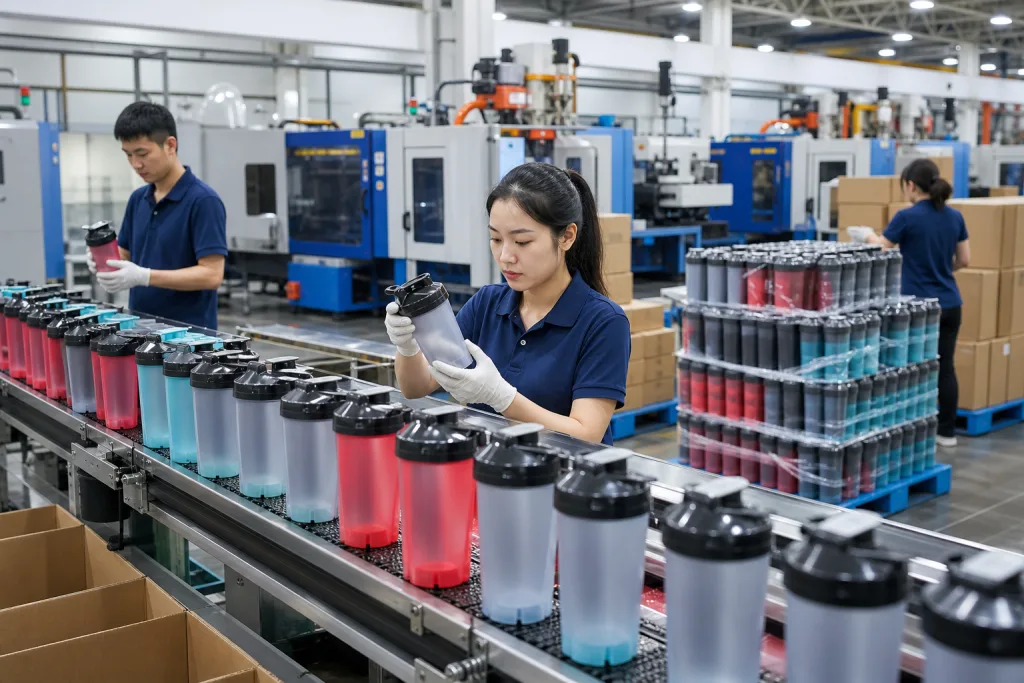
At BottleForge Industrial in Zhejiang, our sports bottle lines run up to 400,000 units per month across standard molds, but that number means little if the spec keeps moving. We run shaker orders and plain hydration orders on the same floor, and they are not the same product. A customizable sports water bottle for general hydration is not always suitable as a customized shaker bottle. Once powder residue is part of the job, thread fit, inner surface finish, and cleaning access matter more than the color of the strap. QC pulled one sample last month with flash left under the lid thread at 0.3 mm, and that was enough to cause a slow leak after shaking. The buyer flagged the logo size first. The leak mattered more.
Choose the bottle spec before artwork
New buyers often send the logo first. That’s backwards. Bottle geometry sets cost, defect risk, and container count before artwork even starts. For a custom made shaker bottle, lock the closure first. A screw-on lid with carry loop is the common build we run, but some loops crack at the gate after rough gym use. If users clip bottles to bags, ask for a loop pull test of at least 10 kg static load for 1 minute.
Next, choose the mixing system. A stainless wire whisk mixes better, but it adds one sourced part and one more corrosion claim if the steel grade on the PO is vague. QC pulled samples last year where the buyer asked for “stainless ball” and the supplier side shipped mixed material. A molded PP mixer insert is simpler on compliance and usually cuts total unit cost by USD 0.05-0.12. Thick shakes mix worse. For most custom fitness water bottle programs, the PP insert is enough. For premium custom logo shaker bottle retail, a 304 stainless mixing ball still sells better.
Typical spec ranges buyers actually use
- Body: BPA-free PP, translucent or solid color
- Lid: PP with TPR or silicone seal
- Shaker ball: SS304, 1.0-1.2 mm wire gauge
- Decoration: silk screen, heat transfer, IML, or laser on metal components
- Packaging: individual polybag, white box, color box, or PDQ tray
For a customized sports water bottle sold in gyms, skip narrow-mouth bodies if users add powder every day. A 70-80 mm mouth diameter is easier to clean and cuts odor complaints. We’ve seen buyers push for 65 mm to save resin, and this is the wrong question to ask. People hate trying to scoop powder through a small opening. If you are sourcing a bulk shaker bottle for a distributor sports water bottle program, ask for pallet loading details early. On the line, even a small carton change like 24 pcs to 30 pcs per master can improve container loading by 8-12%.
You do not want to discover after approval that your shaker bottle only accepts a logo 35 mm high because the body taper is too aggressive.
In Zhejiang, China, standard mold options usually keep MOQs around 3,000 pcs. A fresh mold for a fully custom gym water bottle can push development cost to USD 2,500-8,000 and add 20-30 days. The math often doesn’t work. We’ve seen this go sideways after a buyer approved the drawing, then flagged the sample because the new mold neck measured 0.6 mm off their cap liner spec. For most fitness brands, existing molds with customized decoration are the sensible route unless you are launching a flagship product line.
Price the order like a buyer
Here’s a real buying case. You need 5,000 pieces of a 700 ml customizable shaker bottle for a North American fitness brand. Standard mold, PP body, flip cap lid, one-color silk screen logo, stainless mixing ball, individual polybag, export carton. On our side, with a 6-cavity injection tool running standard PP, you should expect about USD 1.18-1.45 FOB Ningbo depending on resin cost and packing details. Change to a matte spray finish plus color box, and the quote usually lands at USD 1.55-1.85 FOB.
New buyers often look at the wrong line item first. The big cost movers are decoration, packaging, and color split. A custom gym water bottle with one body color and one lid color is easy to run on the line. Three body colors across small quantities create purge loss, extra setup, and slower output—on one recent order, line changeover went from 25 minutes to 70 minutes because the buyer wanted three translucent shades. If you need a bulk fitness water bottle assortment for different club regions, lock the ratio early: for example 50% black, 30% smoke, 20% white.
Typical cost drivers:
- New mold or standard mold
- Silk screen vs heat transfer wrap
- Single-color resin vs custom Pantone matching
- Polybag vs printed color box
- Leak-proof insert, seal material, and extra components
- Third-party inspection and compliance testing
If you are buying for distributor gym water bottle or distributors shaker bottle channels, ask for both FOB and landed estimates. This is the right question. We’ve seen buyers save USD 0.04 on FOB, then lose USD 0.11 per piece on freight because the carton was oversized by 18 mm in height and the nesting was poor. A 24-piece carton with weak pack-out can cost more in freight than a slightly higher ex-factory price from a better engineered bottle. QC pulled the sample on one shipment because the divider board collapsed at 7 kg top load.
For payment terms, the common pattern from China is 30% deposit and 70% balance before shipment. If your order value is above USD 30,000 and repeats quarterly, you may be able to negotiate better terms after the first two successful shipments. Don’t press payment first. Press the inspection standard first. Ask for the AQL level, leak test method, and carton drop requirement before you argue about terms; we’ve seen this go sideways when a PO had “assorted black lids” typed but the buyer meant matte black only. That is where your real protection sits.
Sample approval is not a formality
For a custom shaker bottle project, the sample stage needs to answer four plain questions: does it seal, does it mix, does it print cleanly, and does it survive rough handling? We’ve seen buyers approve one office sample or a photo, then get hit with complaints from 5,000 users after launch. That is the wrong question to ask. A customizable fitness water bottle for club use has to pass more than shelf-appearance checks. On our line, QC pulled a sample last month because the lid sat 0.4 mm high on one side and leaked only after a hard shake.
Start with a pre-production sample in final colors. Not a stock bottle pulled off the shelf. Ask the factory for logo position measurements, net weight, and carton spec, all tied to that exact sample. Then run the basic checks yourself. We ship against approved samples, and if the PO says “black lid” but the master sample is charcoal, that typo becomes an argument later.
- Fill with water, invert for 30 minutes, no leakage
- Shake with powder for 60 seconds, no cap pop-open
- Dish soap wash and air out for 24 hours, check residual odor
- Drop test from 1.0 m on side and base, three times
- Open-close flip cap 50 cycles
If you are buying a customized fitness water bottle for North America, check what users expect on dishwasher use. If the bottle is top-rack only, print that clearly on the packaging panel, not in 5 pt text under the barcode. If your marketing team wants “dishwasher safe,” verify it with repeated wash testing. A verbal promise from sales is not enough. We’ve seen this go sideways after 12 cycles when a logo faded and the buyer flagged it against the approved sample.
Artwork approval matters as much as function. A custom logo shaker bottle with silk screen printing looks clean and keeps cost down, but adhesion on matte texture can fail if the surface treatment is off or the flame treatment is weak. Ask for a tape adhesion test and a rub test. QC should record the result. If your logo has fine lines or less than 0.3 mm stroke width, heat transfer often reproduces better than silk screen. We run both methods, and the math doesn’t work if you save $0.03 on print and lose the order on appearance.
For distributor fitness water bottle and distributor sports water bottle sales, sample photography should cover carton markings, FNSKU or barcode placement if needed, and inner pack details. Show the retail box from all sides. Show the master carton too. A customized gym water bottle that works for one gym chain can fail in a distributor channel if the box size wastes shelf space or the barcode sits under a side seam. We had one case where the buyer flagged a hidden barcode on a 24-unit inner pack, and the fix was just moving it 18 mm.
Build QC into the PO
If the quality requirements are not written into the purchase order, they are opinions, not standards. On a bulk sports water bottle or bulk shaker bottle order, the PO needs hard points: appearance tolerances, functional tests, packing details, and inspection levels. We see this on the line all the time. If the buyer writes only “good quality,” QC has nothing to hold against. If the PO says print offset within +/-1.5 mm and AQL 2.5, then QC pulled the sample and the argument is over in 2 minutes. Buyers in Europe and North America usually protect themselves here, whether they source in Zhejiang or another part of China.
A practical QC framework for a customized shaker bottle order looks like this:
- AQL: Critical 0, Major 2.5, Minor 4.0
- Leakage: 100% in-line air or water leak check if factory supports it; otherwise sampling plus final inspection
- Odor: no abnormal plastic smell after washing and 24-hour airing
- Print: centered within +/-1.5 mm, no obvious pinholes or smearing at 40 cm viewing distance
- Color: within agreed master sample, especially for white and smoke translucent bodies
- Carton drop: 76 cm for packed carton if selling through parcel networks
If your channel is a chain gym, define defects by end-user irritation, not factory convenience. This is the right question to ask. A tiny print speck may be minor. A cap that cross-threads after a week is major. A seal that falls out is critical. We have seen first POs with wording like “no big defects,” and that goes sideways fast. One buyer flagged loose seals on 2 out of 80 checked pieces, while the factory argued they still held water. That argument should have been closed in the PO.
Ask the supplier about compliance documents too. Depending on material and market, you may need REACH, LFGB-related testing references for the EU, or FDA-related food-contact declarations for the US market. If children are the target user, ASTM and CPSIA questions come up fast. For an adult-focused custom sports water bottle, that is usually not the center issue. Social compliance such as BSCI can matter if your customer account asks for it. We have had buyers request LFGB after approving PP material for the lid, then realize the PO typo listed PE gasket instead of silicone gasket. QC caught it before shipment.
Lead time should include QC time, not just molding and packing. A standard 5,000-piece order usually needs 25-35 days after deposit and approved sample. Add 3-5 days if third-party inspection is booked at peak season. SGS or local inspectors do not always get next-day slots in August. If you change packaging after mass production starts, expect delay. That is normal. We run orders where a late insert-card change adds 2 days, and a carton mark revision adds 1 more because the buyer flagged the shipping mark after 60% packing was done.
Ship it without creating new problems
Once the product passes inspection, a lot of buyers exhale too early. That is when new problems start. We ship custom sports water bottles with a clean seal test, then QC pulls the arrival sample and finds scuffing on the shoulder, crushed gift boxes, or a carton short by 2 pcs because pack-out was weak, not because production was wrong. For gym chains, carton setup also needs to work for branch allocation. Cheap tape and oversized cartons save nothing if each store has to break down and recount by hand.
For a 700 ml bulk gym water bottle, common export packing is 24 pcs per carton, but 36 pcs can work if the body nests well and retail packaging is minimal. Ask for carton dimensions, gross weight, and loading quantity for both 20GP and 40HQ. We usually cap master carton weight at 18 kg because once it gets heavier, warehouse teams start throwing it, and this is the wrong place to save cost. A rough benchmark: optimizing carton size can improve container utilization enough to reduce freight per bottle by USD 0.03-0.07. On a 30,000-piece annual program, that matters.
If you sell online or through regional distributor gym water bottle accounts, carton marking needs discipline. We have seen a PO with the item code typed one digit off, and that small typo turned into relabeling at destination. Include item code, color, quantity, carton number, gross/net weight, country of origin, and any routing marks. For Amazon-style fulfillment, FNSKU placement must be checked before mass labeling. The buyer flagged one run because the label sat 6 mm too low and covered the recycle icon and wash instruction, which created warehouse rework.
Before release for shipment, confirm:
- Final inspection report matches PO and approved sample
- Master carton photos are approved
- Barcode scan works on unit and carton level
- Spare parts policy for lids and seals is agreed
- Booking date matches your launch plan
A good supplier in China should also tell you what goes wrong after loading. We have seen this go sideways in summer: freshly printed bottles packed too fast hold odor in a sealed carton longer, especially after 12 days on water versus 3 days in the factory. In winter, drop performance shifts a bit, so if the line tested at room temperature only, ask again. If you are a distributor shaker bottle buyer, ask for 1-2% spare lids or seals on larger orders. The math works. A few extra cartons of spares cost less than sorting after-sales complaints one case at a time.
The last detail most buyers miss is reorder continuity. If your first customized sports water bottle order succeeds, keep a golden sample, approved Pantone reference, carton spec, and inspection checklist on file. We also keep the carton die-line and a sealing tape spec like 48 mm x 100 m BOPP on repeat programs, because changing small things between PO1 and PO2 creates stupid problems. That is how you make order two easier than order one.
Get your shaker bottle spec reviewed before ordering
Send your target capacity, logo file, quantity, and market. We will flag MOQ, compliance, leakage, and packaging risks before you place a PO.
Frequently asked questions
What is a realistic MOQ for a customizable shaker bottle?
For a standard mold in China, a realistic MOQ is usually 3,000 to 5,000 pieces per model and colorway set. If you want a custom logo shaker bottle with one body color, one lid color, and simple silk screen printing, 3,000 pcs is often workable. If you need three color splits, printed boxes, and a stainless whisk, 5,000 pcs is more practical because the setup loss is higher. A fully custom made shaker bottle with a new mold is different: MOQ may still start at 3,000 pcs, but the mold cost can add USD 2,500 to 8,000 and development can add 20 to 30 days. For gym chains, existing molds usually make more sense unless the bottle shape is central to your brand identity.
How much should I budget for a bulk shaker bottle order?
For a 700 ml PP customized shaker bottle using a standard mold, budget roughly USD 1.05 to 1.85 FOB China per piece. The lower end usually means one-color bottle, one-color print, simple polybag packing, and no special finish. The upper end usually means matte coating, color box, more demanding decoration, or extra accessories. Freight, testing, and inspection are separate. A third-party final inspection may cost around USD 250 to 400 per day depending on city and scope. If you are ordering 5,000 pcs for a fitness brand launch, the all-in landed cost can move significantly based on carton efficiency and destination port, so ask for both FOB and carton-loading data before comparing suppliers.
Which material is best for a custom fitness water bottle used as a shaker?
For most commercial shaker programs, PP is the practical choice. It is light, affordable, and works well for repeated shaking. A PP body with 2.2 to 2.8 mm wall thickness gives decent rigidity without pushing cost too high. Tritan can look more premium and clearer, but it is usually more expensive and not always necessary for gym retail. Stainless steel is excellent for insulation but less practical for visible mixing and often heavier for club use. If your product is a custom sports water bottle first and a shaker second, material choice may change. For powder mixing, the wide mouth, thread quality, seal design, and odor performance matter more than chasing a premium resin name.
What quality tests should I require before shipment?
At minimum, require leak testing, drop testing, print adhesion testing, and an appearance inspection under an agreed AQL standard. A common final inspection level is AQL 2.5 for major defects and 4.0 for minor defects, with critical defects at 0. For a custom gym water bottle or customized sports water bottle, ask for a 1.0 meter drop test on side and base, 30-minute inverted leak test, 50-cycle lid opening test, and a simple odor check after washing and airing. If the bottle includes a loop or handle, request a 10 kg static pull test. If your market is the EU or North America, also review food-contact compliance documents relevant to the material and destination country.
How long does production usually take for a custom shaker bottle order?
For a repeatable standard-mold program in Zhejiang, China, normal lead time is about 25 to 35 days after deposit, artwork approval, and confirmed pre-production sample. If you are ordering in peak season, add 5 to 10 days as a safety margin. New packaging, special Pantone matching, or changes after sample approval can add another 7 to 10 days. If a new mold is involved, development and sample confirmation can add 20 to 30 days before mass production even starts. For larger annual programs, it helps to book forecast quantities early. A supplier running 400,000 units per month can still face delay if your order needs unusual materials or if you wait until the pre-holiday rush to confirm artwork.