Key Takeaways
- For most school programs, 350-500 ml Tritan bottles with a flip-straw lid hit the best balance of weight, cost, and break resistance at roughly USD 2.10-3.40 FOB China
- A practical MOQ for a custom kids water bottle is usually 1,000-3,000 pcs per color, while new mold development typically adds 25-40 days
- Print choice matters: silk screen is lowest cost, but UV or heat transfer usually lasts 30-50% longer in school use
- Ask for CPSIA, LFGB or FDA contact material reports, REACH checks, and AQL 2.5 final inspection before shipment
You are not buying a generic promo item. A customizable school water bottle for schools or kids retail needs to take drop tests, get crushed in lunch bags, go through rough washing, and still come back without odor, leaks, or chipped print. We’ve seen buyers lock artwork first and ask about bottle spec later. That is the wrong order. On our line, QC will do a quick 1.2 m drop check before mass production approval, because a pretty print means nothing if the lid starts weeping in week two.
School district buyers and importers often start with unit price, then pay for the mistake later: a straw lid failing at 5,000 cycles, a 420 g bottle body that feels too heavy for a 6-year-old, or decoration that will not survive dishwasher use. In Zhejiang, China, we run into this every season. One buyer flagged a leak rate after first shipment, and the root cause was a silicone seal seated 0.8 mm off in assembly. The better way is a direct spec check against age group, sales channel, and compliance requirements before you lock testing dates and ship windows.
Start with the school use case
For a customizable school water bottle, start with the use case. Not material. Ask who will carry it, how often it gets dropped, and what kind of daily abuse it takes on campus. A kindergarten bottle needs a different lid force and body size than a middle school sports bottle, and both are far from a retail-driven custom children water bottle sold through distributors. On our line, QC pulled a sample last month because a pop-up lid needed 2.8 kg thumb force, which is too much for younger kids.
For school district programs, we usually run a 350-500 ml body, total filled weight under 650 g, and a one-hand lid kids can open without fighting the thread. For younger users, a bottle diameter of 65-72 mm fits smaller hands better. This part is simple. Go above 600 ml and complaint rates climb, because the bottle turns bulky in lunch bags and standard classroom cup holders. We have seen buyers push for 700 ml "for value," then walk it back after a 72 mm cup-holder test failed.
Importers ask if stainless steel is always the better choice. Usually not. A double-wall stainless bottle looks more premium, but it pushes up FOB cost, unit weight, and freight per carton. For a bulk school water bottle program tied to budget-sensitive tenders, single-wall Tritan or single-wall stainless is the safer buy. For club stores or gift packs, vacuum stainless can fit. The wrong question is "Which material is best?" The right one is "What survives school use at the target landed cost?" We have seen this go sideways when the buyer flagged weight after the first drop-test batch.
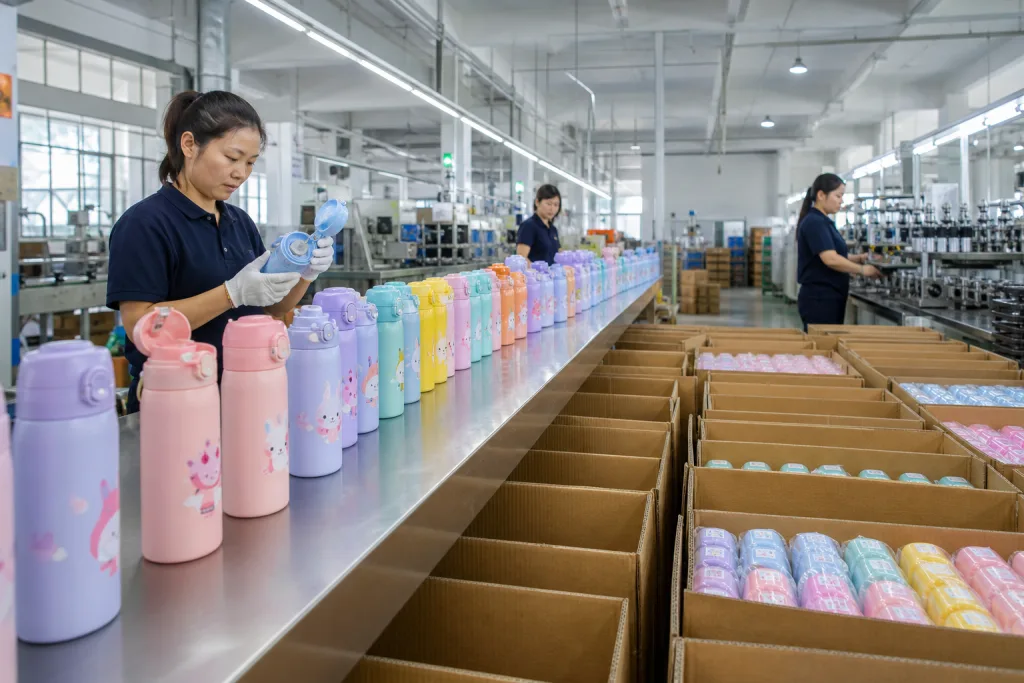
At our Zhejiang, China factory, typical MOQs for kids models start at 1,000 pcs for existing shapes and 3,000 pcs when you need color separation across multiple SKUs. Production capacity is around 300,000 units per month across kids bottles and tumblers, but molding is rarely the choke point. Decoration setup and testing usually slow the schedule first. A silk-screen jig change can burn half a shift, and one PO last season even had the barcode suffix typed wrong, which held packing for a day.
- School giveaway: lighter bottle, simple lid, lower unit cost; we ship these most often in 350-450 ml
- Retail kids line: stronger decoration, better shelf impact, packaging compliance; the buyer usually asks for hang test and abrasion check
- Sports camp program: larger volume, carry handle, faster lead time; 500-600 ml is common if the bag pocket allows it
- Private label: custom pantone, hangtag, barcode, carton marking; MOQ pressure starts once SKUs split into 4 colors
Head-to-head bottle spec table
Below is the comparison buyers actually ask us for when they check a bulk children water bottle program. These are standard B2B ranges we run for export orders, not made-up low prices from odd stock or mixed-container leftovers. Last month one buyer tried to benchmark against a 600 pcs clearance lot; the math didn’t work.
| Spec | Tritan single-wall | 304 stainless single-wall | 304 stainless vacuum |
|---|---|---|---|
| Typical size | 400-500 ml | 400-500 ml | 350-500 ml |
| Body weight | 120-180 g | 180-260 g | 280-420 g |
| FOB China price | USD 2.10-3.40 | USD 2.40-4.20 | USD 4.20-7.50 |
| MOQ | 1,000-3,000 pcs | 1,000-3,000 pcs | 1,000-2,000 pcs |
| Lead time | 25-35 days | 30-40 days | 35-45 days |
| Best use | School daily use | Budget premium | Higher-value retail |
Tritan is still the default pick for a custom school water bottle if drop resistance and low weight matter more than heat retention. The body stays light in a school bag, and color matching is easier on the line. We usually see 3-5 colorways per program, and the buyer flagged Pantone drift once when a cap supplier changed resin lot. For a children water bottle distributor, or for 12 children water bottle distributors supplying school chains under one assortment plan, that color spread helps sell-through.
Single-wall stainless sits in the middle. It gives a stronger hand feel and some buyers like that it avoids the plastic-taste complaint, but dents show fast after concrete drops from desk height, around 750 mm in our internal abuse check. Vacuum stainless is for premium retail projects, not every school tender. We’ve seen this go sideways when the packed bottle hit 410 g and the school said it was too heavy for kids under 8.
For a children water bottle wholesale order, ask your children water bottle supplier or children water bottle suppliers to quote the full build: body material, lid type, decoration detail, packaging spec, and test scope. This is the right question to ask. If you send only bottle size and logo, quotes from different children water bottle vendors are not apples to apples. QC pulled one sample last season where the PO said “silicon ring” instead of “silicone ring,” and even that small typo caused confusion on sealing spec.
Lids decide complaint rates
Most post-shipment claims on a bulk kids bottle order come from the lid, not the bottle body. We see this on the line all the time: buyers debate Pantone body color for 2 weeks, then give the lid one line on the PO. That is the wrong question to ask. Hinge life, straw hardness, seal design, and spare-part consistency drive complaint rate far more than shell color. If you want fewer returns, write the lid spec in more detail than the bottle spec.
For school use, we usually see 3 common choices:
- Flip straw lid: best fit for ages 5-12, easy to drink from, but the mold has more moving parts and tighter fit control
- Spout lid: simpler structure, lower cost, good for sports programs where buyers want faster assembly and fewer components
- Screw cap with carry loop: strongest seal, slower for children to open and close during class breaks
A flip straw lid should be cycle-tested. Ask for 5,000 opening cycles as a minimum and leak testing at 100% on assembly. QC pulled the sample last month and found a hinge pin drift of 0.3 mm after repeated opening, which later turned into loose closure feel. Silicone seals should be food-grade and consistent in shore hardness, normally around 50-60A for this application. Too soft, the straw kinks. Too hard, younger children push back fast.
This is where a capable children water bottle factory or children water bottle manufacturer shows up clearly against a trading-only source. Two lids can look the same and still fit differently because the seal groove depth, hinge tolerance, or thread engagement is off by 0.2 mm. We normally recommend a leak standard of no visible leakage after upside-down testing for 30 minutes and no functional failure after three drop tests from 1.0 meter with water fill. We ship school tenders against written specs like this because we have seen vague wording go sideways.
If your project is children water bottle promotional, a simple screw cap may be enough. If it is a retail children water bottle customized line, the lid needs to handle repeat use and easier cleaning. Ask whether the straw is removable, whether the bumper is overmolded TPE, and whether replacement parts can be supplied for follow-up orders. One buyer flagged this after receiving 8,000 pcs: the first order passed, but the second order used a different straw supplier and the bite feel changed. That kind of mismatch creates complaints fast.
Decoration choices and artwork limits
Buyers starting a children water bottle custom or children water bottle customizable program often assume logo printing is easy. It isn’t. On kids bottles, decoration is usually the No. 2 risk after lids. Curved walls, textured powder coat, and 200+ dishwash cycles cut print life fast. On our line, QC pulled a sample last month because the logo sat across a radius break and started chipping at the edge.
Here is the practical ranking:
- Silk screen: lowest setup cost, good for 1-2 colors, usually USD 0.08-0.20 per color
- Heat transfer: better for character art and wrap graphics, usually USD 0.25-0.55
- UV print: sharp multicolor graphics, good detail, usually USD 0.30-0.60
- Laser engraving: excellent permanence on stainless, limited visual style for children
For a custom logo kids bottle used in schools, silk screen works if the bottle is hand-wash oriented and the budget is tight. For retail, UV or heat transfer is the safer call. They carry licensed-style art better and hold up better in daily handling. On Tritan, full wrap graphics need tight adhesion control and bleed planning; we usually check the film edge under a 3M tape test before release. Buyers push back on decoration cost here, but this is the wrong place to cut 5 cents.
Confirm the print area in millimeters, not from a mockup on screen. A typical front print area on a 500 ml kids bottle may be 45 x 70 mm for logo-only work, while a wrap can reach 180 x 80 mm depending on taper. Ask your children water bottle vendor for a dieline and a real sample photo before mass production. We’ve seen this go sideways over a 2 mm shift. If your importer team needs Amazon or big-box readiness, fix barcode position and scannability early; one PO we received had the EAN placed over the shoulder curve, and the buyer flagged it after the first carton check.
Good artwork approval saves more money than late price negotiation. A wrong print position can make 2,000 bottles unsellable.
Compliance is not optional
If you import a bulk kids water bottle into Europe or North America, compliance sits inside the product cost. It is not a side service. School buyers push harder now, and we agree with that. Ask your children water bottle manufacturer or children water bottle manufacturers for a current test roadmap before you place the PO; we have seen POs delayed 12 days because one lid resin grade on the BOM did not match the approved sample.
Typical requirements are FDA or LFGB food-contact compliance by market, REACH chemical screening for Europe, and CPSIA-related checks where US children’s product rules apply. Review every part that touches the mouth or carries decoration. That means the straw, bite valve, coating, and printed logo. QC pulled one sample last season where the bite valve passed, but the print on the 0.4 mm outer wall failed rub testing after 50 cycles. Retail packs need their own review too. Packaging ink, age grading, and warning copy matter more when the bottle goes onto shelves instead of straight to a school district.
On the factory side, ask about ISO 9001 systems, BSCI or equivalent social audit status, and final inspection to AQL 2.5 for major defects and 4.0 for minor defects. For a children water bottle customized program with multiple colors, master sample approval should cover Pantone tolerance, print adhesion, odor test, leak test, and carton drop test. We run leak testing on the line with 0.03 MPa air pressure, and this is the wrong question to ask: “Do you have reports?” Better question: “Are your reports tied to the same material code and supplier lot as my order?” In Zhejiang and wider China, plenty of factories can show reports; fewer hold the same standard lot after lot.
For importers, split compliance into three checkpoints: pre-production material confirmation, in-line first article approval, and pre-shipment inspection. That catches mistakes before 10,000 units are packed. We have seen this go sideways over one PO typo—cap color listed as PMS 298C instead of 299C—then 6,000 sets were already in cartons. If you are buying from a children water bottle supplier in China for the first time, spend the extra USD 250-400 on third-party inspection. The math works. One inspection fee is cheaper than one rework run or one held shipment at destination.
MOQ, packaging, and freight math
A custom made kids bottle gets expensive fast when the small line items start piling up: one polybag, one color box, one hangtag, one insert card, one barcode label, inner carton split, then a 40/30/30 mixed color ratio the buyer added in a revised PO. We see this every week. Buyers chase FOB down by USD 0.05 and miss USD 0.28 in packing cost plus the extra carton cube. For a children water bottle bulk order, that is where margin disappears. This is the wrong question to ask if you only compare unit price.
Typical MOQ for existing kids bottle models is 1,000 pcs per item, often with 250-500 pcs per color if the total volume supports it. We run standard body color and one-color logo on the line without much trouble. A fully new custom kids bottle shape is different. New mold work can add USD 3,000-12,000 in tooling and 25-40 days of development, and the first T1 sample often comes back with a hinge gap or lid fit issue that QC pulled with a 0.5 mm check. Sample lead time for decorated pre-production pieces is normally 7-12 days after artwork approval.
Packaging choices change the freight math more than buyers expect. A plain export carton gives the lowest landed cost. A printed color box may add USD 0.18-0.45 per unit and increase carton cube. If you supply schools direct, simple packaging usually makes sense; the math doesn't work on fancy retail packing for a campus order. If you are a children water bottle distributor serving retail, shelf-ready packaging can pay back, but only if the sell-through supports it. We have had buyers flag a dented box corner at drop test, not the bottle itself.
Practical freight rule
Tritan bottles are light but cube-heavy. Vacuum stainless is heavier and still cube-heavy. For most bulk kids water bottle projects, sea freight is the only workable option unless delivery timing is tight. A 40HQ container can load far more unboxed bottles than gift-boxed bottles, and the gap is not small once carton size goes up by even 20 mm on two sides. Ask for carton dimensions, gross weight, and units per carton on every quote. We ship by those numbers. Without them, you cannot compare landed cost from different children water bottle suppliers in China.
Best-fit recommendations by buying scenario
If you want a clean shortlist, match the bottle to the actual use case. This sounds obvious. On the line, it saves rework.
- School district daily issue: 400-500 ml Tritan body, flip straw lid, single-color silk screen, plain carton. We ship this setup more than any other for bulk school water bottle programs because the math works: lower unit cost, fewer lid complaints, easier reorders at 3,000 pcs MOQ.
- Premium fundraiser or bookstore retail: 350-500 ml vacuum stainless, powder coat, UV print, retail box. Margin is better, landed cost is higher, and QC usually checks coating adhesion first with a cross-hatch cutter before mass packing.
- Sports camp or outdoor program: 500-600 ml single-wall stainless or Tritan with carry loop and simple spout. Go for quick cleaning and fewer failure points. We’ve seen this go sideways when buyers choose complex straw parts for rough outdoor use.
- Licensed-style kids assortment: Tritan with wrap heat transfer, stronger packaging control, tighter color approval. The buyer usually flags color drift first, so we run signed Pantone approval before production. This suits a children water bottle customized retail line.
If you are a school buyer, don’t over-spec premium insulation unless there is a real use case. This is the wrong question to ask. Kids care more about easy opening force, no leaks after a 1.2 m drop test, and graphics they will actually carry to class. If you are an importer or children water bottle wholesale buyer, go one step deeper: can one bottle body run with two lid options and three decoration methods on the same mold set? That is how you keep the range cleaner and tooling risk lower.
A good children water bottle factory in China should quote side-by-side options, not push one model from the catalog. Ask for exact bottle weight, wall thickness, test scope, MOQ, and lead time on each option. QC pulled one sample last month where the PO said 500 ml but the approved drawing showed 450 ml, so details matter. For most programs, a 0.5-0.7 mm stainless single-wall body or a well-molded Tritan bottle gives enough durability without overpaying. That is usually the right call for a custom kids water bottle order, even if the catalog is trying to sell you a fancier item.
Send your school bottle spec for a real quote
Share size, lid type, artwork, target price, and delivery date. We will reply with workable options, MOQ, compliance scope, and FOB China pricing.
Frequently asked questions
What is the best material for a customizable school water bottle?
For most school use, Tritan is the safest starting point because it is light, impact-resistant, and cost-efficient. A 400-500 ml Tritan bottle usually lands at USD 2.10-3.40 FOB China depending on lid and print. Single-wall 304 stainless works if you want a more premium feel without full vacuum cost, usually USD 2.40-4.20 FOB. Vacuum stainless is better for retail or gifting, but at USD 4.20-7.50 FOB it is often too expensive for school tenders. If the age group is under 8, weight matters a lot, so Tritan usually wins. If your market strongly prefers metal, choose a simple single-wall stainless body and keep total empty weight under 260 g.
What MOQ should I expect for custom kids water bottle orders?
For existing models from a China factory, MOQ is usually 1,000 pcs per style, with some flexibility on color splits if total volume reaches 2,000-3,000 pcs. A printed logo on stock colors is the easiest setup. If you need custom Pantone body colors, individual packaging, and multiple lid colors, a more realistic MOQ is 2,000-3,000 pcs. Fully custom molds for a new kids bottle shape can require tooling from about USD 3,000 to USD 12,000 plus 25-40 days development time. For first orders, many buyers reduce risk by using an existing body and customizing only lid color, print, and packaging. That gives faster approval and lower exposure.
Which lid style has the lowest complaint rate in school programs?
A simple screw cap usually has the lowest leak risk, but it is not always the best user experience for children. In practice, a well-made flip straw lid gives the best balance for ages 5-12 if it is tested properly. Ask for 100% leak testing in assembly, 5,000 open-close cycles, and drop testing from 1.0 meter with water fill. If your supplier cannot state those numbers clearly, expect problems later. Spout lids are simpler and cheaper, but younger children may prefer a straw. For high-volume school distribution, avoid over-complicated push-button mechanisms unless the factory has a proven history with that lid platform.
What compliance documents should a children water bottle supplier provide?
At minimum, ask for food-contact compliance matched to your market: FDA for the US or LFGB for Germany and much of Europe. For EU projects, add REACH screening for relevant chemicals. For children’s products, ask whether CPSIA-related requirements apply to your specific construction and decoration. If the bottle has printed graphics, coatings, straws, or silicone parts, those components should be included in review. On quality control, request an inspection standard such as AQL 2.5 major and 4.0 minor, plus leak-test criteria and carton drop-test standards. If you are buying from China for the first time, a third-party pre-shipment inspection usually costs only USD 250-400 and is worth it.
How long does production take for a custom school water bottle order?
For an existing model with standard customization, normal lead time is 25-35 days after sample approval and deposit. Stainless styles or more complex decoration often run 30-45 days. Pre-production samples usually take 7-12 days if artwork and Pantone references are clear. New mold projects add 25-40 days before normal production starts. The biggest delays are usually artwork revisions, packaging confirmation, and test failures on decoration or lids, not the bottle body itself. If you need delivery for back-to-school timing, work backward from your arrival date and leave at least 2 weeks buffer for inspection and shipping documents. For sea freight from Zhejiang, China, that planning matters more than squeezing 3% on unit price.