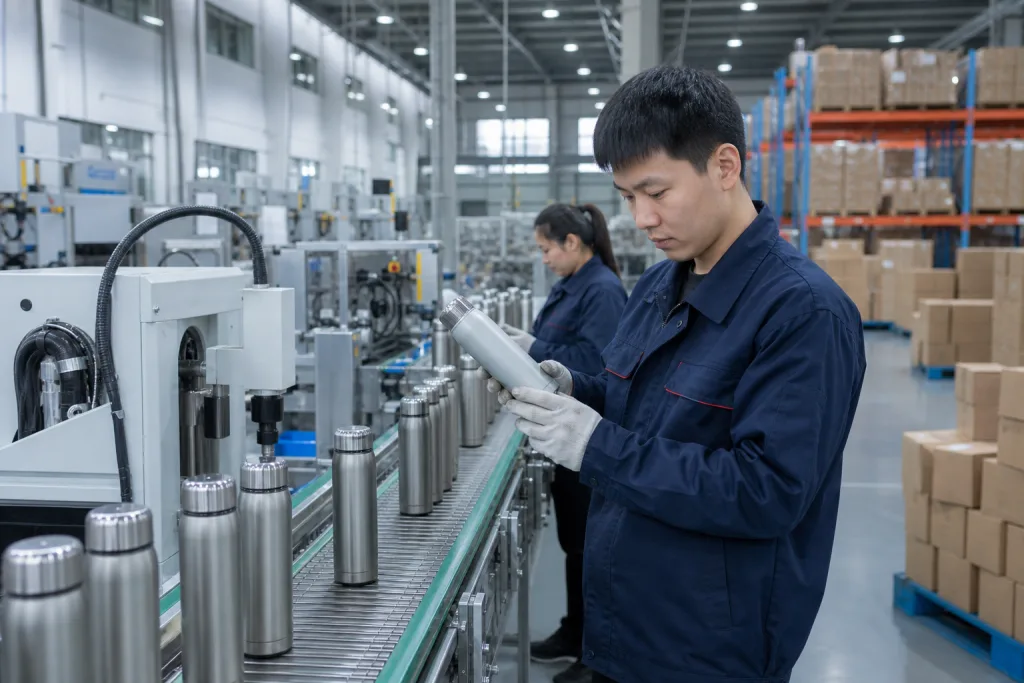
Key Takeaways
- For most stainless steel bottles, realistic MOQ starts at 1,000-3,000 pcs per SKU, while custom color plus custom packaging often pushes MOQ to 3,000 pcs
- Typical mass production lead time from Zhejiang, China is 30-45 days after sample approval and 30% deposit, not 15 days for fully customized drinkware
- 304 stainless inner and outer walls at 0.4-0.5 mm are standard for mainstream bottles; 316 interior usually adds USD 0.35-0.90 per unit
- AQL 2.5 for major defects and 4.0 for minor defects is a practical inspection level for custom drinkware before shipment
You need a customizable reusable water bottle that looks right, ships on time, and does not turn into warranty claims six weeks after launch. Sounds easy. Then the quotes land with vague steel grades, lead times that move from 12 days to 18 days, and decoration options that fail after 200 dishwasher cycles. If you buy for retail, promo, or distribution, the cheapest canteen supplier in China can burn your margin fast; we have seen buyers come back with 3 mm logo shift on the first mass batch and ask who will pay for the rework.
At BottleForge Industrial in Zhejiang, China, we hear the same questions every month: what MOQ is real, which print method holds up, how much leakage testing is enough, and when a custom growler or customized canteen needs extra compliance work. QC pulled the sample, ran a vacuum leak check, and found the lid torque was off by 0.2 N·m on one trial lot. The right order is product first, factory second, price third. Price-first is the wrong question to ask.
What are you really buying?
When you ask for a customizable reusable water bottle, you are not buying one SKU. You are buying a spec stack: capacity, insulation, steel grade, lid structure, decoration method, packaging, and compliance. We see quote trouble start at this point. The buyer sends a nice shape photo, but no use case, no target price, no drop test requirement, not even whether the bottle needs to fit a 72 mm cup holder.
Start with the sales channel. A canteen promotional event giveaway at 3,000 pcs runs on a different cost model than a retail line for outdoor stores or a distributor drinkware order for a regional wholesaler. For daily commuting, buyers usually ask us for powder coating, a carry loop, and branding that survives 200 dishwasher cycles; QC pulled samples before where the logo faded too early. For a custom growler used for beverages, you need to settle carbonation risk, neck finish, and filling method first. If that part is fuzzy, the math doesn't work.
The checklist buyers should settle first
- Capacity: 500 ml, 750 ml, and 1,000 ml are the easiest sizes to source at scale, since we already run those molds and carton counts.
- Construction: single wall for low cost, double wall for hand comfort, or vacuum insulated if you need hot/cold retention the line can verify by spot test.
- Material: 18/8 stainless steel, Tritan, glass, or hybrid builds; buyers ask for "304" on the PO all the time, so this should be written clearly.
- Lid type: screw cap, straw lid, flip lid, chug lid, bamboo cap; the hinge life and leak risk are different, and the buyer flagged this more than once after sampling.
- Decoration: silk screen, laser, heat transfer, UV print, embossed logo; each one changes setup cost, lead time, and the usable logo panel in mm.
- Packaging: bulk pack, white box, color box, PDQ display, or FNSKU labeling; outer carton drop performance matters, and MOQ often changes here.
If your brief only says custom canteen or customized drinkware, your canteen manufacturer will fill in the blanks with the lowest-cost or fastest option. That is normal on the factory side. It is also how you end up with the wrong mouth diameter, a base that wobbles by 1.5 mm on the table, or a logo area too small for your artwork. A capable canteen factory in Zhejiang should ask blunt follow-up questions before sending final pricing. If they do not, we've seen this go sideways with change orders, new samples, and 12 days lost.
You should define the use case before you compare quotes. Otherwise you are comparing guesses, not bottles.
Which factory questions matter first?
New buyers usually start with the wrong question: “What is your best price?” Price matters, but it comes after capability. For a canteen customizable project, first ask what the supplier actually is: a trading company, a canteen vendor using contract production, or a direct canteen manufacturer. None is automatically a problem. The difference is who controls the line, who answers when QC pulled the sample, and who owns the delay if a lid fit is off by 0.5 mm.
A direct factory should answer with hard numbers, not sales talk. BottleForge Industrial in Zhejiang runs drinkware programs with capacity above 300,000 units per month across stainless and mixed-material lines, with standard MOQ from 1,000 pcs for existing molds and 30-45 days production lead time after sample sign-off. Ask monthly output, QC headcount, and peak-season lead time. If the supplier cannot give those in 2 minutes, stop there. We’ve seen this go sideways in October, when a buyer was quoted 12 days and the actual line was already booked to 18 days.
Ask these before sample payment
- Are you a canteen factory or a trading company? If mixed, which process is in-house?
- What is your normal MOQ by SKU, color, and logo method?
- What standards do you work to: ISO 9001, BSCI, REACH, LFGB, FDA, ASTM?
- What is your leakage test standard and vacuum retention benchmark?
- Can you support barcode labels, FNSKU, carton marks, and Amazon prep?
- What AQL level do you accept for third-party pre-shipment inspection?
For Europe and North America, ask for the scope of the test report, not a loose “passed” statement. REACH for coatings matters. LFGB or FDA food-contact declarations matter. For children’s items, ASTM or CPSIA relevance matters. This is not the wrong question to ask; skipping it is. The buyer flagged this on us once because a report covered the body only, not the silicone straw, and customs held the shipment for 9 days.
Ask how they handle artwork approval as well. A lot of customized canteen order problems are not factory defects. They start in the approval file: logo too close to the side seam, metallic ink printed on a rough powder coat, or a color mismatch because Pantone was never locked on the PO. We run a final art check against the mockup and carton mark before mass production because one typo in a model code can turn 5,000 pcs into old stock fast.
How low can MOQ really go?
MOQ is where buyer expectations hit factory math. For stock shapes with one-color logo, a lot of canteen suppliers in China will quote 500 pcs. Sometimes that is real. More often it is a sample-run quote with thin price room, one or two color options, or leftover stock mixed into the carton. We saw one PO where the buyer typed “5000” and the line read it as “500”; QC pulled the sample and caught it before packing.
For steady production, use these working numbers:
- Existing stainless bottle + one-color silk screen: 1,000 pcs per size.
- Custom body color + logo + white box: 2,000-3,000 pcs.
- New lid color parts or custom mold tweak: 3,000-5,000 pcs.
- Fully new mold for a customizable growler or custom canteen shape: 5,000 pcs plus tooling.
Why so? Coating, print setup, box printing, and part sourcing each have their own floor. A canteen vendor may agree to 1,000 pcs on paper, then split the run across substitute lids or caps. That is how one carton opens with three slightly different lid shades. We run a 0.3 mm ink thickness check on the silk-screen table for a reason.
If you are a canteen distributor or one of several canteen distributors building a line for multiple customers, ask for a mixed-SKU plan. Some factories in Zhejiang, China will take 3,000 pcs total across 3 colors or 2 capacities if the bottle structure stays the same. That beats forcing one SKU into a fake low MOQ. The wrong question is “can you do 300?” The right one is “what total volume keeps the line efficient?”
What to watch in low-MOQ quotes
- Higher unit price, usually USD 0.20-0.80 more.
- Fewer coating colors available.
- Standard OPP bag only, no retail box.
- Single master carton assortment limits.
- Longer waiting time until enough raw materials are grouped.
If you need a customizable canteen for a pilot launch, give the supplier your 12-month volume estimate. Factories loosen up when they can see 1,000 pcs now turning into 10,000 pcs on the next PO. Keep the first order plain, then go deeper on the reorder. We’ve seen this go sideways when a buyer asked for five lid colors on day one and the packing team had to sort caps by hand for 6 hours.
What drives price besides the bottle?
Unit price is not just material plus labor. On custom drinkware, the price usually moves with decoration, lid parts, and packaging. Buyers fixate on 304 or 316, but a two-piece lid with an extra silicone seal can cost more than the steel upgrade.
For a mainstream 500 ml vacuum bottle ex works from China, the working range is about USD 2.80-4.80, depending on wall thickness, coating, and lid spec. We had one PO where the buyer flagged a typo on the carton mark, and the reprint ate margin fast. Add freight, duties, testing, and packaging before you compare landed cost. A bamboo lid, retail color box, and two-position print can add USD 0.70-1.20.
Main cost levers
- Steel grade: 304 is the base spec; 316 interior for tea, sports use, or premium positioning adds cost.
- Wall thickness: 0.4 mm body is common; 0.5 mm feels more solid, but it adds weight and steel cost.
- Coating: plain spray is cheaper than textured powder coat. We run both on the line.
- Decoration: laser engraving is durable; UV print gives color detail but needs cure control, and QC pulled the sample when the ink was still soft.
- Lid assembly: more silicone parts, straws, and moving hinges mean more assembly time and more leak risk.
- Packaging: custom inserts, gift boxes, and multilingual instructions add real cost. MOQ on the box often changes the math.
If you are buying a customized growler or customizable growler, pricing shifts again because larger capacities push freight up fast. A 64 oz growler with a wide mouth and handle may only cost USD 1.20 more to make than a bottle, but shipping per unit can jump harder because of carton cube. We’ve seen this go sideways on a 12-day sea quote versus an 18-day one.
Ask your canteen supplier for a clean cost split: bottle, lid, decoration, packaging. Good canteen manufacturers will not hand over every margin line, but they should tell you what is moving the price. If they cannot explain a USD 0.60 difference between two versions, the process is not under control.
How do you avoid quality surprises?
Quality control on a customizable reusable water bottle is straightforward if the factory and buyer agree on checkpoints before the line starts. “100% checked” is the wrong question to ask. We hear that phrase on too many calls, and it means nothing unless the PO defines defects, sample size, and pass/fail limits down to details like logo shift within 1.5 mm or rim dents visible at 30 cm.
A practical baseline for B2B orders is AQL 2.5 major / 4.0 minor with a third-party pre-shipment inspection before final balance payment. That setup catches the usual problems without slowing shipment. For premium retail, buyers often tighten cosmetic limits on logo alignment and powder coat consistency; we have seen QC pulled the sample for a 2 mm logo drift even though the bottle sealed fine. For promotional programs, the math does not work if you reject every slight finish shade difference, so keep the focus on leak rate, print adhesion, and count accuracy.
Your QC checklist should include
- Leak test: inverted bottle testing, usually 30 minutes minimum for screw caps; 2 hours is more realistic for straw systems because tilt leakage is where the buyer flagged it last time.
- Vacuum test: insulation retention based on temperature drop over set hours; on our line, weak vacuum usually shows up fast on the vacuum gauge before packing.
- Coating adhesion: cross-hatch or tape test on printed areas; 3M tape is common for a quick floor check.
- Salt spray where relevant: especially for metal exterior parts in humid use cases; 24-hour or 48-hour standards should be written on the spec sheet.
- Odor check: silicone seals and interior should be neutral after cleaning; if the seal smells after washing, QC should stop the lot.
- Drop/carton test: ISTA-style checks if you use e-commerce packaging; a 1A-style carton drop tells you more than a neat-looking dieline.
On stainless drinkware, common defects are dented rims, off-center threads, paint pinholes, weak vacuum, and logo drift. We also see burrs around the mouth on rushed runs, which is why rim inspection under a simple go/no-go gauge matters. On lids, the weak points are silicone fit, hinge durability, and straw leakage under tilt. A reliable canteen manufacturer should separate cosmetic defects from functional defects in the inspection standard, or the inspection goes sideways fast.
For Amazon or direct-to-consumer channels, carton labeling and barcode accuracy matter almost as much as product quality. We regularly see good bottles delayed because outer carton marks, FNSKU, or suffocation warning text were missed; one PO even had a master carton mark typo that forced a relabel job on 2,400 units. If you are a distributor growler or promo buyer, ask for a pre-production sample with all packaging elements, not just the bottle. We ship fewer surprises that way. It catches more mistakes than another late-night email chain.
Which print method fits your channel?
Decoration is where brand ambition hits the line. Buyers ask for bright color, low cost, short lead time, and dishwasher durability in one PO. Usually you pick three. We’ve seen this go sideways, so choose by sales channel and reorder target, not by what looked good in last year’s sample room.
For basic customized drinkware, silk screen is still the workhorse because the math works on 1-2 spot colors and the setup is straightforward on the line. We run 120 mesh and check logo edge sharpness under a simple loupe before mass print. Laser engraving gives a cleaner, longer-wearing mark, especially on powder-coated stainless, and buyers like it when they want a premium feel without adding another ink risk. Heat transfer and UV print fit multicolor art, gradients, and wrap graphics, but process control has to stay tight. QC pulled a sample last month where the UV cure looked good at first glance and still failed a scratch check after packing.
A practical selection guide
- Silk screen: best for 1-2 colors, MOQ-friendly, lower cost, moderate durability. Good fit for 500 pcs on stock colors when the buyer flagged budget first.
- Laser engraving: premium look, very durable, ideal on powder coat, usually adds USD 0.08-0.20. We normally confirm artwork line width before production because thin strokes can fill in.
- Heat transfer: good for full-color wraps, more setup work, not ideal on all textures. On textured powder coat, adhesion is the wrong question to ask; surface flatness is usually the first problem.
- UV print: vivid graphics and fine detail, but confirm cure strength and scratch resistance. Ask for a tape test result, not just a photo.
- Emboss/deboss mold effect: strong brand impact, but usually only makes sense at higher volume. Below 3,000 pcs, the mold cost often kills the idea.
For a customizable canteen sold at retail, I would usually push powder coat plus laser for premium SKUs, and powder coat plus silk screen for mid-range SKUs. That split covers most price ladders we ship. For event-driven custom canteen orders, where cost matters more than 2-year durability, silk screen on stock colors is often enough. One buyer pushed for full-wrap UV on a 1,000 pc giveaway order, but the math didn’t work once freight and rejects were added.
Always request a logo placement drawing with dimensions in millimeters. “Front center” is not a spec. It should state print width, height, seam distance, and reference line from bottle base or shoulder. We prefer a marked PDF with a 35 mm base reference because the line can check it fast. A typo on one PO changed 45 mm to 54 mm, and that small mistake is how you end up with a full shipment of crooked-looking branding.
When should you place the order?
Timing trips up first-time buyers. If you need stock on shelf in September, an August PO is already late for a fully canteen customized order from China. Production is only one block on the calendar. You still need sampling, approval, testing, and freight booking. On our side, even a simple logo file can lose a day if the buyer sends RGB art and we have to rebuild it for screen printing.
A realistic timeline for a standard customizable reusable water bottle looks like this:
- Day 1-3: confirm specification, artwork, and quotation.
- Day 4-10: pre-production sample or digital mockup approval.
- Day 11-15: deposit received, raw material booking.
- Day 16-45: mass production.
- Day 46-50: inspection, rework if needed, final packing.
- Day 51+: vessel booking or air shipment.
That timeline is normal. Peak season is not. From August to November, most canteen vendors and canteen manufacturers in Zhejiang add 7-15 days because the line is full and vessel space gets tight. If your program uses custom color boxes, add proofing time; one barcode digit off on the PO can stop the print run. If the final decorated sample needs lab testing, add another 5-10 working days depending on the lab.
The safest buying pattern is simple: approve one reference sample, freeze the spec sheet, and stop changing details after deposit. We have seen this go sideways. A late change to cap color, carton assortment, or logo size sounds small, but QC pulled the sample, found the old logo still on the line, and the whole packing plan had to be reset.
If you are managing multiple SKUs for a canteen distributor network, ask your supplier to build the schedule backward from your in-warehouse date. This is the right question to ask. A solid factory will map production, inspection, and shipping around that date, down to carton count and pallet loading, and tell you fast whether the target is real or just sales talk.
Get a practical quote before you place the PO
Send your target size, quantity, logo file, and ship-to market. We will reply with MOQ, unit cost, lead time, and the quality checks you should lock first.
Frequently asked questions
What MOQ should I expect for a customizable reusable water bottle with my logo?
For an existing bottle mold with one-color logo, 1,000 pcs per SKU is a realistic starting point in China. If you want custom body color, custom packaging, and multiple lid colors, MOQ usually moves to 2,000-3,000 pcs. A fully new shape or lid mold can push MOQ to 5,000 pcs plus tooling charges. You may find 500 pcs offers, but check what is being sacrificed: stock colors only, no retail box, mixed components, or weaker lead-time commitment. If you are launching a trial, ask the factory whether they can split 3,000 pcs across 2-3 colors under one structure. That often works better than forcing one low-MOQ SKU.
How do I choose between 304 and 316 stainless steel?
For most everyday bottles, 304 stainless steel inside and outside is the standard commercial choice. It is cost-effective, durable, and widely accepted for food-contact drinkware. Choose 316 interior when the bottle is positioned as premium, used heavily for sports drinks, tea, or more demanding corrosion resistance. In B2B pricing, 316 interior often adds about USD 0.35-0.90 per unit depending on size and supplier scale. Ask for the exact structure in writing, such as 304 outer plus 316 inner, not just “premium steel.” Also confirm wall thickness, usually 0.4-0.5 mm, because steel grade alone does not tell you how solid the bottle will feel in hand.
What quality standard should I set before shipment?
A practical baseline is AQL 2.5 for major defects and 4.0 for minor defects, with third-party pre-shipment inspection before you release final payment. Functional checks should include leak testing, vacuum retention, logo adhesion, and carton labeling accuracy. For e-commerce, add barcode and packaging verification. For premium retail, define cosmetic tolerances for scratches, dents, and print alignment in millimeters. Ask the supplier to sign off on the defect list before production starts. If you only say “good quality,” you will argue later about what counts as acceptable. Good factories in Zhejiang usually work with inspection protocols and should be comfortable with SGS, BV, or Intertek visits.
How long does production usually take for customized drinkware?
For a standard stainless steel program, production normally takes 30-45 days after sample approval and deposit. Sampling itself can take 5-10 days for existing models and longer if molds or unusual finishes are involved. Add 5-10 working days if you need final decorated sample testing, and expect peak season in China to add another 7-15 days from August through November. Sea freight timing is separate, so build your plan from the in-warehouse date, not the ex-factory date. If a supplier promises 15 days for a fully customized bottle with custom packaging, ask what exactly is standard and what is actually being customized.
Which logo method is best for retail versus promotional orders?
For retail, the safest choices are usually powder-coated bottles with laser engraving or high-quality silk screen, depending on your budget and design. Laser is more durable and has a cleaner premium look, often adding around USD 0.08-0.20 per unit. Silk screen is cheaper and works well for simple 1-2 color logos. For promotional orders where cost and speed matter more than long-term abrasion resistance, silk screen on stock colors is often enough. If your design needs gradients or full-wrap art, use heat transfer or UV print, but request adhesion testing on the final finish. Decoration should match the sales channel, not just the artwork file.