Key Takeaways
- A realistic MOQ for a stainless customizable refillable water bottle is often 1,000-3,000 pcs per color, while stock-color logo orders can start at 500 pcs
- Typical FOB China pricing runs about USD 2.20-4.80 for 18/8 stainless single-wall bottles and USD 3.80-8.50 for vacuum insulated models, depending on size and decoration
- Normal lead time is 7-12 days for samples and 30-45 days for mass production after deposit and artwork approval
- Use AQL 2.5/4.0 final inspection, REACH or LFGB as needed, and leak testing at 100% if you want fewer claims after delivery
You are not buying a bottle. You are buying landed cost, complaint rate, delivery window, and branding that still looks right after retail handling, corporate gifting, or distributor turnover. That is why a customizable refillable water bottle is harder to source than the first quote suggests. The shell is the easy part. Trouble starts with lid leakage at 0.03 MPa air-pressure checks, logo wear after 200 rubs, carton size overruns, and a canteen supplier that says “FDA is fine” but cannot explain your actual compliance market.
In Zhejiang, China, 40 factories can send a quote in 24 hours, but maybe 6 run decoration, assembly, and outbound inspection with discipline. We see this on the line all the time: QC pulled the sample, the color was right, then the print position drifted 2 mm on mass production. If you are comparing a custom canteen program for Europe or North America, use a hard checklist. Material. MOQ. Logo method. Testing scope. Factory capacity. Also ask what the quoted price leaves out, because this is the wrong question to skip and we have seen it go sideways on freight, inserts, and drop-test packaging.
What are you actually sourcing?
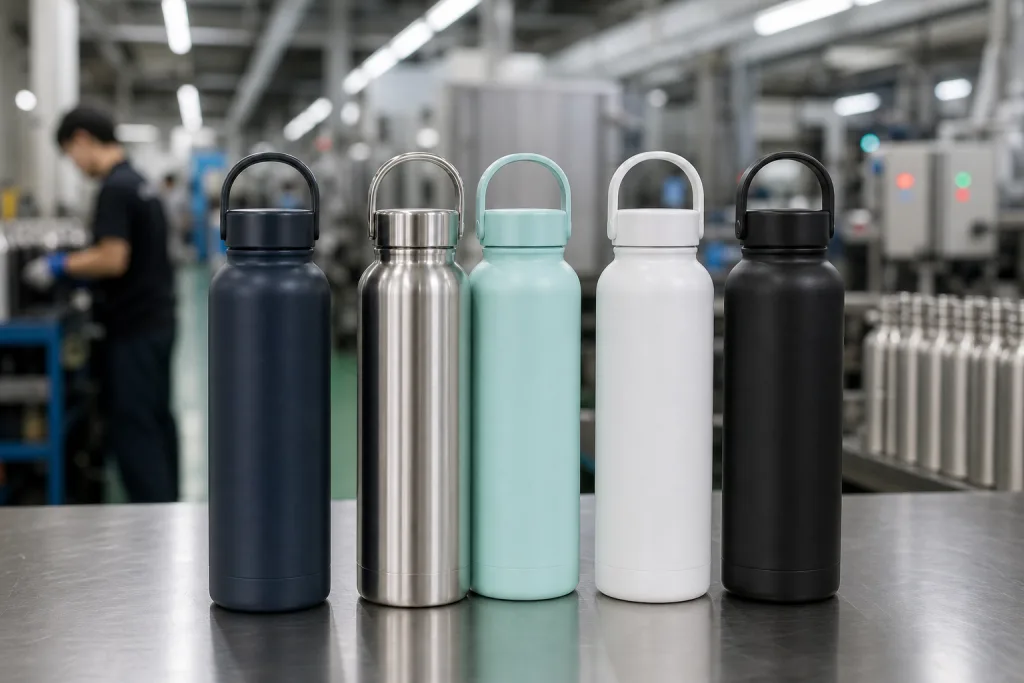
Buyers say “customizable refillable water bottle” and mean 3 different items. We see this on the line every week. One is a lightweight sports bottle, usually single-wall stainless steel or plastic, for daily hydration. One is a vacuum flask or travel bottle with double-wall insulation. The third is a wide-mouth bottle or growler-style item for outdoor use, beverage programs, or premium gifting. If you do not lock the use case first, you will compare the wrong quotes from the wrong canteen manufacturers. This is the wrong question to ask: “What is your best bottle price?” Ask what bottle type fits the job.
Start with these decisions:
- Volume: 350 ml, 500 ml, 750 ml, and 1,000 ml cover most B2B demand.
- Material: 18/8 stainless steel for durability, Tritan for clear impact-resistant bottles, borosilicate glass for premium but fragile programs.
- Wall construction: single-wall for lower cost, double-wall vacuum for thermal performance.
- Mouth style: narrow mouth for retail hydration, wide mouth for ice cubes and easier cleaning.
- Use channel: e-commerce, retail, corporate gift, gym chain, school, or canteen distributor resale.
In China, and especially in Zhejiang, factories specialize by process. One plant runs low-cost single-wall bottles all day; another runs powder coating, vacuuming, and copper-plated insulated bodies with a different setup. We have seen buyers send the same RFQ to 12 suppliers and then wonder why the prices are all over the place. The math does not work if the factory’s core line is different from your item. Ask what share of monthly output matches your SKU type. A factory making 600,000 units per month sounds big. If only 10% is insulated custom drinkware, your order can still sit behind their main program, and QC pulled the sample from a line that does not run your spec every day.
For procurement, write a one-page product brief before you ask for pricing. Put in capacity, dimensions, target FOB price, logo colors, target market, testing requirement, and packaging format. Add basic measurements too, such as bottle height in mm, bottom diameter, and carton pack. We ship quotes faster when the brief is clean. A good canteen manufacturer will come back with a tight offer, often the same day for a standard mold. A weak canteen supplier sends a generic catalogue, broad ranges, and misses details; last month one buyer even had a PO typo on lid color, and that single line delayed sample approval by 2 days. That usually tells you enough.
How should you set specs?
The main reason B2B bottle projects fail is simple: the spec sheet is missing hard details. We’ve seen buyers approve a nice rendering, send the PO, then QC pulled the sample and found a 1.2 mm strap where they expected 1.8 mm, powder coat flaking at the corner radius, or a bottle that missed the carton ID by 6 mm. Treat the spec sheet like an engineering release. A mood board won’t save the line.
At minimum, define:
- Steel grade: SUS304 interior and exterior for standard food contact; SUS316 if your program needs higher corrosion resistance.
- Body thickness: 0.4 mm to 0.5 mm is common for bottles under 750 ml; some budget items drop to 0.35 mm.
- Vacuum construction: double-wall with getter and vacuum retention target, if insulated.
- Lid material: PP, Tritan, stainless cap, or mixed construction with food-grade silicone seal.
- Coating: spray paint or powder coating, usually 60-80 microns dry film thickness for better wear resistance.
- Decoration area: exact logo size in mm and position tolerance, ideally within plus or minus 2 mm.
- Packaging: egg-crate divider, white box, color box, PDQ, or e-commerce drop-test format.
If you need a canteen custom program for retail, ask for full dimensions, finished weight, and master carton gross weight on day one. This is the wrong question to skip. One 1,000 ml bottle with a bamboo lid can look sharp in a photo and still push carton weight above 15 kg; the buyer flagged that on one run only after the warehouse rejected the stack height. We’ve seen this go sideways.
Useful checklist for first RFQ
- Target market: EU, US, Canada, UK
- Compliance standard: REACH, LFGB, FDA, Prop 65, ASTM if children are involved
- Thermal target: for example 12 hours hot, 24 hours cold at room temperature 20-25°C
- Leakproof requirement: 100% upside-down test for 30 minutes
- Branding method: silkscreen, laser, heat transfer, UV print, embossing
If a canteen supplier in China cannot turn your brief into a signed specification drawing before production, expect rework risk. We run this step before tooling release for a reason. A drawing should show thread finish, logo position, carton pack-out, and even small callouts like a 3 mm base recess; last month we caught a PO typo that listed 24 pcs/ctn instead of 20 pcs/ctn. Hidden cost starts here, not later.
What will pricing really depend on?
Most buyers look at unit price first. Fair enough. But the gap between two offers usually comes from what each factory put into the quote. One canteen vendor prices a stock mold, 1-color silkscreen, white box, no testing. Another prices Pantone color matching, powder coating, drop-test carton, and one polybag per bottle. We see this every week on the line. Normalize the quote item by item, or the math does not work.
Typical FOB China price bands for B2B orders look like this:
- 500 ml single-wall stainless bottle: USD 2.20-3.60 at 1,000-3,000 pcs
- 500 ml vacuum insulated bottle: USD 3.80-6.20 at 1,000-3,000 pcs
- 750 ml vacuum insulated bottle: USD 4.80-7.20 depending on lid and coating
- Custom growler 1.2L-1.9L: USD 8.50-15.00 depending on handle, base, and cap structure
Then add the variables buyers usually miss. QC pulled one sample last month where the lid drawing on the PO said “strew lid” instead of “straw lid,” and yes, that kind of detail can slow approval by 2 days.
- Logo method: laser engraving may add only USD 0.08-0.20, while full-wrap transfer can add USD 0.35-0.90.
- Custom color: Pantone-matched powder coat often adds USD 0.12-0.30.
- Special lids: chug lid might add USD 0.20, while a straw lid with extra parts can add up to USD 0.80 over a standard screw cap.
- Packaging: custom gift box can add USD 0.35-1.20; barcode labels are usually USD 0.02-0.05 each.
- Testing: third-party food-contact or physical testing can cost USD 300-1,200 per SKU depending on scope.
If you buy as a canteen distributor or distributor drinkware importer, ask for price breaks at 1,000 pcs, 3,000 pcs, 5,000 pcs, and 10,000 pcs. Ask what changed at each level. A capable canteen factory in Zhejiang should tell you if the saving comes from better tube yield, carton count, or coating efficiency, not from cutting steel thickness from 0.5 mm to 0.4 mm. This is the wrong place to save money. We have seen cheap quotes go sideways because the cost was cut in the body material, not in production waste.
Ask one blunt question: what exactly would make this price increase after PO? If the buyer flagged “subject to final review” with no clear list, push back. The answer tells you if the supplier runs its process or is still guessing.
MOQ, samples, and timeline realities
Most new buyers open with 300 pcs and want full custom on everything: body color, lid, logo, and retail box. For stainless steel, that number usually breaks fast unless you stay with stock parts and simple printing. The wrong question is not "Can you do 300?" The right one is "Which parts stay standard?" Setup scrap, mold matching, and box supplier MOQ set the floor, and we’ve seen this go sideways when a buyer flags the cost only after the dieline is made.
For common bottle programs in China, practical MOQ ranges are:
- Stock bottle + 1-color logo: 500 pcs
- Custom color + stock shape: 1,000 pcs per color
- Vacuum bottle with custom box: 1,000-3,000 pcs
- New mold body or lid: often 3,000-10,000 pcs plus tooling
- Custom growler with new cap system: usually above 5,000 pcs
Samples are another place buyers get the timeline wrong. A digital mockup is 1-3 days if the logo file is clean. A pre-production sample with the actual Pantone, print position, and lid match is usually 7-12 days; QC pulled one last month because the logo sat 2 mm off center. If you need a new mold, prototype timing is 20-30 days before testing starts. Mass production is usually 30-45 days after deposit, artwork approval, and sample signoff. In peak season from August to November, Zhejiang factories often run 45-60 days because the line is packed.
Ask what stays in-house and what goes outside. If the factory prints, coats, and assembles in-house, we can control the schedule better. If powder coating or packaging goes to a partner, add 5-7 buffer days. We ship against real slot booking, not hope, and that matters more than headline capacity. At BottleForge Industrial scale, buyers may hear "hundreds of thousands of units per month," but the math doesn't work if your PO lands late or the barcode artwork is still being fixed.
Checklist before paying deposit
- Approved artwork in vector format
- Signed final specification sheet
- Confirmed carton marks and barcode format
- Sample approval record with date
- Agreed incoterm: FOB Ningbo, FOB Shanghai, or EXW
Get these locked before deposit. Even one small miss—a carton mark typo or an unsigned spec sheet—can push shipment by 7 days, and then the buyer says the factory was late.
Which compliance checks matter most?
Compliance starts with two facts: where you sell and who will stock it. A corporate gift order often moves with a basic food-contact declaration and a signed spec sheet. A retail launch into a chain store is different. The buyer will ask for test reports, label files, audit records, and batch consistency across the full PO. Do not assume a canteen supplier knows your market rules unless you write them into the PI or PO. We see mixed-market factories every month, and if the requirement is not clear, they usually quote the lowest standard to keep cost down. Last month a buyer flagged a PO typo on “LFBG” instead of “LFGB.” Small typo, big delay.
For Europe and North America, the common checkpoints are:
- Food-contact safety: LFGB or EU food-contact migration testing for Europe; FDA-relevant materials declarations for the US.
- Chemical restrictions: REACH and, where needed, Prop 65 review.
- Mechanical and performance: leak test, drop test, coating adhesion, dishwasher claim validation if marketed that way.
- Social and system audits: BSCI, Sedex, or equivalent if your retailer requires it.
- Quality system: ISO-style document control and traceability, even if not every supplier holds every certificate.
For children’s items, ASTM and CPSIA-related checks may apply based on the accessory set and age grading. A straw lid, silicone bumper, or carry strap changes the review fast. This is the wrong question to ask: “Do you have kids’ compliance?” Ask which part was tested, for which age grade, and under what report. For US e-commerce, label review also matters. Check country of origin, care instruction, warning statement if needed, and FNSKU placement for Amazon programs. We ship cartons every week where the barcode is off by 5 mm, and Amazon will still reject it.
On quality control, ask for measurable standards, not general promises. Final random inspection should follow AQL 2.5 for major defects and 4.0 for minor defects unless your customer specifies tighter. Define the defect list before production starts: dented body, crooked logo, paint scratch above 3 mm, loose handle, odor, leakage, missing seal, mixed carton count. QC pulled the sample once on a 5,000-piece run because the logo sat 2 mm low on one side. The factory said it was acceptable. The buyer did not.
A canteen vendor worth using will run in-line checks, not just end-of-line checks. On insulated customized canteen products, ask if they verify vacuum retention lot by lot and how they record it on the line. One failed seal can turn into a return problem 90 days later, especially in winter promotions. We have seen this go sideways. The math doesn't work: an extra inspection fee is small, but a retail chargeback or 800 returned bottles is not.
How do you judge the supplier?
Most buyers can spot a good-looking sample on the table. Fewer check whether the factory can hold that same finish, lid fit, and print position across 3,000 or 30,000 units. That is the real filter when you choose canteen manufacturers or canteen vendors. We have seen this go sideways: first sample passed, then QC pulled the mass-production sample and found the logo sitting 2.5 mm high on one shift.
Use a simple scorecard during qualification:
- Quoting discipline: do they ask technical questions about capacity, steel grade, finish, lid structure, and drop test, or do they just throw out a price in 20 minutes?
- Documentation: can they issue a spec drawing, packing list format, and inspection standard fast, or are you still waiting 3 days for a draft carton mark with your PO typo copied into it?
- Production ownership: what is in-house versus outsourced, and which steps run on their line: tube cutting, hydroforming, powder coating, laser marking?
- Problem handling: how do they handle leakage, color deviation, or carton damage claims, and who signs off after the vacuum test station finds a fail?
- Communication speed: 24-hour replies are normal for export teams in Zhejiang; 3-day silence during development is a warning.
Ask for a recent production case close to your item: same body type, same finish, similar annual volume. If you are a distributor canteen buyer, ask whether they support mixed-SKU container planning, spare parts, and repeat PO color consistency. We ship these programs every season, and carton balance matters. If you are sourcing canteen promotional items, ask how they control logo registration tolerance on large runs; on silk print jobs, the buyer flagged anything over 1 mm shift.
The supplier should be honest about limits. This is where weak factories start talking big. A matte powder-coated customizable canteen in pastel colors will show weld-ring variation faster than a glossy black bottle, and a 0.08 mm coating difference can make it more obvious under warehouse lighting. A straight answer helps. Overpromising does not.
Also check whether the canteen factory understands freight math. This is not a small detail. Good suppliers will work the carton dimensions, pallet pattern, and loading quantity before you place the order. Saving USD 0.12 on the bottle but losing 800 units in a 40HQ does not make sense. We run these calculations early because the math does not work if the ex-factory price looks good and the container utilization is poor.
If the supplier can talk through compliance, coating thickness, AQL, and loading plan in one call, you are probably dealing with a real export manufacturer, not a trading desk with a catalogue. Ask one more question: who owns final inspection release at AQL 2.5? If they answer with a title, a report format, and a sampling level, that is a good sign.
Get a practical quote for your bottle program
Send your target capacity, logo file, packaging idea, and order quantity. We will reply with workable MOQ, FOB pricing, and lead time from Zhejiang, China.
Frequently asked questions
What MOQ should I expect for a customizable refillable water bottle?
For a standard stock-shape bottle with one-color logo, 500 pcs is achievable from some China suppliers. For a custom color plus logo, expect 1,000 pcs per color. For fully customized drinkware with custom box, special lid, or multiple decorations, 1,000-3,000 pcs is more realistic. If you need a new mold for a customized growler or unique custom canteen body, MOQ can rise to 3,000-10,000 pcs plus tooling. Packaging can also drive MOQ because color boxes often have print minimums around 1,000 pcs. If a canteen supplier offers very low MOQ on a highly customized item, check whether they are mixing stock components, charging unusually high setup fees, or planning to outsource small batches.
How long does production usually take from approval to shipment?
For B2B orders, plan 7-12 days for a pre-production sample after artwork and color confirmation. Mass production usually takes 30-45 days after deposit and approved sample. If you need a new mold, add 20-30 days for tooling and initial validation. Peak season in Zhejiang and wider China, especially August through November, often pushes lead time to 45-60 days. Custom packaging, third-party lab testing, or outsourced coating can add another 5-10 days. If your goods are going to Amazon FBA, leave time for carton labeling, FNSKU application, and appointment scheduling. A realistic timeline is always better than a fast promise that slips twice.
Which logo method is best for custom drinkware?
It depends on your channel and budget. Silkscreen is the most economical for simple one-color art and usually costs about USD 0.05-0.15 per unit. Laser engraving gives a premium permanent look on stainless surfaces and often costs USD 0.08-0.20. Heat transfer or water transfer works for multi-color artwork and wraps but can add USD 0.35-0.90 depending on coverage. UV print can produce sharp detail on flatter surfaces, but durability should be tested if the bottle will see heavy abrasion. For canteen promotional orders, one-color silkscreen is still common. For retail customized canteen projects in North America or Europe, powder coat plus laser is often the safest balance of appearance and durability.
What tests should I request before placing a big order?
At minimum, request food-contact compliance relevant to your market, plus a practical performance checklist. For Europe, that usually means LFGB or EU migration-related testing and REACH review where applicable. For the US, request material declarations and review Prop 65 risk if needed. Product performance should include 100% leak testing, coating adhesion, odor check, and carton drop validation if you sell online. For insulated bottles, ask for thermal retention verification and vacuum integrity checks by lot. Final inspection should use a clear defect list and AQL 2.5/4.0. If the bottle is for children, add ASTM or CPSIA-related review depending on the design. Good canteen manufacturers in China will help define the right test scope instead of pushing generic reports.
How do I compare two canteen manufacturers fairly?
Compare them on a normalized quote sheet, not just the unit price. Make sure both are quoting the same steel grade, wall thickness, lid structure, finish, logo method, packaging, testing, and incoterm. Check MOQ, sample charge, tooling cost, lead time, and what is produced in-house. Ask each canteen factory for actual carton size, net weight, gross weight, and loading quantity for a 20GP or 40HQ. Then review their quality controls: leak test percentage, AQL standard, and whether they can provide pre-production samples and final inspection photos. A supplier that is USD 0.18 cheaper but uses thinner steel, longer lead times, or outsourced decoration is not necessarily cheaper after claims and delays.