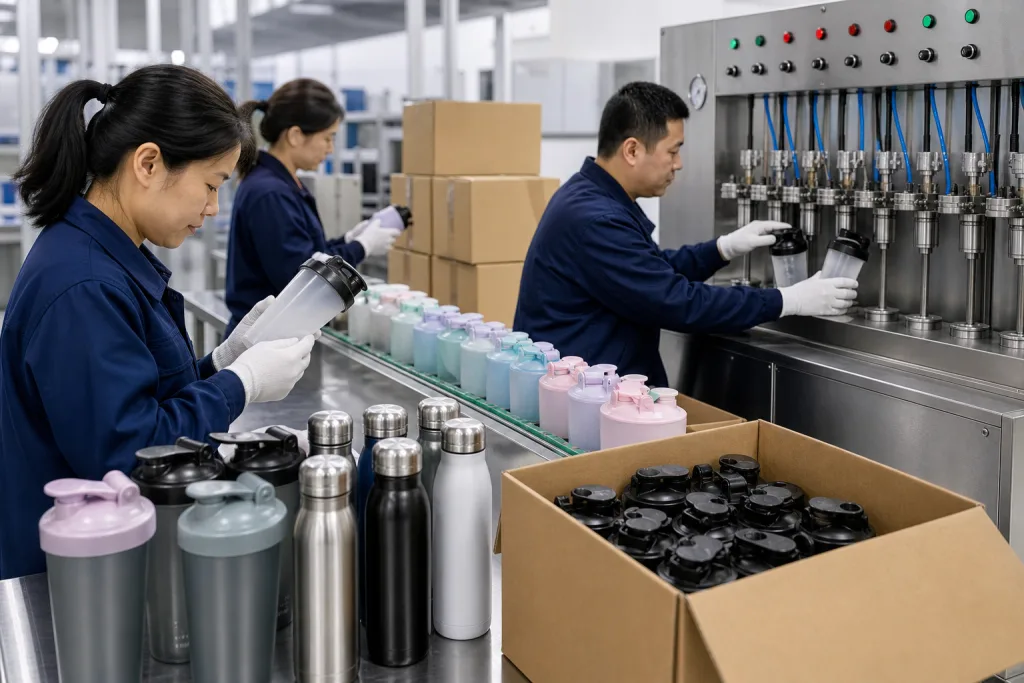
Key Takeaways
- For most B2B orders, MOQ starts at 1,000 pcs per color with 25-35 day lead time from Zhejiang, China.
- PP shaker bottles usually land at USD 1.10-2.20 FOB China; stainless options are commonly USD 3.80-6.50 FOB.
- Leak risk drops when lid-and-cap torque testing is defined up front, typically 500-1,000 open/close cycles.
- AQL 2.5 for major defects and REACH/LFGB/FDA document checks are more useful than chasing the cheapest sample.
You can line up 50 suppliers this week and still land on the wrong customizable protein shaker for your market. The bottle shape is usually not the problem. The gap is between a sample that looks fine on the desk and a production run that has to pass gym abuse, dishwasher cycles, leak tests, barcode labels, and customs papers.
If you source for retail, promo, or distribution in Europe or North America, you need a sharper way to compare options. We see buyers mix up sport bottle specs, shaker bottle specs, and custom canteen requirements all the time. On our line, a 0.5 mm lid mismatch or a loose gasket can turn into a carton of returns. A protein shaker is not just a logo item. Lid torque, mixer style, resin grade, odor control, and print method all hit claims, margin, and repeat orders.
Start with the actual use case
The fastest way to buy the wrong customizable protein shaker is to start with the logo print before you pin down the job. Start with the sales channel, daily use, and the first failure the end customer will complain about. We ask this on day one. A gym chain usually pushes for low leak rates, 7- to 10-day replenishment on repeat POs, and caps that survive drop tests from 1.2 m. A supplement brand usually cares more about shelf impact and logo adhesion after 100 dishwasher cycles. A canteen distributor or distributor drinkware buyer often asks one factory to cover shaker bottles, a custom canteen line, and a customizable growler range under one MOQ program, often 3,000 pcs per style.
This point changes the whole spec. The best shaker for retail is often the wrong pick for a canteen promotional campaign. A promo buyer may accept a simpler PP body if the landed cost stays below a target like USD 2.00, and we have seen buyers flag a 6 g weight increase because the math does not work on giveaway projects. A specialty retailer usually wants thicker walls, better odor control, and a cleaner thread finish checked with a go/no-go gauge, even if FOB rises by USD 0.30 to 0.60 per unit.
In Zhejiang, China, plenty of canteen manufacturers and canteen suppliers also run sports bottles and tumblers on the same floor. That sounds efficient. Still, verify whether the line is actually set up for shaker lids, agitator balls, and repeat leak testing at 0.03 MPa. We have seen this go sideways. A canteen factory that mainly runs straight-wall bottles can miss fit consistency on flip caps and threaded inserts, and QC pulled one sample last month with a 0.4 mm thread mismatch that caused seepage after transport vibration.
- Retail fitness: prioritize leak resistance, visual clarity, dishwasher performance, and compliant labeling checked against the final artwork file.
- Promotional: prioritize unit cost, decoration area, and fast MOQ splits by color, such as 1,000 black + 1,000 red within one 3,000 pcs order.
- Distributor program: prioritize repeatability, carton efficiency, and the ability to extend into customized canteen or customized growler SKUs later without reopening tooling.
Define the channel first. Then the spec sheet gets tighter, the buyer comments get sharper, and the sample review stops turning into personal opinion. This is the right question to ask before anyone talks about printing.
Head-to-head spec table that matters
Buyers love to line up 500 ml, 700 ml, and 800 ml and call it a comparison. That is the wrong question to ask. On our line, the bigger differences show up in resin grade, lid structure, mixer design, print method, and complaint rate after 60 to 90 days in market.
| Option | Typical FOB China | MOQ | Best fit | Main risk |
|---|---|---|---|---|
| PP body + flip cap + mixing ball | USD 1.10-1.60 | 1,000-3,000 pcs | Promo, entry retail | Odor retention, scratch visibility |
| Tritan body + screw lid + agitator grid | USD 1.90-3.20 | 1,000-2,000 pcs | Mid-range retail | Print abuse if wrong method chosen |
| Stainless steel double wall shaker | USD 3.80-6.50 | 500-1,000 pcs | Premium retail, gift sets | Weight, higher freight cost |
| PP body + handle lid + storage base | USD 1.70-2.60 | 1,000 pcs | Supplement bundles | More components, more assembly defects |
PP is the cost play. We ship a lot of it for canteen customizable programs where the target has to stay under a landed cost cap. The tradeoff is familiar: if protein shake residue sits overnight, PP will hold odor faster than Tritan, and QC pulled samples before with light wipe-scratch marks on gloss bodies. Tritan gives cleaner clarity and a more premium hand feel. It also behaves better on shelf next to customized drinkware or custom growler lines, but the buyer flagged logo wear on one order because they chose silk screen for a high-rub gym channel. Stainless fits premium launches and corporate gifting. For entry-level gym promos, the math often does not work once freight jumps on a 0.35 kg to 0.48 kg unit.
We usually tell buyers to ask for wall thickness on the quote sheet, not after sampling. For a 700 ml PP body, 0.9-1.2 mm is common; for Tritan, around 1.5-2.0 mm is more typical depending on shape and grip panels. We check this with an ultrasonic thickness gauge on new molds. If a supplier cannot state wall thickness, lid resin, and seal material clearly, we have seen that go sideways. A capable canteen manufacturer or canteen vendor should answer in one email, down to the seal hardness and whether the lid uses PE or silicone.
Where designs fail in real production
Most failures on a customizable protein shaker are boring, repeat defects, not factory disasters. We see the same 5 issues on the line: cap leaks, hinge pins whitening or cracking, print registration drifting 1-2 mm, odor complaints after sealing, and rough threads that scrape on first use. The buyer often asks for a better-looking pre-production sample. That is the wrong question. A clean sample does not tell you what happens at 8,000 pcs after the torque gauge and go/no-go thread gauge start catching drift.
The lid is the highest-risk component. A shaker bottle gets shaken hard after a workout, then dropped into a gym bag with the cap facing sideways. If snap force is low or the silicone seal sits unevenly in the groove, leak claims show up fast. We have had QC pull the sample after a buyer flagged seepage at the spout corner. Ask for actual test points:
- 100% air-leak or water-leak test on finished assembly
- 500-1,000 cap open/close cycle check
- Drop test from 1.0-1.2 m, usually empty and filled conditions
- Dishwasher simulation if the item is sold as top-rack safe
Decoration failures usually come next. Silkscreen is cost-effective, but on a curved shaker body the artwork can stretch if the print height is pushed past what the fixture holds flat; we have seen logos distort once art climbs above 45-50 mm on some diameters. Heat transfer gives more graphic freedom, but the line needs tight temperature and dwell-time control or edges start lifting. Laser marking works well on stainless. It does nothing for some bottle types, so the math doesn't work if a buyer asks for one decoration method across every SKU. For buyers running a broader custom drinkware range with custom canteen, customizable canteen, and customized canteen programs, standardizing print position, artwork height, and color approval rules across categories cuts down approval mistakes.
Some China factories serving canteen distributors or distributor canteen accounts try to run one generic lid across 3 or 4 SKUs. That saves tooling cost up front, usually one mold set and less spare-part stock, but we have seen this go sideways with protein powder. Powder packs under deep hinge pockets, vent paths stay dirty, and washing gets harder. One buyer even sent a PO with the color code typo swapped on the lid and flap, which turned a simple shared-lid idea into a rework mess. Ask the canteen supplier or canteen suppliers on your shortlist for assembly exploded views or at least component counts. If one lid has 9 parts and another has 6, you already know where failure risk is heading.
A sample proves appearance. A production control plan proves repeatability.
Compliance, QA, and the documents you need
If you buy for Europe or North America, paperwork is mandatory. A customizable protein shaker is a food-contact item, so the file should match the destination market, not just the factory's standard packet. For the US, buyers usually ask for FDA-related food-contact documents. For Germany programs, LFGB comes up fast. REACH screening also gets pulled into the file on some projects. On our side, QC pulled the sample and matched the resin code on the lid before we released the declaration. Skip that check and the file looks fine until customs or your retailer asks one more question.
Do not assume a canteen factory manages documents the same way across every SKU. We've seen plants that run stainless tumblers well but struggle to keep plastic shaker test files current, especially after a mold change on a 700ml PP cup. Some canteen vendors are trading companies with 2 or 3 sub-suppliers behind them. That is not the problem by itself. The real question is who owns quality control and who holds the original reports. If the buyer flagged an LFGB report and the seller needed 4 days to "check with the partner factory," we've seen this go sideways.
For production quality, ask for the inspection standard in writing before PO approval. AQL 2.5 for major defects and 4.0 for minor defects is common for drinkware. Put the defect definitions on paper too. Major defects include leakage, wrong logo color, sharp edges over the gate trim, and failed barcode application if you need retail labeling. Minor defects usually mean light print offset, slight color variation within tolerance, or a small cosmetic mark in a non-decorated area under 3mm. This is where arguments start. If your PO says "no defects accepted" and the approved sample says nothing, the math doesn't work.
At BottleForge Industrial in Zhejiang, we normally tell buyers to define checkpoints before deposit, and yes, before tooling revision if the whisk ball or lid thread changed by 0.2mm:
- Pre-production approval: color, logo position, packaging layout, barcode format
- Inline inspection: lid fit, print adhesion, assembly consistency
- Final inspection: AQL sampling, leak test, carton drop, quantity count
If you are also buying custom growler, customizable growler, or customized growler items from the same China source, keep separate test files by material family. Stainless, PP, Tritan, and glass do not carry the same compliance risk. We ship buyers mixed programs like this all the time, and the cleanest setup is one folder per material with matching declarations, migration reports, and SKU photos. A disciplined canteen supplier will do that without being chased twice.
MOQ, tooling, and cost trade-offs
Most buyers stare at unit price and miss the cost stack. That is where projects slip. For a customizable protein shaker, landed cost usually moves on four points: body material grade, lid structure, decoration, and packaging format. A plain PP shaker with one-color silkscreen and bulk packing can be close to USD 1.10-1.40 FOB China at decent volume. Add a custom color lid, agitator, insert card, and individual color box, and you can add USD 0.35-0.80 quickly. On our line, QC pulled a sample last month where the box spec changed from 300gsm to 350gsm board, and the packing cost jumped before the buyer caught it.
MOQ is usually set by the tightest component, not the bottle body. The body might run at 1,000 pieces, but a custom Pantone lid or printed box can push practical MOQ to 2,000-3,000. If a supplier throws out a low MOQ, ask one direct question: leftover stock parts or fully bespoke production? This is the right question to ask. We have seen POs marked "custom blue lid" with no Pantone code, then the buyer flagged the shade after production started. In Zhejiang, China, straight quoting saves days of back-and-forth for both sides.
Typical commercial ranges
- Existing mold, standard color: 1,000 pcs MOQ
- Existing mold, custom color and logo: 1,000-3,000 pcs
- New mold for exclusive body or lid: USD 3,000-12,000 tooling depending on complexity
- Lead time after approval: 25-35 days for repeatable programs, 35-50 days for new-tooling projects
For distributors, the smarter question is not “What is your best price?” It is “What is the lowest-risk spec at my target retail margin?” A canteen distributor, canteen distributors group, or distributor growler buyer often wants one family look across 4 or 5 SKUs. That means your protein shaker may need to visually match a custom canteen or customizable drinkware line even if the cost lands USD 0.12 higher per unit. We run into this on logo placement too: a 15 mm shift to match the rest of the line sounds small, but it can force a new screen setup. A good canteen vendor should balance line consistency with margin, not just push the cheapest resin.
A factory with around 300,000 units/month capacity can usually carry seasonal programs better than a small workshop, but only if component planning is tight. Capacity on paper means nothing if the lid supplier is late by 6 days or the agitator stock is short 2,000 pcs. We ship smoother when body injection, screen printing, and assembly schedules are tied to one parts plan. Ask what parts are made in-house and what parts are outsourced. If the answer stays vague, we have seen this go sideways.
Choosing the right format for each channel
Not every customizable protein shaker belongs in every channel. We’ve seen buyers force one universal SKU, then the math doesn’t work. Split the spec by channel. It usually cuts claims, trims dead stock, and avoids silly rework later when the PO says 700 ml but the carton was built for 750 ml.
For e-commerce and Amazon FBA, keep the footprint tight, the pack-out protective, and the label panel flat enough for barcode scan. QC pulled samples last month where the FNSKU crossed a side seam, and the buyer flagged it fast. A simple 600-700 ml Tritan body with a secure screw lid usually shoots better in listing photos and ships with fewer breakage claims than a handled design with extra parts sticking out 18 mm from the body.
For gym chains and corporate wellness, durability matters more than fancy material language. PP works if the hinge or thread runs clean on the line and survives drop checks from 1.2 m. This channel borrows a lot from canteen promo buying: low return rate beats luxury positioning. We ship plenty of plain-body programs where the logo is one-color silk print and the buyer only cares that 5,000 units land on time and the lid doesn’t leak.
For retail specialty and gift sets, stainless shakers or shaker-plus-storage sets can justify higher FOB. If you already buy from canteen manufacturers for insulated bottles, adding a premium shaker is usually operationally clean since the same spray booth and packing team can run it. The wrong question here is “Can we make it insulated?” Ask whether the mixer insert still works and whether a hand can reach the bottom radius for cleaning; we’ve seen this go sideways with narrow-mouth designs under 55 mm.
For distributor programs, think in assortment blocks, not one item at a time. A distributor drinkware or distributor canteen account often wants one visual system across customized drinkware, customized canteen, and shaker bottles, and that means the small details carry weight. Cap color chips, logo scale, matte or gloss finish, and outer carton markings all need to line up. We run into this on approvals all the time: the bottle is fine, but the buyer rejects the set because one master carton says “Matt” and the other says “Matte.”
The practical shortlist for most buyers is simple:
- Entry promo: PP body, mixing ball, one-color print, usually starting from 3,000 pcs MOQ
- Mainstream retail: Tritan body, agitator grid, stronger decoration spec with a defined print panel
- Premium: double-wall stainless, powder coat, gift-ready packaging with insert fit checked by drop test
If your supplier pushes one option for every use case, keep looking. A real canteen factory or canteen manufacturer should tell you where each format wins, where it fails, and what claim pattern shows up after shipment. That’s basic sales engineering, not sales talk.
Send your shaker brief and target price today
Share capacity, material, logo method, target market, and MOQ. We will recommend the lowest-risk customizable protein shaker spec from Zhejiang, China.
Frequently asked questions
What is a realistic MOQ for a customizable protein shaker with custom logo?
For an existing mold, a realistic MOQ is usually 1,000 pieces per model and colorway. If you want a custom Pantone body, matching lid, printed carton, and insert card, the practical MOQ often moves to 2,000-3,000 pieces because the packaging supplier and color-matching process set the floor. Stainless shaker bottles can sometimes start at 500-1,000 pieces if the factory already runs that shape. Be careful with very low MOQ offers from China. They often mean limited color choice, shared packaging, or mixed-stock components rather than a fully customized drinkware program. Ask the supplier to separate MOQ by bottle body, lid, print, and box so you can see what is driving the minimum.
Which material is best for a protein shaker: PP, Tritan, or stainless steel?
It depends on channel and price target. PP is the budget workhorse at roughly USD 1.10-1.60 FOB China and suits promotions, gym giveaways, and higher-volume distributor programs. Tritan is the better choice for mid-range retail because it looks cleaner, feels more premium, and usually resists odor better; expect roughly USD 1.90-3.20 FOB. Stainless works for premium programs, gift sets, and insulated use cases, often at USD 3.80-6.50 FOB. The mistake is treating them as interchangeable. If you sell a custom canteen or custom growler line already, stainless may match your assortment visually, but it is heavier and costs more to freight. For mainstream shaker performance, Tritan is often the safest balance.
How do I reduce leak complaints on shaker bottle orders?
Put leak control into the spec sheet, not just the sample comments. Require 100% leak testing on finished assembly, define the test method, and ask for cap and lid torque ranges if the design uses threaded parts. Also request open-close cycle checks of 500-1,000 cycles and a drop test from about 1.0-1.2 meters. Many leaks come from uneven seals, inconsistent hinge geometry, or poor thread finish, not from the body itself. If your canteen supplier also makes generic sports bottles, verify that the shaker lid is designed for vigorous shaking. During final QC, use AQL 2.5 for major defects and make leakage a major defect. That one line in the inspection standard can save a lot of claims later.
What compliance documents should I ask from a China shaker bottle supplier?
For Europe and North America, ask for food-contact compliance documents relevant to the material and destination market. In practice, buyers commonly request FDA-related food-contact declarations for the US, LFGB-oriented documentation for Germany-focused business, and REACH information where applicable. You should also ask for material identification for bottle, lid, seal, and agitator, plus test reports tied to the actual factory or approved sub-supplier. If the supplier is a canteen vendor or trading company using multiple factories, confirm who owns the reports and whether they match your exact SKU. Add packaging requirements too, especially if you need retail barcode labels, FNSKU, or drop-test-ready cartons. A clean document pack is part of quality, not admin overhead.
Can one supplier handle protein shakers and other drinkware like canteens or growlers?
Yes, many suppliers in Zhejiang, China can cover shaker bottles, sports bottles, tumblers, custom canteen products, and even some custom growler programs. The benefit is easier brand consistency and fewer vendor relationships. The risk is assuming one factory is equally strong in every category. A canteen manufacturer may be excellent at stainless vacuum bottles but average on plastic shaker lids, or a canteen factory may outsource key parts. Ask which products are made in-house, what their monthly capacity is, and whether the QA plan differs by category. If you want a family program across customizable canteen, customizable protein shaker, and customized growler items, ask for separate test files and production photos for each line before consolidating orders.