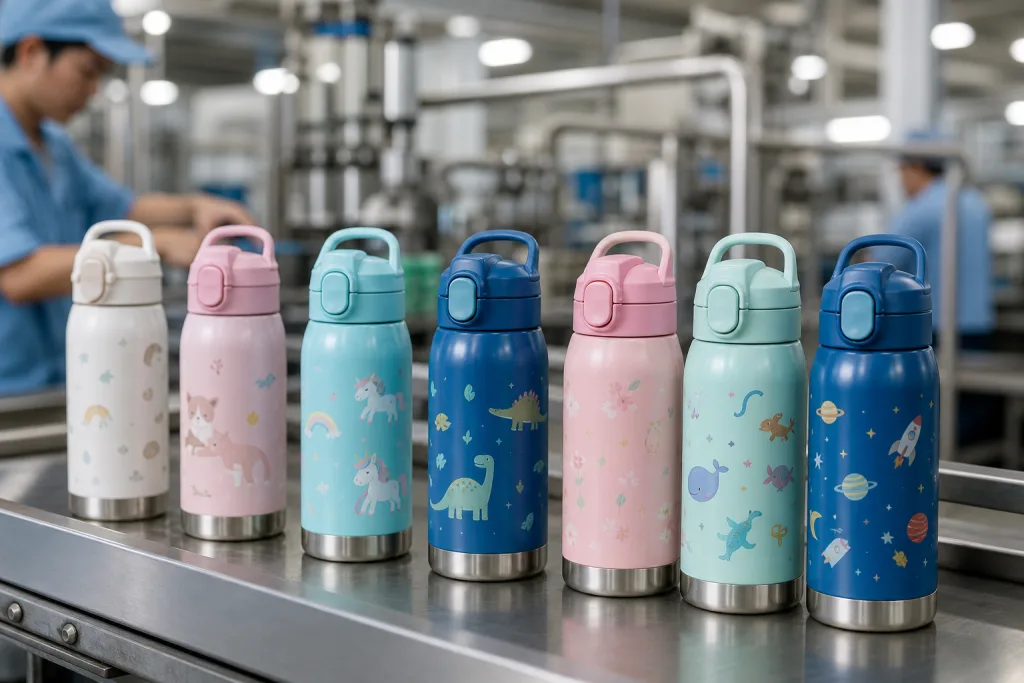
Key Takeaways
- For most PP or Tritan kids bottles, practical MOQ starts at 3,000-5,000 units per color, while stainless options usually start at 2,000-3,000 units
- A realistic lead time from Zhejiang, China is 30-45 days after sample approval, with pre-production samples typically needing 7-10 days
- Leak complaints often trace back to lid structure and silicone gasket fit; AQL 2.5 final inspection is more useful than relying on supplier self-checks
- Typical FOB pricing ranges from USD 1.20-2.10 for plastic kids bottles and USD 2.80-4.80 for insulated stainless models at 5,000 units
You do not buy a kids bottle the way you buy an office tumbler. The risk points are different, and buyers usually feel that after the first claim hits: bite-safe parts, backpack leak control, print wear after 200 dishwasher cycles, and paperwork a compliance team will actually sign off. On a quotation sheet, a customizable kids water bottle looks simple. On the line, 0.5 mm too much flash on a silicone straw valve can turn into a leak test failure. The real cost sits in the spec lines buyers skip too early.
At our Zhejiang factory, we see the same pattern every month. Buyers start with shape and price, then the buyer flagged lid seepage after a 1-meter drop test, a missing REACH declaration, or artwork rubbing off after two weeks in classroom use. We ship plenty of bulk children water bottle orders, and this is the wrong question to ask if you only start with FOB price—the math does not work. If you are building a custom school water bottle program, read the spec sheet like a buyer who has to clear QC, documents, and a 3,000-piece MOQ, not like a shopper.
Start with bottle body material
The first line on the spec sheet is body material, and for a customizable kids water bottle that choice drives compliance, drop performance, decoration limits, landed cost, and how often the after-sales team hears about cracks or leaks. On our line, QC usually checks body thickness with a digital caliper before print approval because a 0.2 mm shift can change how a bottle survives a desk drop. The usual options are PP, Tritan, single-wall stainless steel, and double-wall stainless steel. Glass exists, but for school programs it is usually the wrong fit unless the age group is older and the channel is retail, not district tenders.
For entry-price bulk kids water bottle programs, PP still runs often because the math works. A 500 ml PP bottle can land around USD 1.20-1.60 FOB China at 5,000 units depending on lid complexity and print, and it usually handles repeat drops better than buyers expect. Tritan usually adds USD 0.20-0.45 per unit, but you get cleaner clarity and a stronger retail look on shelf. We have seen buyers flag PP as “too basic” once the first sample hits the sales table, so a lot of children water bottle custom programs move to Tritan for color visibility, easier merchandising, and stronger perceived value.
For schools, stainless is picked more for service life than insulation. A single-wall 18/8 stainless body at 0.4 mm wall thickness takes rough use better than a lot of plastic bottles, though dents still show up; we have seen dent depth around 1.5 mm after a stair-drop test. Double-wall vacuum models push up cost and weight, and that matters fast if the target user is under age 8. If you are a children water bottle distributor selling to districts, keep empty bottle weight below about 280 g for younger grades. This is where buyers ask the wrong question: they focus on “premium feel” and miss backpack weight.
- PP: lowest cost, solid drop resistance, less premium look; common MOQ starts at 3,000 pcs on simple color bodies
- Tritan: clear body, better shelf appeal, moderate cost increase; good fit when the buyer wants logo color to show cleanly through the wall
- Single-wall stainless: durable and reusable, no insulation; watch for dents around the shoulder after handling tests
- Double-wall stainless: premium build, heavier unit weight, higher freight cost; carton weight climbs fast on 24 pcs master packs
Ask your children water bottle manufacturer for material declarations, BPA-free statement, and REACH screening support before sampling, not after artwork approval. We ship smoother when this is settled early, because once the buyer flagged a PO typo on “Trition” instead of Tritan and the paperwork had to be redone. Buyers in Europe and North America should not accept vague wording like “eco material” without actual test scope.
Lid structure decides complaint rate
If one spec line needs a hard look before color, it is the lid. On our line, most after-sales claims on a custom kids water bottle trace back to the lid set: straw fit, bite valve cut, hinge pin play, or a silicone seal that sits 0.3 mm off its groove. A bottle can pass a quick factory leak check and still fail in school use after kids cross-thread the cap, drop it off a desk, or leave juice inside for 3 days.
The main lid styles are screw cap with carry loop, flip straw lid, push-button hygienic lid, and sipper spout. Flip straw lids sell fast for kindergarten and elementary programs, but they carry the highest complaint rate because we run more parts through assembly—spring, pin, straw, nozzle, seal. More parts means more molds, more hand assembly, and more places for tolerance drift. For a bulk school water bottle order where the district does not want to manage replacements, a basic screw lid with integrated straw usually holds up better over 12 months than a spring-loaded push button lid. We have seen this go sideways when the buyer chose the fancier lid to save 8 cents on perceived value.
What to ask on the spec sheet
- Silicone gasket hardness, usually 50-60 Shore A
- Straw material and odor control requirements
- Handle pull test standard, for example 5 kg for 1 minute
- Leak test method: inverted, side lay, and pressure simulation
- Spare parts policy for lids and straws
At our factory in Zhejiang, China, we usually tell buyers to test 12 filled samples in real school bags for 48 hours, not just on the air-pressure bench. QC pulled a sample last month that passed the inverted leak test but seeped after a side-lay bag test with the straw folded under a lunch box. That is the wrong question to ask: "Does it pass the bench test?" Ask how it behaves after 20 bag drops and two cap twists by a six-year-old. If you are buying children water bottle customized products for resale, confirm that replacement lids can be ordered separately at MOQ 500-1,000 pieces. Good children water bottle suppliers should offer that without a long argument.
If the unit price looks unusually low, the cut is usually in lid assembly, gasket fit, or straw resin grade, not the bottle body.
Capacity, size, and child usability
Capacity is a shipping and usage decision, not just a merchandising call. It changes carton count, freight per unit, how the bottle sits on a classroom desk, and whether a child carries it after week one. The common range for a custom children water bottle is 350 ml to 600 ml. For preschool and lower elementary, 350-450 ml is the safer range. For grades 4 and up, 500-600 ml usually sells better. On our line, the 400 ml and 520 ml sizes cover about 80% of school-program inquiries.
Buyers often push capacity too far because the adult on the PO thinks bigger sells better. We have seen this go sideways. Then the bottle does not fit lunch bags, side pockets, or desk holders, and the buyer flagged it only after pre-shipment photos. A 600 ml insulated bottle with a wide base can easily exceed 75 mm diameter and 260 mm height, which is awkward for smaller hands. If you are a children water bottle wholesale buyer selling into school channels, the extra 100 ml on the gift box is the wrong question to ask. Grip, fit, and carry comfort matter more.
Look closely at these dimensions:
- Body diameter: 65-72 mm is comfortable for most children
- Mouth opening: 35-45 mm balances easy cleaning and spill control
- Net weight: under 220 g for plastic, under 280 g for insulated stainless
- Carton pack-out: often 24 or 36 units per carton
For importers building a bulk kids bottle assortment, we usually recommend one lid family across two capacities, such as 400 ml and 520 ml. The math works better. You cut spare-part SKUs, avoid duplicate tooling, and keep compliance files cleaner. We run this setup often: same cap thread, same gasket set, two body heights, one leak test standard at the air-pressure station. A serious children water bottle factory should tell you up front whether the same cap thread and gasket set can run across multiple bodies.
If you sell online or through school fundraising, ask for product dimensions with tolerance, for example plus or minus 2 mm, and unit weight tolerance within 3 percent. Ask for the packed size too, not just the bottle size. QC pulled one sample last season where the inner tray added 6 mm to the retail box width, and that was enough to disrupt carton planning. These details help prevent FNSKU relabel delays if the outer pack dimensions change after final sample approval.
Decoration method changes your margin
The decoration line on the spec sheet is where margin gets won or lost. A custom logo kids bottle for a school, museum, or licensed kids program often needs mascots, class codes, or 300 student names on one PO. That is where production reality starts. The print method has to match the bottle material, MOQ, and how hard kids will beat up the bottle on the playground. We check artwork position on the line with a 2 mm jig, not by eye.
Silkscreen is still the low-cost option for simple logos at volume. On a children water bottle bulk order of 5,000 units, a one-color silkscreen print may add only USD 0.05-0.08 per unit. That math works. Heat transfer or water transfer handles multi-color artwork and wrap designs, but the adder is higher, usually USD 0.12-0.28 depending on size and coverage. UV print looks clean on short runs, but we have seen this go sideways on kids items that get dropped, rubbed in lunch bags, and washed hard. If curing time or coating control is loose, QC pulled the sample for scratch failure fast.
For stainless bottles, powder coating plus screen print is the common route, and we usually check coating thickness around 60-80 μm before printing. For Tritan, pad print or screen print is standard, though full-wrap options are still possible. If each bottle needs a student name, ask about variable-data workflow at the quotation stage, not after sample approval. This is the wrong question to ask late. Plenty of children water bottle vendors say yes to personalized names, but the real issue is sorting accuracy above 99.5 percent on 3,000 different names, especially when the buyer flagged one typo on a class list and wants a full recount.
Buyer checks that matter
- Adhesion test method for artwork
- Dishwasher claim, if any, and actual test cycles
- Pantone matching tolerance
- Positioning tolerance for logos, often plus or minus 1.5-2 mm
- Whether logos are applied before or after assembly
If the product is for children water bottle promotional use, keep the decoration simple and durable. A clean one- or two-color logo on a stable base color usually creates fewer claims than gradients with large coverage. We ship plenty of repeat orders this way. Buyers working with children water bottle distributors in Europe often learn it after the first returned batch, usually from logo scuffing or color shift that should have been caught at pre-shipment inspection under AQL 2.5.
Compliance paperwork is not optional
Kids drinkware is as much a paperwork job as a production job. We have seen a low quote go sideways fast because the factory had no clean file set for lids, straws, or ink. For a children water bottle customizable program shipping to Europe or North America, ask for the compliance package before you pay the mass-production deposit, not after the line starts.
The required file set changes by material and sales market. On EU programs, buyers usually ask us for REACH screening, LFGB or food-contact migration support, and for the US they often ask for CPSIA or ASTM-related support if the item is sold as a kids product. Some programs also need California Proposition 65 review, phthalates checks for soft parts, and packaging declarations. A factory with ISO-style control should trace each resin, masterbatch, straw, and gasket lot back to the supplier; on our side, QC pulled the sample and matched lot records down to a 25 kg resin bag label. This is the wrong question to ask: “Do you have all certificates?” The right question is which reports match this exact SKU, cap, straw, print, and box.
For social compliance, 3 out of 5 school-district and importer projects we quote ask for BSCI or an equivalent factory audit. It does not prove product safety. It does cut sourcing friction. If you work with a children water bottle supplier in Zhejiang, ask whether the audited site is the same site that runs your order. We have seen trading companies submit one factory report while production moved to another workshop 40 km away, and the buyer flagged it during onboarding.
- AQL: Ask for final inspection at AQL 2.5 major, 4.0 minor
- Traceability: Lot code on carton and ideally on bottle or insert
- Drop test: Define test height, such as 80-100 cm filled
- Odor test: Important for Tritan, PP lids, and silicone straws
Good children water bottle manufacturers in China will not promise “all certificates” before they confirm your market, age grading, and packaging format. That answer is less smooth, but it is the honest one. We have had POs with the age grade typed wrong and retail box artwork changed after sampling; both changes affected the paperwork set.
MOQ, pricing, and shipping math
Cost first. A workable quote for a custom made kids bottle should break out mold status, unit price, print cost, packaging cost, sampling fees, and freight terms. If a supplier gives you one bundled number, comparison gets messy fast. We’ve seen this go sideways after the PO lands, usually on carton cost or logo printing because the buyer assumed it was included.
For existing molds from a Zhejiang children water bottle factory, common MOQ is 3,000 units per model per color for plastic bottles and 2,000-3,000 units for some stainless models. That is the normal range on the line. Gift box packaging, Pantone color matching within 1.0 Delta E, or name personalization will push MOQ up because setup time and packing labor go up. A plain PP or Tritan bulk kids bottle might quote around USD 1.20-2.10 FOB Ningbo or Shanghai at 5,000 units. Stainless insulated kids bottles usually sit around USD 2.80-4.80 FOB depending on body size, coating, and lid type. Buyers ask for 1,000 units with custom box and laser name list all the time; this is the wrong question to ask, because the math doesn’t work.
Lead time usually breaks down like this:
- Existing sample with logo: 5-7 days
- Pre-production sample: 7-10 days
- Mass production: 30-45 days after approval and deposit
- Peak season extension: add 7-15 days from August to November
These dates assume artwork is clean and the seal test passes on the first round. Last month QC pulled the sample because the straw lid leaked after a 1.2-meter drop test, which added 3 days before sample release.
Do not ignore carton efficiency. It matters. A bottle that saves USD 0.06 per unit but cuts carton loading by 20 percent can cost more once freight is added. School importers get hit by this most often when a wide handle or tall flip lid wastes air space in the master carton. Ask for carton dimensions, gross weight, and estimated units per 40HQ before approving shape. We ship these numbers off the packing spec sheet, usually within 24 hours. A factory producing 500,000 units per month should be able to send them fast, and if they cannot, that is a red flag.
If you are buying as a children water bottle vendor or distributor, ask whether the supplier can hold 5-10 percent overrun for replenishment orders. This saves trouble if the first program sells faster than forecast and you need matching bottles from the same color lot. We run into this on back-to-school orders. The buyer flagged a shade difference once after a repeat run, and the issue started with no overrun stock held from the first batch.
What a serious supplier should confirm
When you compare quotations from different children water bottle vendors or children water bottle suppliers, use one test: can they lock the answer and keep it there next week. A solid China supplier should confirm the exact material grade, where each part comes from, the test scope, packing build, and inspection plan in writing. We run into this all the time on the line. The buyer flags a lid change, then the quote changes with it.
For school district buyers and importers, the cleanest process is usually:
- Approve model and target price range
- Confirm body material, lid structure, and age use case
- Review compliance list for destination market
- Approve artwork and packaging dieline
- Receive pre-production sample with actual print
- Book inspection against agreed AQL standard
If a children water bottle manufacturer cannot issue a proper specification sheet, ask for one with these columns: item number, capacity, body material, lid material, gasket material, net weight, unit size, logo process, packing method, carton size, MOQ, sample time, mass lead time, and test support. The math does not work when three email threads are fighting over the same lid spec. QC pulled the sample once and found the PO said 450 ml while the carton mark showed 500 ml. That kind of typo costs real money.
From Zhejiang, our view is plain: the best custom kids bottle project is not the one with the lowest opening quote. It is the one that ships on time, passes inspection, and avoids two months of replacement work. If you source a custom school water bottle or children water bottle wholesale program this way, margin holds and the buyer stops chasing rework.
Get a kids bottle spec review before ordering
Send your target capacity, lid style, logo file, and quantity. We will review MOQ, FOB pricing, compliance points, and production timing from Zhejiang, China.
Frequently asked questions
What is a normal MOQ for a customizable kids water bottle?
For existing molds, most factories in China will quote 3,000 to 5,000 units per model per color for plastic kids bottles and around 2,000 to 3,000 units for some stainless models. If you need custom Pantone body colors, printed gift boxes, or individualized student names, MOQ can rise by 20 to 50 percent. For replacement lids or straws, a practical MOQ is often 500 to 1,000 pieces. If a supplier offers 500-unit production on a fully customized run, check whether they are using stock colors, digital print shortcuts, or charging the setup cost back into a much higher unit price.
Which material is best for school-use custom kids water bottle programs?
For broad school use, Tritan and PP are usually the most practical. PP is lower cost and handles drops well, making it strong for promotional and district programs where the target FOB is around USD 1.20 to 1.60. Tritan costs more, often adding USD 0.20 to 0.45 per unit, but gives a clearer, more retail-friendly look. Stainless steel works when you want longer service life or a premium feel, but empty bottle weight can exceed 280 g on insulated models, which is not ideal for younger children. For grades K-3, many buyers stay in the 350 to 450 ml plastic range.
How do I reduce leak complaints on bulk kids water bottle orders?
Start with lid simplification. Basic screw lids with integrated straw systems usually create fewer complaints than spring-loaded push-button lids because there are fewer moving parts. Ask for silicone gasket hardness around 50 to 60 Shore A, confirm leak testing in three positions, and request 48-hour real-use bag testing on at least 12 filled samples. Also define a handle pull test, such as 5 kg for 1 minute, and make sure the final inspection uses AQL 2.5 for major defects. If you expect ongoing reorders, secure spare lid availability at 500 to 1,000 pieces so you can solve issues without replacing complete bottles.
What compliance documents should I ask a children water bottle supplier for?
Ask for a market-specific compliance pack, not a generic certificate bundle. For Europe, that often means REACH support and relevant food-contact testing depending on material and use case. For the US, buyers commonly request CPSIA-related support for children-focused items, plus phthalates review for soft parts and Proposition 65 screening when needed. You should also ask for material declarations for bottle body, straw, lid, and gasket, plus carton traceability by lot. If your program is tied to public institutions or large retail, BSCI or similar social audit status from the actual Zhejiang or China production site is often required as well.
What lead time should I plan for custom children water bottle orders from China?
For an existing model, logo sample time is usually 5 to 7 days and a proper pre-production sample with approved print and packaging details takes about 7 to 10 days. Mass production usually runs 30 to 45 days after sample approval and deposit. During peak export season, especially August through November, add another 7 to 15 days. Sea freight then depends on destination, but your planning risk is usually factory lead time, not transit. If your launch is fixed, ask the supplier to lock raw materials and decoration capacity before deposit so your schedule is less exposed.