Key Takeaways
- Set measurable specs early: 18/8 inner, 0.4 mm inner wall, 0.5 mm outer wall, and vacuum heat retention target such as 12 hours above 60°C
- Most field failures come from four points: vacuum loss, lid leakage, coating adhesion, and packaging weakness; each can be checked before shipment with AQL 2.5
- For custom thermos orders in China, realistic MOQ is 1,000 pcs/SKU, sample time 7-12 days, and mass production 25-35 days after deposit and artwork approval
- If your promotional thermos needs EU and US sale, confirm REACH, LFGB or FDA-contact compliance, coating test reports, and carton drop standards before PO release
You can sign off on a clean sample and still get a bad shipment. We see it on customizable insulated water bottle orders every month: weak vacuum, lids that start seeping after 7 days, logos scuffed in retail handling, or crushed master cartons because nobody locked the drop-test standard before packing. For outdoor retailers and promo brands, this is not a small miss. A 3% leak rate in a 10,000-piece run means 300 complaints, replacement cost, and a buyer who stops trusting the program. QC pulled the sample once on a 750ml bottle where the weld looked fine, but the vacuum retention failed after the hot-water hold check.
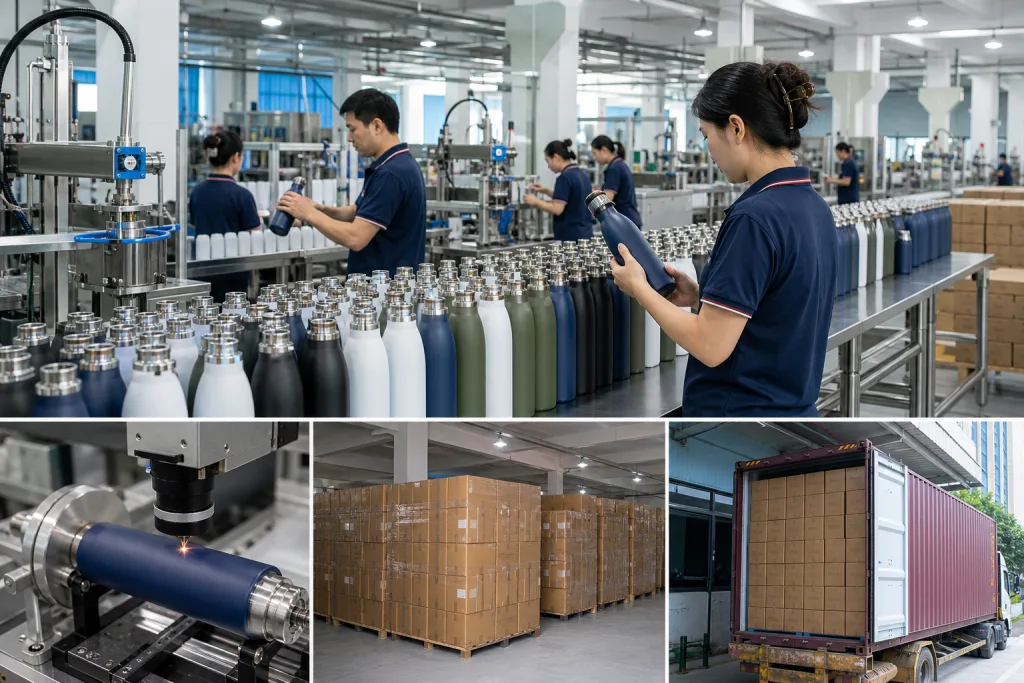
Stainless thermos production in Zhejiang is mature. It is not automatic. You need the right specs before tooling, before PP samples, and before mass production, or the line will run to the wrong target. At BottleForge Industrial in Zhejiang, our stainless line runs about 450,000 units per month, with MOQ from 1,000 pieces per colorway and lead times of 25 to 35 days. The wrong question to ask is usually price first. The difference between a smooth order and a painful one is what you define and what you inspect. We have seen buyers approve artwork with a 0.5 mm logo line that printed fine on the sample, then rubbed off in transit because the coating cure window was too tight.
Where vacuum bottles fail first
The first failure point in a customizable insulated water bottle is usually the vacuum, not the outside finish. A bottle can pass visual check and still miss insulation spec because the vacuum draw drifted, the copper coating was thin, or the sealing point ran hot on the line. We see new buyers spend two emails on Pantone and logo position, then skip the function spec. That is the wrong question to ask. If heat retention is not written on the PO, the factory will build to appearance first.
For a standard custom thermos in 500 ml or 750 ml, write the steel grade and wall structure in plain terms. A practical baseline is SUS304, often called 18/8, for the inner wall and usually the outer wall too. Common thickness is 0.4 mm inner and 0.5 mm outer; we check this with a micrometer during incoming material review. Some thermos supplier quotes drop to 0.35 mm inner or mix steel grades to shave $0.20 to $0.35 off FOB. The math does not work if the body dents in transit or the weld seam gets unstable.
Heat retention should not be written as “good” or “long lasting.” Put a number on it. For example:
- Fill with 95°C water
- Test at ambient 20-25°C
- After 6 hours, temperature not lower than 70°C
- After 12 hours, temperature not lower than 60°C
For cold retention, define ice-water or 4°C water conditions and the hold time. Different thermos manufacturers in China run slightly different test setups, and 12 hours vs 18 hours starts with the method, not the sales sheet. QC pulled the sample last month on one project where the buyer flagged a strong cold-hold claim, but their PO did not say starting fill temperature or whether ice was included. We have seen this go sideways.
A good manufacturer thermos line will also run vacuum inspection on every unit or near 100% of units using vacuum or heat-based screening. Ask for the tested percentage, ask whether failed bodies are reworked or scrapped, and ask to see lot records. Scrapping is cleaner. Reworked vacuum bodies turn into claims 3 months later. If you are buying bulk thermos for outdoor retail, request production records by lot number, not one lab sample report; on our side, each lot is tied back to the sealing station and operator shift.
Leakage usually starts in the lid
When a buyer says a customized thermos leaks, we don’t start with the stainless body. We start with the lid. Most failures come from the cap system: silicone gasket drift by 0.3 mm, thread mismatch between lid and neck finish, straw assembly tolerance stacking up, or a vent plug pressed in shallow on the line. This gets riskier on thermos custom projects with new lid tooling, flip tops, or multi-part caps built for sports and commuter SKUs.
The lid is where we get a bit paranoid, and that is the right habit. Ask your thermos vendor or thermos factory to freeze three points in writing before production. We’ve seen this go sideways when a PO said “black lid” and missed the silicone spec.
- Material: PP, Tritan, stainless, and food-grade silicone grades, with the exact resin or hardness called out if already approved
- Leak test method: inverted 30 minutes, sideways 30 minutes, and hot-water test if relevant, with pass/fail standard written on the QC sheet
- Torque range: cap closing torque and pull force for straws or handles, checked with a torque meter instead of hand feel
For a screw lid on a 500 ml customizable thermos, we usually run 100% leak testing during assembly and then pull a random hot-water inversion sample every batch. Hot water shows problems faster. Silicone softens a bit, internal pressure shifts, and weak sealing points show up in 12 minutes instead of waiting for a return complaint 18 days later. If your order is a promotional thermos for office giveaways, a small seep becomes a desk complaint. If your order is for outdoor retail, the math doesn’t work — leakage turns into returns fast.
Do not approve lids by photo
We see distributor thermos programs fail for one simple reason: the buyer approved only the decorated pre-production sample and skipped functional sign-off. Ask for at least 3 to 5 PP samples from mass-production materials, not hand-built engineering samples from the sample room. For straw lids and handled lids, ask for cycle testing such as 500 to 1,000 open-close cycles, and ask what failed if QC pulled the sample at cycle 420. If the thermos distributors or thermos supplier you work with cannot state their lid failure rate and corrective action, that is a warning sign. This is the wrong question to skip.
On a standard order, the lid should be treated as a separate QC checkpoint, not an accessory added at the end.
Dents, wobble, and bad base geometry
Another common failure is mechanical, not chemical. The bottle dents from a light knock, rocks on the table, or the base dishes in after carton compression. We usually trace this to thin steel, weak bottom forming, or poor annealing before the shaping die. For outdoor retail programs, this is where a cheap quote turns into chargebacks after store audit checks. We have seen buyers approve a sample, then the line runs 0.35 mm body stock instead of the agreed spec, and the math does not work.
Ask for body dimensions with tolerances on the drawing. Control diameter, overall height, mouth opening, and base flatness. A bottle that wobbles more than 1 to 2 mm on a granite table feels low grade even if vacuum performance passes. On 1,000 ml and 1,200 ml SKUs, sidewall dent risk goes up fast, especially with powder coating, because the coating can hide small body pull marks that QC pulled on bare-metal samples but missed later on the packed line.
You can reduce these issues by specifying:
- Minimum wall thickness, such as 0.4/0.5 mm rather than “standard”
- Base impact pad or silicone boot for retail outdoor use
- Carton loading limits and inner tray structure
- Drop test standard, for example 1 corner, 3 edges, 6 faces from 76 cm
A lot of suppliers thermos in China make a bottle feel heavier with paint, color box, and inserts while keeping the steel light. We ship enough Amazon orders to say this plainly: that works for a short-run promotional thermos, not for a distributor thermos program that has to survive parcel handling. The buyer usually flags dents at the lower radius first. If you sell on Amazon or DTC, ask for ship-test packaging, not only export master cartons. Define FNSKU label position and carton scan readability early; we once got a PO with the label callout shifted 18 mm, and warehouse scanning slowed down on arrival.
At QC, do not rely on visual checks alone. Put random units on a granite table or flat steel plate and check wobble unit by unit. Measure net weight against the approved sample weight with tolerance, because weight drift is often the first sign that body thickness changed from lot to lot. This is the wrong question to ask late in production. By the time dents show up in a drop test, the line has already run thousands of pieces.
Logo decoration that fails in handling
A custom thermos can pass leak and insulation checks, then still die in the market because the logo finish fails after handling. We see this all the time, and it is avoidable. The buyer approves a clean showroom sample, often with a large wrap print or soft-touch coat, then the line starts and QC pulled the sample after carton drop simulation and found scratching, ghosting, color shift, or weak adhesion on the mass-run parts.
For stainless bottles, the common decoration methods are powder coating, spray painting, silk screen, heat transfer, laser engraving, and digital printing. Each one fails in its own way. Screen print chips on rough powder texture; we’ve measured powder peaks at 60–80 μm that cut ink coverage. Spray paint drifts lot to lot if the gun setup or bake time changes by 5–8 minutes. Laser lasts, but you lose color. Heat transfer wrinkles at shoulder and base radius if body height moves even 1.5 mm after forming. A customizable thermos with dishwasher claims is the wrong place to guess—test it on production parts, not just the hand-made sample.
Write the test standard into your purchase order:
- Adhesion test: cross-hatch with 3M tape, no significant peeling
- Scratch or rub test: defined load and cycle count
- Color tolerance: visual standard under D65 light or approved pantone reference
- Salt spray requirement if hardware parts are exposed
For promotional brands, logo consistency matters more than 7 out of 10 factories admit. If your order has multiple colors, ask for a sealed color standard and a photo under controlled light. We use a light box, not warehouse daylight. For matte powder coating, some variation is normal, but it must stay inside an agreed visual window. We have seen buyers flag 1 carton out of 500 because the black looked warmer on the second shift. If the product is a thermos customizable program with seasonal reorders, keep a retained golden sample in both your office and the China factory; we usually label it with PO number, Pantone callout, and approval date so the line has something real to match.
One practical point: if the bottle will be handled with sunscreen, hand sanitizer, or bug spray in outdoor use, test chemical resistance. Do not skip this. We’ve seen this go sideways after a buyer sent back photos from a July event: the rubberized finish turned sticky in 12 days. Some soft-touch and rubberized finishes look premium on day one, then fail fast once alcohol or DEET hits the surface.
Compliance paperwork that arrives too late
One of the most common sourcing failures has nothing to do with heat retention. The bottles are finished, packed, and sitting on pallets, then the compliance file is late or wrong for the destination market. That is where shipments get stuck at customs, miss retailer booking windows, or come back for relabeling. For a manufacturer thermos project going to Europe or North America, set the compliance package before sampling starts, because a lid ink, a logo coating, or a silicone grade may need to change. We have seen a 12-day shipment turn into 18 days just because the PO said “EU test report” with no material breakdown.
At minimum, ask your thermos manufacturers or suppliers thermos which food-contact and chemical route they are quoting against. The answer should match the item and market, not a sales template. Depending on product and market, that may include REACH screening, LFGB or EU food-contact migration testing, and FDA-related material declarations for the US. If the bottle is sold for children, ASTM and CPSIA-related requirements may also apply based on the straw, handle, or printed accessory. On our side, QC usually pulls the sample by BOM version, because a 2 mm silicone straw and a 3 mm one do not always sit under the same report scope.
Do not accept a generic line that says “meets EU and US standard.” That is the wrong question to ask. You need the document name, test scope, sample description, report date, and the exact material callout. We have had buyers flag a report that covered clear PP while the production order used black masterbatch, and the lab file was useless. Same with lid silicone passing while the exterior coating was never screened for restricted substances. Those are not small gaps; that is where the math does not work.
Factory audit still matters
If your customers ask for social compliance, confirm whether the thermos factory has BSCI, Sedex, or ISO-related systems that fit your program. Ask for the latest audit date, not an old certificate sitting in a slide deck. On the factory floor, incoming material checks, in-process inspection records, and final AQL inspection tell you more than polished sales files. A realistic final inspection level for drinkware is often AQL 2.5 for major and 4.0 for minor defects, but premium outdoor retail often pushes tighter, especially on coating scratches and logo position. We run random carton pulls at the line, and that catches more truth than a conference room pitch.
In Zhejiang and across China, capable factories often outsource one or two steps such as powder coating or packaging inserts. That is normal. What matters is whether you know exactly which steps stay in-house and which go to a subcontractor, because traceability, remake speed, and lead time shift fast after that. We have seen this go sideways when a buyer assumed the color box was done inside the plant, but the insert supplier was 40 km away and missed a barcode revision by one digit.
Lead times slip at the boring stages
Most buyers watch Chinese New Year and peak season. Fair enough. The slip usually starts earlier, in the dull stuff: cartons, silicone color matching, barcode sign-off, or insert approval. On custom thermos programs, those details kill more ship dates than buyers expect. Last month QC pulled a sample because the PO said EAN-13, while the artwork file showed UPC-A. One line on paper, four lost days. If your catalog launch date is fixed, this is the wrong question to ask: “Is bottle production on time?” The better question is whether packaging and artwork are running on the same clock as the line.
A standard schedule for a customizable insulated water bottle order from Zhejiang may look like this:
- 2-3 days for quotation and technical clarifications
- 7-12 days for sample with logo
- 3-5 days for artwork and packaging confirmation
- 25-35 days mass production after deposit and final approval
- 2-5 days for final inspection and booking
If you are ordering thermos custom packaging with EVA trays, gift boxes, or multilingual manuals, add time. We normally add 4-7 days once EVA die-cut samples or folded box mockups enter the flow. The bottle body may be ready in 22 days, but if the printed carton supplier has a plate issue or the barcode does not scan at 660 mm on the verifier, we do not ship. We've seen this go sideways on promotional thermos orders: simple bottle, fixed event date, no room to recover.
Protect yourself with one master specification sheet that covers bottle, lid, logo, carton marks, barcode format, pallet standard, and test requirements. We run this sheet across sales, purchasing, and QC so the same Rev.B file stays on the table. Include critical-path materials at the start: steel, powder, silicone, carton board, plus accessories with MOQ pressure. If one item is long lead, you want that answer on day 2, not day 20. A buyer flagged this once after the fact, but by then the 304 stainless tube was in-house and the gift box board was still missing.
For repeat programs, reserve raw material and keep common lids in forecast. This is where stable SKUs save real time. We ship reorders faster when 2,000-5,000 sets use the same cap, same carton footprint, and the same pallet pattern. Reliable thermos manufacturers in China cut reorder time from 35 days to around 20-25 days on these programs because the boring approvals are already locked.
What to lock before paying deposit
If you want fewer surprises, lock the spec before the deposit. Sounds simple. On the factory floor, it is not. The buyers who get smooth bulk thermos orders are usually not chasing the lowest quote; they pin down the details early so the line is not guessing from a 2D photo and one WhatsApp note.
Your checklist should cover body material, wall thickness, capacity tolerance, net weight tolerance, lid material, gasket material, insulation target, leak-test method, approved decoration method, barcode position, carton drop standard, and inspection plan. Put numbers on it where you can: 0.4 mm or 0.5 mm wall, ±3% capacity, ±5 g net weight. If your bottle is a promotional thermos, say whether slight cosmetic defects on the base are acceptable; we have seen buyers reject a full lot over a scuff under the base pad. If it is a premium outdoor SKU, write a tighter cosmetic standard for visible surfaces. This is the right question to ask.
Ask for these three samples in sequence:
- Blank construction sample: confirms size, weight, and lid fit
- Pre-production logo sample: confirms decoration and packaging
- Golden sample from mass materials: held by both buyer and factory
Then align the inspection gate. A lot of thermos suppliers say, “we inspect.” That is too loose. You want the actual checkpoints: incoming steel verification, in-line leak test, coating adhesion test, final AQL, and carton verification. QC pulled the sample should mean something specific, not just a photo on a table. For large orders above 20,000 pieces, a mid-line inspection is sensible because finding a logo shift or lid mismatch after final packing gets expensive fast; we have seen a PO typo on barcode position force 3,000 cartons to be relabeled by hand.
The stainless bottle business in China has capable suppliers, especially in Zhejiang. Capability alone does not save a vague spec. A good thermos manufacturer will not be annoyed by detailed requirements; most of us prefer them because the math works better on planning, sampling, and claims risk. Clear specs mean fewer arguments, faster approvals, and a reorder you can run next season without rebuilding the file from zero.
Send your thermos spec for a factory review
We will check construction, decoration, packaging, and compliance risks before you place the PO, with practical feedback on MOQ, cost, and lead time.
Frequently asked questions
What is a realistic MOQ for a custom stainless thermos order?
For a standard existing mold, realistic MOQ is usually 1,000 pieces per size and color, sometimes 500 pieces if decoration is simple and stock components are used. If you want a new lid color, gift box, or uncommon coating, expect 1,000 to 3,000 pieces. A fully new mold for a customizable thermos body or lid can push MOQ higher or require tooling fees from USD 2,000 to USD 12,000 depending on complexity. For promotional thermos projects, you can sometimes combine colors to hit 1,000 pieces total, but the unit price usually rises by USD 0.20 to 0.60 because setup loss and QC handling increase.
How do I verify leakproof performance before shipment?
Ask for the leak test method in writing and apply it to PP samples and final production. A practical protocol is 100% air or water leak check in assembly, then random sample inversion for 30 minutes, sideways for 30 minutes, and a hot-water test for pressure-related seepage. For straw lids, add 500-cycle open-close testing and pull-force checks on removable parts. During final inspection, use AQL 2.5 for major defects and classify any active leakage as major or critical depending on your market. If your order is 10,000 pieces, also ask for batch records so you know which production date and line the units came from.
What compliance documents should I ask for in Europe and North America?
For Europe, commonly requested documents include REACH-related declarations and food-contact testing such as LFGB or equivalent migration testing depending on your market channel. For North America, ask for material declarations and food-contact suitability for the stainless, plastics, silicone, and inks used. If the bottle is intended for kids, extra requirements may apply, including CPSIA-related checks and mechanical safety review of small parts. Do not accept a generic one-page statement. Ask for the test report date, exact sample description, color reference, and component list. A black PP lid and a clear PP lid are not automatically covered by the same report if pigments differ.
What FOB price range should I expect for bulk thermos from China?
For a common 500 ml double-wall stainless custom thermos with powder coating and one-color logo, FOB China pricing often sits around USD 3.20 to 5.20 at 3,000 to 10,000 pieces, depending on lid style, steel thickness, and packaging. A simpler bottle with plain box may be below that, while handled lids, special finishes, or premium retail packaging can move the cost above USD 6.00. Do not compare prices without checking whether both quotes use SUS304 inside and outside, 0.4/0.5 mm wall thickness, and the same leak test and carton standard. Cheap quotes often hide thinner steel or lighter packaging.
How long does a custom insulated bottle project normally take?
If you use an existing bottle shape and standard lid, expect roughly 7 to 12 days for samples and 25 to 35 days for mass production after deposit, artwork approval, and packaging confirmation. During peak periods in China, especially before holiday shutdowns, add 7 to 10 days. New tooling for a customized thermos lid or body may add 20 to 45 days for mold making and testing. Packaging can also become the bottleneck. If you need gift boxes, multilingual inserts, or Amazon carton labels, lock those details in the first week. Many delays come from barcode, carton mark, and insert revisions, not from steel bottle production itself.