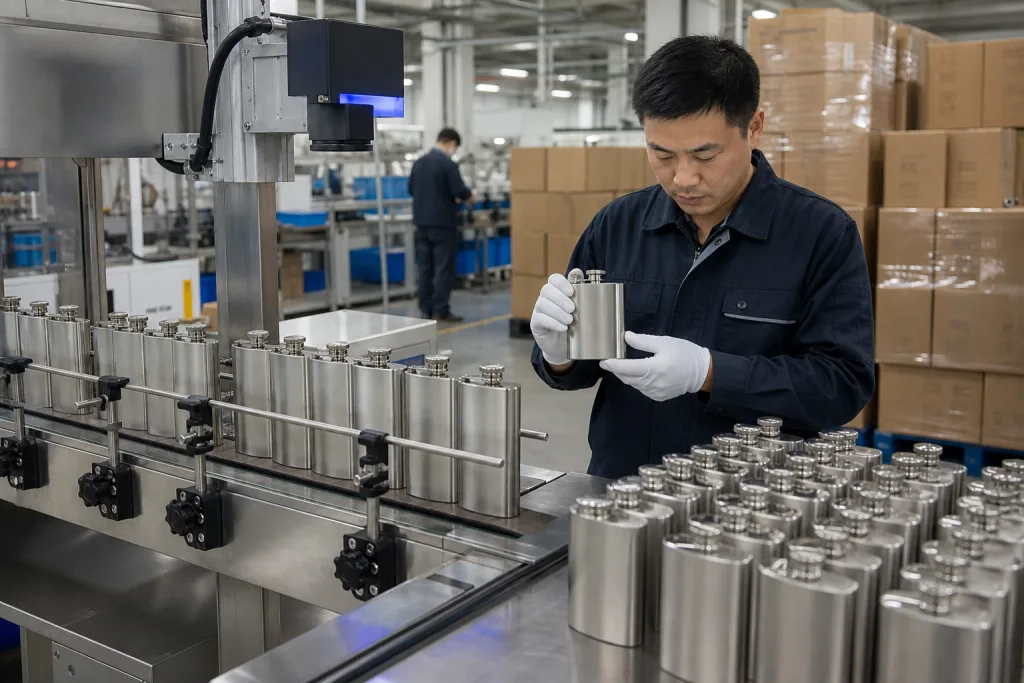
Key Takeaways
- A solid starting MOQ for a customizable hip flask is usually 1,000-3,000 pcs per design, with sample lead time of 7-12 days and mass production in 25-40 days from approval
- Use 304 stainless at 0.5-0.6 mm body thickness for standard flasks; thinner walls below 0.4 mm raise dent and seam-failure risk during transit
- Set an AQL such as 2.5 major / 4.0 minor and define 100% leak testing, or you will argue about acceptable defects after goods leave China
- Decoration durability varies sharply: laser marking is permanent, while screen printing needs defined tape, alcohol-rub, and dishwasher-adjacent resistance standards
You usually do not lose money on a customizable hip flask because the catalog photo looked a bit off. You lose it 45 days later, after first shipment: logos rub off in an MEK wipe test, cap threads seep at 15° tilt, a side seam shows pinholes after a 1.2 m drop, the coating fails REACH paperwork, or the gift box lands crushed because the insert was 2 mm too loose. Most of this starts before sampling. It starts when the PO says “8 oz stainless flask” and nothing else.
If you buy custom drinkware for a brand, a promotion, or a distributor drinkware program, you need a tighter spec than the one 7 out of 10 factories will ask for. We run into the same problem in Zhejiang on hip flasks, canteens, and growlers: vague briefs turn into chargebacks and long email chains. QC pulled a sample last month where the buyer flagged “304 stainless” on the PO, but the finish standard, leak test, and carton drop requirement were missing. A usable buying document turns those failure points into checks you can measure. Frankly, “Can you make an 8 oz flask?” is the wrong question to ask.
Where flask projects usually break
Buyers new to flasks often treat them like a small version of a bottle. Wrong. A hip flask is a formed, welded, flattened metal container with a narrow neck and a cap assembly that gets opened and closed again and again. That puts the weak points somewhere else than a custom canteen or a customizable growler.
The common production failures are predictable:
- Micro-leaks at the side seam, shoulder weld, or neck joint
- Cap mismatch from rough threads, poor gasket fit, or hinge pin looseness
- Panel deformation because wall thickness is too light for shipping compression
- Decoration failure when ink adhesion is poor on powder coat, polished steel, or faux leather wrap
- Odor or residue complaints from poor cleaning after welding and polishing
- Compliance gaps when coatings, packaging inks, or contact materials are undocumented
In Zhejiang supply clusters, we see this all the time: a factory can quote in 20 minutes because the line already has the same tooling. That does not mean they control the risk points. A canteen factory may still outsource decoration, cap parts, or gift-box work. One PO typo on cap color or logo position, and the buyer flags it before we even start packing.
If you are buying for a canteen distributor, promotional run, or retailer gift set, the problem gets worse because presentation matters as much as function. A flask that passes leak test but has a crooked badge or wrinkled PU wrap still loses the order. Separate functional acceptance from cosmetic acceptance. This is the right question to ask.
You are not buying a flask shape. You are buying a leak-proof, regulation-safe, decoration-stable unit packed for one sales channel.
Thin metal, dented goods, returns
The fastest way to make a flask quote look cheaper is to cut metal weight. We see this all the time on the line. For a standard 6 oz to 8 oz customizable hip flask, 304 stainless steel with body thickness around 0.5 mm to 0.6 mm is a practical baseline. At 0.4 mm or below, the math often fails: after one carton drop from 76 cm, freight compression and shelf handling start showing dents on the front panel.
Ask for these material details in writing:
- Steel grade: SUS304 for body and neck as baseline
- Body thickness: target 0.5-0.6 mm, tolerance clearly stated
- Cap material: stainless shell plus food-contact inner component if used
- Surface finish: mirror polish, satin, powder coat, spray paint, wrapped PU, or leatherette
On price-driven projects, some factories will offer 201 stainless on non-contact parts or a mixed-material cap assembly. That is not wrong by itself. The wrong move is leaving it vague on the PO. We had one buyer write “304 flask” while the cap shell stayed unspecified, and QC pulled the sample only after salt-spray questions came up. For Europe and North America, buyers usually want a simple, documented 304 contact path because it cuts compliance checks and corrosion disputes later.
What to specify for shipping survival
Tell the canteen supplier or canteen vendors exactly how the goods will be sold. This matters. Bulk-packed promo goods can live with a wider cosmetic range; boxed retail gifts cannot. For e-commerce or Amazon FBA style fulfillment, ask for stronger inner protection, corner support, and face separation. A flask has a wide flat panel, so dents show faster than on a round custom growler or custom canteen body. We have seen this go sideways when buyers approved a nice pre-shipment sample, then switched to tighter packout without retesting.
A sensible carton spec might include 1 pc per polybag, individual white box or gift box, then master cartons limited to a weight under 12 kg. Ask for carton drop testing and photo confirmation from 6 faces, 12 edges, and 8 corners. If your supplier in Zhejiang says they can cut cost by increasing pack density 20%, check dent risk before you approve it. The freight saving is often smaller than the returns bill, and the buyer usually flags damage on the first 200 units, not after the full lot ships.
Leaks start at the seam
If you only check the polish, you miss the defect that costs money: leakage. We see it start at the body seam, the shoulder near the neck, or the cap seal. A flask can pass a 24-hour standing test and still fail in a bag after one hot afternoon.
Put the leak method in the PO. Do not leave it open. On our line, we run air-pressure or vacuum checks, but the setup changes by factory. Ask for:
- 100% leak test on every unit before packing
- Random retention test for 12-24 hours with water-filled samples from each lot
- Cap open/close cycle test such as 500 cycles for hinge durability
- Thread engagement check to confirm cap closes fully without cross-threading
For final inspection, lock in AQL levels such as 2.5 major / 4.0 minor. Then mark leakage as major or critical. We’ve seen buyers accept a slow seep because it showed up after standing overnight. That math does not work for gifting or retail.
Ask what gasket sits in the cap. Some flasks use a simple silicone or plastic insert. If it is not seated right, the buyer flags smell, bag leaks, and over-tightening. For alcohol-contact use, specify food-contact compliance for the seal and ask for migration paperwork where needed. QC pulled the sample, and a 0.3 mm gap at the insert was enough to fail it.
This is not just a flask issue. We ship customized drinkware, a customizable canteen, and growler orders, and closures drive a lot of post-shipment complaints. The flask gets judged harder, because buyers expect a metal body to hold. Build the inspection plan around that, or you will be handling claims later.
Decoration that fails after delivery
A flask is usually sold on looks first, function second. Decoration failure is a margin problem, not a small cosmetic issue. We’ve seen buyers sign off a nice pre-production sample, then skip durability standards on the PO, and the first 2,000-piece batch lands with logo rub-off, Pantone drift, or wrap edges lifting by 1-2 mm.
The safest decoration option is not always the lowest quote. This is the wrong question to ask. On the line, we check decoration by process, substrate, and handling limit:
- Laser engraving holds up best on bare stainless and coated surfaces, and color variation is low because there is no ink layer to shift
- Silkscreen printing gives solid brand color, but QC should run adhesion testing and packed goods need tighter handling limits to avoid scuffing
- UV print looks clean on short runs, but on curved metal we’ve seen edge wear show up fast during carton vibration tests
- Embossed badge or wrap lifts gift value, but alignment control and glue failure become the main risks; the buyer flagged this on a 5,000-piece order after badges drifted off-center
For a customizable hip flask, ask the factory to approve decoration against measurable checks, not just a signed sample. We ship against numbers:
- Pantone match tolerance where applicable
- 3M tape adhesion test after curing
- Alcohol rub test, for example 50 double rubs minimum
- Scratch resistance standard agreed by master sample
- Logo position tolerance, such as ±1.5 mm
If the flask has powder coating, the curing window matters. Under-cured coating chips. Over-cured coating shifts color. We usually watch oven temperature and dwell time batch by batch; one 180°C setting held 2 minutes too long is enough to move a light beige off target. If it has PU or faux leather wrap, ask what adhesive is used and how it performs at 0°C and 45°C. We’ve seen this go sideways when wrapped flasks left Zhejiang looking fine, then crossed a hot, humid route and the glue line opened at the seam.
Buyers also mix product categories here. A canteen customized item or customized canteen for outdoor retail can survive rough use and visible wear. A hip flask sold as a gift item usually cannot. If your end customer is a canteen distributor or canteen vendor building a corporate gifting line, decoration failure drives reprint and replacement cost faster than body defects, and the math doesn’t work once 300 gift boxes need to be reworked by hand.
Compliance mistakes hide in details
Most buyers ask for a food-contact statement and stop there. That is loose purchasing practice for Europe and North America. A hip flask looks simple on the table, but compliance does not stop at the 304 stainless shell. We also check the powder coat, paint, cap insert, silicone gasket, adhesive, gift-box ink, barcode label, and polybag. QC pulled a sample last month where the gasket hardness was 60 Shore A instead of the approved 70 Shore A, and that single change forced a retest.
For EU orders, you may need documents tied to REACH and the right food-contact requirements based on the material set and the claim on pack. For North America, retailer programs often ask for selected heavy metals, phthalates on soft parts if those parts exist, and packaging checks. Gift and general merchandise channels add another layer. Some buyers ask for BSCI or an equivalent social audit from the factory. Buyers push back on this all the time, but this is the wrong question to ask: “Is the flask compliant?” The right question is whether the tested BOM matches shipment lot 24A-07, carton by carton if needed.
Ask the canteen manufacturer or canteen factory these direct questions:
- Which components are made in-house, and which are outsourced?
- Can the lab report be tied to the same bill of materials used in production?
- Does the report cover coating and seal material, not only stainless steel?
- Can they provide production-date traceability by carton or lot code?
At BottleForge-style volumes, a factory running 300,000 units per month across drinkware categories can usually handle the paperwork if the BOM is locked early. We run into trouble after testing, not before. The buyer changes a matte-black coating to Pantone 877C, swaps the PE cap insert, or moves the gift box to a new printer with different ink, and the report no longer matches the goods on the line. We have seen this go sideways over a 0.2 mm liner change that never made it onto the revised PO.
This applies just as much to custom canteen, canteen custom, custom growler, and customized growler programs. The shape changes. The discipline does not. Freeze the tested setup before mass production, then ship against that file set. Rebuilding documents after a customs hold or retailer query is slow, expensive, and the math doesn't work once 12,000 units are already packed in export cartons.
Sampling that tells you nothing
A lot of “approved samples” tell you almost nothing about the real order. We see hand-polished mockups, UV-printed proofs, or samples built off a bench setup the line never runs in bulk. Then 30 days later the buyer gets a lot with softer edges, lighter logo fill, or a weld line QC pulled on the second carton. That gap is where claims start.
Break sampling into stages:
- Reference sample: checks size, capacity, and basic appearance; on our side this is where we verify mouth width and body height with a digital caliper
- Pre-production sample: made with the actual material, decoration method, and packing setup from the line, not a sales mockup
- Golden sample: the signed approval standard kept by both buyer and factory for QC comparison at shipment
For a normal customizable hip flask project, sampling takes about 7-12 days if only logo application is needed. New tooling, wrapped finishes, or custom gift sets can push it to 15-20 days. Mass production is commonly 25-40 days after sample approval and deposit, depending on decoration complexity and packaging labor. Zhejiang factories often quote 18 days and deliver in 28. We’ve seen this go sideways. Ask what assumptions sit behind the quote: stock mold, standard cap, standard box, or outsourced plating? This is the right question, not “what is your fastest lead time?”
Use the sample stage to force answers on details buyers usually skip. On hip flasks, these misses show up fast: a 6 oz body filling short, laser mark too shallow, or a barcode wrapped over the side radius so the scanner rejects it.
- Actual fill capacity in ml and oz, with tolerance
- Net weight tolerance
- Engraving depth or print thickness
- Retail barcode placement, FNSKU if needed
- Carton marks, country-of-origin wording, and spare-cap policy
If you are a canteen distributor, distributor canteen buyer, or distributor growler program manager handling multiple SKUs, standardize this checklist across categories. We ship mixed POs like this all the time, and one typo in a customizable growler PO or canteen customized brief can carry straight into carton marks. Put the details in writing. The fewer items left as “understood,” the fewer surprises land at your warehouse.
What to lock before paying deposit
A good flask PO should be dull. That is a compliment. It means the commercial points and technical points are locked, so the line can run without three rounds of WeChat questions. Before you pay the deposit, make sure the supplier—whether that is one canteen vendor, a canteen distributor, or a broader canteen supplier network partner—has signed off on the full spec pack, not just the rendering.
Your checklist should include:
- Product spec: capacity, dimensions, steel grade, thickness, finish, cap structure, hinge style
- Decoration spec: method, artwork code, position, color standard, durability tests
- QC spec: AQL level, critical defects, leak protocol, cosmetic standard by viewing distance
- Packaging spec: unit pack, insert, barcode, carton weight, drop expectation
- Compliance file: reports, declarations, factory audit status, origin statement
- Commercial terms: MOQ, ex-works or FOB, deposit ratio, lead time, late-shipment handling
For a standard flask, MOQ is usually 1,000 pcs per logo or finish. Plain-stock based runs can start at 500 pcs. Gift-box combinations often need 2,000 pcs or more because the box supplier will not hold a tiny run. We ship FOB Ningbo or Shanghai on plenty of Zhejiang orders. If you are combining the flask with other customizable drinkware such as a custom canteen or customizable canteen line, ask for a carton plan early. This is the right question. We have seen mixed loading cut dead space by 12% on a 40HQ, and the buyer flagged one job because the outer carton hit 18.6 kg instead of the PO limit.
Last point: do not let the word “custom” cover loose specs. This is the wrong question to ask: “Can you make it like the photo?” Ask for the neck size, wall thickness, logo position from the bottom in mm, and leak test method. QC pulled one sample last month where the PO said satin finish, but the artwork file note said brushed. That kind of mismatch slows approval fast. The cleaner your spec, the less your project depends on luck, whether you work with canteen manufacturers, canteen distributors, canteen suppliers, or one canteen factory in China.
Send your flask spec for a factory-level review
Share artwork, target price, quantity, and market. We will flag leak, decoration, packaging, and compliance risks before you place the order.
Frequently asked questions
What is a realistic MOQ for a customizable hip flask?
For most Zhejiang, China suppliers, the practical MOQ is 1,000 to 3,000 pieces per design, depending on finish and packaging. A plain polished flask with 1-color logo may start around 1,000 pcs. A wrapped flask, custom mold, or gift-set program can move MOQ to 2,000-5,000 pcs. If a factory offers 300 pcs, check whether they are using stock goods with limited customization or charging a high setup cost. For B2B buyers, MOQ is not just a production number; it affects carton efficiency, decoration consistency, and sourcing cost. If you are also buying a custom canteen or customizable growler range, some canteen manufacturers can combine categories in one shipment, but MOQs usually still apply by SKU.
Which decoration method is safest for long-term logo durability?
Laser engraving is usually the safest choice if durability matters more than color accuracy. It resists abrasion, alcohol rub, and routine handling better than screen printing. Silkscreen works well for bold branding, but you should require a tape adhesion test and at least 50 double alcohol rubs on approved production samples. UV print can be acceptable for short runs, but it is not my first choice for curved metal gift items. If the flask uses powder coating or PU wrap, test the exact construction, not a similar sample. The same logic applies across custom drinkware, canteen customized products, and customized growler lines: pick decoration based on use case, not only catalog appearance.
How do I control leak risk before shipment?
Write the leak protocol into the PO. Ask for 100% leak testing on every flask, plus random 12-24 hour filled retention tests by lot. Classify any leak as a major or critical defect under your AQL, commonly 2.5 major / 4.0 minor. Also require cap thread checks and a hinge durability test, such as 500 opening and closing cycles. If the cap includes a silicone or plastic seal, ask for the exact material and compliance paperwork. Do not accept vague wording like “factory standard leak test.” In China, one supplier’s standard may be air pressure only, while another also runs standing water checks. For a canteen supplier or canteen vendor managing several drinkware categories, standardizing this requirement saves a lot of post-arrival claims.
What price range should I expect for a custom hip flask order?
A standard 6 oz or 8 oz 304 stainless customizable hip flask in bulk usually lands around USD 1.60-3.20 FOB China, depending on thickness, finish, logo method, and packaging. A polished flask with 1-color print is near the low end. Powder coating, laser engraving, faux leather wrap, or rigid gift box can push cost above USD 3.50-5.50. New tooling or metal badge decoration adds more. If a quote is sharply below market, check metal thickness, steel grade, cap construction, and packaging assumptions. Buyers often compare flask pricing to a custom canteen or custom growler, but the process cost is different because flasks have more visible seam, neck, and cap-detail risk.
What documents should I ask for from a flask factory?
At minimum, ask for a material declaration, relevant food-contact or chemical compliance paperwork for the exact BOM, packing list format, and factory profile. For EU business, REACH-related documentation is commonly requested, especially if coatings, wraps, adhesives, or soft components are involved. Many buyers also ask for BSCI or similar social compliance if the flask is for retail programs. On the QC side, require a signed specification sheet, approved artwork, golden sample record, and inspection standard with defect definitions. If your supplier is also acting as a canteen manufacturer or canteen distributors' sourcing partner for broader custom drinkware, request traceability by production lot so reports can be tied back to actual shipped cartons.