Key Takeaways
- A practical customizable growler program usually starts at 500-1,000 pcs MOQ and 30-45 days lead time.
- 18/8 stainless, 0.5-0.7 mm wall thickness, and leakproof lid testing matter more than marketing claims.
- FOB China pricing for a standard custom growler often falls around USD 3.20-6.80 depending on finish and decoration.
- A factory in Zhejiang with 80,000-120,000 units/month can handle mixed canteen customized and growler SKUs more reliably.
If you are buying a customizable growler for retail, promotions, or distributor programs, the hard part is not finding a bottle. It is choosing a spec that ships cleanly, decorates well, and does not turn into a return ticket six months later. A 64 oz stainless growler looks simple on paper, but wall thickness, lid type, finish, and carton count all move the landed cost and the sell-through. We ship these with 0.5 mm and 0.7 mm walls on different programs, and the math changes fast.
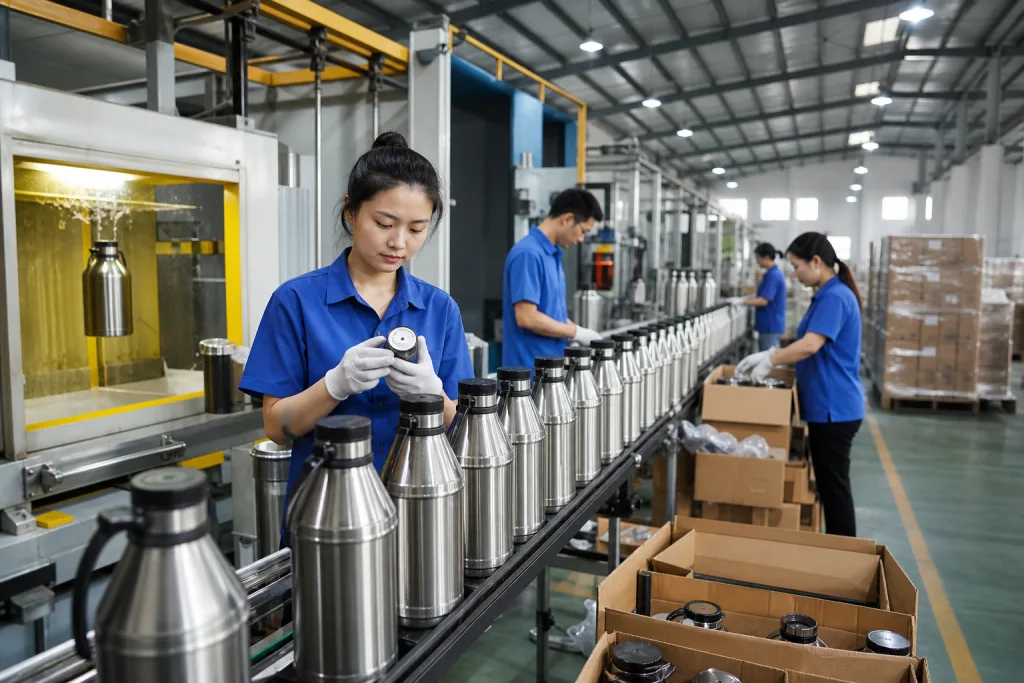
In Zhejiang and across China, the better factories already run this kind of mixed OEM work: custom drinkware runs, private label cartons, laser logos, and color coatings on the same line. QC pulled the sample last week because the buyer flagged a lid typo on the PO, and that is the sort of thing that saves a 5,000-piece order. The question is not which catalog photo looks nicer. It is which canteen custom features fit your channel and which are noise. If you are comparing a custom growler against a broader customized drinkware program, start with the spec sheet, not the sample shot.
Spec table that actually matters
I’ll keep the HTML exactly as-is and rewrite only the prose inside, with tighter B2B factory language and a few concrete production details.Buyers burn time on glossy photos when the decision comes down to a few production specs. For a customizable growler, the useful comparison is not “premium” versus “basic.” It is shape, sealing system, and decoration method that fit the channel. If you buy for a canteen distributor or a distributor drinkware program, the job is to protect margin and keep returns off your desk.
| Spec | Value to check | Why it matters |
|---|---|---|
| Capacity | 32 oz, 64 oz, 128 oz | Drives freight, carton count, and the retail price bracket |
| Material | 18/8 stainless steel | Gives better corrosion resistance and cleaner food-contact paperwork |
| Wall thickness | 0.5-0.7 mm | Sets weight, dent resistance, and how solid it feels in hand |
| Lid | Screw lid, flip lid, swing top | Leak risk shifts by channel and by how the buyer uses it |
| Decoration | Laser, screen print, powder coat | Changes MOQ and unit cost fast |
For most B2B custom drinkware orders, a 64 oz stainless body with a powder-coated exterior and laser logo is the safest middle ground. We run that spec a lot because it sells into outdoor, brewery, and gift channels without looking like a throwaway promo piece. Last month, QC pulled the sample and the buyer flagged a 1.2 mm lid gap on a swing top, so we tightened the tolerance before mass production. If you need a customized growler for heavy retail display, go darker matte; if the order is promotional, a satin body with one-color print usually keeps the math sane. The right canteen manufacturer should hand you gauge, tolerance, and carton packout, not a pretty render.
Growler versus canteen formats
I’ll keep the HTML intact and rewrite the prose to sound like a factory-side sales engineer, with tighter phrasing and one concrete shop-floor detail per paragraph.People use the word growler loosely, but the buying logic changes fast once you line it up against a canteen. A custom canteen is lighter, easier to carry, and fits fitness or travel orders better. We run a 62 g lid on one line for these jobs, and buyers usually care more about color, handle shape, and cap style than extra volume.
A customizable growler gets judged on wall strength and closure performance. It is built for beer, cold brew, or high-volume beverage service, so the lid has to survive repeated washing and rough handling without leaking. QC pulled the sample at 24-hour soak, and that’s where weak lids show up. This is the right fit for breweries, restaurants, and premium retail; canteen promo orders win when the buyer wants a lower unit price and a wider audience.
- Choose growler format when you need 32 oz to 64 oz capacity, tougher branding, and shelf appeal that holds up in retail.
- Choose canteen custom format when weight, portability, and daily carry matter more than bottle volume.
- Choose customized canteen for sports, travel, or campus programs where the product gets used every day.
If you are a canteen supplier or canteen vendor serving mixed channels, offer both. A custom canteen fits general hydration, while a custom growler fits beverage accounts that care about closure and fill size. We see this work well in one Zhejiang production line because color matching, lid sourcing, and QC stay under the same control, and the buyer flagged one PO typo on cap color that we caught before packing.
Decoration choices by channel
I’ll rewrite the section in-place, keep the HTML intact, and tighten the language so it sounds like a factory-side sales engineer. Then I’ll do a quick pass for the banned filler patterns and keep the structure unchanged.Decoration is where orders get padded up or underbuilt. For a canteen customized program, a one-color silkscreen is often enough. For a customizable growler, the market usually expects a harder finish because buyers handle it more and the bottle stays on display longer. That is why powder coating and laser engraving are the two we run most on mid-market custom drinkware; the line shows the difference after 200 cycles, not after a showroom photo.
Use this as a practical rule set:
- Laser engraving for premium brewery accounts, outdoor brands, and corporate gift buyers.
- Silkscreen for canteen promotional runs and distributor orders that need the lowest setup cost.
- Full-color wrap if the artwork needs shelf impact and the MOQ can cover the setup bill.
Laser is clean, permanent, and easy to live with. It also skips the color-match fights that come with printed logos. Screen print costs less, but that is the wrong answer if the order will get handled hard or washed in machines all season. We had a buyer flag a PO once because the logo line said 1.5 mm but the artwork file showed 2.0 mm, and QC pulled the sample before packing. If you are buying from a canteen factory in China, ask for abrasion testing, adhesion notes, and finish photos after a 24-hour dishwasher cycle. A decent canteen manufacturer should hand over that data without drama. For canteen distributors, that beats a sales pitch every time because it cuts down the returns.
In export work, decoration failure is usually not a design problem. It is a spec control problem.
Lid styles and leak risk
I’ll rewrite the section in place, keeping the HTML tags unchanged and tightening the sales-engineer tone. I’m checking the wording against the style constraints, then I’ll return only the cleaned HTML.Lid choice is where a customizable growler starts looking like a real product, or like a warranty problem. The body can be solid, but if the lid flexes, leaks, or strips after 20 to 30 openings, the buyer will blame the whole order. We saw this on a 2,000-piece run last quarter: QC pulled the sample, the cap thread skipped under hand torque, and the buyer flagged it before packing. That is the part people miss on distributor canteen programs, where the end customer never separates lid failure from bottle failure.
For beer, cold brew, and premium beverage service, a screw lid with a silicone sealing ring is still the base spec we run most often. It is easy to pack, easy to explain, and the line can hold it at a steady torque without drama. Swing-top lids look better on shelf, but they add a hinge, a gasket, and one more place for the wrong thing to happen. Flip lids work for some canteen programs, though they are a poor fit if the buyer cares more about shelf life than convenience.
If you are sourcing from canteen manufacturers in Zhejiang or anywhere else in China, ask for torque testing, drop testing, and leak testing at three fill temperatures. This is the wrong question to ask only after the PO is signed. We usually start with a 1-meter drop test, a 24-hour inverted leak test, and a simple inspection note on the sealing ring size, because a 1 mm mismatch can turn into a freight headache. If the supplier cannot quote those tests clearly, walk away.
MOQ, lead time, and landed cost
I’ll keep the HTML untouched and rewrite the prose to sound like a factory-side sales engineer, with tighter numbers and a more grounded tone.Most buyers miss how much MOQ and lead time decide the spec. A decorated custom growler looks good on paper, then the buyer sees a 300-piece MOQ and the setup eats the margin. On our line, standard custom drinkware programs usually sit at 500 to 1,000 pcs per SKU, with 30 to 45 days after sample approval. If the PO adds color coating, laser logo, and a custom carton, the schedule slips. QC pulled one sample last month with a carton typo, and that extra reprint cost the buyer two days.
Typical FOB China for a plain stainless growler sits around USD 3.20-4.20. Add powder coating and you are usually at USD 4.20-5.80. Go to heavier gauge, better lid hardware, or gift packaging, and USD 5.80-6.80 is normal. That is not cheap. It is the math. A Zhejiang factory should quote those bands fast and tell you what moves the number. If the quote stays fuzzy, the factory is padding, or the quoting person does not know the shop floor. We run a 1.2 mm shell on some builds, and that alone changes cost more than most buyers expect.
For distributor growler programs, the clean setup is 1 body, 2 lid options, and 3 logo methods. That keeps stock under control and still gives your sales team enough range for retail, hospitality, and promo accounts. We ship mixed runs this way all the time, and it works when the MOQ per variant stays disciplined. A plant that can turn 80,000 to 120,000 units per month can juggle those orders without wrecking the calendar. The buyer flagged one quote because they wanted four lid colors on a 500-piece run; that is the wrong question to ask.
Use-case fit by buyer type
I’ll keep the table and tags intact, then tighten the prose so it sounds like a factory-side sales engineer wrote it. Next I’m rewriting for buyer-fit specificity, with one concrete shop-floor detail per paragraph and none of the AI filler.Head-to-head pricing only works if you compare the right buyer job. Brewery buyers ask for taste-neutral body material and a closure that holds carbonation after 48 hours on the shelf. Retail buyers care about shelf pop and how many units come back with chipped lids. Promo buyers push for the lowest landed unit. Distributors want repeatability, clean spec control, and no surprises on reorder.
| Buyer type | Best format | Why it wins |
|---|---|---|
| Brewery or beverage brand | 64 oz customizable growler | Strong branding, premium feel, better upsell |
| Outdoor or fitness channel | Customizable canteen | Lighter carry, broader daily use |
| Promotional agency | Canteen promotional SKU | Lower cost and simpler print |
| Distributor drinkware program | Two-SKU mix | Better channel coverage and reorder stability |
If you are a canteen manufacturer or canteen factory building a B2B assortment, forcing one SKU into every channel is the wrong question. We run this split on the line with a 3,000 pcs MOQ on one side and a simpler print spec on the other, because the buyer flagged a “one size fits all” proposal after the first sample round. A customized canteen sells cleanly into schools, gyms, and travel. A customized growler fits beverage, hospitality, and premium gift programs. That is why canteen distributors keep both in the book under one custom drinkware line. Map the SKU to the use case early, and the price pushback gets a lot softer.
What to demand from the factory
I’ll rewrite the three paragraphs in place, keep the HTML untouched, and tighten the sales-engineer tone with concrete factory-floor details.A solid canteen factory in China does not just throw out a unit price and wait for your PO. Ask for the 304 stainless steel mill cert, finish photos from the polishing room, sample lead time, carton spec, and the defect standard before you sign. If they say the product is compliant, make them show REACH, food-contact paperwork, and their export QC sheet. For Europe and North America, that is the sale. We have seen buyers get burned on a missing ink code on the carton.
Use AQL 2.5 for major defects and AQL 4.0 for minor defects if your program is standard retail. For a premium customized drinkware order, tighten the checks on leakage, lid fit, and logo placement; a 1.5 mm print shift can get the buyer flagged at receiving. A real canteen supplier should also confirm pack count, carton drop test expectations, and barcode placement if you are building FNSKU or retail-ready labels. If you are sourcing through a canteen vendor in Zhejiang, ask for a factory video from the coating line, assembly bench, and final inspection table. QC pulled the sample on our last growler run. Brokers usually cannot show that.
For bigger programs, ask whether the line can run both canteen customized and custom growler orders in the same month without changing tooling every few days. That tells you more about real capacity than a polished brochure ever will. If they cannot explain the changeover time in minutes, the math does not work.
Get a factory quote with real specs
Send your target capacity, logo method, MOQ, and destination port. We will price the right customizable growler, not a vague sample.
Frequently asked questions
What is the usual MOQ for a customizable growler?
For a standard customizable growler, the common MOQ is 500 to 1,000 pcs per color or decoration setup. Some factories in Zhejiang will accept 300 pcs for a simple logo order, but the unit price usually jumps 15% to 30%. If you want powder coating, custom lid parts, or gift packaging, plan on a higher MOQ. For distributors canteen orders, the smarter move is to standardize the body and vary only the logo or carton. That keeps inventory manageable and avoids paying too much for short runs.
How much does custom drinkware cost FOB China?
A basic stainless custom growler typically lands around USD 3.20-4.20 FOB China. Add powder coating, better lid hardware, or premium packaging, and you may see USD 4.20-6.80. Laser logo usually adds less than full-color printing on higher volume orders. If the supplier in China gives you a price far below those bands, check whether the wall thickness is under 0.4 mm or whether the lid is a weak generic part. Cheap quotes often hide QC problems.
Is a canteen custom order easier than a growler order?
Usually yes, because a canteen custom order often uses simpler geometry and lighter packaging. A customizable canteen is easier to ship, and decoration can be more forgiving. A growler is more demanding because closure performance matters more, especially for beverage use. If you are a canteen distributor, the canteen can be easier for price-sensitive channels, while the growler is better when you need a premium drinkware story. Both can come from the same canteen factory, but the QC focus is different.
What quality checks should I ask for?
Ask for leak testing, drop testing, logo adhesion, and carton compression checks. A standard retail program often uses AQL 2.5 for major defects, but premium custom drinkware can be tightened further on leakage and finish. For a customized growler, request an inverted 24-hour leak test and a 1-meter drop test on a small sample set. If you are buying from canteen manufacturers in China, also ask for material declaration, REACH support if needed, and a confirmed carton quantity per master case.
Which buyers should choose a customizable canteen instead?
Choose a customizable canteen if your customer wants daily carry, lighter weight, or broader lifestyle use. That includes fitness brands, schools, travel retailers, and corporate gifting programs. A canteen promotional order is usually easier to price and easier to display. A customizable growler is better when you need beer, cold brew, or premium beverage positioning. Many canteen suppliers now offer both so distributors can sell one line into multiple channels without rebuilding the whole sourcing relationship.