Key Takeaways
- For a 500 ml borosilicate glass bottle bulk order, MOQ is usually 1,000-3,000 pcs and FOB China pricing often lands at USD 1.55-3.80 depending on sleeve, lid, and print
- High borosilicate glass with wall thickness around 2.5-3.0 mm costs more but cuts thermal shock and breakage claims compared with thin soda-lime glass
- Decoration choice changes both durability and setup cost: silk screen can start around USD 40-80 per color, while decal or sleeve options raise unit cost but improve design flexibility
- A practical production plan is 7-10 days for samples and 30-45 days for mass production, with AQL inspection and REACH or ASTM checks written into the PO
You are not just buying a bottle. You are buying a claim your customer will check every day: clean taste after 3 fills, lower plastic use, enough durability for a gym bag, and branding that still looks sharp after 6 months of abrasion. That is why a customizable glass water bottle works for wellness brands and sustainable retailers, but only if you lock the glass spec, decoration process, packaging standard, and compliance plan before you send RFQs. On our line, QC pulled a sample last month where the silk print looked fine at packing and started scuffing after 200 rubs.
Most sourcing problems start with a loose brief. A buyer asks for a custom glass water bottle, gets 3 prices from China, and treats them as the same item. They are not. In Zhejiang, we keep seeing the same misses: borosilicate grade, sleeve material, logo process, drop-test packaging, and MOQ by lid color—500 pcs in black is not the same as 3,000 pcs split across 6 colors. If you want stable quality, this is the wrong question to ask: “Who is cheapest?” The better question is what spec the factory actually quoted, because we have seen this go sideways over a 2 mm wall-thickness change and one PO typo on lid finish.
Start with four sourcing decisions
If you are comparing a customizable glass water bottle across suppliers, break the job into four decisions first. Do this before you line up quotes. If you skip it, two offers can look the same on paper and perform differently on the shelf, in transit, and on the line. We’ve seen 550 ml samples from two factories match in photos, then one failed a 90°C hot-water shock test and the other passed.
- Decision 1: glass type. High borosilicate or soda-lime. For wellness retail, borosilicate is usually the better fit because it handles temperature swing better and gives a cleaner premium feel in hand. On our side, QC checks wall thickness with a digital caliper in mm, because thin spots are where this goes sideways.
- Decision 2: bottle construction. Single-wall bottle, tea infuser style, silicone sleeve, bamboo lid, stainless lid, or protective carry loop. Each choice changes breakage rate, freight weight, and where the item sits at retail. A bamboo lid looks good, but buyers have flagged mold risk before if the sealing area is not finished well.
- Decision 3: branding method. One-color silk screen, multi-color decal, laser on lid, sleeve emboss, or custom hangtag. Match the artwork to the budget and the reorder plan. This is the wrong question to ask last. We run screen print for simple logos fast, but a 4-color decal adds setup, approval time, and more points for QC pulled sample checks.
- Decision 4: compliance and packaging. Retail carton, mailer-safe box, or FBA pack-out. This is where sustainable retailers often lose margin because they under-spec transit protection. A 3-layer box may save a few cents, then fail a drop test from 76 cm and wipe out the savings.
Buyers usually ask for a custom borosilicate glass bottle and start with shape first. Fair enough. But shape is rarely the biggest commercial variable. The bigger issues are breakage exposure, print durability, and whether the lid leaks after repeated opening and closing. A solid borosilicate glass bottle supplier in China should ask about sales channel, target retail price, country of sale, and whether the item ships empty, gift-boxed, or packed with tea accessories. If a supplier does not ask those questions in the first 2 emails, that’s a red flag.
At BottleForge Industrial in Zhejiang, we start with the same question every time: what must not fail after launch? For some brands, it means zero metallic taste and a clean wellness look. For others, it means passing retailer packaging tests and holding landed cost under a fixed number such as USD 3.20 FOB for a 550 ml set. Last month, the buyer flagged a PO typo on lid color and we caught it before mass print. That is how we frame the buying decision. The math needs to work.
Choose the right glass specification
If you’re buying a customizable borosilicate glass bottle, get the glass grade written on the PI and artwork approval. We see buyers use “glass bottle” for everything, and that is the wrong question to ask. Not all glass behaves the same on the line or in the customer’s kitchen. High borosilicate is the usual pick for premium hydration bottles because it handles thermal shock better than soda-lime. If the end user rinses the bottle in warm water, then fills it with cold water, the difference shows up fast. We’ve had QC pull a sample after a crack started from the shoulder down to the base.
For a typical 450-600 ml custom glass water bottle, practical specs usually look like this:
- Body material: high borosilicate glass
- Wall thickness: 2.5-3.0 mm for standard retail use
- Mouth diameter: 35-50 mm depending on cleaning preference
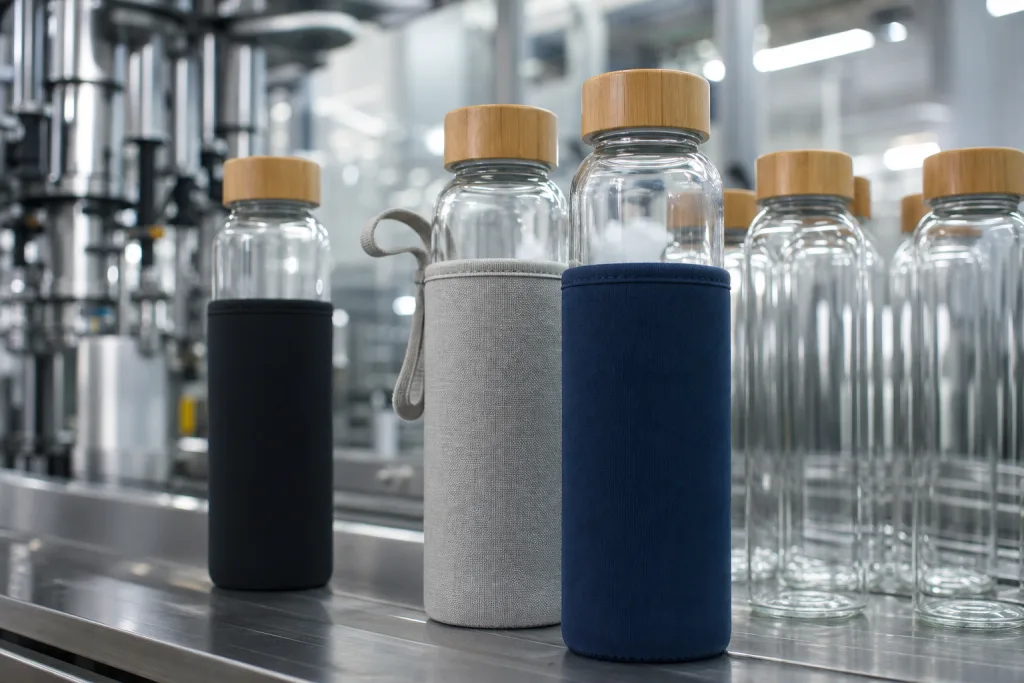
- Lid: PP inner with stainless outer shell, or bamboo cap with food-grade silicone seal
- Sleeve: food-contact silicone, usually 2.0-3.0 mm thick
These are workable numbers. We run 2.5 mm on plenty of retail orders, and 3.0 mm if the buyer wants a heavier hand feel. Thicker walls do improve perceived quality, but they also push up unit weight and freight. A 550 ml bottle with sleeve and stainless cap can ship at 430-520 g per unit, while a lighter version may be 320-380 g. That gap hits parcel cost hard. For e-commerce sellers, the math doesn’t work if you chase a “premium” feel without checking the freight table first.
Lid material has its own trade-off. Bamboo looks good on shelf and sells well in wellness channels, but natural material brings color variation. It also reacts to moisture if the sealing design is weak or the bamboo moisture content is not controlled around 8%-12%. We’ve seen this go sideways on repeat orders where the first lot looked clean and the second lot came darker. Stainless caps are easier. Batch to batch, they stay more consistent and fit large-volume borosilicate glass bottle wholesale programs better. If your retailer wants appearance consistency across 10,000 pcs, don’t assume natural bamboo will match piece for piece.
Ask your borosilicate glass bottle factory for thermal shock data, the leak-test method, and whether the mouth is flame-polished. A smooth catalog photo tells you nothing. We’d rather see a real test sheet, the torque range in kgf·cm, and a leak test at the line after capping. Serious borosilicate glass bottle manufacturers in China should also be able to talk about REACH, LFGB, or ASTM-related material compliance for your market. If they can’t answer that in one email, the buyer flagged the right problem.
Match decoration to channel economics
Branding is where a customizable glass water bottle stops being a plain SKU and starts carrying margin. It is also where first orders get expensive fast. The wrong question is “what looks best?” The right one is “what will hold up in this sales channel and still run at my MOQ?” On our line, the buyer usually flags decoration after seeing the first pre-production sample, not before.
For a borosilicate glass bottle custom project, the common options are simple:
- Silk screen on glass: best for 1-2 solid colors, clean look, lower setup cost. Expect setup around USD 40-80 per color and a modest unit adder. We run this most often on straight-wall bottles because registration is easier to control within 1-2 mm.
- Heat-transfer or decal: better for gradients and detailed graphics, but it adds process steps and reject risk usually goes up. QC pulled the sample more than once for edge lifting after oven curing.
- Laser on lid: durable and understated, useful for bamboo or stainless caps when you want quiet branding. On bamboo lids, depth matters; if the engraving runs too hot, you get a dark burn ring the buyer did not ask for.
- Embossed or debossed silicone sleeve: good for long-life branding, but sleeve mold charges can be several hundred dollars and MOQs are higher. The sleeve tool is the cost driver here, not the logo itself.
If you are building a borosilicate glass bottle promotional item for events, keep artwork simple. A one-color logo on a standard stock bottle can make sense at 1,000 pcs. We ship these jobs faster because there is less to prove out on press. If you are launching into sustainable retail, you may need a fuller pack: printed bottle, custom color sleeve, FSC paper tag, and retail-ready color box. That can push MOQ to 2,000-3,000 pcs per design because sleeve color matching and box printing set the run size. We have seen sleeve Pantone approval add 12 days vs 18 days for a plain stock sleeve, and that gap matters if the launch date is fixed.
Buyers often ask borosilicate glass bottle vendors for “full customization” before they map the cost of each variable. Every custom color or accessory creates a separate production condition. A customized glass water bottle with Pantone-matched sleeve, special cap loop, and gift box can work, but only if your reorder forecast supports it. If your realistic first-year demand is 3,000 pcs, do not split it into five lid colors and three sleeve colors. The math doesn't work. We have seen this go sideways: one PO even had a sleeve color typo, and the whole approval cycle had to restart. Start with one core SKU and one premium variation.
China factories with solid export experience will usually push you toward fewer variables on the first PO. That is not resistance. It is practical cost control. On first orders, we would rather lock one stable decoration standard and pass drop test and carton test than chase six cosmetic versions on the same line.
Price the bottle the right way
Buyers send the same RFQ to 6 factories and get quotes from USD 1.40 to USD 4.20. We see this every week. Usually it does not mean one supplier is greedy and one runs lean; it means the quote basis is different. One factory priced a 500 ml bottle at 430 g with a stock lid, another priced 550 ml at 520 g with a custom box. The wrong question to ask is “who is cheapest?” Ask for a line-by-line cost sheet.
For a 500-550 ml bulk glass water bottle, common FOB China cost ranges look like this at 1,000-3,000 pcs:
- Plain high borosilicate bottle with standard PP/stainless lid: USD 1.55-2.10
- With silicone sleeve: USD 1.95-2.70
- With bamboo lid and printed logo: USD 2.10-3.00
- With custom box and multi-process branding: USD 2.80-3.80
These numbers are not universal, but they are grounded in actual Zhejiang export pricing and broader China sourcing in 2025-type market conditions. On our line, a sleeve color change alone can push MOQ to 2,000 pcs per color, and a gift box can add 0.8-1.2 kg to the outer carton weight. Freight, testing, duties, and damage allowance sit outside the bottle price. Budget them separately.
What changes the unit price fastest
- Custom lid tooling or custom silicone color
- Extra-thick wall glass
- Multi-color printing or decal
- Gift box instead of brown box
- Higher inspection level or lab testing per batch
If you buy from borosilicate glass bottle distributors, or you resell as a borosilicate glass bottle vendor, watch the margin killers that do not show up in the first quote. Breakage replacements hurt. Oversized parcel fees hurt more. Low fill rate in a master carton is where the math stops working. We have seen a bottle that was USD 0.18 cheaper become the expensive option because the divider setup caused 3% more transit damage, and QC pulled the sample after a drop-test failure on one corner panel.
Ask every borosilicate glass bottle manufacturer for the same quote template: bottle size, net weight, gross weight, packing method, carton dimensions, MOQ by color, sample cost, tooling cost, FOB port, and lead time. Put it in one sheet and make each factory fill the blanks. We once got 2 identical-looking offers, then spotted one PO typo on the packing line: 24 pcs/carton vs 20 pcs/carton. That one detail changed freight fast. Without this discipline, price comparison is guesswork.
Audit quality before you scale
For glass, QC is not optional. One clean sample does not prove the bulk run. We’ve seen a pre-production sample pass, then 7 out of 200 pcs in the first packed lot show mouth chips under a 10x lamp. Your purchase order for a customizable glass water bottle should spell out inspection points line by line, especially if you sell into a sustainability-focused retail channel where the buyer flagged tiny cosmetic defects on shelf.
Start with the basics. Use an AQL plan, typically AQL 2.5 for major defects and 4.0 for minor defects on standard consumer goods, unless your retailer specifies otherwise. This part should be written on the PO, not left in email chat. Major defects for a custom glass water bottle usually include leakage, cracked glass, unstable base, sharp mouth edge, serious print shift over 1.5 mm, and missing accessories.
Ask your borosilicate glass bottle factory or third-party inspector to check:
- Leak test after cap torque is applied
- Verticality and wobble on flat surface
- Wall thickness consistency
- Logo adhesion or print scratch resistance
- Carton drop performance
- Odor check on silicone parts
If the bottle includes a silicone sleeve, verify fit consistency. Loose sleeves slide and look cheap. Over-tight sleeves slow the line and push defect rates up; on one 3,000 pcs order, assembly time moved from 12 seconds to 19 seconds per unit because the sleeve ID was off by 1 mm. If the lid has bamboo, check the bonding structure and sealing ring fit after humidity exposure for 24 hours. We’ve seen this go sideways. QC pulled the sample and found the bamboo cap face lifting at the edge after storage at 85% RH.
Compliance matters, but this is the wrong question to ask first if the basic build is unstable. Depending on your destination market, you may need REACH-related checks for Europe, LFGB for food-contact confidence, or ASTM/CPSIA relevance if the design targets children. For general adult hydration, lid and seal materials should be documented, and any claim like BPA-free should be supported by material declarations. Ask for the silicone grade, the bamboo coating spec, and the glass composition record—not just a one-page promise letter.
Do not approve mass production from photos alone. Approve from a golden sample with signed artwork, exact packaging, and a clear defect standard.
Factories in Zhejiang with mature export systems should be comfortable with this. We ship this way every week. If a supplier pushes back on basic QC language, treat that as a warning sign, even if the sample looked fine. Last year a buyer sent us a PO with “sillicone” typed wrong and no drop-test request; that kind of loose paperwork is where claims start.
Plan MOQ, lead time, and replenishment
The best bottle program is the one you can reorder without chaos. Samples on borosilicate move fast in China, but scale gets slower once you stack on custom caps, sleeves, boxes, and print approvals. For a standard customizable glass water bottle on an existing mold, this is the schedule most factories will quote—and if your artwork file comes in with the wrong pantone code, the line waits:
- Pre-production sample: 7-10 days
- Lab dip or color confirmation: 3-5 days
- Mass production: 30-45 days after deposit and sample approval
- Peak season buffer: add 7-15 days
MOQ is rarely one clean number. Ask for MOQ by bottle, by cap color, by sleeve color, and by box design. A supplier may quote 1,000 pcs MOQ, then add 2,000 pcs per custom sleeve color or 3,000 pcs for a custom printed gift box. That is normal. The wrong question is “What is your MOQ?” The right question is “Show me the full MOQ matrix by component,” because we have seen POs held up over one low-volume lid color.
For a borosilicate glass bottle wholesale program, I usually tell buyers to start with one hero size, often 500 or 550 ml, one standard cap, and one secondary accessory. Simple sells. It also runs better on the line. Once you split volume across 4 bottle sizes and 3 sleeve colors, the math doesn't work: unit cost climbs, spare carton stock gets messy, and replenishment shifts from 30 days to 45 days because each SKU is short on quantity.
At our Zhejiang operation, capacity planning for drinkware programs starts with forecast accuracy, not factory promises. A plant rated at 300,000 units per month can still miss your ship window if artwork lands 6 days late, packaging gets revised twice, or the lid vendor swaps color chips mid-project. We run weekly scheduling against approved files, not buyer estimates. QC pulled the sample on one order last month because the logo on the gift box was 2 mm off-center, and that single fix cost 4 days.
If you sell through e-commerce or Amazon, add time for barcode application, FNSKU labeling, and master carton labeling. Same bottle, different handling. A borosilicate glass bottle customized for retail shelf and the same bottle prepared for FBA are not the same operational SKU. Carton marks, inner pack counts, and label positions need to be locked early. First-time importers often leave this to the end, then the buyer flagged the carton spec after production and we had to relabel 1,200 units by hand.
Pick the supplier you can work with
The right borosilicate glass bottle manufacturer is not the lowest quote or the factory with the polished showroom. This is the wrong question to ask. You need a supplier whose process fits your business model and order pattern. Most wellness brands and sustainable retailers we ship to ask for the same basics: stable appearance from lot to lot, a low complaint rate, and clean paperwork. On the line, that usually means agreed color tolerance, carton drop checks, and sample sign-off before mass production.
When you screen borosilicate glass bottle manufacturers, ask direct questions:
- Do you run your own decoration or subcontract it?
- What is your actual MOQ for a custom borosilicate glass bottle with sleeve and gift box?
- Can you provide BSCI or other social compliance documents if required by my retailer?
- What percentage of your shipments go to Europe and North America?
- How do you control breakage in export cartons?
A capable borosilicate glass bottle supplier should answer plainly, not hide behind sales copy. If you are buying from borosilicate glass bottle distributors instead of the factory direct, that can work, but you need to know who owns QC, packaging approval, and claims handling. We have seen this go sideways when the buyer flagged a logo shift, the trader blamed the decorator, and nobody on the factory floor had the approved artwork. Too many layers slow fixes and turn a 2-day correction into 9 days.
Judge communication hard. Are drawing revisions clear and dated? Do they mark Pantone references correctly, or did someone type 285C on the PO when the approved color was 2587C? Do they flag risk early, like natural bamboo shade variation or a 3% to 5% decal reject rate? QC pulled samples for exactly these issues last month. Good suppliers in China do not say yes to everything. They tell you the trade-off before you pay for the mold.
For most buyers, the best first PO is boring on purpose: a proven bottle shape, a proven lid, a controlled print area, transit-safe packaging, and documented testing. We usually suggest 1 color print, standard carton spec, and no new tooling on the first run, even if the sales team wants something flashier. The math doesn't work if you launch with a custom setup before sell-through is proven. Once the product moves, you can step into a more customized borosilicate glass bottle customized program with exclusive tooling or a wider color system.
Get a workable glass bottle quote, not a vague estimate
Send your target size, lid style, artwork, and channel. We will reply with MOQ, FOB pricing, lead time, and the quality points worth locking first.
Frequently asked questions
What is a realistic MOQ for a customizable glass water bottle?
For an existing bottle mold, the normal MOQ is 1,000 pcs per size. If you want a custom silicone sleeve color, expect 1,000-2,000 pcs per color. For a printed retail box, many China suppliers will ask for 2,000-3,000 pcs per artwork because box printing has its own run economics. A custom lid or new mold pushes MOQ and tooling cost higher. If you are testing a market, ask for one stock bottle, one stock cap, and one-color silk screen first. That is usually the lowest-risk way to launch a custom glass water bottle without carrying too many slow-moving variants.
Is borosilicate really better than soda-lime for retail water bottles?
For premium hydration bottles, yes, usually. High borosilicate handles temperature change better and gives a cleaner, more premium perception than standard soda-lime glass. It is not unbreakable, but it is the safer choice if your customer may rinse with warm water or switch between chilled and room-temperature drinks. Typical wall thickness is 2.5-3.0 mm for a 500-550 ml bottle. The trade-off is cost: a borosilicate glass bottle bulk order may be USD 0.20-0.60 higher per unit than a lower-spec alternative, depending on construction. For wellness brands and sustainable retailers, that premium is often justified by lower complaint risk and stronger shelf positioning.
How long does custom production take from sample to shipment?
If you use an existing mold, plan 7-10 days for a pre-production sample and around 30-45 days for mass production after approval and deposit. Add 3-5 days if you need color matching or revised packaging artwork. In peak months, add another 7-15 days. New tooling can add 20-35 days depending on the part. If your order includes FNSKU labels, Amazon carton marks, or drop-tested mailer packaging, build that into the schedule early. The most common delays are not glass production itself. They are late artwork approval, box revision, and accessory color confirmation between the bottle factory and lid or sleeve vendors in China.
What tests should I require before shipping a bulk glass water bottle order?
At minimum, require a leak test, appearance inspection, carton drop check, and AQL-based final inspection. For adult drinkware, AQL 2.5 major and 4.0 minor is a common starting point unless your retailer sets tighter rules. If the bottle uses silicone, ask for odor and fit checks. If the cap uses bamboo, ask for sealing and appearance checks after humidity exposure. For Europe, REACH-related material review is common. For North America, your retailer may ask for specific food-contact documentation or ASTM-linked checks depending on the product category. Always approve a golden sample with final packaging before mass production starts.
What FOB price should I budget for a custom borosilicate glass bottle?
A practical FOB China budget for a 500-550 ml custom borosilicate glass bottle is USD 1.55-2.10 for a plain bottle with standard lid, USD 1.95-2.70 with a silicone sleeve, and around USD 2.80-3.80 with upgraded packaging and multi-process branding. Those numbers assume a 1,000-3,000 pc order and an existing mold. Custom tooling, thicker walls, bamboo lids, or complex gift boxes will push price higher. Also budget for sample charges, testing, freight, and breakage allowance. If one supplier is far below market, check whether they quoted soda-lime glass, thinner walls, simpler packaging, or excluded logo and carton details.