Key Takeaways
- Entry pricing for a 650-750ml customizable fruit infuser bottle usually starts around USD 2.20-3.60 FOB China at 3,000-5,000 pcs
- New mold or major lid changes often add USD 3,500-12,000 and 20-35 days before mass production
- Silkscreen logos can add USD 0.05-0.12 per unit, while full-wrap printing or complex finishes can add USD 0.25-0.80
- Typical total lead time is 35-60 days after sample approval, with repeat orders often dropping to 20-35 days
Your brief is straightforward: launch a customizable fruit infuser bottle that looks clean, seals well, and still fits your margin. Then the quotes land—USD 2.10 from one factory, USD 4.80 from another—and nobody shows the breakdown. We see this every month. The gap is usually not the bottle silhouette on the rendering. It comes from the material grade, infuser construction, logo process, test scope, and whether the MOQ is 500 pcs or 3,000 pcs. On our line, QC pulled samples where the silicone gasket was 1 mm thinner than spec, and that alone changed leak performance and cost. If a supplier cannot explain the delta, this is the wrong question to ask; ask what is included in the price.
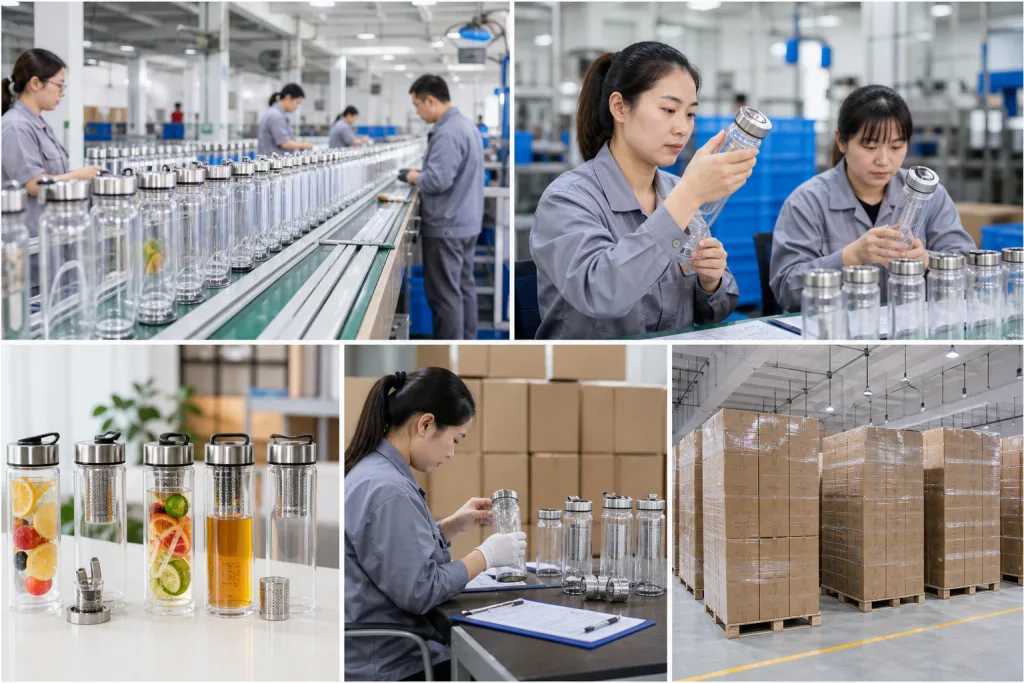
For wellness brands and hydration startups buying from Zhejiang, China, the fast route is to split the project into cost blocks and calendar blocks. A custom infuser bottle is not just a bottle. We run it as a cap assembly, an infuser basket or filter, a gasket set, a decoration step, and a packaging program, each with its own lead time. A printed logo sample might be ready in 3 days, while a new injection mold correction can push approval from 12 days to 18 days. We have seen buyers flag a clean-looking pre-production sample, then hold shipment because the retail box barcode on the PO had one digit wrong. Small miss, big delay.
What really sets the unit price
If you are sourcing a customizable fruit infuser bottle, unit price usually comes from BOM, not from the word “custom.” A standard 700 ml Tritan bottle with a removable fruit cage, PP lid, and one-color logo prices nothing like a vacuum stainless custom tea infuser bottle with a 0.3 mm mesh basket, powder coating, and gift box. New buyers often compare capacity first. This is the wrong question to ask. On our line, the cost jump usually starts with material, filter structure, and packing spec—not the printed logo.
The biggest cost blocks are usually:
- Body material: Tritan is common for a fruit infuser bottle bulk program because it is clear, BPA-free, and lighter than glass. Borosilicate glass costs more to handle, and QC pulled cracked samples before drop-test packing was adjusted. 18/8 stainless raises raw material and welding cost, especially once the body needs vacuum structure, but buyers usually accept the higher price because the shelf value looks stronger.
- Infuser design: A simple fruit rod or basket is cheaper than a fine-pore tea strainer. A bulk tea infuser bottle needs tighter mesh tolerances and cleaner fit-up, often with a finer screen around 0.2-0.4 mm, especially if you want leaf tea rather than only fruit slices. We have seen this go sideways when the buyer asks for “no leaf escape” on a low-cost filter.
- Lid complexity: Flip lids, carry loops, lock buttons, and dual-injection parts add tooling and assembly time. A basic screw lid runs fast. A push-button lid with silicone seals and spring parts slows the line and adds more inspection points.
- Decoration: A custom logo infuser bottle with one-color silkscreen is low cost. UV print, heat transfer, soft-touch coating, and metallic paint are not. One buyer flagged a Pantone mismatch on a matte coating run, and we had to recheck every lot against the approved panel.
- Packaging: Plain egg-crate export cartons are cheapest. Individual color boxes, barcode stickers, and inserts add quickly. Even a simple insert card changes packing speed, and retail boxes with a 5-layer inner structure ship at a different carton count.
As a working range, Zhejiang factories often quote a factory direct infuser bottle in Tritan at USD 1.80-2.60 ex-works for 1,000-3,000 pcs if you use an existing mold and plain packaging. At 5,000 pcs, the same custom fruit infuser bottle may sit around USD 2.20-3.20 FOB with retail box and one-color print. Glass usually lands around USD 2.80-4.20. Stainless insulated versions can reach USD 4.50-7.50 depending on wall construction, coating, and filter type. The spread is normal. The math does not work if a supplier offers stainless vacuum with retail packing at the low end of basic Tritan pricing.
If your quote is far outside those ranges, ask for a line-by-line cost split. You do not need every factory margin disclosed, but you do need to see whether the delta comes from resin grade, box spec, or decoration method. We ship plenty of projects where the bottle cost looked fine, then the retail box added USD 0.38 and the buyer missed it on the PO. That is how experienced buyers compare suppliers in Zhejiang, China without getting stuck on vague promises.
MOQ tiers and price breaks
MOQ is where startup plans hit the shop floor. For a bulk infuser bottle, the real MOQ changes with the level of customization. If you pick an existing bottle body and cap from the catalog, we usually run 1,000 pcs per color. If you change the lid structure, bottle profile, or infuser basket, the stated MOQ stops mattering. The mold plan drives it. We have seen buyers ask for a new lid hinge and a new 2.5 mm infuser slot pattern, then expect the same MOQ as stock tooling; this is the wrong question to ask.
Typical tiers for a customizable infuser bottle program look like this:
- 1,000 pcs: Existing mold, limited colors, standard PP or Tritan parts, one logo position. Good for a first market test. Unit price is usually 12-25% higher, and QC pulled plenty of these runs where buyers wanted gift-box packaging on a test order—the math doesn't work.
- 3,000 pcs: Better for a customized fruit infuser bottle with retail carton and color-matched lid. This is usually the practical starting point. On our line, 3,000 pcs is where screen printing setup and carton sourcing stop fighting each other.
- 5,000 pcs: Stronger leverage on resin buying, printing setup, and packaging. A lot of China factories get more open on mixed color ratios at this level. We often quote 60/40 color splits here instead of forcing a 50/50 run.
- 10,000 pcs and above: Suitable for full custom made infuser bottle projects, especially if you need exclusive Pantone matching, dedicated inserts, or distributor packaging. At this volume, buyers usually ask for a sealed color chip and pre-production sample approval before mass production.
For a distributor fruit infuser bottle or distributor tea infuser bottle program, ask if the MOQ is per SKU, per color, or per decoration. Buyers mix this up all the time. They hear “MOQ 3,000 pcs” and assume it can be split into six colors of 500. Most factories will reject that because color masterbatch setup, print screens, and carton runs each have their own minimum. We have even seen a PO typo that read “6 colors assorted, same cost as 1 color,” and the buyer flagged the quote later.
Watch the packaging MOQ as a separate line. Some suppliers will accept a low opening order for bottles, then set a higher MOQ for color boxes. You might buy 2,000 bottles and still need 3,000 boxes. That hits cash flow fast. For startups ordering a factory fruit infuser bottle, a sensible first PO is often 3,000-5,000 pcs across two colors, one decoration method, and one standard box. Not glamorous. It gives you a real landed cost, and the replenishment cycle is usually cleaner later—12 days for repeat packaging versus 18 days for a new box run, based on how we ship.
Ask for three quotes every time: 1,000 pcs test run, 3,000 pcs launch run, and 5,000 pcs scale run. You will see fast if the supplier is pricing straight or burying setup cost in the first tier.
Tooling, samples, and hidden project cost
If you want a customized infuser bottle that actually stands apart, tooling is where the budget stops being abstract. Buyers should split cosmetic customization from structural customization early, or the math doesn't work. A color change, logo print, or matte coating usually runs on existing tools. A wider fruit chamber, a new locking cap, or an integrated tea basket usually needs new steel. On our line, the first check is simple: did the part geometry change by 1-2 mm, or are we only changing decoration?
Common one-time costs
- Silkscreen setup: USD 30-80 per color per position
- Laser engraving fixture: USD 50-150
- Color box artwork setup: often free, sometimes USD 50-120 if dieline changes
- New cap mold: USD 2,500-6,000
- New body mold: USD 4,000-10,000 for plastic, often higher for complex stainless parts
- Infuser insert mold: USD 800-2,500 depending on mesh/plastic assembly
For a custom tea infuser bottle or customizable tea infuser bottle, fit tolerance is where projects go sideways. Fine mesh baskets need clean thread engagement and stable gasket compression, and we usually check this with a torque tester and a go/no-go gauge during sampling. If cap torque swings from 0.8 N·m to 1.4 N·m, or QC pulled the sample and found a sharp basket edge, the buyer flags it fast. Consumers call that cheap even when the leak test passes. Good factories fix it in sample rounds, not after 10,000 units are packed.
Sample cost also gets mixed up. A stock sample may cost USD 20-50 plus courier. A pre-production sample with custom color and logo often costs USD 80-200. A CNC or 3D-printed appearance sample for a custom made infuser bottle can run USD 200-600. If steel tooling starts, you may need a T1 sample, then a corrected T2 sample. That is normal. We have seen buyers push back on T2 cost, but if the T1 cap thread binds after 3 turns, skipping correction is the wrong place to save money.
At BottleForge scale, a practical export factory can run 500,000 units per month across drinkware lines, but that does not mean every custom infuser bottle project moves instantly. Sample review cycles still depend on decision speed. If your team takes 7 days to approve each revision and there are 3 rounds, that is 21 days gone before bulk production even starts. We ship faster when one person owns approvals, Pantone references are locked, and packaging text is checked before sampling. A small typo on a PO or color box can burn 5 days with no value added.
Lead time from sketch to shipment
A realistic schedule for a fruit infuser bottle custom project runs on four separate clocks: engineering, sampling, production, and outbound logistics. Ask only for “lead time,” and you will get a soft answer. This is the wrong question to ask. On our side, sales needs to know whether you mean first sample, PP sample, or FOB date before we can quote anything cleanly.
For an existing mold custom infuser bottle with standard materials, a workable timeline is often:
- Day 1-3: confirm specification sheet, capacity, material, logo files, and target packaging
- Day 4-10: stock or digital sample prepared
- Day 11-17: custom color/logo pre-production sample
- Day 18-22: sample approval and PO/deposit
- Day 23-45: mass production, assembly, AQL inspection, packing
- Day 46-50: container loading and export documents
That means about 35-50 days after sample approval, or roughly 45-60 days from first confirmation to FOB shipment. On the line, one missed detail can burn 3 days fast; last quarter a buyer flagged a lid color that was 1 shade off the Pantone chip, and QC pulled the sample before packing.
For a new-mold customized tea infuser bottle or a special factory tea infuser bottle, add:
- 10-15 days for mold design and approval
- 15-25 days for tooling fabrication
- 7-12 days for T1/T2 samples and correction
That pushes the full timeline closer to 60-90 days before shipment, sometimes longer before Chinese New Year or peak summer hydration season. If you need Amazon FBA prep, barcode labeling, and appointment scheduling, leave another 3-7 days buffer. We have seen this go sideways when the outer carton mark changed after T1, because the steel needed one more correction and the mold shop lost 4 days.
Repeat orders are easier. For a proven bulk fruit infuser bottle with approved carton and stable colors, 20-35 days is common from deposit to ship for a Zhejiang supplier that already runs the parts. If you reorder in peak months without a forecast, expect resin, packaging, or mesh insert lead times to stretch from 12 days to 18 days. The math does not work if the PO lands late and everyone still expects the old ship date. Smart buyers send a 90-day rolling forecast even when the PO is not final. That gives the factory room to book raw material, reserve carton space, and hold a 304 mesh insert supplier slot without pushing you into finished stock too early.
Quality checks buyers should demand
Infuser bottles fail in predictable ways: leaking lids, cracked carry loops, mesh burrs, resin odor, and logos that come off after 20 rubs. We see this on the line. A clean-looking sample proves almost nothing unless QC pulled the sample from mass production, not from a hand-picked set. For every bulk infuser bottle or bulk tea infuser bottle order, ask for a short written quality plan before deposit.
Start with the basics. Ask the supplier for material declarations and test capability tied to your market: REACH for Europe, LFGB where applicable for food-contact expectations, and ASTM/CPSIA if the bottle could cross into kids-related channels. If you are buying from China for the EU, confirm whether colorants and printed coatings meet the required chemical limits. We have seen POs marked only “food grade silicone,” with no grade sheet, no migration report, not even a Shore hardness spec like 60±5. That is the wrong question to ask. “Food grade” by itself is not enough.
For production control, use a written inspection standard. One page is enough if the checkpoints are clear and measurable. We run this with a torque meter, drop rig, and sealed sample rack, not by feel.
- Leak test: inverted 30 minutes, then side lay test
- Torque test: cap open/close consistency across sample set
- Drop test: packed drop from 76cm or 1m depending on carton spec
- Logo adhesion: tape test and alcohol rub for printed areas
- Odor check: especially on gaskets and Tritan parts
- Mesh finish: no burrs, sharp points, or loose welds on tea baskets
For final random inspection, many buyers use AQL 2.5 major / 4.0 minor. We ship plenty of distributor orders on that basis, and it works for wellness retail and ecommerce if the checklist is tight. Premium branding needs stricter cosmetic limits at sample approval: for example, color variation against the master sample, print position within 1.5mm, and no visible scratches at 30cm. If you leave that vague, the buyer flags it at final inspection and the factory pushes back. We have seen this go sideways.
Also ask whether the factory operates under ISO 9001 procedures and whether social compliance such as BSCI is available if your channel requires it. You do not need a stack of 12 certificates no one reads. You need the right documents for your market, matched to the SKU, before production starts. Once the container booking is in and the cartons are taped, the math does not work.
How startups keep margin and speed
The best sourcing calls for a customizable infuser bottle are usually the boring ones. They protect your first 12 months of cash flow. We have seen startups burn margin fast by stacking a 1,000 pcs MOQ, multi-pass decoration, and a gift box that measures 26 x 9 x 9 cm. The math doesn’t work. Most clean launches start from a standard bottle platform, then spend brand budget on logo, cap color, and product photos instead of paying for a new mold set.
A practical launch formula for a custom logo infuser bottle is:
- Use an existing 650ml or 700ml mold
- Choose Tritan body, PP cap, silicone seal
- Limit to 2 body colors and 1 lid color
- Use 1-color silkscreen or laser mark
- Pick a compact color box under 24 x 8 x 8 cm to control freight
- Start at 3,000 pcs and target repeat within 60-90 days
This kind of factory infuser bottle program usually gets you a retail-ready item without turning the first PO into an engineering test. On the line, QC pulled the sample and checked thread fit with a go/no-go gauge before mass run. That part matters. If your concept is tea-led rather than fruit-led, a custom tea infuser bottle can justify a finer basket mesh and tighter threading tolerance, like 0.2 mm control on the lid fit, but keep the outside simple until sell-through is proven. We have seen this go sideways when a new brand asks for custom shape and custom basket in the same order.
For distributors infuser bottle and distributors fruit infuser bottle buyers, margin is usually won in the carton, not in a fancy spec sheet. If one outer carton holds 24 units instead of 20, freight per piece drops fast and the warehouse team likes the stack better. We ship both packouts, and the 24-pack usually lands cleaner unless the bottle diameter creeps past 72 mm. Color discipline matters too. A buyer flagged slow movers last year after ordering five lid colors on one PO; the repeat came back with two colors only, and dead stock eased up within one cycle.
Buy with the second order in mind. Ask your Zhejiang supplier for repeat-order lead time in days—12 days versus 18 days changes your ad planning—ask which raw materials are imported versus local in China, and ask whether the factory can hold 500 spare color boxes in case the PO quantity changes. One inspection finding we see too often is carton mark data not matching the purchase order because of one typo in the SKU code. Small mistake, big delay. A sourcing plan is not just first landed cost. It is your ability to replenish fast when one social ad suddenly hits or a retail shelf test starts to move.
Need a firm quote and realistic timeline?
Send your target capacity, material, logo file, packaging idea, and order quantity. We will break out MOQ, tooling, unit price, and lead time clearly.
Frequently asked questions
What is the normal MOQ for a customizable fruit infuser bottle?
For an existing mold, the normal MOQ is usually 1,000-3,000 pcs per model, often with a color minimum. If you want a simple custom logo infuser bottle in standard colors, 1,000 pcs can work, but the unit price is usually 12-25% higher than a 3,000-5,000 pc order. For a true custom fruit infuser bottle with a new cap, body, or infuser structure, the practical MOQ is often 3,000-10,000 pcs because tooling cost needs to be spread across the run. Also ask whether the MOQ applies per SKU, per color, or per packaging version. Many China suppliers quote one MOQ for bottles but a separate MOQ for custom color boxes or inserts.
How much does a bulk fruit infuser bottle usually cost?
A common 650-750ml Tritan bulk fruit infuser bottle using an existing mold typically lands around USD 2.20-3.60 FOB China at 3,000-5,000 pcs, depending on lid complexity, infuser basket design, and packaging. Plain export packing sits at the low end; a retail box and one-color logo push it up. Borosilicate glass versions often run USD 2.80-4.20, while stainless insulated models can reach USD 4.50-7.50 or higher. If you see very low pricing below USD 2.00 FOB, check material grade, wall thickness, gasket quality, and whether testing or inspection is excluded. The cheap quote is often missing something you expected to be standard.
How long does a custom infuser bottle project take from approval to shipment?
If you use an existing mold, most custom infuser bottle orders need about 35-50 days after sample approval to reach FOB shipment. Including the sample stage, the whole process is often 45-60 days. A new mold project takes longer: add roughly 20-35 days for tooling plus 7-12 days for T1 and corrected samples. That puts many customized tea infuser bottle or custom made infuser bottle programs in the 60-90 day range. If your order needs Amazon prep, FNSKU labels, or complex gift packaging, leave another 3-7 days. Repeat orders are much faster and often ship in 20-35 days if materials and packaging are already approved.
Do I need a new mold for a customized infuser bottle?
Not always. If your changes are limited to color, logo, finish, or packaging, you usually do not need new tooling. That is the fastest and cheapest path for a customizable infuser bottle launch. You probably need a new mold only when you change the body profile, lid mechanism, thread system, carry loop structure, or infuser geometry. Typical tooling runs from USD 800-2,500 for a simple insert mold, USD 2,500-6,000 for a cap mold, and USD 4,000-10,000 for a plastic body mold. Before approving tooling, ask for 2D or 3D drawings, tolerance notes, and a clear statement of mold ownership and maintenance responsibility.
What quality standards should I request for a bulk tea infuser bottle order?
For Europe and North America, request material and compliance documents that match your channel, not just a generic “food grade” statement. REACH is important for Europe, and many buyers also ask for LFGB-related food-contact confidence where relevant. For North America, ASTM or CPSIA can matter depending on how the product is marketed. On the production side, specify leak testing, logo adhesion testing, odor check, and mesh burr inspection. For final inspection, AQL 2.5 major and 4.0 minor is a common baseline for distributor tea infuser bottle programs. If the bottle is going into premium retail or ecommerce gifting, tighten cosmetic standards in writing before production starts.