Key Takeaways
- For most B2B programs, 18/8 stainless steel with 0.4-0.5 mm body thickness and 500-750 ml capacity gives the best balance of cost, durability, and thermal performance.
- Typical MOQ for a customizable double walled bottle is 1,000 pcs per color, with sample lead time of 7-10 days and mass production in 25-35 days from artwork approval.
- Decoration choice changes complaint risk: laser engraving has near-zero color shift, while silk screen and powder coat logo alignment need tighter AQL checks.
- FOB China pricing often ranges from USD 2.80 to 6.90 depending on size, lid, coating, and packaging, so small spec changes can move margin by 8-15%.
You are not buying a bottle. You are buying landed cost, complaint rate, delivery risk, and whether the logo still looks clean after 90 days on shelf. A customizable double walled bottle looks simple in a render, but we have seen one wrong call on steel grade, lid structure, or decoration turn a launch into returns, rework, and margin loss. On the line, a 0.2 mm wall tolerance or a weak powder coat adhesion result shows up fast. Smart buyers start with decisions and trade-offs, not colors and mockups.
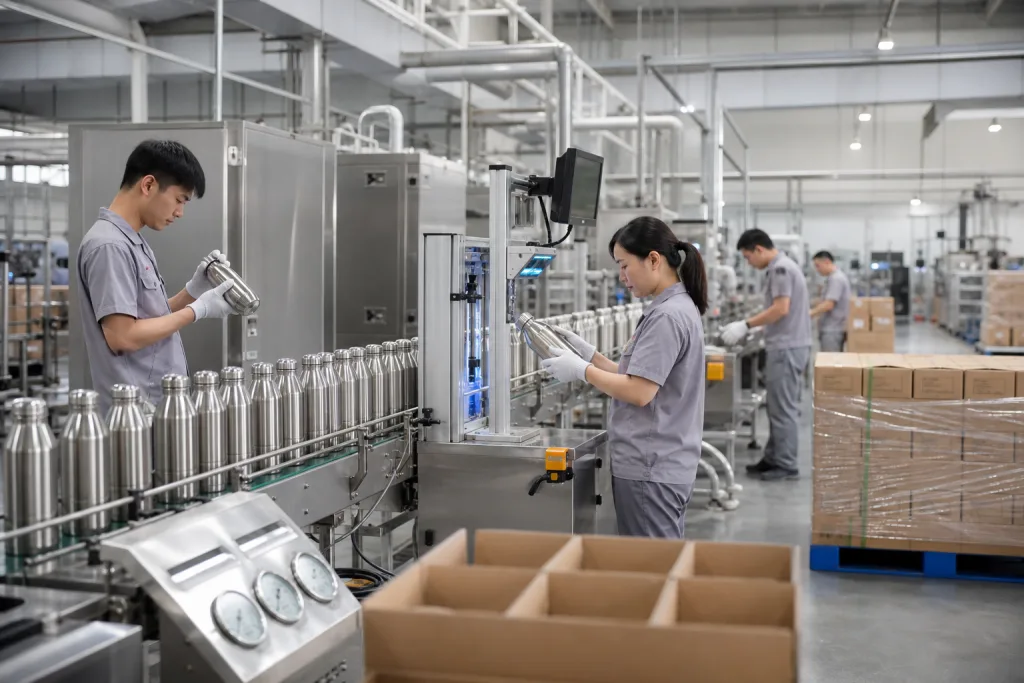
In Zhejiang, we see this every month. A buyer asks for a custom canteen or customizable drinkware quote before locking bottle capacity, insulation target, compliance scope, and branding method, then compares 3 prices built on different specs. This is the wrong question to ask. We ship for retail, promotion, Amazon FBA, and canteen distributor programs, and the buyer usually flagged the same gap later: no clear print method, no drop-test target, or even a PO typo on lid color. If you are sourcing this category, you need a tighter buying checklist.
Start with four buying decisions
Before you request a quote from a canteen supplier or canteen factory, lock four buying decisions first. Skip this, and the quote sheet is useless. We see buyers compare a 500 ml promo bottle to a retail 750 ml SKU and wonder why the numbers are off by USD 2.00 before sampling even starts.
- Use case: commuter bottle, gym bottle, corporate gift, school program, outdoor custom growler line, or retail shelf item.
- Thermal target: keep cold 24 hours, hot 12 hours, or just “double wall” for condensation control.
- Branding method: simple one-color logo, wrap print, laser mark, embossed mold, or premium textured powder coat.
- Channel constraints: Amazon FBA carton limits, retail gift box needs, distributor drinkware assortment, or promotional budget cap.
Here is how this plays out on the line. A canteen promotional order for a trade show usually puts price and delivery first, not max insulation. A customized growler for specialty retail needs a heavier hand feel, better leak control, and a cleaner finish around the shoulder weld. A canteen distributor in Europe may need REACH alignment, dishwasher guidance, and barcode placement checked to within 3 mm on the gift box. A short-run event order in North America usually does not. The wrong question to ask is “What is your best price?” Ask what build matches the sales channel.
At BottleForge Industrial in Zhejiang, China, our planning starts with these four points because they drive almost everything else: steel grade, vacuum process, lid tooling, decoration line, and inspection plan. We run different setups for different jobs. A 500 ml bottle with standard screw lid and one-color print can run from USD 2.80-3.60 FOB China at 1,000-3,000 pcs. Change that to a 750 ml bottle with rubber paint, carry loop lid, and individual gift box, and you can move to USD 4.80-6.20 FOB fast. On the factory floor, even a gift box change matters; a 20 mm taller box can cut master carton quantity and push freight up.
If a canteen manufacturer gives you one price without asking these questions, that is usually a placeholder number. Not a sourcing decision. We have seen this go sideways after the PO lands and the buyer flags details that were never quoted, like a laser logo on two positions or a drop-test requirement for Amazon cartons.
Choose the bottle architecture carefully
The core structure of a customizable double walled bottle decides cost, complaint rate, and how the bottle feels in hand. New buyers often look at color first. That is the wrong question to ask. Start with body shape, steel grade, wall thickness, mouth diameter, and base construction, then let the decoration team follow.
Steel and wall thickness
For Europe and North America, 18/8 stainless steel, also called SUS304, is still the standard for both inner and outer walls. On our line, a common setup is 0.4 mm inner and 0.45-0.5 mm outer wall, checked with an ultrasonic thickness gauge before vacuum. Go thinner and you might save a few cents per unit, but we have seen dent claims jump after carton drop tests and rough last-mile delivery. Go thicker and the hand feel improves, but net weight climbs and freight math starts to break, especially on 40HQ loading.
Mouth and base design
A narrow-mouth 32-40 mm opening holds heat better and gives cleaner spill control. A wide-mouth 50-60 mm opening is easier to clean and better for ice cubes, but heat loss is faster and the lid seal needs tighter control; QC pulled the sample once because the silicone ring twisted during torque test. For a customizable canteen sold into sports or office channels, 500 ml and 750 ml are the safest sizes. We ship those every month. For a customizable growler or custom growler line, 1.2 L to 1.9 L can work, but mold options narrow and carton drop risk rises fast once the bottle gets tall and heavy.
Ask your canteen manufacturers about the vacuum point and copper coating process on the inner wall. Do not skip this. A proper vacuumized body with inner copper layer will usually improve heat performance by 10-20% versus a low-spec bottle, and we check the vacuum hold after sealing at the body neck. Also confirm whether the base is standard concave, anti-slip pad, or stainless exposed. Silicone base pads cut shelf noise and reduce wear, but they add one more bonding step, and we have seen 2-4% more defects when glue spread is uneven or the buyer flagged pad shift over 1 mm.
Good sourcing is not choosing the most features. It is choosing the fewest features that still fit your channel, margin, and complaint tolerance.
If you are working with multiple canteen vendors or canteen suppliers, issue one technical sheet with capacity tolerance, finish, net weight range, and leak-test standard. Put the mouth diameter and bottom type on it too. Otherwise each canteen vendor will quote a different structure, and then you are not comparing prices—you are comparing different bottles with the same photo on the PO.
Match branding to real-world abuse
Most customized drinkware complaints start at decoration, not the bottle body. Buyers chase Pantone and miss what happens after packing: carton rub on partition edges, dishwasher abuse, warehouse scuffing, and hand oil on the grip zone. QC pulled a sample last month with a perfect body weld and a logo already hazing after 50 rubs on a dry cloth. That is the real failure point.
You have five practical decoration routes on a customizable double walled bottle:
- Silk screen: low setup cost, clean for 1-2 colors, good for 1,000+ pcs. Best when the logo panel is flat enough, the finish is smooth, and the jig holds the bottle steady on the line.
- Heat transfer: better for multicolor graphics, but unit cost is higher and scratch resistance lives or dies on process control. If bake time drifts even a little, the buyer flags edge lifting first.
- Laser engraving: durable, premium look, ideal for stainless or painted surfaces. Usually adds USD 0.12-0.35 per unit. We run this a lot on powder-coated bodies because there is no ink layer to chip off.
- Powder coating with print: strong retail appearance and better grip; common on custom canteen and customized canteen projects. Coating thickness around 60-80 μm helps hand feel, but the print still needs its own adhesion check.
- Embossed or debossed tooling: premium, but tooling can run USD 300-1,000+ and only makes sense for longer programs. This is where buyers ask for a “cheap mold,” and the math does not work.
For canteen custom promotional work, screen print is still common because it is cheap and fast. We ship plenty of these on event orders where the logo is simple and the timeline is tight. For a retail-facing customized drinkware program, powder coat plus laser is usually the safer call over time. Color print can chip or shift when bottles rub inside carton partitions during transit; we have seen this go sideways on matte black bottles packed too tight at 24 pcs per carton. Laser avoids that issue, but the final contrast depends on the coating color and the steel tone under it.
If you sell through distributor growler or distributor canteen networks, ask for a rub test, adhesion test, and photo approval against actual coating samples. Flat digital mockups are not enough. Ask to see the real bottle, not just a rendering on a PDF. Also define logo position tolerance in millimeters. We normally work to ±1.5 mm on standard cylindrical bottles. If your artwork wraps around a taper body, discuss seam and sightline placement early; one PO we received even had the logo note typed 180° opposite the intended handle view.
Many canteen distributors in North America also want mixed-logo programs. That is possible, but do not assume the same MOQ as a single-logo order. A base MOQ might be 1,000 pcs per colorway, but split logos may need 250-500 pcs per artwork per batch depending on line efficiency. This is the wrong question to ask: “Can you mix logos at no upcharge?” Better question: how many artwork changes can the line hold in one shift without pushing defect rate up.
Price the project beyond FOB
Buyers who compare FOB China pricing only usually pick the wrong supplier. The better comparison is total delivered cost plus failure risk. We have seen a quote win by USD 0.18, then lose USD 0.46 per bottle after relabeling, carton rework, and claim deductions.
Typical FOB China pricing for a customizable double walled bottle from Zhejiang or other coastal China regions looks like this at 1,000-3,000 pcs:
- 500 ml standard bottle, spray finish, one-color logo: USD 2.80-3.60
- 750 ml powder-coated bottle with carry lid: USD 4.20-5.50
- 1.2 L customizable growler with handle lid: USD 5.80-6.90
FOB is line one, not the full math. Add packaging, testing, freight, duties, and failure cost. A color gift box may add USD 0.28-0.65. Barcode labeling can add USD 0.03-0.08. We run carton drop checks on the line, and a 5-layer export carton with dividers costs more up front, but it usually cuts transit claims enough to pay for itself. If you ship to Amazon FBA, FNSKU labeling and carton dimension control are mandatory. One carton at 63.5 cm instead of the PO limit has already caused enough trouble for our team.
Check whether your canteen manufacturer includes normal quality cost in the price. Ask directly about vacuum retention checks, leak tests, and outgoing inspection. QC pulled the sample last month on a low-price program because the lid torque was out by 0.3 N·m, and that is exactly where cheap quotes go sideways. A price that skips process control can create a 3-5% defect rate fast. On a 10,000-unit order, the math doesn't work.
Compare three numbers if you want a clean decision: unit FOB, estimated landed cost, and expected complaint allowance. For a well-controlled bottle program, a realistic field complaint target is under 0.5-1.0%. For low-cost canteen promotional orders, some buyers accept 1.5%. Be honest about your channel. Retail buyers should not buy to event giveaway standards. This is the wrong question to ask if the team keeps pushing only for the lowest ex-factory number.
If you are evaluating a canteen supplier, ask what monthly capacity they actually run, not what the catalog suggests. A factory claiming broad catalog coverage but shipping only 50,000 units a month may struggle in peak season. Our own planning benchmark for standard stainless drinkware is 300,000 units/month, which matters when color assortment expands late in the project. We have had buyers add 4 new SKUs after sample approval, and the powder coating line schedule changed the same day.
Control compliance and quality risk
If your buyer market is Europe or North America, compliance is not a sales extra. It is the entry ticket. For a customizable drinkware program, ask for a clear test and inspection path before deposit. We usually ask for that before MOQ and mold timing are locked, not after the PO lands with a typo on the lid color code.
The normal checklist covers food-contact compliance for the target market: REACH-related substance controls where relevant, LFGB expectations for some EU buyers, and California Proposition 65 attention for certain US programs. For kids-related formats, ASTM or CPSIA-linked considerations may apply depending on product type and components. If your bottle has a straw lid, silicone bumper, or painted coating, each material layer needs to be declared correctly. QC pulled one sample last month where the silicone sleeve matched spec, but the printed coating declaration was missing from the file set.
On the quality side, define your AQL and critical checks early. A practical outgoing plan for standard bottle orders is AQL 2.5 for major defects and 4.0 for minor defects, with 100% checks for leakage and vacuum retention at line or batch level. This is the wrong question to ask late in the project; if you wait until mass production, the math doesn't work. Core tests should include:
- Leak test with inverted hold time, often 30 minutes minimum
- Vacuum performance sample test, such as hot water retention after 6 or 12 hours
- Coating adhesion and rub resistance
- Carton drop test, especially for gift-box retail packs
- Thread fit and lid torque consistency
If you buy from a canteen factory in China, ask whether they support BSCI or similar social compliance if your retail customer requires it. Also ask for ISO-based process discipline, even if your order size is modest. We run into more issues on a canteen customized project with three lid components and two decoration steps than on a plain stainless bottle. On the line, one 0.5 mm mismatch between the straw guide and lid seat is enough to start leakage complaints.
One point buyers often miss is odor. Silicone seals and straw parts can pass basic checks but still create customer complaints if post-production airing is poor. Include odor review in your golden sample approval. We have seen this go sideways after sealing parts in PE bags too fast after production, even though the leak test passed. It sounds simple. It saves claims.
Plan MOQ, timeline, and supplier fit
The right canteen supplier is usually not the lowest quote on page one. It is the factory whose MOQ, tooling method, reply speed, and document control fit how you buy and how you ship. We see this early: one buyer wants 1,000 pcs with a simple logo; another wants 6 SKUs, 2 barcode systems, and a carton mark change after the PO lands. Those are different jobs.
For a standard customizable double walled bottle, common MOQ is 1,000 pcs per model per color. Some canteen vendors in China will take 500 pcs for a trial order if you stay with stock colors and standard packaging, but the unit price goes up and decoration choices get tighter. New mold development for a customized canteen shape or special lid can take 20-35 days for tooling and another 7-10 days for validation samples. That is normal. On the factory floor, a new lid mold still needs sample checks with calipers at the hinge and thread points, often down to 0.2 mm, before the line will run cleanly.
A realistic schedule for stock-shape projects is:
- Artwork and quote confirmation: 2-4 days
- Pre-production sample: 7-10 days
- Mass production: 25-35 days after sample approval and deposit
- Final inspection and booking: 3-7 days
If you need mixed SKUs for a distributor growler or distributor drinkware assortment, add time for carton planning and barcode mapping. This is where orders go sideways. We have seen a PO with one digit wrong in the EAN list hold packing for 2 days while QC pulled the sample cartons and checked outer marks line by line. Good canteen suppliers issue a packing matrix before production closes, not after 60% of the goods are already packed.
When screening canteen manufacturers, ask the practical questions first. Who buys the steel coil? Who makes the lids? Is powder coating in-house or subcontracted? How many vacuum machines are on site? What percentage of orders are exported to Europe or North America? This is the right filter because the math does not work if a factory owns bottle forming but sends coating and lid assembly outside with weak control. In Zhejiang, China, the supply base is strong, but not every canteen factory runs outside processes well. We have had buyers flag coating consistency after seeing only 2 vacuum machines on a line promised for 80,000 pcs.
A final filter is how they handle bad news. If a canteen vendor hides color variance or pushes shipment before inspection is finished, take that as your answer. You want a partner who says, plainly, “this Pantone on powder coat will drift by 5-8%, choose a closer stock color or change process.” That is what experienced export teams do. On our side, if final inspection finds 3 cartons with mixed lids or a scratch rate above the agreed standard, we stop and report it before booking space.
Get a bottle spec review before you quote
Send your target price, market, and artwork plan. We will suggest the right bottle structure, MOQ, and compliance path from Zhejiang, China.
Frequently asked questions
What MOQ should I expect for a customizable double walled bottle?
For standard stock shapes, the normal MOQ is 1,000 pcs per size per color, with one logo treatment. Some canteen suppliers in China can do 500 pcs for a trial run if you accept existing lid options, stock coatings, and simple packaging, but unit cost usually rises by 8-15%. If you want a fully customized canteen body, private lid mold, or embossed logo, expect higher commitment because tooling and line setup need to be absorbed. For mixed-logo programs sold through canteen distributors, a practical split is often 250-500 pcs per artwork within a larger master order. Always confirm whether MOQ applies by model, colorway, or decoration, because different canteen manufacturers count it differently.
How do I choose between 500 ml, 750 ml, and larger bottle sizes?
Start with channel and use case. For office, gifting, and commuter use, 500 ml is the lowest-risk format because it fits more cup holders, weighs less, and ships more efficiently. For sports and retail shelf programs, 750 ml often gives the best value perception without becoming bulky. If you are planning a custom growler or customizable growler line, 1.2 L to 1.9 L can work well for outdoor and specialty stores, but defects from dents and lid sealing matter more because of the larger surface area and heavier filled weight. Freight also changes. A 750 ml bottle may cost only USD 0.50-1.20 more than 500 ml FOB, but container efficiency and carton drop performance can shift enough to affect your landed cost.
Which logo method is best for durable customized drinkware?
If durability is the top priority, laser engraving is usually the safest choice. It resists rubbing, warehouse abrasion, and normal hand washing much better than surface print, and the added cost is often only USD 0.12-0.35 per unit. For lower-cost canteen promotional projects, silk screen still works well if artwork is simple and the coating is stable, but it needs stronger inspection for adhesion and logo placement. Heat transfer is better for complex graphics, though scratch resistance depends heavily on process control. Powder coating gives a more premium retail look and better grip, especially for a custom canteen line, but Pantone matching can drift. Ask for actual coated samples, not only digital proofs, and define logo position tolerance, usually around ±1.5 mm.
What compliance documents should I ask a canteen manufacturer for?
Ask for documents tied to your market and product configuration, not generic certificates. For Europe, many buyers want food-contact declarations and substance control support aligned with applicable EU requirements; some also request LFGB-related testing expectations. For North America, pay attention to food-contact safety, Proposition 65 where relevant, and any retailer-specific restricted substance list. If the bottle includes straw parts, silicone, paint, or powder coating, those materials should be identified separately in the declaration pack. On the factory side, BSCI can matter for retail supply chains, and ISO-driven process control is a good signal even if not contractually required. Also ask for the actual lab report dates and model references. A test report from a different bottle is not useful.
How long does a custom order usually take from China?
For a standard stock-shape customizable double walled bottle from China, sample lead time is usually 7-10 days after artwork confirmation, and mass production is commonly 25-35 days after sample approval and deposit. During peak season, add 7-10 days, especially if you need multiple coating colors or gift boxes. A fully customized canteen with new mold development normally needs 20-35 days for tooling before sample approval even starts. Shipping time depends on mode and destination, but many buyers underestimate the internal timeline: barcode checks, AQL inspection, carton approval, and booking all take days. If your launch date is fixed, work backwards from warehouse receipt, not ex-factory date, and leave buffer for at least one sample revision.