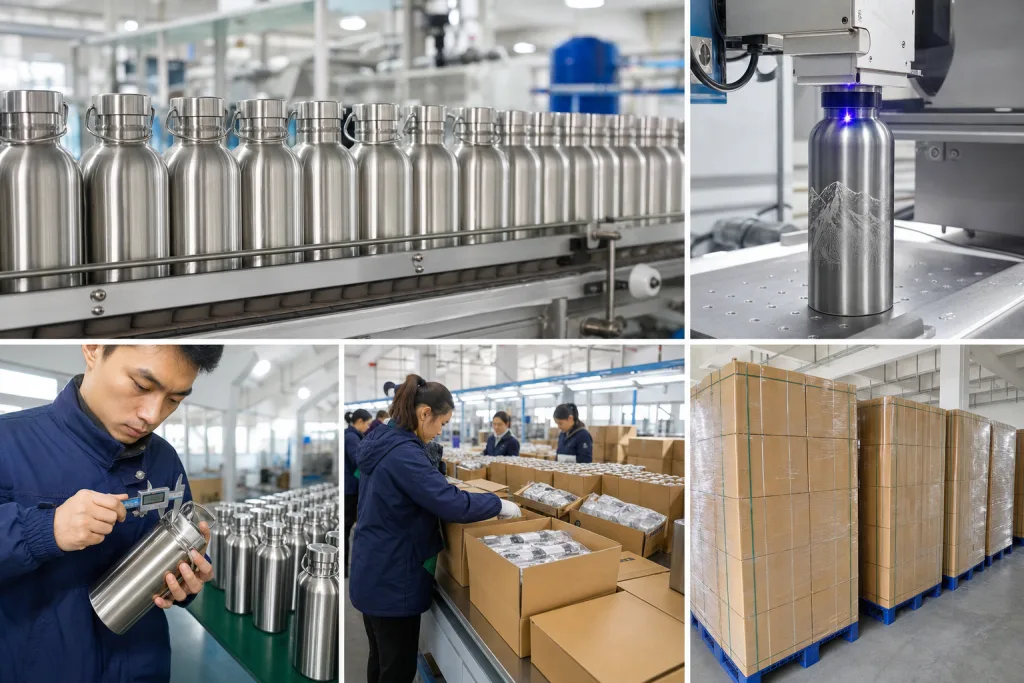
Key Takeaways
- Most customizable canteen projects need MOQ from 500 to 3,000 pcs, with lead time around 25 to 40 days after sample approval.
- For stainless canteen custom orders, 304 inner walls with 0.4-0.5 mm thickness are common; 316 costs about 12-18% more.
- FOB China pricing for a basic custom canteen often starts around USD 2.10-3.80, while full-print promo versions can move higher.
- Ask for REACH, food-contact declarations, AQL 2.5/4.0 inspection terms, and carton-drop test results before you place volume.
- A reliable canteen supplier in Zhejiang should show monthly output, decoration limits, and packaging options before you approve artwork.
If you are buying a customizable canteen for retail, promo, or private label, color is the easy part. The hard part is lining up cost, compliance, and lead time without ending up with a design that looks fine in the sample room and falls apart on the line. A workable canteen custom program has to survive transit, pass REACH and food-contact checks, and still leave margin on the table.
We build custom drinkware in Zhejiang, and the buyers who stay out of trouble ask the same questions on day one: What is the MOQ? Which decoration holds up after 500 washes? How many days from PO to shipment? A serious canteen factory in China should answer with numbers, not slogans. If they cannot tell you wall thickness, coating process, or carton pack-out, walk away. You are buying repeatable units, not one good sample.
What are you actually buying?
I’ll keep the tags and list structure intact, then rewrite the prose to sound like a factory-side sales engineer with tighter, more specific wording.Buyers often ask for a “customizable canteen,” but the brief is usually thin. Are you selling to hikers, gym promo buyers, corporate gifting teams, or schools? The answer changes the bottle body, cap style, and print route. A custom canteen for outdoor retail may need a matte powder coat and a carabiner loop. A canteen promotional order usually needs the lowest landed price and fast logo work. For a reseller line, we run cleaner cartons and a wider color card, because the buyer will flag sloppy packing on day one.
Start with four calls: material, capacity, decoration, and closure. Stainless steel is still the safest base for premium custom drinkware. Single-wall plastic only makes sense when the target price is tight. Most retail orders sit at 400 ml to 750 ml; 1,000 ml moves better in outdoor channels. For canteen customizable projects, lid tooling matters. A cap that leaks in a carton test will cost you more than a 10-cent upgrade, and QC pulled the sample for that reason on a 2,000-piece run last month.
- Material: 304 stainless, 316 stainless, aluminum, or Tritan-style plastic.
- Capacity: 400 ml, 500 ml, 750 ml, 1,000 ml.
- Decoration: laser, silk screen, UV print, or full-wrap transfer.
- Use case: retail, promo, school, sports, or OEM private label.
Which specs matter most?
If you are comparing canteen manufacturers, do not get pulled in by glossy renders. The money is in the numbers. On stainless steel, ask for inner wall thickness, outer wall thickness, and coating thickness if powder coating is in the spec. For a durable customized canteen, 0.4 mm to 0.5 mm on the body is the range we run. Below that, dent resistance drops fast. Above that, carton weight climbs and the freight quote does too.
Ask about lid material too. PP lids are low-cost and stable; Tritan-style lids cost more, look cleaner, and hold up better on premium lines. If the canteen needs to go in a freezer, dishwasher, or hot-fill line, say it upfront. We had one buyer flag a PO because the lid code said PP but the finish note expected Tritan gloss. That typo would have gone straight to sample if QC had not caught it. A Zhejiang factory should tell you which build survives 100°C hot water, which one cracks at -20°C, and which coating still looks decent after 3 to 5 years of normal use.
Do not approve a sample until the spec sheet is locked: capacity tolerance, leak test standard, drop-test height, and carton quantity.
- Leak test: 24 hours inverted, no seepage.
- Drop test: 1 meter, 3 faces, 2 corners.
- Capacity tolerance: typically ±5%.
- Surface finish: gloss, matte, powder coat, or brushed metal.
How much should it cost?
Price sits on material, size, and decoration, but a buyer still needs a working range before asking canteen suppliers for quotes. For a basic 500 ml stainless custom canteen with one-color print and standard packaging, FOB China often lands around USD 2.10 to 3.80 at mid-volume. Add vacuum insulation, laser engraving, or premium packaging, and the number climbs fast. A customized growler or larger insulated piece can go above USD 4.50 once the finish and hardware get heavier.
If you are comparing canteen distributor offers, ask whether the price includes carton marks, barcode labels, and individual polybags. We’ve seen quotes look sharp on paper, then the buyer flagged extra charges for artwork setup, inner boxes, or test reports after the PO was already moving. That is not a bargain. Check the base first: is the quote built on 1,000 pcs or 10,000 pcs? Once tooling is stable and packing is fixed, an 8% to 15% drop is normal.
Here is the straight answer: if the quote sits far below market, something is missing. The coating is thin, the lid is low grade, or export packaging is not in the number. The math doesn’t work. In China, especially Zhejiang, the gap between a real factory quote and a trading-only quote can be wide, and we run into that on the line when QC pulled the sample at 24-hour leak test and the finish failed at the rim. You want the supplier that can repeat the second order, not just win the first.
What is a workable MOQ?
I’ll rewrite this section in-place, keep the HTML intact, and tighten the language so it reads like a factory-side sales engineer wrote it.MOQ should fit your channel, not the supplier’s mood. A real canteen factory will separate stock body MOQ from decoration MOQ. If we run an existing mold, 500 to 1,000 pcs is a workable start for a simple custom drinkware order. If you want a new mold, new lid, or a special box, plan on 3,000 pcs or more. For canteen customized packaging, the carton MOQ can sit lower than the product MOQ, but only when the print plates are already standard.
For a distributor launch, we usually see buyers split into 2 colors and take 2,000 pcs total to keep risk under control. For a promo program, 1,000 pcs can work if the print area is small and the ship date is flexible. The buyer flagged this on one PO: black 500 pcs plus white 500 pcs is not the same as one 1,000 pcs run if the MOQ is set per SKU. A Zhejiang supplier should spell that out before you pay the deposit. If not, the math does not work.
- Low-MOQ stock body: 500-1,000 pcs.
- Private mold or cap: 3,000 pcs+.
- Multi-color split: allowed when total quantity is met.
- Sample lead time: 5-10 days.
Which decoration lasts longest?
I’ll rewrite the section in-place, keep the HTML exactly as-is, and make the prose sound like a factory-side sales engineer wrote it.Decoration is where a lot of canteen buyers burn margin. The low quote is not always the cheap order. Silk screen works well for 1 or 2 solid colors and clean logos. Laser engraving holds up best on stainless steel and will not peel. UV print gives you more color range, but on high-touch drinkware it needs proper surface prep. If you want a premium canteen custom look, powder coat plus laser logo is a solid combo. We run this on the line with a 0.2 mm mask check before QC releases the sample.
For a customizable growler or a larger insulated body, wrap printing or transfer decoration is often the only way to cover the full surface. That is where the math gets ugly. Full-wrap graphics add labor, scrap, and inspection time, and we have seen buyers push back after they approved a PO with a typo on the wrap width. A canteen factory in China should tell you how the decoration sits on a curved shell and whether the ink or engraving changes wash resistance. If the spec says dishwasher-safe, put it in writing. Otherwise the sample passes on day one and starts failing after 20 cycles.
- Laser: best durability, limited color.
- Silk screen: low cost, 1 or 2 solid colors, clean logos.
- UV print: flexible artwork, stronger visual impact.
- Transfer print: better for complex wrap graphics.
How do you qualify the factory?
I’ll rewrite the section in-place, keep the HTML unchanged, and make it read like a buyer-facing factory note with sharper specifics and fewer generic phrases.If you are choosing between canteen manufacturers, you need more than a catalog and a price list. Ask for monthly output, QC flow, and export records. A serious canteen factory in Zhejiang should be able to run 200,000 to 500,000 units per month, depending on the mix. If they cannot give a clean number, they are probably not tracking the line closely.
Then ask for certificates and audit proof. For North America and Europe, that usually means food-contact declarations, REACH support, and social compliance such as BSCI or a comparable audit. If the supplier says “no problem” but cannot show test reports, the math does not work. You also want their AQL standard. A common export level is AQL 2.5 for major defects and 4.0 for minor defects, but the real test is whether they hold that line on every order.
As a practical check, request three things: a spec sheet, production photos from the current line, and a recent inspection report. Good canteen suppliers answer fast. Last month, QC pulled the sample rack before we sent photos because one lid gasket was 0.4 mm off; that is the kind of detail a buyer should look for. Good canteen vendors also know how to work with freight forwarders, label rules, and mixed-SKU packing for distributor drinkware programs.
Send your canteen spec and target price
We can quote MOQ, lead time, and decoration options for your custom drinkware program in 24 hours.
Frequently asked questions
What is the best material for a customizable canteen?
For most B2B buyers, 304 stainless steel is the best default because it balances cost, corrosion resistance, and mainstream compliance. If your customer needs higher corrosion resistance, especially for salty or acidic use, 316 stainless is stronger but usually costs 12% to 18% more. Aluminum is lighter, but coating quality becomes critical. For low-cost promo orders, plastic can work, but it is not the right answer for premium custom drinkware. If you want a canteen customized for outdoor retail or corporate gifting, 304 stainless with a 0.4 mm to 0.5 mm wall is the safer commercial choice.
How long does production usually take?
For a standard canteen custom order with existing tooling, typical lead time is 25 to 40 days after sample approval and deposit. Simple one-color print jobs can finish closer to 20 to 25 days if the factory schedule is open. New mold work, special lids, or complex packaging can push that to 45 to 60 days. Ask the canteen manufacturer to break the schedule into sampling, artwork confirmation, production, inspection, and packing. If they cannot give you dates in days, they are not ready for export work.
What decoration is best for logos on canteens?
Laser engraving is the most durable option for stainless steel because it does not scratch off or fade easily. Silk screen is better when you need a clean one-color logo at the lowest cost. UV print works when your artwork has gradients or multiple colors. For a canteen promotional campaign, many buyers choose silk screen because it is inexpensive and fast. For premium branded custom drinkware, laser plus powder coat usually feels more valuable. Always ask for a wash test if the product will be used daily.
Can a canteen supplier handle mixed colors and SKUs?
Yes, but only if the factory has enough line discipline. A reliable canteen supplier in Zhejiang can usually support mixed colors, mixed lids, and mixed artwork as long as the total MOQ is met. For example, 2,000 pcs total may be split into 4 colors of 500 pcs each. The main risk is packaging confusion, so the supplier should confirm carton labels, barcodes, and inner pack counts before production starts. If you sell through distributors canteen channels, mixed-SKU packing can be useful, but it must be controlled tightly.
What documents should I ask for before ordering?
Ask for the quotation, product spec sheet, material declaration, food-contact or REACH support, and inspection terms. If you need private label, also request artwork proof, carton dimensions, and outer carton marks. For Amazon or retail distribution, you may also need FNSKU or UPC labeling instructions. A good canteen factory should provide sample photos, testing references, and a production timeline in writing. If you are buying from canteen vendors in China, especially Zhejiang, these documents help you compare real offers instead of just unit price.