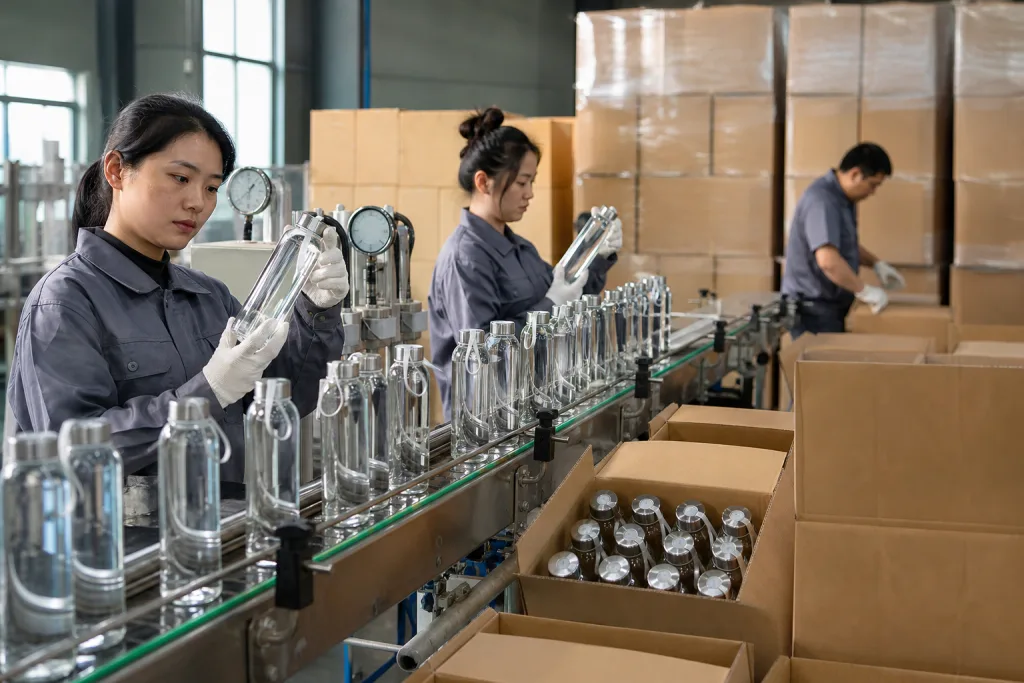
Key Takeaways
- Start with 4 decisions: glass grade, bottle construction, logo method, and pack-out; this can cut sampling revisions by 30% to 50%
- Typical MOQ for a borosilicate glass bottle bulk order is 1,000 to 3,000 pcs per SKU, with 25 to 35 days production after sample approval
- For e-commerce, target drop-tested inner packaging and keep breakage under 1.5% on arrival, not just a low FOB price
- Ask for REACH, LFGB or FDA contact material declarations, plus AQL 2.5 final inspection before balance payment
You are not buying a bottle. You are buying a breakage rate, a reorder cycle, a landed cost, and the unboxing experience after parcel abuse and retail shelf handling. On our line, a customizable borosilicate glass bottle often looks straightforward on the product page, then turns expensive after silk-screen registration drifts by 1.5 mm, a cap seeps at the vacuum leak tester, or the drop test cracks the base.
For wellness brands and sustainable retailers, the decision usually comes down to four points: glass grade, bottle construction, decoration method, and packaging standard. Get those fixed early and the program moves in 12 days instead of 18 days. Miss them and you can lose 3 to 5 weeks on sample rework; QC pulled one set last month because the PO had the wrong lid thread note. A borosilicate glass bottle factory in Zhejiang, China should sort out these trade-offs before quoting. If that discussion starts after production, we've seen this go sideways.
Decide the bottle architecture first
The first question is not color or logo size. It is the bottle structure. A customizable borosilicate glass bottle for a yoga studio shelf is built differently from a bulk glass water bottle for corporate gifting. A DTC commuter bottle is different again. We’ve seen buyers start with artwork first, then redo the cap and carton after the drop-test math failed.
Most buyers should lock these points before asking a borosilicate glass bottle manufacturer for pricing:
- Capacity: 350 ml, 500 ml, 550 ml and 750 ml are the most stable mold families, and 500 ml usually gives the cleanest freight math at MOQ 3000 pcs.
- Single wall or double wall: single wall is lower cost and lighter; double wall looks premium but costs 35% to 60% more and adds line risk because concentricity and sealing both get tighter.
- Mouth diameter: 35 mm to 50 mm affects filling, cleaning, and tea infuser fit; a buyer flagged 35 mm last spring because their brush head measured 38 mm and customer complaints started fast.
- Base thickness: around 6 mm to 10 mm is common for durability, especially on 500 ml and 550 ml formats; QC usually checks this with a caliper on pulled samples.
- Accessory system: bamboo lid, stainless lid, silicone sleeve, tea infuser, carry loop; this is where lead time slips if one part comes from a second vendor.
For most wellness brands, a 500 ml single-wall custom glass water bottle with a food-grade silicone sleeve is the safest first launch. It balances shelf appeal, shipping weight, and price. We run this spec often. In Zhejiang, plenty of factories will quote the bottle body in 24 hours, but far fewer hold assembly tolerance across the neck finish, cap thread, gasket hardness at 50 to 60 Shore A, and sleeve fit. That is the wrong question to skip.
If you are buying from a borosilicate glass bottle supplier or comparing several borosilicate glass bottle vendors, ask one practical question: what leakage rate do you accept at final QC? Ask for the method too. If the answer is vague, move on. A serious factory should give a test method, such as an upside-down leak test for 30 minutes or vacuum simulation on selected samples. On our side, QC pulled the sample, marked the bottle number on the neck tag, and logged any seepage at the gasket line.
Pick the right borosilicate grade
Not every bottle sold as borosilicate is the same, and this is where buyers get burned. We see the term used loosely on POs all the time, but your spec should stay tight. High borosilicate glass usually gives better thermal shock performance and a cleaner, brighter look than soda-lime glass. That matters if the end user pours in hot tea, takes the bottle from a refrigerator to a countertop, or expects a premium clear finish with fewer visible seeds under a 6000K light box.
For a borosilicate glass bottle custom project with borosilicate glass bottle manufacturers, lock these points in writing before sampling. QC pulled samples last month where the buyer approved shape first, then flagged the rim finish later; that wastes 12 days fast.
- Material claim: state whether it is high borosilicate and ask for the material declaration, not a sales promise.
- Working temperature guidance: many programs position bottles for roughly -20°C to 120°C, but the exact claim has to match the bottle structure, filling condition, and user instruction.
- Wall thickness: around 1.8 mm to 2.2 mm is typical on single-wall bodies; going thinner cuts a few cents, and the math doesn’t work if breakage climbs during drop test or carton transit.
- Visual defect standard: define what you will accept for bubbles, seeds, flow marks, and rim finish, and check it against an approved limit sample from the line.
A borosilicate glass bottle wholesale quote that is USD 0.18 cheaper can turn expensive fast if the wall runs thin or the neck finish drifts out. We have seen 500 ml bottles fail cap fit because the neck OD was off by 0.6 mm. For a 500 ml bottle, a realistic FOB China price range is often USD 1.10 to 2.20 depending on cap material, sleeve, decoration, and packaging. Double-wall constructions can move to USD 2.40 to 4.20 FOB.
China stays competitive here for a simple reason: we run close to the supply base. In Zhejiang, truck time between bottle supplier, printing shop, and packaging vendor is often 2 to 5 hours, not 2 days. That helps lead time only if your borosilicate glass bottle factory runs incoming inspection instead of forwarding cartons like a trading desk. Ask who inspects raw bottles, who measures dimensions with a caliper and neck gauge, and whether lot records are kept by shift and date. This is the right question to ask.
If your retail promise includes hot beverage use, do not rely on a generic “heat resistant” claim. Tie the claim to a documented specification and user instruction.
Match decoration to your sales channel
The wrong logo method kills a good bottle. A borosilicate glass bottle customizable program needs to match the channel first, not the artwork file first. Shelf retail, subscription boxes, wellness gift sets, and borosilicate glass bottle promotional orders do not buy the same way, so we do not run the same decoration on the line.
Common options and trade-offs
- Silkscreen printing: lowest setup cost for simple 1 to 2 color logos. We usually quote MOQ 1,000 pcs, and the screen fee stays manageable. Best FOB value if your logo area is controlled and the buyer is not asking for fine 0.3 mm lines.
- Heat transfer: works for more complex artwork and gradients. The artwork range is wider, but QC pulled the sample more often for edge lifting or small registration shift when process control was loose.
- Laser marking on lids: useful for bamboo or stainless caps. Durable and clean. We use it often on 304 stainless cap tops, but it only works on the right lid material and the mark depth needs checking before mass production.
- Decal firing: premium look for some glass projects, but longer process time and tighter artwork review. The kiln cycle adds days, and we have seen buyers miss tiny font issues on the approval file that become expensive after firing.
For a customized glass water bottle sold in sustainable retail, I usually push for lighter bottle printing and stronger branding on the carton, hangtag, or sleeve. Glass already sells the premium story. Heavy graphics make scratches show faster, and we have seen reject rates climb after cartoning when the print coverage is too large. This is the wrong question to ask if the buyer only asks, "Which logo method is cheapest?"
Ask your borosilicate glass bottle supplier for decoration yield data from actual runs. On a stable line, simple silkscreen jobs may hold a defect rate below 2%. Transfers with wraparound artwork can run higher if the logo sits too close to the mold seam, often within 8 to 12 mm, or if bottle curvature shifts lot to lot. That is where experienced borosilicate glass bottle suppliers make their money, because the math does not work if rework and sorting eat the margin.
If you are a borosilicate glass bottle distributor or one of the borosilicate glass bottle distributors serving private-label accounts, lock logo position and print width early. We ship faster when those two points are fixed on the first PO, even if the buyer flagged a typo in the item code later. You can save 7 to 10 days by avoiding repeated pre-production sample cycles. A custom borosilicate glass bottle should not turn into a design experiment after tooling and packaging are already approved.
Price the full landed program
A low unit price tells you almost nothing if the cap seeps at the 45-degree leak test, the gift box fails a 76 cm drop, or the warehouse rejects 48 pcs on one pallet for broken necks. When you compare a borosilicate glass bottle vendor or distributor borosilicate glass bottle quote, price the full landed program, not the headline FOB number. We’ve seen buyers save USD 0.08 on the bottle and lose USD 0.22 in repacking and claims. The math doesn’t work.
These are the cost drivers that matter most:
- Bottle body: cost moves with capacity, wall thickness in mm, and whether you run single wall or double wall construction.
- Cap system: bamboo with PP inner, full stainless, or a plastic lid with carry loop; buyers often flag thread fit and gasket smell first.
- Silicone sleeve or boot: improves grip and break protection, but it adds hand assembly time on the line and one more color match point.
- Packaging: plain egg-crate carton, individual white box, kraft gift box, or retail-ready color box; a 5-layer carton versus 3-layer changes damage rates fast.
- Testing and inspection: AQL final inspection, drop test, leakage test, and barcode checks; QC pulled the sample more than once because the PO barcode font was off by 1 mm.
For a standard 500 ml customizable glass water bottle with bamboo lid, one-color print, and white box, many programs land around USD 1.45 to 2.10 FOB China at 2,000 pcs. Add a silicone sleeve and gift box, and that usually moves to USD 2.10 to 3.00. If you need Amazon FBA prep, FNSKU labeling, and tighter packaging control, add labor cost and expect a slower outbound schedule—12 days versus 18 days is common once labeling and carton checks are folded in.
MOQ changes the economics fast. This is the wrong question to ask if you only want the lowest starting number. Many borosilicate glass bottle manufacturers quote 1,000 pcs for stock-body custom logo orders, but 3,000 to 5,000 pcs is the normal range once you ask for a custom sleeve color, custom carton, or a mold adjustment. We run this every month. If you are a distributor glass water bottle buyer handling 4 or 5 customer accounts, keep one common bottle body and change the lid, sleeve, or print. That keeps old stock usable and cuts dead inventory.
A factory in Zhejiang, China with monthly output above 300,000 units should be able to break cost out by component instead of sending one lump-sum number. Ask for bottle, cap, decoration, and pack-out as separate lines. If they cannot do that, reorder forecasting gets messy fast, and the buyer usually feels it on the second PO when one cap option adds USD 0.11 and nobody catches it until after deposit.
Qualify the factory, not just sample
A sample can pass and bulk can still go wrong. We see this in glass all the time. The right question is not whether the sample looks clean on the table; it is whether the process behind it stays stable from the first 500 pcs to the last carton. Whether you buy from a borosilicate glass bottle factory, a trading company, or one of several borosilicate glass bottle vendors, ask how they control incoming tubing, decoration, assembly, and packing. On our side, QC pulled the sample at the annealing area first, not only from the finished goods table.
Your checklist should include:
- AQL standard: many importers use AQL 2.5 for major defects and 4.0 for minor defects.
- Leak testing: define sample size and pass criteria per lot. Ask if they run vacuum or upside-down hold testing, and for how long—10 minutes and 30 minutes give different answers.
- Drop test: especially for individual retail boxes and e-commerce pack-out. We normally check corner, edge, and flat drop positions because one clean face drop proves nothing.
- Compliance documents: REACH, LFGB, FDA-related declarations depending on market, plus packaging material statements if needed. The buyer usually asks for the bottle report first, then finds the silicone gasket file missing.
- Social and system audits: BSCI, ISO-style processes, or customer-specific audit readiness. Ask for the latest audit date, not just a logo on the PDF.
For a borosilicate glass bottle customized order going into Europe, check the food-contact claim on lid parts, gaskets, inks, and coatings, not only the glass body. The glass body is usually the easy part. The accessory set is where paperwork gets lost, and we have seen a PO held because the lid seal spec showed "food grade sillicone" with the typo left uncorrected.
Ask for photos or video of the line packing your customized borosilicate glass bottle. You want to see neck protection, partition layout, and whether packed bottles rub against each other. A 2 mm gap in the divider matters. So does whether workers add the bottom pad before sealing the carton. Good factories in China know breakage is not only a production issue; it is a packaging engineering issue. A factory that ships 200,000 to 500,000 drinkware units per month should already run a standard carton compression and transit test routine. If they do not have that, the math does not work.
If you are talking to borosilicate glass bottle distributors rather than the source factory, ask who owns the quality claim when breakage exceeds the agreed threshold. Put that into the PO before deposit payment. We have seen this go sideways when the buyer flagged 3.8% transit breakage and the distributor pushed it back to the packing supplier.
Build a reorder model early
Smart buyers treat a custom borosilicate glass bottle launch as cycle one, not the whole program. Reorders are where margin gets fixed. If the first PO uses one-off artwork, a one-off carton size, and a one-off accessory set, the second order drags just like the first. We’ve seen this go sideways when a buyer changed the insert by 8 mm for one promotion, then had to recheck every outer carton on the next run.
Start with a simple reorder model:
- Use one bottle body across multiple SKUs. We run the same mold across 500 ml variants all the time; changing decoration is cheaper than opening a new body tool.
- Limit accessory variation to 2 or 3 lid colors. This is not a style question. The math doesn’t work once gasket, cap, and strap combinations start multiplying on the line.
- Keep carton dieline unchanged where possible. A stable box size cuts proofing time and makes drop-test repeats easier.
- Store approved Pantone, logo placement, and master sample records. QC pulled the sample on one repeat order because the PO said “mat black” and the approved cap was actually Pantone Black 7 C.
A typical reorder for stock-body borosilicate glass bottle bulk production in China runs 20 to 30 days after artwork confirmation. New custom packaging usually adds 7 to 12 days. If you buy through borosilicate glass bottle distributors in North America or Europe, local stock can cut transit and shorten the calendar, but unit cost is often 15% to 40% higher than direct FOB buying. Buyers push back on that spread, but after we compare landed options line by line, the price gap is usually real.
For sustainable retailers, standardization also cuts waste. Shared components mean fewer dead cartons and fewer mismatched caps sitting in a warehouse. One factory-floor example: if 3 lid colors share the same 38 mm neck finish and the same insert layout, leftovers still have a home on the next PO. If your brand story is built around responsible sourcing, this matters.
The best borosilicate glass bottle supplier is not always the one with the lowest first quote. The better question is whether the supplier can hold repeat production steady, keep compliance files clean, and set an MOQ plan you can actually reorder against. A good customized glass water bottle program should feel boring on the second and third run. That is what success looks like on the line.
If you want one benchmark, this is fair: for a stock-shape 500 ml bottle with custom logo and box, MOQ 1,000 to 2,000 pcs, sample lead time 7 to 12 days, and mass production 25 to 35 days is normal from a well-organized supplier in Zhejiang, China. We ship programs like this every month. If every step still feels improvised after sample approval, keep looking.
Get a borosilicate bottle quote that matches reality
Send your target capacity, decoration, packaging, and market. We will review MOQ, compliance, lead time, and the real trade-offs before sampling starts.
Frequently asked questions
What MOQ should I expect for a customizable borosilicate glass bottle?
For a stock-body bottle with custom logo, MOQ is usually 1,000 to 2,000 pcs per SKU. If you want a custom sleeve color, custom gift box, or non-standard lid finish, MOQ often moves to 3,000 pcs or more. Fully custom molds can start around 5,000 pcs depending on shape complexity. The practical question is not just the bottle MOQ, but the lowest MOQ across all components. A supplier may accept 1,000 bottles, but the sleeve vendor may require 3,000 pcs and the color box printer 2,000 pcs. Ask for a component-by-component MOQ breakdown before you approve artwork.
Is high borosilicate really better than regular glass for water bottles?
Usually yes, especially for premium retail and wellness use. High borosilicate glass handles thermal change better than ordinary soda-lime glass and generally gives a cleaner, more premium appearance. For practical sourcing, that means better positioning for hot tea, infused water, and daily use where customers expect a durable feel. It does not mean unbreakable. Wall thickness, base thickness, packaging, and lid fit still matter. A 500 ml high borosilicate bottle with 1.8 mm to 2.2 mm wall thickness and a 6 mm to 8 mm base is a common balanced specification for retail programs. Ask your supplier to document the material claim instead of using broad marketing wording.
What is a realistic FOB price for bulk borosilicate glass bottle orders?
For a standard 500 ml single-wall bottle, expect roughly USD 1.10 to 2.20 FOB China depending on cap material, decoration, and packaging. A bamboo lid, one-color silkscreen logo, and white box usually sit in the middle of that range. Add a silicone sleeve and premium gift box, and the FOB price can move to USD 2.10 to 3.00. Double-wall bottles often start above USD 2.40 and can exceed USD 4.00. If a quote is much lower, check what has been removed: wall thickness, inspection level, packaging quality, or accessory grade. Low breakage and stable reorders are usually worth more than saving USD 0.15 on paper.
Which compliance documents should I request for Europe or North America?
At minimum, request food-contact declarations for the glass, lid components, gasket, ink, and any coating or sleeve material. For Europe, buyers commonly ask for REACH-related statements and often LFGB-supporting documentation for relevant food-contact parts. For North America, FDA-related material declarations are common. If you sell to children, add market-specific testing review such as ASTM considerations where applicable. Also request packaging material information if your retailer requires it. Beyond paperwork, put AQL 2.5 final inspection and leak testing into the PO. Documents matter, but inspection is what protects your shipment.
How do I choose between buying direct from a factory or through distributors?
Buy direct if your annual volume justifies it, usually once you are ordering 5,000 pcs or more across repeat SKUs and can manage sampling, compliance review, and import logistics. Direct factory buying in China usually gives better pricing, more control over customization, and faster engineering feedback. Use a borosilicate glass bottle distributor if you need lower inventory risk, local stock, or shorter replenishment for small runs. The trade-off is higher unit cost, often 15% to 40% more than direct FOB. For many wellness brands, the best path is to validate the product with a smaller distributor-backed run, then move to direct sourcing when reorder demand is proven.