Key Takeaways
- A 20 oz customizable beer tumbler typically lands at USD 3.20-5.80 FOB China at 1,000-5,000 units, depending on 18/8 steel, coating, lid, and print
- Common MOQ starts at 500 units for existing molds, but realistic custom color plus logo programs are smoother at 1,000-3,000 units
- Normal lead time is 7-10 days for pre-production samples and 25-40 days for bulk production after sample approval and deposit
- Tooling for a new lid, base, or body mold can add USD 2,000-8,000 and 20-35 days, while logo setup is often only USD 30-120
You are not stuck finding a customizable beer tumbler. You are stuck costing it right, getting it shipped on schedule, and not getting hit with surprises after deposit. That is the sourcing problem we see every week. A stainless tumbler that looks simple on a website can move by USD 0.60 to 2.00 per unit once you change steel grade, lid type, print method, carton spec, or testing requirements. We run into this on the line all the time: one lid swap from AS to Tritan, or a carton change from 24 pcs to 12 pcs, and the quote is different.
For buyers in Europe and North America, the questions are usually the same: what is the MOQ, what drives the FOB price, how many days do samples and mass production take, and which factory controls matter before you wire money to China. This is the right question set. In Zhejiang, where a lot of custom drinkware is made, those answers are measurable on the factory floor, not guessed from a sales sheet. A common starting MOQ is 500 to 1,000 pcs per color, sample lead time is often 5 to 7 days, and mass production is often 25 to 35 days after sample approval; if the buyer flagged a barcode or logo position issue, add 2 days because QC pulled the sample and we rechecked the print file against the PO. If you know the numbers upfront, you buy better and argue less later.
What actually sets the unit price
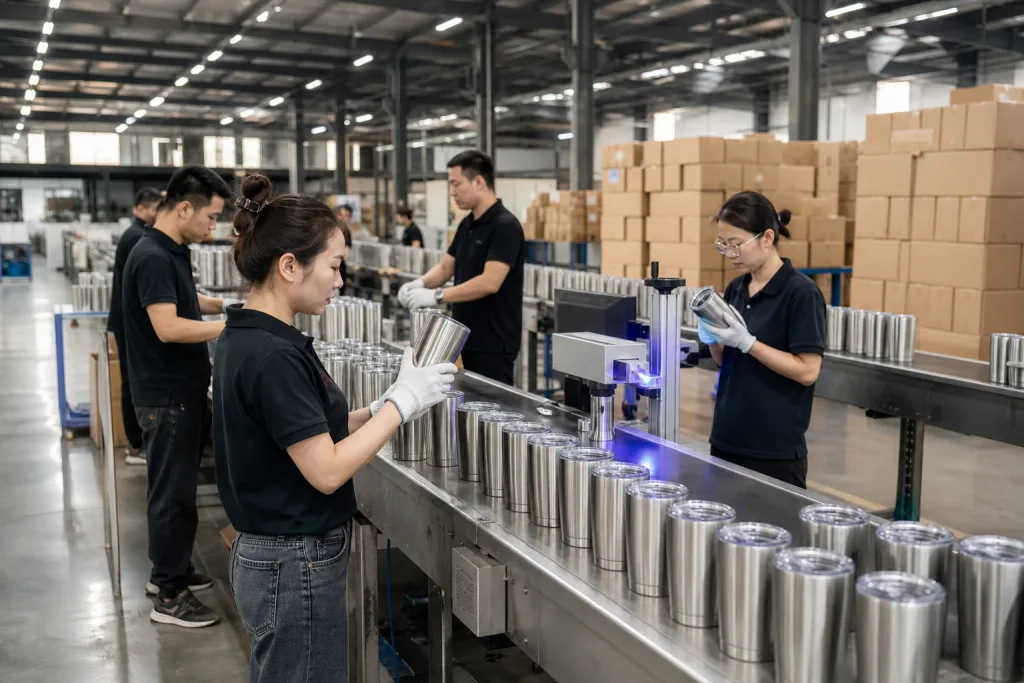
The base price of a customizable beer tumbler comes from steel and build, not the logo. On a standard 20 oz double-wall vacuum tumbler, we price around steel grade, body weight, lid structure, surface finish, and decoration method. If you source from a canteen factory in Zhejiang or another part of China, ask for the empty body weight in grams and the steel spec first. Weigh it on a bench scale. That tells you more than a glossy sales sheet, and this is the right question to ask before you compare artwork charges.
A typical quote structure looks like this:
- 201 stainless exterior + 304 interior: lower cost, common for promotional programs
- 304 inside and outside: usually USD 0.20-0.45 more per unit
- 18/8 food-contact spec: the safer default for North America and Europe
- Powder coating: usually adds USD 0.18-0.40
- Electro-polish or spray paint: often cheaper, but not as durable as powder
- Slider lid vs screw lid: USD 0.10-0.35 difference is normal
On a 20 oz size, wall thickness often runs around 0.4 mm inner and 0.5 mm outer. That sounds small, but QC pulled the sample and you can feel the difference in hand fast. Lighter gauges cut cost, then dent risk goes up and the tumbler starts to feel cheap. We have seen buyers push for a lower gram weight, then flag sidewall dents after transit. If your brand wants a premium retail feel, ask for the gram weight and the drop-test standard before approval.
Logo method is usually not the main cost driver unless you are running full wraps or multi-color artwork. Single-color silkscreen may add USD 0.05-0.12. Laser engraving is often USD 0.08-0.20. Full-wrap heat transfer can add USD 0.25-0.60 depending on coverage. On the line, setup waste shows up fast if each SKU uses a different coating and carton size. If you also buy custom drinkware lines like a custom canteen or customizable growler, we can often share coating colors and carton specs across SKUs to cut that waste. The math works better at 3,000 pcs than at 500.
The cheapest quote usually hides lighter steel, a simpler lid, or a loose packing assumption. We have seen this go sideways. If the quote does not list material, weight, finish, logo method, and packing, it is not a real quote yet.
MOQ tiers that change your economics
MOQ is where new buyers misread the quote. A canteen manufacturer may show 300 units on Alibaba, but that usually means stock color, one 1-color logo, and plain export carton. If you want a real customized drinkware program with Pantone-matched powder coating, a retail box, barcode labels, and inspection hold points, the working MOQ goes up fast. We’ve seen this go sideways when the PO says “custom” but the approved sample is still off-the-shelf.
For a customizable beer tumbler using an existing mold, the normal tiers in China look like this:
- 500 units: workable for a simple trial run, but unit cost is highest because the line still needs screen setup and carton prep
- 1,000 units: common entry point for serious custom orders; this is where most buyers start if they want logo control without forcing the math
- 3,000 units: where coating yield, print setup, and master carton efficiency start to look healthy
- 5,000+ units: stronger pricing room on packaging materials and sourced parts like lids, straws, or inserts
At BottleForge Industrial scale, a line capacity of roughly 300,000 units per month helps on repeat orders, but it does not make every low MOQ economical. This is the wrong question to ask. The better question is how many setup points your order creates. A 500-unit job still burns time on the powder booth, silk-screen plates, packing line changeover, and QC sampling at AQL 2.5. We run the same hooks and jigs either way.
If you work as a canteen distributor, distributor drinkware importer, or canteen vendor serving several smaller brands, mixed-color programs usually land better. For example, 3,000 units total split into three colors at 1,000 each is usually easier than asking for 500 each across six colors. Six colors means six powder changes, more purge loss, and more chances for shade drift; QC pulled the sample on one run last year because matte navy was 0.8 Delta E off target. The same logic applies if you also buy custom growler, customized canteen, or customizable canteen SKUs in the same project.
Buyers sometimes ask whether canteen custom projects and beer tumblers can be combined to hit MOQ. Sometimes yes, sometimes no. You may be able to combine retail boxes, barcode stickers, or one decoration run if the artwork size matches. Body production is different because mold, coating hangers, and QC standards change by SKU. One tumbler body might run on a 73 mm hanger, while a canteen uses another fixture on the line. Good canteen suppliers or canteen vendors will split what can be combined from what cannot, instead of promising everything on day 1 and fixing it later.
Sample fees, tooling, and hidden add-ons
Most overruns do not come from the tumbler body. They come from extras nobody fixed at PO stage. We usually see 3 cost buckets before mass production: sample fee, setup or tooling, and compliance or packaging add-ons. On the line, one missing logo position note or a box size change of 5 mm is enough to reopen cost.
Typical ranges are straightforward:
- Existing sample with stock finish: USD 20-50 each plus courier
- Logo sample: USD 50-100 each
- Pre-production sample with custom color: USD 80-200 each
- Silkscreen setup: USD 30-80 per color
- Laser fixture/setup: USD 30-60
- Retail box die line revision: USD 50-150 if simple
New tooling is a separate budget line, and this is where buyers sometimes ask the wrong question. The issue is not only mold price; it is whether your annual volume can carry it. If you want a unique body silhouette, custom handle, special base, or proprietary lid for a customizable beer tumbler, new mold cost can run from USD 2,000 to 8,000. Complex lid mechanisms can go higher fast. Tool lead time is usually 20-35 days before the first functional sample, and we have seen 22 days for a simple cup body versus 31 days once a threaded lid and leak test are involved. For most B2B programs, we suggest customizing finish, logo, and packaging first, then moving to private tooling after volume is proven. The math does not work at 1,000 pcs.
Watch compliance costs early. Europe buyers may require REACH review for coatings or packaging inks. North American buyers may ask for ASTM-related testing if the item is sold in certain channels, especially for kids or gift sets. A canteen supplier in China should explain what is standard material declaration and what needs third-party lab work. QC pulled one gift-box sample last month because the ink odor was too strong, and that alone pushed lab review back 4 days. Third-party testing can add USD 300-800 per report, depending on scope.
If you sell through Amazon, put FNSKU labels, carton mark rules, and drop-test packaging validation into the cost sheet from day 1. We have seen this go sideways after the factory already ordered plain master cartons with the wrong side mark, or after the buyer flagged a PO typo on carton count. Many canteen distributors and distributor canteen importers miss that until shipment booking week, and then the rework charge is real.
The calendar from inquiry to shipment
Lead time is not one block. It is a chain of signoffs, and one late approval can push the vessel booking by 7 days. For a customizable beer tumbler made in Zhejiang, the schedule we usually run looks like this:
- Quotation and spec confirmation: 2-4 days
- Artwork check and sample payment: 1-3 days
- Pre-production sample: 7-10 days
- Sample transit by courier: 3-7 days
- Bulk production: 25-40 days after approval and deposit
- Final inspection and booking: 3-7 days
If you need a molded color lid, a gift box insert, or a new carton print plate, plan for the long side of the range. We have seen a carton mark pause for one PO typo on the barcode line. If you are placing a repeat order on an approved color with unchanged packaging, 20-25 production days can be possible, and on some 3,000-piece runs the line finishes in 22 days.
The biggest delays usually do not come from the shop floor. They come from late artwork approval, Pantone disputes, packaging copy edits, or waiting for compliance signoff. We have seen this go sideways after the buyer flagged the logo position three times and QC pulled the sample again at 35 mm from the rim. At that point, the clock is not slipping. It is starting over.
Ask your canteen factory or canteen manufacturer for milestone dates in writing: sample ready date, sample ship date, material purchasing date, first article date, in-line QC date, final inspection date, and ex-factory date. This is the right question to ask. We ship smoother when both sides are looking at the same sheet, down to the first article signed off at 10:00 a.m. and the in-line QC check at AQL 2.5.
For seasonal beer promotions, count backward from your warehouse date, not the PO date. Ocean freight from China to Europe may take 30-40 days port to port. To the US, 20-35 days is common depending on coast and service. Add customs clearance and inland delivery; 6 days can disappear there fast. If your promo window is September, approving samples in August is too late. The math does not work.
How to compare factory quotations fairly
To compare quotes from canteen suppliers, canteen manufacturers, or a canteen vendor network, put every factory on the same quotation sheet. If you do not, you are pricing 3 different builds with 3 different cost assumptions. We see this go sideways fast. One buyer sent 20 oz on the RFQ, but one PO came back typed as 600 ml, and the quote gap looked fake once we checked the spec.
Your quotation sheet should require these fields:
- Capacity: 16 oz, 20 oz, 30 oz, actual fill volume
- Material: 304/201 or 304/304 stainless
- Weight: body and lid in grams
- Vacuum structure: double-wall, copper coating if any
- Surface: powder coat, spray, polished, matte
- Logo: silkscreen, laser, transfer, wrap position
- Packing: polybag, egg-crate, white box, color box
- Trade term: EXW, FOB Ningbo, FOB Shanghai
FOB matters because Zhejiang factories often quote FOB Ningbo by default. If one supplier quotes EXW and another quotes FOB China port, the lower number tells you nothing until freight, export docs, and local charges are lined up on the same basis. The same problem shows up in inspection scope. One factory includes basic in-line QC, where QC pulled the sample every 2 hours on the line; another includes only self-checking by the shift leader. This is the wrong question to skip.
For a dependable order, ask for an AQL standard up front. A lot of B2B buyers run AQL 2.5 for major defects and 4.0 for minor defects on drinkware. If you sell premium retail, tighten the cosmetic standard around the visible logo panel, usually the front 40 mm to 60 mm area the buyer flagged first during approval. Also confirm whether the supplier accepts third-party final inspection before balance payment.
Ask for audit status directly. BSCI, ISO 9001 process discipline, and documented incoming material checks are not decoration; they cut the risk of uneven coating, leaking lids, or mixed components in one lot. On our floor, incoming 304 tubes and PP lids are logged by batch before we run production. A good canteen distributor or distributor growler buyer should also ask for leak-test method, vacuum retention criteria, and dishwasher warning language if relevant. If a factory cannot state the leak test pressure or hold time, the math does not work.
Where buyers lose time and margin
The costly mistakes are the plain ones we see every month on the line. A buyer approves the wrong powder-coat texture from a 50 mm chip. The barcode lands on the logo side. The lid gets assumed dishwasher safe without a test record. The tumbler looks good in photos, then fails a retailer shelf-depth limit by 8 mm. Nothing looks dramatic on paper. The chargebacks still come.
For a customizable beer tumbler program, the controls are basic and they save margin:
- Approve a signed specification sheet with photos, dimensions, weight tolerance, and logo position; we like to see the logo location called out in mm from the bottom seam
- Match Pantone by actual sprayed sample, not only digital artwork; QC pulled the sample more than once because screen color and powder output did not match
- Confirm carton quantity, carton gross weight, and carton size before PO release; one PO typo on master carton count can throw off freight math fast
- Request a packaging drop test if you use color boxes or e-commerce packs; 76 cm corner-drop failure is a common inspection finding
- State whether spare lids or replacement policy is needed; if not, the buyer flags missing spares after shipment and the claim starts late
If you are a canteen distributor, canteen suppliers will offer 6 or 8 accessories to win the project. That part is normal. The extra straw, brush, insert card, or hangtag gives the packing line one more place to miss count or pack the wrong item. We have seen this go sideways on first orders. Keep the first run tight, maybe MOQ 3,000 on one clean packout. After the supply chain proves it can hold spec, then add the extras.
Another margin leak is over-customizing too early. A customized growler, custom growler, customized canteen, and customizable canteen line sounds good when the end customer asks for a full collection, but the math doesn't work at 1,000 units per SKU. You pay for separate samples, separate cartons, separate stock positions, and more time on the line for changeover. One buyer pushed for 4 body sizes and 3 lid sets on the first launch, then cut the PO after sampling. The safer move is one hero tumbler size, one lid family, and two colors.
China can deliver solid quality on custom drinkware if the specification is tight. This is the wrong question to ask: “Can you copy the last sample?” The buyers who struggle usually treat the PO as the specification. It is not. The specification is the product.
Get a real tumbler quote before you commit
Send your target quantity, size, logo method, and packaging requirement. We will return a practical MOQ, FOB price range, and lead-time estimate from Zhejiang.
Frequently asked questions
What is the normal MOQ for a customizable beer tumbler?
For an existing mold, 500 units is possible, but that is usually for a basic logo on a stock color. If you want Pantone-matched powder coating, retail packaging, and cleaner production planning, 1,000 units is the more practical MOQ. At 3,000 units, your unit price often drops by USD 0.20-0.50 because coating runs, packaging purchase, and decoration setup become more efficient. If you are buying from a canteen factory in China and want mixed colors, ask whether the MOQ is per color or per order. Many factories will accept 3,000 total units split into 1,000 per color, but not 300 per color across ten colors.
How much does a custom logo beer tumbler usually cost FOB China?
A standard 20 oz vacuum-insulated customizable beer tumbler usually falls around USD 3.20-5.80 FOB China at 1,000-5,000 units. Entry-level versions using 201 exterior and simple packaging can be below that. Heavier 304/304 construction, premium powder coating, screw lids, and full-wrap decoration can push the price above USD 6.00. Add roughly USD 0.05-0.12 for single-color silkscreen, USD 0.08-0.20 for laser engraving, and USD 0.25-0.60 for wrap transfer printing. Always confirm whether the quote includes lid, inner tray, master carton, and FOB Ningbo or only EXW. That is where a lot of confusion starts.
How long does production take after sample approval?
For a repeatable factory program in Zhejiang, pre-production sampling usually takes 7-10 days, and bulk production normally takes 25-40 days after sample approval and deposit. If your tumbler uses an existing mold, standard lid, and approved packaging, some repeat orders can ship in 20-25 days. New color box artwork, molded accessories, or special coating textures usually add time. If you need a new mold, add around 20-35 days before the first workable sample. Buyers should also leave 3-7 days for final inspection and booking. Then add ocean transit from China, which may be 20-35 days to the US and 30-40 days to Europe.
Do I need third-party testing for custom drinkware orders?
Not every project needs the same testing, but many importers do need at least material declarations and basic compliance records. For Europe, REACH-related review is common for coatings, inks, and packaging components. For North America, channel requirements vary by retailer and end use. Third-party lab testing often costs around USD 300-800 per report depending on the scope. If the tumbler is part of a gift set or has unusual accessories, testing needs may expand. Ask your canteen supplier or canteen manufacturer what is already covered by existing reports and what must be retested for your exact SKU, decoration, or packaging combination.
What should I check before placing a deposit with a China factory?
Before you pay a deposit, lock five things: the approved drawing or specification sheet, the exact decoration file, the packaging spec, the quality standard, and the shipment term. Your spec should list capacity, dimensions, weight tolerance, steel grade, finish, lid type, logo position, and carton details. Ask for AQL terms such as 2.5 major and 4.0 minor, and confirm whether you can use third-party inspection before balance payment. Also verify lead time in calendar days, not vague wording like 'about one month.' A solid canteen factory in Zhejiang or elsewhere in China should also provide business documents, bank details matching the company name, and a clear sample approval process.