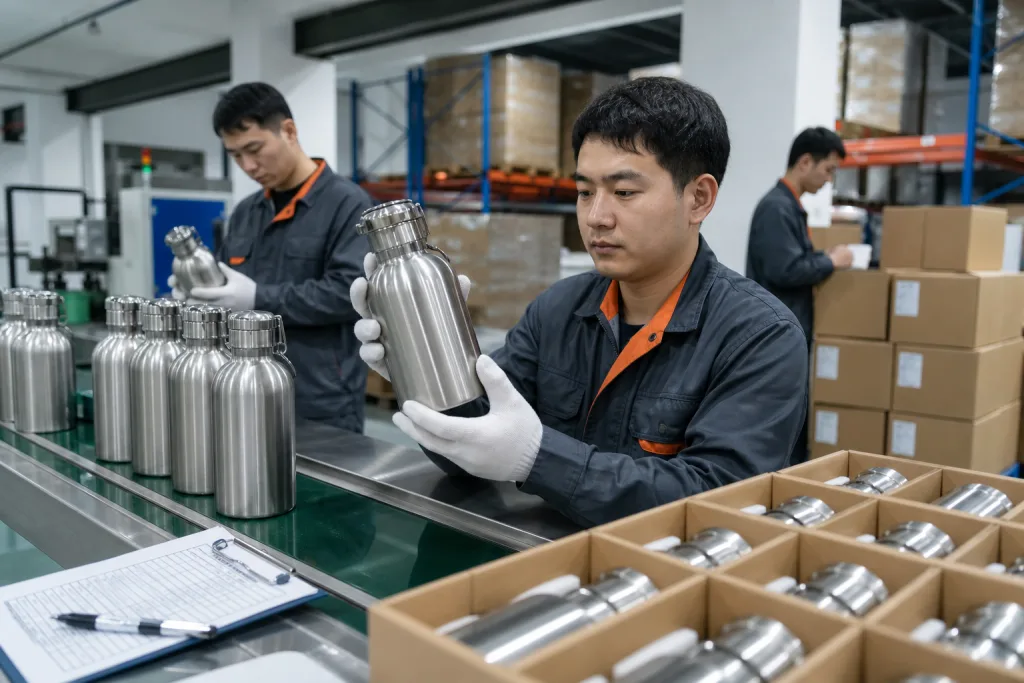
Key Takeaways
- For a 64 oz stainless customizable beer growler, a realistic MOQ is 500-1,000 units per color, with FOB China pricing often around USD 4.80-8.20 depending on steel grade, finish, and packaging.
- Lock core specs early: 18/8 stainless, 0.5 mm inner wall, 0.4-0.5 mm outer wall, leak test standard, logo size, carton drop requirement, and AQL 2.5 inspection level.
- Sampling usually takes 7-12 days, mass production 25-40 days, and custom packaging can add 5-7 days if inserts, color boxes, or barcode work are not approved on time.
- A capable Zhejiang or China canteen manufacturer should confirm REACH, LFGB or FDA-contact compliance, welding points, coating adhesion, and spare lid tolerance before production starts.
You are not buying a customizable beer growler to admire on a desk. You are buying it to get through production, freight, customs, retail handling, and daily use without leaks, dents, or a logo that sits 2 mm off-center. This is where first orders go sideways. The drawing looked fine. The quote looked fair. Then the lid thread came back rough on the go/no-go gauge, the powder coat chipped after the carton drop, or QC pulled the sample and found the master carton burst at 18 kg.
A practical buyer in Europe or North America usually needs two things at once: margin that still works and a specification the line can repeat batch after batch. The factory part matters just as much. You need a China supplier that does not improvise after sample approval because we have seen this go sideways over one PO typo on logo position or one unapproved lid change. In Zhejiang, where we run a large share of the stainless drinkware work, the difference between a clean shipment and a claims problem is often decided before the deposit hits. This walkthrough follows one real buyer case from RFQ to final inspection.
A buyer starts with one brief
Say you're a distributor buyer covering a regional craft brewery chain in Germany and Canada. The brief is clear: a customizable beer growler for seasonal launches with a matte black body, laser logo on one side, screen print on the other, and a leakproof screw lid. Then the sales team adds the usual follow-up: can the same factory later make a custom canteen, a sports bottle, and other custom drinkware for promo runs? That's standard B2B. We hear it every week. One buyer even wrote "screw kid" on the PO instead of "screw lid," and the line still knew what he meant. Buyers want one solid source, not six factories fighting over samples.
Your first RFQ should be short and exact. Skip the sales copy. If your spec is loose, the factory will quote the nearest stock mold, and this is where projects go sideways. Put enough detail in the brief so both sides are pricing the same bottle, the same lid, and the same decoration setup.
- Capacity: 64 oz / 1.9 L
- Material: food-grade 18/8 stainless steel, single wall or vacuum insulated
- Body construction: seamless preferred, visible weld line to be declared
- Lid type: PP inner + stainless outer, food-safe silicone seal
- Decoration: 1-color silkscreen or laser engraving
- Target FOB Ningbo: your budget range, for example USD 5.50-6.80
- MOQ: 1,000 units total, split across 2 colors if possible
- Market: EU and North America compliance required
This is also the point where you find out if the supplier is a real canteen factory, canteen supplier, or a trader forwarding catalog PDFs. A real canteen manufacturer in Zhejiang usually replies with wall thickness like 0.5 mm inner / 0.4 mm outer, mold status, powder coating options, test method, and lead time. A weak canteen vendor sends one line with price and no detail. That's the wrong quote to compare. QC pulled the sample on one project last month and found the visible weld line the buyer had already flagged, so declaring it up front saved a remake.
At BottleForge Industrial in Zhejiang, typical drinkware capacity runs above 600,000 units per month across tumblers, bottles, growlers, and related lines. That matters. Your customized growler project may start at 1,000 units now and move to 10,000 units if the brewery program lands in 12 cities. We run growlers, bottles, and caps on shared production planning, so capacity is not just a sales claim; it's what keeps lead time from stretching from 18 days to 35 when a repeat order hits.
Choosing the right growler build
Not every customizable growler needs vacuum insulation. For a brewery doing fresh-fill takeaway, a single-wall stainless body is often enough and cuts unit cost. We run both builds on the line, and for local refill programs the buyer usually cares more about cap seal and stackability than heat retention. For outdoor retail, gifting, or premium merchandise, double-wall vacuum is the safer pick because it feels heavier in hand and cuts condensation complaints at shelf level.
Here is the split most B2B buyers actually use:
- Single wall: lower cost, lighter weight, FOB often USD 4.80-5.90 for 1,000 units, better for simple brewery refill programs. MOQ is often easier too, and 1,000 pcs is common for a stock-shape body.
- Vacuum insulated: higher margin perception, FOB often USD 6.30-8.20 for 1,000 units, better for retail shelves and branded promotions. QC pulled the sample on one order because the outer wall showed a small oil-canning mark after vacuuming, which tells you why process control matters.
Ask the supplier for the actual section spec, not just the capacity. Example: inner wall 0.5 mm, outer wall 0.4 mm, mouth diameter 58-65 mm depending on lid design, and net weight around 480-780 g depending on construction. If the steel is too thin, the body dents during pallet handling; we have seen denting at the bottom radius after a 12 kg carton took a hit on the forklift. If it is too thick, the math doesn't work. You are paying for weight, not function.
Buyers sourcing a customized canteen or customizable canteen often assume growler and canteen tooling are interchangeable. They are not. Thread finish is different, neck profile is different, and the cap torque range is different. We have seen this go sideways in pilot run when the buyer reused an old PO drawing with the wrong neck note. A capable canteen factory or canteen supplier should say no early instead of trying to force-fit existing tooling.
If your program may expand beyond growlers, ask whether the same China supplier also makes canteen custom projects, canteen customizable models, and other customizable drinkware. That is a better test than asking how many SKUs they list online. Factories handling both customized drinkware and growlers usually control decoration alignment, lid sealing, and carton loading better. We ship mixed programs like this, and the buyer flagged fewer issues once the same plant handled both the bottle body and cap pack-out.
Where pricing really moves
Most first-time buyers stare at the unit price and miss the 6 cost drivers behind it. For a custom growler, price usually moves on steel grade, wall thickness, finish, lid structure, packaging spec, and how you split the order. Sales wording does not change cost. The wrong question to ask is “why is your price lower?” Ask what is missing. On our line, QC pulled samples last month where one supplier used thinner outer wall stock by 0.08 mm and the quote looked cheap for a reason.
Take a 1,000-unit order from China. You send the same RFQ to 3 suppliers for a matte powder-coated 64 oz vacuum customizable beer growler with 1 laser logo, 1 printed logo, and individual white box. One quote lands at USD 5.95 FOB, one at USD 6.80, and one at USD 7.40. That spread is normal. We see it every week. One factory may price with a standard lid and plain export carton first, then add details later after the buyer flagged the mismatch on the PO.
- Powder coat with rough texture can add USD 0.18-0.35 versus standard spray finish.
- Laser engraving is usually USD 0.08-0.20 per position depending on size.
- Silkscreen printing is usually USD 0.05-0.15 per color per position.
- Custom color box may add USD 0.28-0.65 depending on paperboard and print coverage.
- A custom lid mold can cost USD 1,500-4,000 if you reject standard tooling.
- Split colors below MOQ often add USD 0.10-0.25 per unit.
Ask each supplier to quote the same trade term, preferably FOB Ningbo or FOB Shanghai. If you compare EXW against FOB, the math does not work. You miss trucking, export filing, and port handling, and then the “cheap” quote is not cheap. In Zhejiang, we ship through Ningbo on most orders, and an export-ready factory should give you the loading port and HS code fast, not after 4 emails. We have seen buyers lose 2 days just because the port was assumed wrong on the draft PI.
If you are also a canteen distributor or work with canteen distributors, ask for a family quote sheet: growler, bottle, tumbler, plus customized canteen options built on similar decoration methods. That saves setup time on the next SKU. A serious canteen manufacturer or canteen manufacturers group usually runs the same screen-print vendor, laser fixture, and box supplier across these items, which cuts sampling friction. We run this way in Hangzhou, and it matters when the buyer wants 4 shapes but only 1 outer carton standard.
Approving samples without missing risks
Sampling is where deals get saved or blown up. For a standard model, a pre-production sample usually takes 7-10 days after artwork approval. If you need a new lid, custom handle, or a fresh mold adjustment, assume 12-20 days. We tell buyers this upfront because the line loses time fast once tooling changes start. Do not approve a sample by photo only unless the order value is trivial. We have seen this go sideways over a 0.8 mm logo shift that looked fine on WeChat photos.
When the sample arrives, inspect it like a QC technician, not like a brand manager. This is the right mindset. Put the sample on a glass table, use a caliper, and check these points:
- Thread fit: open and close the lid 20 times; look for cross-threading and metal shaving.
- Leak test: fill with hot water, invert for 30 minutes, then leave on side for 2 hours.
- Base flatness: place on glass or steel table; no rocking above 1.5 mm is a reasonable control point.
- Logo position: measure centerline and rotation; print drift beyond 2 mm should be discussed.
- Coating adhesion: cross-hatch tape test on hidden area if possible.
- Odor: silicone seal and inner surface should have no strong chemical smell.
If this supplier also presents itself as a canteen vendor, canteen vendors, or canteen supplier for broader lines, ask to see sample control records from another customized drinkware order. Ask for the actual sign-off sheet, not a chat record. QC pulled the sample on one project last month because the PO said “mat black” and the artwork file said “matt black,” and nobody caught the finish mismatch until packing review. Good factories in China usually keep sample sign-off sheets, Pantone references, and packaging approvals together. Weak factories keep only chat screenshots.
For retail or Amazon-style programs, ask for barcode layout, FNSKU placement if needed, and master carton mark format before the sample stage closes. The math doesn't work if you wait. It is much cheaper to move a barcode on artwork than to relabel 3,000 units in a warehouse. We ship enough relabel jobs to know this is pure waste, and one outer carton mark in the wrong 60 mm x 40 mm position can hold a booking. This is true whether you are ordering a customized growler today or a customizable canteen next quarter.
How production control should look
After deposit, control needs to tighten up. Not relax. A workable purchase order for a customizable beer growler should lock five things on paper: approved sample reference, full spec, decoration file version, packaging standard, inspection level, shipment term, and claim window. We also ask buyers to write the sample code right on the PO, such as “Gold sample GS-240318-A,” because we have seen one wrong lid finish on a repeat order caused by a simple file mix-up. If these points stay vague, the line will fill the gap for you, and that is the wrong place to improvise.
The production timeline for a repeatable order in Zhejiang is often:
- Artwork confirmation: 1-3 days
- Pre-production sample: 7-12 days
- Material prep and body making: 10-15 days
- Coating and decoration: 5-7 days
- Packing and final inspection: 3-5 days
- Total lead time: 25-40 days after deposit and approvals
Those numbers are normal if approvals move fast. If the buyer flags logo position after sample release, 25 days becomes 32 fast. On our floor, the pre-production sample usually gets checked with a color swatch, a vernier caliper, and a vacuum leak test before bulk starts, because a 1 mm logo shift or a slow seep at the cap thread will come back as a claim later.
Use a simple QC plan, but run it hard. For most buyer programs, AQL 2.5 major / 4.0 minor works. Critical defects should stay at zero tolerance: leakage, sharp burrs on drinking surface, wrong barcode, wrong logo, wrong capacity marking, or missing compliance statement. QC pulled one sample last season with a clean body and the wrong inner barcode label. The buyer would never see it at loading, but the warehouse would. Carton quality matters too. For a 1.9 L growler, ask for at least a 5-ply export carton if shipping by sea, and put the drop test expectation in writing for the inner box if it is a retail pack. If that line is missing, the math does not work once cartons get stacked three layers high.
If your business model is distributor growler, distributor canteen, or general distributor drinkware, the main risk is not only product failure. It is mixed-label stock, short carton counts, and missed vessel cutoff. We ship plenty of repeat distributor orders, and the buyer pushback is usually the same: “product was fine, carton mark was wrong.” Ask the China factory to send packing photos, carton dimensions, gross/net weight, and pallet pattern before balance payment. A standard pallet pattern like 10 cartons per layer x 4 layers is basic data, not a favor.
A reliable canteen manufacturer or canteen manufacturers network should already be used to buyer discipline. That shows up in small things on the floor: version control on artwork, in-process records, CAPA logs, audit files ready to pull in 10 minutes. Teams that understand BSCI and ISO 9001 expectations usually handle growler projects with fewer loose ends, even when the order itself is not audit-driven. We have seen this go sideways when a factory says audits are “not needed” for a simple item. That answer usually means their paperwork is thin.
Compliance, inspection, and claims prevention
For Europe and North America, do not treat compliance as paperwork. Your customizable growler touches food-contact steel, lid seals, coating, ink, and carton board. Ask the factory what they can actually submit for stainless drinkware: REACH-related material declarations, LFGB or FDA food-contact alignment by market, and component testing for parts like silicone gaskets if the structure uses them. We usually get this question after sampling, and that is late. On our side, QC will pull a gasket sample and check Shore hardness against the BOM before mass run. If the product is sold into the US and used by children, ASTM issues may come up for other bottle categories, though not usually for a brewery growler.
Before shipment, use a third-party final random inspection or a tight in-house standard. Inspect after at least 80% packed, with 100% packed as the better checkpoint. That timing matters because half-packed goods hide carton problems. Common failure points on growlers from China are predictable, and we have seen the line miss them when output gets pushed from 1,200 to 1,600 pcs per shift:
- Lid seal compression varies between mold cavities, so one cap passes torque and the next one leaks at 0.03 MPa
- Powder coat gets scratched when packed too fast and dividers are set 2 mm short
- Logo rotation shifts across different printing jigs, and the buyer flagged a 4 mm visual drift on a mixed pallet
- Vacuum loss shows up on insulated units after hold testing, even though first-piece samples looked fine
- Carton burst strength fails when actual gross weight runs above spec, often after the PO typo kept the old carton grade
If the supplier says they are both a canteen factory and canteen promotional specialist, ask how they split premium retail QC from event giveaway QC. This is the right question to ask. The answer should be about inspection criteria, AQL limits, appearance standards, and rework rules, not just two price levels. We ship promo orders with wider cosmetic tolerance in some cases; we do not ship leakage, sharp edge issues, or bad finishing on any grade. If a factory cannot explain that difference in 2 minutes, the math does not work.
Claims prevention starts with evidence, not memory. Keep the approved sample number, seal sample if possible, signed artwork, carton spec, and inspection report in one order file. Add photos of the master carton markings and the drop-test result too; one missing lot code has caused more than one chargeback. When there is a dispute, a buyer with documents usually recovers in 12 days instead of 18. We have seen this go sideways when the buyer approved one Pantone on email and the PO showed another. That is true whether you work with one canteen vendor or several canteen suppliers and canteen distributors across categories.
Send your growler spec for a real factory quote
Share capacity, finish, logo file, target market, and quantity. We will review feasibility, MOQ, compliance points, and lead time before you commit.
Frequently asked questions
What MOQ should I expect for a customizable beer growler?
For a standard stainless model, MOQ is usually 500 to 1,000 units per design, with 1,000 units being the most common price break. If you want two body colors, many factories in China will allow a split such as 500 black and 500 white, but some will add USD 0.10 to 0.25 per unit for extra setup. If you request a new lid mold, embossed body, or very specific packaging, MOQ can move to 2,000 to 3,000 units. In Zhejiang, better-organized drinkware factories can sometimes support lower trial orders for existing models, but you should expect a higher FOB price and fewer decoration options below 500 units.
How much does a custom growler cost from China?
A realistic FOB China range for a 64 oz custom growler is about USD 4.80 to 5.90 for single-wall stainless and USD 6.30 to 8.20 for double-wall vacuum, based on 1,000 units. Decoration affects the number: one laser logo may add USD 0.08 to 0.20, one silkscreen position may add USD 0.05 to 0.15, and a custom retail box may add USD 0.28 to 0.65. If your supplier quotes far below that, check steel grade, wall thickness, seal quality, and carton spec. Low prices often hide thinner material, weaker coating prep, or reduced QC steps rather than true manufacturing efficiency.
What tests should I require before shipment?
At minimum, require leak testing, appearance inspection, logo position check, and carton verification. For insulated units, ask for vacuum performance checks on sampled pieces. A practical final inspection uses AQL 2.5 for major defects and 4.0 for minor defects, with zero tolerance for leakage, sharp burrs, wrong artwork, and wrong barcode. For components touching liquid, ask what food-contact compliance documents the factory can support for your market, such as LFGB, FDA-related declarations, or REACH-related documentation. If you are launching into retail or e-commerce, add drop-checks on the packed unit and verify that carton weights and dimensions match booking data before the container leaves China.
How long does production usually take?
For an existing growler model, expect 7 to 12 days for a pre-production sample after artwork approval and 25 to 40 days for mass production after deposit. If you need a custom lid, handle change, or new packaging insert, add around 5 to 10 days. During peak season, especially before Q4 shipping windows, some Zhejiang factories can stretch beyond 45 days if coating lines and packing lines are full. You can reduce delays by approving artwork quickly, locking carton marks early, and avoiding last-minute logo edits. Ask the factory to confirm each milestone: sample date, material arrival, coating slot, inspection date, and ex-factory date.
Can one supplier handle growlers and custom canteen programs together?
Yes, but you should verify capability instead of assuming it. Many drinkware suppliers in Zhejiang and other parts of China offer growlers, bottles, tumblers, and custom canteen lines under one export team. The real question is whether they control the processes that matter: welding quality, vacuum performance, coating, printing registration, and compliance documentation. Ask for model lists, production photos, and sample references across both customized growler and customized canteen projects. If they can support common MOQs of 500 to 1,000 units, lead times around 25 to 40 days, and consistent packaging control across categories, then a consolidated supplier relationship can save you time and reduce sourcing friction.