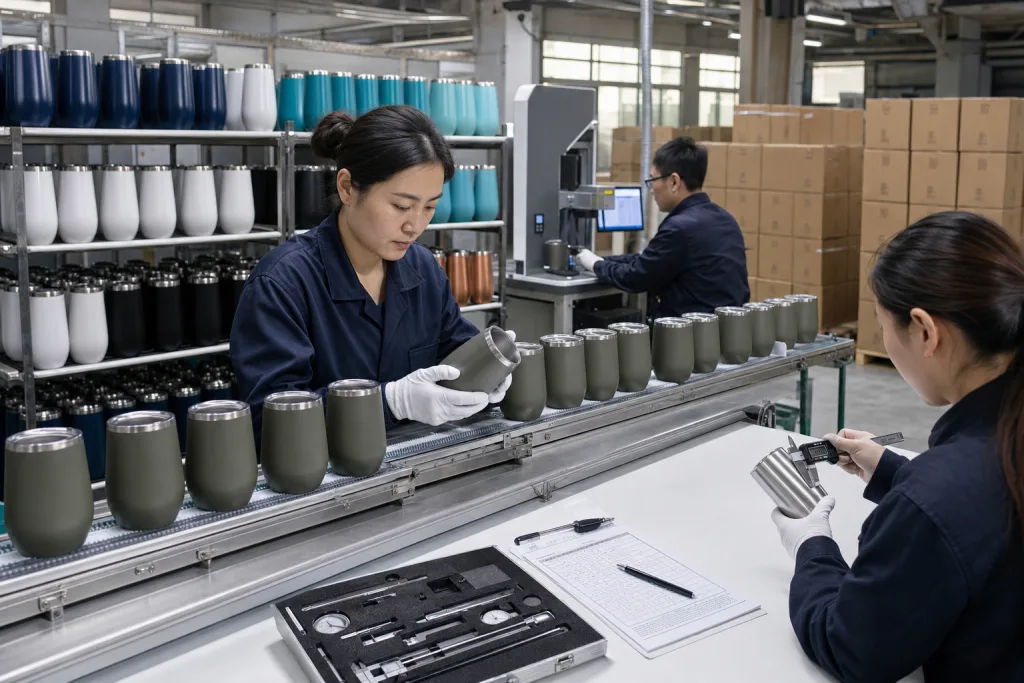
Key Takeaways
- For a 12 oz custom wine tumbler, practical MOQ is usually 1,000-3,000 pcs per color, with FOB China pricing around USD 2.10-4.80 depending on steel grade and print method.
- 304 stainless inner plus powder coating is the safest mid-market spec; going from single-wall to double-wall vacuum can lift unit cost by 35-60%.
- Sampling normally takes 7-12 days, bulk production 25-40 days, and a reliable Zhejiang factory should state AQL 2.5 inspection terms before deposit.
- Laser engraving, silk screen, and wrap printing each suit different volumes; decoration choice can move complaint rates by 2-5% in rough retail handling.
You usually do not have a wine tumbler problem. You have a margin leak, a lead-time miss, or a quality claim brewing on the line. A custom wine tumbler looks simple at first glance, but a 0.2 mm wall change, a different lid fit, or the wrong print process can shift landed cost, push defects past AQL 2.5, and leave artwork looking tired after six months of use. That hits fast in retail, promo programs, hospitality, and distributor business.
Most buyers sourcing from Zhejiang or broader China need to lock four decisions early: body construction, decoration method, packaging level, and order structure. This is where deals go sideways. We have seen buyers send a PO with the color code typo'd and no drop-test standard, then lose 12 days sorting out inserts and master carton counts instead of starting production. Get these four right and the project runs. Get them wrong and even a solid canteen manufacturer or canteen supplier spends the next 30 days quoting confusion instead of building the right tumbler.
Start with the four buying decisions
If you are evaluating a custom wine tumbler, skip the color cards first. Skip the lifestyle photos too. Start with the four buying decisions that change cost, lead time, and complaint risk on the line.
- Construction: single-wall, double-wall non-vacuum, or double-wall vacuum. This sets insulation performance, whether the cup sweats on the table, and how many pieces we can load per carton before freight starts to bite.
- Material set: 18/8 stainless, 18/0 stainless, AS lid, Tritan lid slider, silicone seals, and whether the product is BPA-free and REACH aligned. Ask for the exact lid resin and gasket Shore hardness; QC pulled a sample last month where the PO said Tritan but the injected part was AS.
- Decoration: silk screen, laser engraving, heat transfer, 3D digital print, or full powder coat with logo. This affects logo look, rub resistance, and reject rate. We check print position with a simple jig in mm, because a good mockup means nothing if the logo walks 3 mm on mass production.
- Packaging: egg-crate bulk, white box, color box, PDQ tray, or e-commerce mailer. Buyers miss this all the time. A box change can cut carton count by 12%-18%, and the math doesn't work if the shelf look improves but freight jumps.
For most B2B programs, a 12 oz or 14 oz tumbler is the standard commercial sweet spot. In our Zhejiang supply base, the common body uses 0.4 mm inner wall and 0.45-0.5 mm outer wall for vacuum stainless models. A basic 12 oz vacuum custom wine tumbler with splash lid often lands in the USD 2.10-2.90 FOB China range at 3,000 pcs, while a premium powder-coated version with custom box and laser mark can move toward USD 3.40-4.80. On factory floor terms, that spread usually comes from coating passes, lid spec, and pack-out speed, not from magic. We run leak test and vacuum check before packing, and we've seen this go sideways when a buyer pushes for lower MOQ and full custom packaging at the same target price.
If you are also comparing broader custom drinkware lines, the same logic applies to a custom canteen, customizable canteen, customizable growler, or customized growler. A serious canteen factory or canteen manufacturer should explain the trade-offs with numbers. Not slogans. Ask what happens to carton size after switching from nested packing to window box, or why one lid gasket leaks less under a 60-degree tilt test. This is the right question to ask. If they cannot answer with data, sample weight, or even a carton measurement in cm, keep looking.
You are not buying a tumbler shape. You are buying a defect profile, freight profile, and reorder profile.
Choose the right body and lid spec
The fastest way to overspend is simple: buying performance your channel will never sell. Under-spec the body, and returns start fast. We’ve seen this go sideways on a 0.4 mm single-wall promo run where the buyer wanted “premium feel” at giveaway pricing—the math doesn’t work.
When each structure makes sense
- Single-wall stainless: lowest cost, usually USD 1.20-1.90 FOB at 3,000 pcs. Best for event giveaways and low-price canteen promotional programs. Light. Easy to hit target cost. Not ideal for chilled wine because condensation is expected, and QC will see sweat on the bench within 15 minutes of an ice-fill check.
- Double-wall non-vacuum: less common in wine tumblers now. Better hand feel than single-wall, with less outer-wall temperature transfer, but the thermal story is weak and buyers often push back once they compare it against vacuum samples side by side.
- Double-wall vacuum: the default for retail, gifting, and hospitality resale. Better temperature retention, stronger shelf value, and fewer complaints about hand feel. This is what we run most often on the line, usually with a vacuum rate check after sealing.
For most North American and European buyers, 304 stainless steel inside is the safe baseline. You will see quotes based on 201 stainless outer bodies to shave a few cents. That can work on some commercial projects, but ask where each grade is used, line by line on the quotation. We’ve had buyers flag this after the PO was issued because the outer grade was buried in small text. Ask early. A reliable canteen supplier in China will state inner and outer grades clearly.
Lids need a closer look. Most buyers don’t spend enough time here. A wine tumbler lid is often AS or SAN plastic for economy, while Tritan is the better pick when clarity and impact resistance matter more. Slider lids present well, but they add parts, assembly steps, and tolerance risk; on one 80A silicone seal run, QC pulled the sample because the slider drag was inconsistent across 24 pcs. If your product will enter retail or repeat hospitality service, ask for the leak-resistance testing method, seal hardness, and replacement lid availability. This is the right question to ask. A good canteen vendor or canteen vendors network should hold spare lids for at least one production cycle, not push you into a full remake over one cracked component.
If you are building a coordinated range with custom canteen, custom growler, or customizable drinkware items, keep thread styles and color systems aligned where possible. That saves money. It also makes the range look planned instead of mixed from 3 factories. We ship plenty of sets where matching Pantone lids across 4 SKUs cut packaging artwork revisions from 6 rounds to 2.
Price the project the right way
First-time buyers often compare unit price only. That is the wrong question to ask. Price the full project against your sales channel, carton loading, and the margin you need after freight, duty, and marketplace fees.
Ask every canteen manufacturer, canteen manufacturers group, or canteen factory candidate for the same cost structure. We usually put this into one sheet before quoting, and QC pulled the sample once because the PO had “laser logo both side” typed instead of “both sides,” which changed setup time:
- FOB Ningbo or FOB Shanghai unit price
- Tooling charge, if any, for custom lid, base mold, or embossing
- Decoration setup charges by color and location
- Packaging upcharge per unit
- Master carton size, gross weight, and units per carton
- Sample fees and refund policy after bulk order
Example: a 12 oz vacuum custom wine tumbler quoted at USD 2.35 FOB China may look better than one at USD 2.52. The math does not work if the cheaper quote packs 24 pcs per carton with dead space and the other packs 36 pcs tightly in a 5-ply export carton. We have seen buyers save USD 0.17 on product and lose more than that on ocean freight per unit. The same logic applies if you are a canteen distributor, one of several canteen distributors, or a distributor growler program manager trying to protect margin on mixed containers.
MOQ needs context. For a standard shape, factory MOQ is often 1,000 pcs, but decoration MOQ may be 500 pcs per colorway only if the supplier is combining your run with another job already on the line. For safer planning, use 1,000 pcs per SKU as the real commercial MOQ, 3,000 pcs when you want sharper FOB pricing, and 5,000+ pcs when negotiating custom Pantone body colors, bottom pad printing, or special retail inserts. On our side, pad print plates and color swaps are where small orders start going sideways.
At BottleForge-type production scale in Zhejiang, 300,000 to 500,000 units per month across drinkware categories is a realistic benchmark for a medium export factory. Capacity matters because it shows whether the lead time is honest. If a canteen customized or customized drinkware supplier quotes 18 days in peak season for a decorated vacuum tumbler, question it. We run leak testing and vacuum hold checks before packing, and that step alone can jam the schedule if the line is full. In practice, normal bulk lead time is 25-40 days after sample approval and deposit.
Match decoration to your sales channel
Decoration is not just appearance. It decides whether the logo still looks saleable after carton rub, shelf contact, and the dishwashing cycle your buyer expects.
- Silk screen: low-cost for simple artwork, usually 1-2 spot colors. We run this a lot for promo orders from 1,000 pcs up, but the line needs tight mesh control or small text fills in.
- Laser engraving: clean and durable, especially on powder-coated bodies. Unit cost is higher, but QC pulled fewer repeat complaints on engraved logos than screen print on canteen programs.
- Heat transfer: fits multicolor graphics and brand-heavy artwork. Check registration and curved-wall distortion on the first wrapped sample, not after 5,000 pcs are on the line.
- 3D digital or UV print: strong shelf impact for small runs and fast mockup approval. Ask for scratch testing and curing records, because we have seen under-cured prints mark during carton packing.
For a custom wine tumbler, the safest B2B repeat-order setup is usually powder coat plus laser logo. It adds about USD 0.18-0.40 per unit over basic screen print, but that extra cost often cuts visible wear claims in distributor canteen and distributor drinkware channels. We have seen buyers push back on the adder, then come back after one season because the math on complaint handling does not work. For hospitality and corporate gifting, this option usually holds up better in hand and on the table.
If your buyer brief also covers canteen custom, canteen customizable, or customized canteen projects, lock the decoration rules across the whole line. Use one engraving position template and one print inspection standard for tumbler, bottle, and growler, such as logo centerline at 35 mm from the seam reference. This saves approval time. It also cuts artwork mistakes; last quarter we caught a PO with the logo note typed as “left center” on one SKU and “center left” on another.
Ask your canteen vendor or canteen suppliers how they inspect print quality. You want hard limits: logo position tolerance within plus or minus 1.5 mm, no pinholes visible at 30 cm, color delta kept within approved production tolerance, and adhesion tested after cure. If the supplier works under AQL 2.5 for major defects and AQL 4.0 for minor defects, define decoration defects before production starts. This is the wrong question to leave vague. Otherwise, the buyer flagged it, the factory argued it, and everyone loses time over whether a faint edge or light overspray counts as acceptable.
Control compliance, testing, and inspection
Compliance paperwork is where 7 out of 10 custom projects lose time. The tumbler looks simple. The destination market is not. Europe usually needs REACH review, sometimes LFGB depending on the claim set and sales channel, plus packaging compliance checks. The US side often asks for FDA food-contact alignment and, on some programs, ASTM or CPSIA if the item is sold for children even by bundle or promo use. We have seen buyers reuse one report across 3 SKUs, then the lab flag a different lid resin on the second PO. That is where the delay starts. Do not assume one test report covers every SKU.
Request the document pack in week 1, before the line starts sampling:
- Material declaration for steel, lid plastic, silicone, and coating
- Recent food-contact test reports from a recognized lab
- BSCI, Sedex, or social audit status if your brand policy needs it
- ISO 9001 or internal quality process summary
- Carton drop-test standard if you are using retail or e-commerce packaging
Inspection needs a structure. Not opinions. For standard custom drinkware orders from China, third-party pre-shipment inspection using AQL is still the practical tool, and we run that on most export orders above 3,000 pcs. Typical setup is AQL 2.5 major, 4.0 minor, with checks on vacuum retention, logo position within 1.5 mm, color match, scratches, lid fit, odor, and carton marking. If you ship to Amazon or another marketplace, add barcode checks, FNSKU placement, suffocation warning language where required, and carton label format. The buyer flagged this on one run because the FNSKU sat 8 mm too close to the seam, and Amazon receiving kicked back the carton.
A capable canteen manufacturer in Zhejiang should be fine sending in-process photos, vacuum test records, and packaging drop-test videos. On our floor, QC pulled the sample every 2 hours during logo printing and logged the vacuum test on a digital gauge before packing review. If you work with canteen suppliers or canteen distributors across multiple countries, align the QC checklist before production, not after the goods are boxed. This is the wrong question to ask at shipment stage. We have seen this go sideways when one market accepts a satin finish shift and another rejects the same cup as cosmetic damage.
China has strong stainless drinkware capacity, but consistency comes from process control, not geography. Ask who owns quality calls on the factory floor and who signs off final packing. If the answer is vague, the math does not work.
Decide when custom is actually worth it
Not every program should go full custom. We tell buyers this on calls every week. If your target is 2,000 pcs and the line already has a proven 12 oz body in 304 stainless, starting from a standard mold usually beats paying for new tooling. Full custom makes sense in some cases, but this is the wrong first question to ask if the volume is still uncertain.
Use this decision check:
- Choose standard mold plus custom logo when your order is under 3,000 pcs, launch speed matters, and your channel is price-sensitive. We can run laser marking or screen printing on an existing body and ship faster—often 12 days for sample approval instead of 18 days on a new setup.
- Choose standard mold plus custom color and packaging when you need better shelf differentiation without paying for tooling. A Pantone-matched powder coat, a custom gift box, and a revised insert card usually do more at retail than a new silhouette by 3 mm.
- Choose full custom only when you have forecast visibility above 10,000 pcs, a protected retail program, or a distributor growler and tumbler line that needs unique shape identity. At that stage, the mold cost spreads out properly, and the math starts to work.
Tooling for a completely new body can run from a few thousand dollars upward depending on complexity, while custom lid components can add both mold cost and future replacement headaches. We have seen this go sideways: buyer approved the body, then QC pulled the sample and found the lid thread fit was off by 0.4 mm after the second trial. For many buyers, a customized drinkware program built on an existing proven body is the commercial sweet spot.
This applies beyond the wine tumbler itself. If you also buy customizable growler, custom growler, custom canteen, or other customized canteen formats, use shared finishes and packaging architecture instead of reinventing every SKU. One buyer mixed four SKUs under one matte navy coating and one carton spec at 500 pcs per item, and reorders stayed clean. The factories in Zhejiang and other drinkware clusters in China are good at controlled variation. Use that strength.
The best sourcing outcome is usually boring: stable quality, realistic lead times, low rework, and a reorder that does not need a three-week argument over shade difference. On our floor, that means the same spray standard, the same master sample, and AQL 2.5 inspections catching issues before shipment. If a canteen distributor or canteen distributors network needs consistent supply, that boring outcome is what protects margin.
Get a clear custom wine tumbler quote fast
Send your target size, lid style, artwork, packaging level, and quantity. We will quote MOQ, FOB pricing, lead time, and QC points without guesswork.
Frequently asked questions
What is a realistic MOQ for a custom wine tumbler order?
For a standard 12 oz or 14 oz vacuum model using an existing mold, realistic MOQ is usually 1,000 pcs per SKU and color. Some China factories will advertise 500 pcs, but that often excludes custom body color, special packaging, or strict logo requirements. If you want better FOB pricing, target 3,000 pcs. If you need custom Pantone coating, gift box packaging, or multiple print locations, 3,000-5,000 pcs is more realistic. For a fully new mold, buyers should plan from 10,000 pcs unless the tooling cost is paid separately and accepted as a development expense.
How much should I budget per unit for B2B custom wine tumblers?
A practical budget range is USD 2.10-4.80 FOB China for a double-wall vacuum custom wine tumbler. At the lower end, you are usually getting a standard body, basic lid, simple silk screen logo, and bulk or plain white box packing. At the higher end, you may have 304 stainless inside and outside, premium powder coat, laser engraving, color gift box, and tighter QC handling. Single-wall versions can be USD 1.20-1.90. Always compare carton pack-out and gross weight, because freight can change your landed cost by 8-15%.
Which logo method lasts best on a wine tumbler?
For durability, laser engraving on a powder-coated body is usually the safest choice. It resists rubbing, stacked-carton abrasion, and repeated handling better than basic silk screen. Silk screen is still cost-effective for promotional runs and can look good when the artwork is simple, but it is more vulnerable to scratching if the cure process is weak or cartons are packed too tightly. Heat transfer works for multicolor graphics, though curved-wall registration needs control. If your product is for retail, hospitality, or distributor drinkware resale, paying an extra USD 0.18-0.40 per unit for a more durable mark often reduces complaint rates later.
What compliance documents should I ask a China supplier for?
Ask for current food-contact test reports for the finished item or matching material set, plus material declarations for stainless steel, lid plastic, silicone seals, and exterior coating. For Europe, REACH-related documentation is a basic starting point, and some buyers also require LFGB depending on market and product claims. For North America, ask how the product aligns with FDA food-contact expectations. If your company has sourcing policy requirements, request BSCI or Sedex audit status and any ISO 9001 quality documentation. Get these documents before deposit if possible, not one week before shipment.
How long does production usually take from sample to shipment?
For a standard custom wine tumbler program, pre-production sample time is usually 7-12 days after artwork and color details are confirmed. Bulk production normally takes 25-40 days after sample approval and deposit, depending on decoration complexity, packaging, and season. If you need custom retail boxes, add a few days for packaging approval. During peak periods before major holidays, some Zhejiang and broader China factories can stretch beyond 45 days. A realistic sourcing plan also leaves 3-7 days for third-party inspection, rework if needed, and final booking before vessel cutoff.