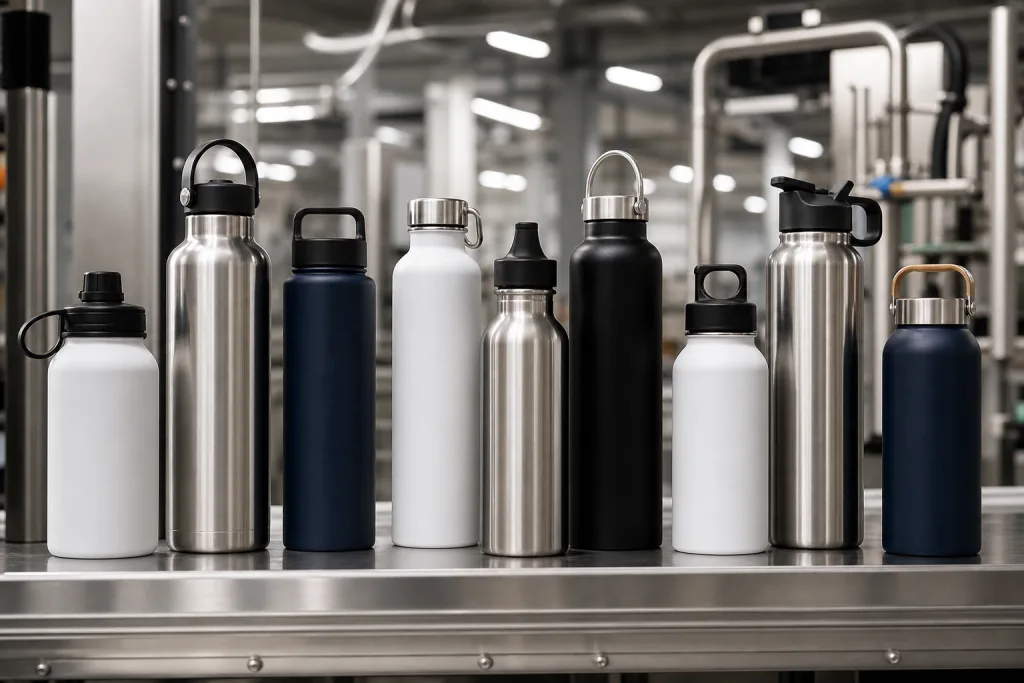
Key Takeaways
- Decide bottle construction first: single-wall, double-wall, or vacuum can shift FOB price by 40% to 120%
- Decoration choice changes MOQ and defect risk: silk screen can start at 500 pcs, powder coat plus laser often needs 1,000 pcs
- For EU and North America, confirm REACH, LFGB or FDA, and use AQL 2.5/4.0 before paying the 70% balance
- A practical China production window is 7-10 days for samples and 25-45 days for bulk, depending on 3,000-20,000 pcs volume
You can source custom water bottles from 200-plus factories in China. That part is easy. The hard part is locking the build, logo process, compliance route, and PO structure before you ask for pricing. Skip that step and the numbers stop matching: one quote is for 304 stainless with spray finish, another is for a thinner wall and silk screen, and the lead time jumps from 25 days to 55 days after the line checks the actual spec sheet.
Most B2B buyers in Europe and North America are not asking for a generic customizable canteen. They need a SKU that fits their sales channel, target margin, and claim risk. A canteen distributor buying 5,000 pcs, a private label brand asking for a 0.3 mm color match, and a promo buyer chasing a landed cost under $3.80 will make different calls. This is the part buyers often rush, and we've seen it go sideways. It is the qualification method experienced Zhejiang export teams use before tooling, sampling, or mass production starts.
Start with four buying decisions
For custom water bottles, four buying decisions set the project early: body material, insulation structure, decoration method, and order model. Buyers still ask us for a quote with only capacity and logo colors, and this is the wrong question to ask. A 500 ml bottle might be soda-lime glass, Tritan, 18/8 stainless steel, or recycled stainless. On the line, we run 0.4 mm to 0.6 mm wall thickness for steel, and that 0.2 mm gap changes cost, dent resistance, and freight.
The first decision is job function in the market. For a canteen promotional buyer, cost and logo size usually beat 12-hour heat retention. For retail custom drinkware, hand feel, leak rate, and finish consistency matter more than saving USD 0.35 per unit; QC pulled a sample last month because the powder coat gloss shifted between two production lots. For a distributor drinkware account selling to gyms or outdoor stores, the spec often moves to a custom canteen body with a narrow-mouth cap, carry loop, and 24-hour cold retention.
The second decision is mold route: buy from a canteen factory on an existing mold or pay for tooling. Existing molds keep MOQ lower, usually 500 to 1,000 pcs per color for standard stainless bottles in Zhejiang. New molds for lids or unique bodies can add USD 1,500 to USD 8,000 and 20 to 35 extra days. We have seen this go sideways when a buyer approves a new lid shape before checking the straw fit and hinge life.
The third decision is compliance scope. Europe may require REACH focus and often LFGB testing expectations from buyers; North America usually brings FDA, CPSIA for kids items, and retailer-specific chemical restrictions. The fourth is packaging and channel. A customized canteen for Amazon FBA needs barcode placement, drop-test-safe cartons, and master carton weight control below around 15 kg in many programs. We ship plenty of these, and the buyer flagged one PO last season because the FNSKU sat 6 mm too close to the carton seam. A canteen distributor serving promotional clients often wants plain white boxes and faster repeatability.
You are not choosing a bottle. You are choosing a manufacturing path with cost, speed, and defect trade-offs attached.
Pick the right bottle platform
There is no single best platform for custom water bottles. The right pick comes down to use case, target shelf price, and decoration load. On most B2B quotes we run, projects fall into four platforms, and this is the wrong question to ask if the buyer only asks for “best quality” without a target FOB or MOQ.
- Single-wall stainless steel: Light and cost-driven, usually USD 1.80 to 3.20 FOB China for 500-750 ml at 3,000 pcs. Good for events, schools, and entry-level distributor canteen programs. We often see 0.4 mm bodies here, and that is normal if the transit test passes.
- Double-wall vacuum stainless steel: The mainstream retail format. Typical FOB USD 3.20 to 6.80 depending on size, coating, and cap. Best for custom drinkware where user experience matters. On the line, these are the bottles buyers compare by hand feel in the first 10 seconds.
- Tritan or RPET sports bottles: Good for visible color, lower freight cost, and a larger logo panel. Usually USD 1.10 to 2.50 FOB. Not ideal if your buyers expect thermal performance. We ship more of these in summer promo programs because carton weight drops fast.
- Growlers: A custom growler or customizable growler usually needs heavier gauge steel, larger mouths, and better handle assembly. Expect higher carton weight and lower packing density. A 64 oz growler with a welded handle can change the carton math enough that the freight saving disappears.
For steel bodies, ask the canteen vendor about material grade and wall thickness. 18/8 stainless is standard for food-contact bodies. A 0.4 mm outer wall may be fine on lower-cost vacuum bottles, but 0.5 mm to 0.6 mm gives a better hand feel and better dent resistance for retail. QC pulled the sample on one order last month because the body measured 0.37 mm with the micrometer, and the buyer flagged it at once. Heavier is not always better. Dead weight alone does not sell the bottle.
Cap style matters more than first-time buyers expect. Screw lids with PP inner parts are simple and reliable. Flip lids and straw lids lift shelf appeal, but they also push up leak-test failures and spare-part headaches. We have seen this go sideways when a buyer switched caps after sample approval and the PO even carried the wrong lid code by one digit. If you are sourcing from canteen manufacturers in Zhejiang for repeat programs, pick a cap family the factory already runs at scale. That protects lead time and keeps replacement parts available 12 months later.
A practical rule: if your landed target is tight and the product is mainly brand exposure, do not overbuild. If the bottle is for daily use and retention, buy vacuum steel and spend the extra USD 0.60 to 1.20 where the consumer can feel it. The math does not work if you add cost in hidden places like thicker foam, extra inner boxes, and a complicated lid, then cut the body spec to recover margin.
Decoration changes cost and failure rate
Logo application is where custom drinkware orders break down. Buyers chase the body price and miss the print cost, then QC pulled the sample and the problem shows up late. Decoration shifts both unit cost and reject rate. On our line, the usual options are silk screen, heat transfer, laser engraving, digital print, embossed mold detail, and powder coating with logo overprint.
Silk screen still carries a lot of promotional canteen orders because the math works at volume and setup is quick. One-color print on a standard bottle may add only USD 0.08 to 0.20 per unit at 3,000 pcs. That part is straightforward. The trouble starts with curved walls, metallic inks, and full-wrap graphics. A 2 mm logo position drift is enough for the buyer to flag it, and we have seen misalignment climb fast once the artwork wraps across the seam. Laser engraving looks cleaner on powder-coated steel and typically adds USD 0.12 to 0.35, but the base finish under the coating must stay even or the engraved logo tone changes from piece to piece.
Match the decoration to the sales channel
For retail custom canteen programs, matte powder coat plus laser is usually the safer long-run call than a big silk-screen wrap. It takes abrasion better during shelf handling and e-commerce transit; we ship drop-tested cartons, but printed wraps still get scuffed first. For event or campaign orders, where sell-through is fast and no one expects 12-month cosmetic durability, silk screen is enough. Buyers ask which decoration looks best. This is the wrong question to ask. Ask which one survives the channel.
Ask every canteen factory three direct questions:
- What is the standard logo position tolerance in millimeters?
- How do you test print adhesion: tape test, dishwasher cycles, rub test?
- What is the extra reject allowance during mass production?
If the supplier cannot answer in numbers, you will pay for the defect later. We have had buyers send a PO with two logos, one Pantone-matched print, and a retail gift box, then push back on why MOQ moved. For a canteen customized with two logos, one Pantone-matched print, and retail gift box, a normal MOQ might move from 500 pcs to 1,000 pcs because the line setup and QC effort are higher. One more station, one more inspection point, more cartons to sort. That is not a sales trick. It is production reality.
Color count needs discipline. Every extra ink, finish, or box variant adds another place for the order to go sideways. Three bottle colors x two lid colors x two box designs can create twelve SKUs before shipping marks are added. We have seen a simple typo on an outer carton mark split stock into the wrong pallet row. A capable canteen supplier can run that mix, but for a first order, the risk usually is not worth it.
Know your true landed cost
FOB China price is the opening number, not the decision number. Serious buyers track landed cost per sellable unit: product cost, packaging, testing, truck-in to port, sea or air freight, duty, and the scrap you will eat from defects or transit damage. We run this math with buyers every week. A bottle quoted at USD 3.40 FOB Ningbo can land at USD 4.60 to 5.20 fast, and we have seen 1 carton size change add USD 0.22 per unit on a 40HQ.
Three cost drivers get missed on the first round. Carton efficiency is the first one. Tall lids, swing handles, and gift boxes kill loading density; on the line, a 5 mm higher lid can change the outer carton from 24 pcs to 20 pcs. A 40HQ container might load 18,000 vacuum bottles in one configuration and only 12,500 in another. Testing is next. If you need REACH screening, LFGB migration, or ASTM/CPSIA checks for kids lines, budget a few hundred to a few thousand dollars depending on scope. Then comes quality fallout. QC pulled the sample on one order because corner-drop damage showed up after the carton burst test, and that is exactly why this reserve belongs in your costing. Frankly, chasing the lowest FOB is the wrong question to ask.
Use a simple landed-cost worksheet:
- FOB unit price
- Decoration and packaging adders
- Freight per unit by carton cube
- Duties and broker fees
- Testing cost amortized over order quantity
- Expected defect reserve: 1% to 3% for mature programs, higher for new complex SKUs
If you buy as a canteen distributor or distributor growler importer, ask the supplier to quote both FOB and EXW and send carton dimensions, net and gross weight, and units per carton before sampling is approved. We usually send a packing spec sheet within 24 hours, with carton size in cm and gross weight checked against the warehouse scale. Buyers flag this late all the time, then the freight math goes sideways. Zhejiang factories with real export experience do this fast because they know a low factory price means nothing if the carton cube is bloated.
Do not ignore payment structure either. Typical terms are 30% deposit and 70% balance before shipment. On larger repeat orders, some China suppliers discuss OA or a later balance date, but only after clean order history and on-time payment records across 2 or 3 POs. We have even seen a PO typo on quantity hold production for half a day, so clear paperwork matters more than people think. Your first protection is not credit terms. It is clear specs, an approved pre-production sample, and final inspection before the balance leaves.
Compliance and quality control checkpoints
If you are buying custom water bottles for Europe or North America, QC starts with paperwork, then moves straight to the line. Ask for the factory business license, audit status such as BSCI or ISO 9001 if relevant, and material declarations for food-contact parts. Then check product controls one by one: raw material verification, leak-test method, vacuum-test method for insulated bottles, coating adhesion, and carton drop performance. We’ve seen buyers stop at certificates, then get stuck when QC pulled the sample and found a 7 mm print scratch that no one had defined as rejectable.
AQL is the working language for shipment inspection. For most drinkware projects, buyers use AQL 2.5 for major defects and 4.0 for minor defects. Critical defects should be zero. Define defects before production, not after. A scratch over 5 mm on the front logo panel may be major for retail, but minor for promotional. A leaking lid is always major or critical depending on channel. This is the wrong question to ask late in the order; once 20,000 pcs are packed, the math doesn't work.
Useful checkpoints include:
- Pre-production sample: lock final color, logo, packaging, and barcode placement; we often check barcode position with a steel ruler in mm because a 3 mm shift can fail a retail carton spec
- In-line inspection: first article plus decoration and assembly checks during mass production; on the line, buyers usually flag logo ghosting, thread fit, or silicone ring seating first
- Pre-shipment inspection: AQL sampling, usually when 80% to 100% packed; if cartons are still loose-packed at 60%, the count is not clean and the inspection result gets noisy
- Lab testing: migration, heavy metals, phthalates if applicable, retention validation; for one PO, the buyer even caught a barcode typo before the sample went to the lab
For vacuum bottles, ask how the canteen factory checks insulation consistency. Some use sample-based temperature drop tests over 6 or 12 hours. Others also verify vacuum integrity during production with a vacuum gauge or station check. For lids, ask for leak-test orientation and duration. A lid that passes upright for 5 minutes may fail sideways overnight in a consumer bag. We’ve seen this go sideways on carry-loop lids where the seal looked fine but failed after torque variation.
China has 100+ capable canteen vendors, but capability varies by category. A supplier strong in simple sports bottles may not be the right canteen manufacturer for a customized growler with heavy handle welds and electro-polished interiors. Match the factory to the product risk. At BottleForge Industrial in Zhejiang, for example, a standard custom stainless program can run 300,000 units per month with MOQ from 500 pcs on selected models, but we still push back when a buyer wants three decoration processes on a 25-day ship window. That honesty saves rework.
Lead time, MOQ, and project structure
Most custom drinkware delays start on the planning side, not on the factory floor. Buyers ask for 500 pcs, 5 colorways, retail gift boxes, third-party testing, and shipment in 20 days. The math does not work. We have seen this go sideways after the PO lands and the buyer flagged one more carton insert after the logo sample was already approved.
For standard custom water bottles on existing molds, realistic timing in Zhejiang is:
- Quotation and feasibility: 1 to 3 days
- Sample with logo: 7 to 10 days
- Bulk production: 25 to 35 days after sample approval and deposit
- Lab test booking and report: 5 to 12 working days depending on scope
MOQ follows the decoration and packaging plan, not just the bottle shape. A one-color logo on an existing stainless body may start at 500 pcs. Add a custom powder coat and gift box, and the line usually needs 1,000 pcs to run cleanly. A custom growler, customized canteen with a unique lid, or customizable drinkware set with 3 inserts may need 2,000 pcs or more. On our side, once the jig and screen are set, tiny mixed orders slow the line and push the unit cost up fast.
If your forecast is uncertain, split the project into phases. Start with 1 standard body in 2 colors, not 4 bodies with 6 colors and 3 box versions. Keep the first PO clean. Prove sell-through first, then add SKUs. We run repeat orders better than rescue jobs, and experienced canteen suppliers will tell you the same after one messy launch.
For distributor drinkware and canteen distributors serving many accounts, ask about component continuity early. Can the same lid fit a 500 ml and 750 ml body? Will the matte navy powder still be available in 6 months? Does the supplier keep spare caps in stock, even 300 pcs for after-sales claims? QC pulled a sample last year where the buyer's PO said "navy mat" and the carton mark said "matt black"—small typo, expensive result. These are the questions that protect margin better than cutting USD 0.10 from the first order.
The best projects are boring in the right way: a clear spec sheet, approved artwork, realistic MOQ, no packaging change after production starts. This is the right question to ask. If the dieline is signed off and the drop test standard is clear before mass production, we ship smoother and the buyer sleeps better.
Get a workable custom water bottle quote
Send your target price, quantity, market, and logo method. We will flag the real trade-offs on MOQ, compliance, and lead time before sampling.
Frequently asked questions
What MOQ should I expect for custom water bottles?
For standard bottles on existing molds, 500 pcs per color is possible on some models, especially with a simple one-color logo. A more typical MOQ is 1,000 pcs when you add custom powder coat, retail box, or multiple logo positions. For a custom canteen with a unique lid, new handle, or customized growler format, MOQ often rises to 2,000-3,000 pcs because tooling setup and component sourcing are more complex. Ask the supplier to split MOQ by body, color, and packaging, not just total pieces. That gives you a realistic comparison between canteen manufacturers in China.
How much do custom water bottles usually cost FOB China?
A rough FOB range is USD 1.10-2.50 for Tritan or RPET sports bottles, USD 1.80-3.20 for single-wall stainless, and USD 3.20-6.80 for double-wall vacuum stainless at around 3,000 pcs. Decoration can add USD 0.08 for a basic print or USD 0.35 or more for premium laser and complex packaging. Gift boxes, straws, tea infusers, and carry loops add cost fast. If a canteen vendor gives you a low headline price, ask for the full build: bottle, lid, logo, box, carton spec, and any mold or setup fees. Otherwise the quote is not useful.
Which tests and compliance documents should I request?
For Europe, buyers commonly ask about REACH and often want LFGB-oriented food-contact confidence depending on the market. For North America, FDA compliance is common, and kids lines may need ASTM or CPSIA-related checks. Request food-contact material declarations for stainless, PP, silicone, paint, and decals. For quality control, set AQL 2.5 for major and 4.0 for minor defects, with zero critical defects. If you are buying customizable canteen products with coatings or prints, also ask for adhesion testing, odor check, and leak test method. Good canteen suppliers in Zhejiang should already understand these requests.
How long does production take for a first custom order?
A realistic first-order schedule is 7-10 days for a logo sample, then 25-35 days for bulk production after sample approval and deposit. If you need new tooling, add 20-35 days depending on the lid or body complexity. Third-party testing can add another 5-12 working days. Peak season before holidays can stretch total timing closer to 45 days. If a canteen factory promises a complex customized drinkware program in 15 days, be careful. Either they are skipping steps or the quote does not include final packaging, testing, or proper production planning.
Should I buy from a trading company or directly from a canteen factory?
Either can work, but you should know what you are paying for. A direct canteen factory usually gives better process visibility, faster technical answers, and fewer communication layers. A trading company can be useful if you need mixed categories, lower admin load, or consolidated sourcing across several product lines. Ask who controls sampling, who owns QC, and where production actually happens. A serious canteen supplier should disclose this clearly. For technical items like vacuum bottles, custom growler programs, or complex lids, direct factory access usually reduces mistakes and shortens decision time by several days.