Key Takeaways
- For custom water bottles Germany orders, 5,000-10,000 units is the practical range for stable FOB pricing, with MOQ often starting at 1,000 pieces per color
- A typical 600ml double-wall 18/8 stainless bottle runs about USD 3.10-4.80 FOB China depending on coating, lid type, and print method
- Normal lead time is 7-12 days for pre-production sample and 30-45 days for mass production after sample approval and deposit
- Set AQL at 2.5 major / 4.0 minor and confirm REACH, LFGB or food-contact test scope before production, not after shipment
You need custom water bottles Germany buyers will approve, not a clean rendering and a cheap FOB number. The problems start later: sales books a 10,000-piece run, design asks for three logo methods, and compliance wants answers on the lid, coating, and carton labels under EU rules. We’ve seen this go sideways. On the line, a 0.3 mm logo position shift or a wrong barcode on the PO can stop sample approval for 3 days.
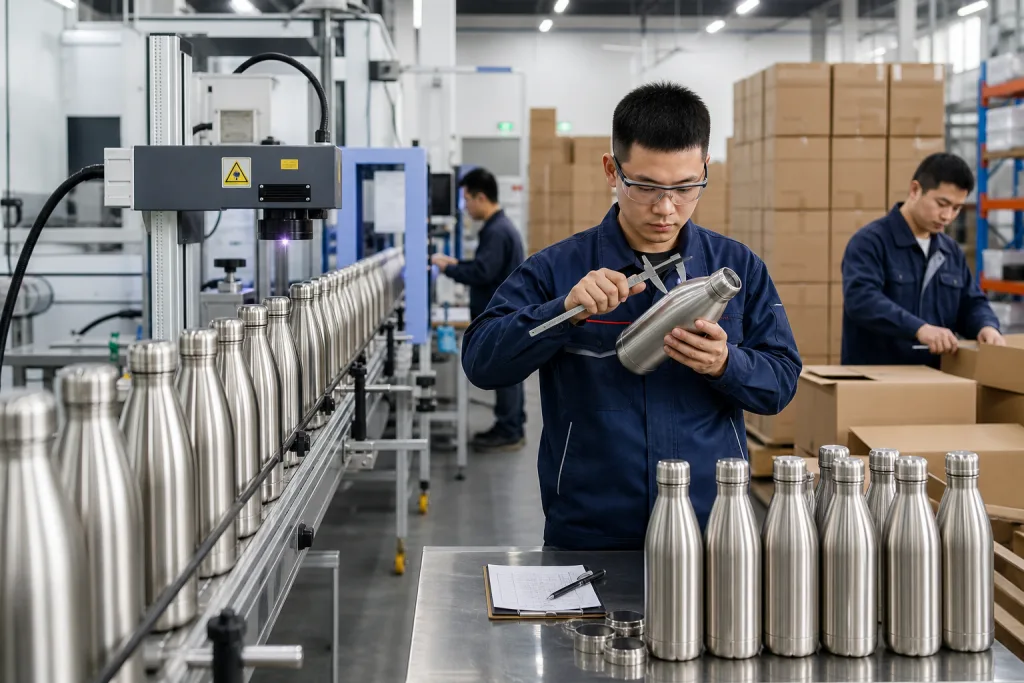
A practical buyer does not need hype. You need a clear path from bottle spec to mass production, with numbers on it. At BottleForge Industrial in Zhejiang, China, we run into the same issue each week: first POs move cleanly when the buyer fixes volume, decoration method, testing scope, and AQL before deposit. If those points stay loose, the math doesn't work. QC pulled the sample last week because the powder coat scratch result was not matched to the signed golden sample, and that kind of miss turns a 12-day sample cycle into 18 days fast.
Start with the German buyer brief
Start with a real PO. You are a procurement manager in Germany buying for a retail chain, a corporate gifting program, or a distributor drinkware catalog. Your forecast shows 8,000 units for launch, split into two colors, shipped under one private label. The bottle will be sold in Germany and Austria, so your team needs a clean finish, coating adhesion that holds after tape test, food-contact compliance for the full assembly, and packaging that survives parcel handling. On our line, QC pulled dented samples after a 76cm carton drop because the inner divider spec was missing.
Before you ask any canteen manufacturer or canteen supplier for a quote, write the brief like an engineer. Not a marketer. A usable RFQ normally includes:
- Body: 600ml double-wall vacuum stainless steel, 18/8 inner and outer
- Wall thickness: inner 0.4mm, outer 0.5mm
- Mouth: standard screw neck, leakproof PP lid with silicone seal
- Finish: powder coating, Pantone matched, 70-90 micron coating target
- Logo: one-color silk screen or laser engraving, position drawing attached
- Packaging: individual kraft box, barcode label outside, German text on master carton
- Compliance: EU food-contact scope, REACH, packaging requirements, drop test expectation
- Quantity: 4,000 black + 4,000 dark green
This is the point where terms like custom canteen, canteen custom, customizable drinkware, or customized drinkware stop being search words and turn into something we can run. A lot of buyers ask for a canteen customizable design without fixing bottle height, lid resin, or artwork size. Then one factory prices 304 stainless with a 0.4mm outer wall, another prices a heavier shell, and a third quotes a different lid tool. Your comparison sheet is dead on arrival. We have even seen artwork files marked “logo about 40mm,” which is how print positions drift by 6mm and the buyer flagged it later.
Factories in Zhejiang, China can quote fast. That is not the hard part. Accuracy is. If you want apples-to-apples pricing from canteen manufacturers or canteen vendors, lock the brief first. This is the wrong question to ask: “What is your best price?” Ask for price against one fixed build, one packing method, one test standard. On bottle orders, 80% of disputes start with details left open at RFQ stage, and we have seen this go sideways over a silicone seal hardness callout that never made it onto the PO.
The quote only makes sense with construction
A buyer sourcing custom water bottles Germany programs will often collect five quotes and treat the lowest one like proof of better negotiation. We’ve seen this go sideways. In most cases, the factories are not quoting the same bottle. One shop prices 201 stainless on the outer wall, another prices 304 outside. One line includes copper coating on the inner wall for heat retention, another skips it. One quote includes individual polybag, barcode sticker, and export carton marks; another leaves those off and the buyer only catches it after the PI is issued.
For the 8,000-piece scenario above, a realistic FOB China range for a 600ml vacuum bottle is:
- USD 3.10-3.50 for standard powder-coated bottle, simple PP lid, one-color silk screen
- USD 3.60-4.10 with better coating control, laser engraving, custom color box
- USD 4.20-4.80 with premium lid tooling, carry loop, copper-plated inner wall, or gift packaging
If you ask for a custom growler or customizable growler, the price steps up fast. The body is larger, steel weight goes up, and carton loading drops. On our side, a 1.9L body can add more than 0.35 kg of stainless versus a 600ml bottle, so the math doesn’t work if you expect the same unit rate. A 1.2L or 1.9L growler can land 35-60% above a standard 600ml bottle depending on handle, cap, and finish.
Ask every canteen factory and canteen vendor to break the quote into visible cost blocks. This is the right question to ask:
- Body and lid
- Decoration
- Packaging
- Testing if applicable
- Tooling if new mold or cap is required
That makes comparison cleaner when you weigh a canteen customized option against a stock bottle with custom artwork. Buyers miss this all the time. If you are a canteen distributor or one of several canteen distributors serving promotional channels, your margin usually gets eaten by decoration and packing details, not the bottle shell. We had one PO where the buyer flagged a 2 mm logo shift on the silk screen, and the rework cost more than the original artwork setup.
At our Zhejiang facility, monthly capacity across bottle lines is about 600,000 units, but that number means nothing until the spec is frozen. We run fast quotes in a day. A production-ready quote takes more checking: lid fit, coating standard, barcode position, carton drop requirement. QC pulled the sample on one 8,000-piece order because the master carton mark had the PO typo carried into print. Fast is easy. A quote you can actually ship against is what saves money.
Sampling decides whether the order survives
After you shortlist the supplier, do not treat the sample like paperwork. On a first PO from China, sampling is the cheapest risk filter you have. We’ve seen this go sideways over a 2 mm logo shift and a carton barcode typo. A clean process has three stages.
1. Digital confirmation
Approve the technical drawing, capacity tolerance, logo size, Pantone reference, and packaging layout. This is where the easy mistakes get caught before steel is cut or powder is mixed on the line. QC often flags things here like a 500 ml callout on the drawing while the PO says 480 ml.
2. Pre-production sample
Lead time is usually 7-12 days. Ask for a functional sample with your actual finish and decoration method, not a stock bottle with a sticker slapped on it. Test the lid thread feel, gasket smell, bottle weight, base stability, and logo position. We run a simple flat-glass wobble check here, and the buyer usually notices fast if the base sits high on one side.
3. Golden sample
Once approved, this becomes the production benchmark for color, print, and assembly. Keep one in Germany and make sure the factory keeps one in China. Put the approval date on it and the PO number too; we still see teams argue later because one side kept an older sample from the courier box.
For custom drinkware, especially customized canteen or customized growler orders, ask these questions before approval. Frankly, “Does it look good?” is the wrong question to ask.
- Is the net weight within tolerance, for example 320g plus or minus 5%
- Does the powder coat resist a basic tape pull test and fingernail scratch better than spray paint
- Does the lid pass a 45-degree and inverted leak test for at least 30 minutes
- Is the logo still acceptable after 100 dishwasher cycles if you claim dishwasher safe, or are you only claiming hand wash
- Does the bottle fit the outer box without compressing the cap or denting the base
If you need a customizable canteen shape that requires new tooling, budget more time. New lid tooling can add 20-30 days; a new bottle mold can add 30-45 days and USD 2,000-8,000 depending on complexity. The math often favors an existing body from a canteen manufacturer, then custom coating, logo, and packaging for the first run. We ship that route all the time for Germany-focused launches because 12 days versus 18 days on sample approval can decide whether the season is missed.
You are not buying a sample. You are buying proof that the factory understood your specification.
EU compliance is not one checkbox
German buyers usually ask the right question, not “Is it food grade?” Ask what was tested, which parts were included, which standard was used, and under what migration conditions. A 304 stainless bottle body, PP cap, silicone seal, exterior paint, and printed box do not sit under one compliance file. We’ve seen QC pull a sample and find the lid passed, while the seal compound on the same SKU had no matching declaration.
For custom water bottles Germany distribution, your document pack often includes:
- EU food-contact compliance: test reports or declarations covering beverage-contact materials, with the exact contact parts listed instead of one broad statement
- REACH: screening for SVHC concerns in relevant non-food-contact parts and coatings where required by your policy or customer spec
- LFGB-related expectations: German buyers often ask for stricter odor and sensory performance, especially on lids and seals; the buyer flagged this on a 2 mm silicone ring for us last season
- Packaging compliance: carton and label information, recycling marks if applicable, and restricted substance controls, down to a carton print revision on the outer box
- Factory audits: BSCI, ISO 9001, or your own ethical and quality audit requirement before we run mass production
Do not treat one generic report from last year as coverage for your current SKU. This is the wrong question to ask. If your canteen supplier changes lid resin from PP to Tritan, or switches the seal compound, the risk profile changes with it. If your bottle uses internal coating, soft-touch paint, or metallic transfer, ask whether those exact materials are named in the file. We ship plenty of repeat orders, and this is where “same material” on a PO can go sideways fast.
For European buyers, we usually confirm the testing scope at sample stage, then run final batch testing on the production sample when needed. On a normal project, that is often US$300 to US$800. Cheap insurance. It beats relabeling 1,200 cartons or holding an 18-day sea shipment at destination because one declaration did not match the actual build. The buyers who do this well are not always the biggest accounts; they just run tighter control.
This is also where a canteen distributor, distributor canteen program manager, or distributor growler buyer needs to watch the “same as last order” assumption. In China, even a stable factory can see raw material lot variation, and we’ve had incoming inspection catch color masterbatch drift before the line started. Lock the approved BOM, keep the revision on the PO, and ask the factory to notify you before any substitution. That is basic control, not mistrust.
Production control before cartons close
Once the deposit lands, your room to push gets smaller unless the process is written down and signed off. For an 8,000-piece bottle order out of Zhejiang, we usually run a schedule like this, with PO details checked on day 1 because one wrong lid code can waste 4 days:
- Day 1-3: confirm PO and artwork, lock Pantone, buy 304 stainless and lids, double-check carton marks and barcode text
- Day 4-10: body forming, seam welding, vacuum processing, arrange lid injection on the mold schedule
- Day 11-18: polishing, powder coating, logo printing or laser engraving, then first-finish sample check
- Day 19-25: assembly, 100% leak test, packaging line setup, confirm insert card and master carton layout
- Day 26-35: final packing, inspection, rework if QC pulled the sample and found issues, then shipment booking
You do not need to chase the factory every day. You do need 3 checkpoints. This is the right question to ask before cartons close.
Material and color confirmation
Ask for steel grade confirmation and coating panels before the full run starts. We usually send a sprayed panel or a finished sample, not a phone photo, because black and dark green shift fast under warm office light. The buyer flagged this on one run last season, and the delta looked small on screen but obvious on the line at 1 meter.
Mid-line production photos or video
Not for marketing. You want proof from the line: logo registration, base finish, lid fit, and carton print. Ask for one close shot with a ruler on logo position and one lid-fit clip after torque check, because we have seen buyers approve a sample and later catch a 2 mm print offset.
Pre-shipment inspection
Use an AQL plan such as 2.5 major / 4.0 minor. Typical critical points for customized drinkware are dents, sharp rim, leaking lids, weak vacuum retention, wrong logo position, paint contamination, and barcode mismatch. QC should also open random cartons and check inner packs, because we have seen this go sideways from a simple PO typo on carton wording.
For vacuum bottles, set the thermal target in writing if it matters for your sales channel. For example, hot water above 42°C after 6 hours or cold retention with ice after 12 hours. If the item is a canteen promotional giveaway for an event, appearance and ship date often matter more. If it is for retail, the math does not work the same way—returns from leaks or weak insulation will cost more than a 3% unit-price saving.
A solid canteen factory already runs in-line checks, like leak testing and rim checks after polishing. Still, ask for the inspection records. The point is not to pressure the factory. The point is to catch a batch problem before 8,000 pieces are sealed into export cartons and loaded out.
Shipping, labeling, and after-sales reality
The order is not done when production passes inspection. Germany-bound custom drinkware gets expensive from small packing mistakes. Lock carton dimensions, gross weight, pallet pattern if needed, and shipping mark format before the line starts final packing. We see this all the time: a 600ml bottle packed 25 pcs per export carton works on paper, then the gift box grows by 12 mm and the carton drops to 20 pcs, which pushes freight cost per piece up fast.
If you ship into Amazon or a 3PL program, send barcode rules at the artwork stage. FNSKU placement, carton labels, and master carton count belong in the artwork pack, not in a late-night email after QC pulled the sample. One buyer even sent a PO with the carton count typoed, 24 instead of 42, and the warehouse flagged the mismatch on arrival. If you run mixed SKUs for a canteen distribution program, carton marking discipline matters more than on a full-container, single-item order.
For sea shipment from China to Germany, buyers often budget roughly:
- Production: 30-45 days after approval and deposit
- Sea transit: around 30-40 days depending on routing and port congestion
- Buffer: 7-10 days for customs, trucking, and warehouse intake
So the real cycle is usually 70-95 days, not the 45 days new buyers ask for. This is the wrong question to ask. The right date is goods-in at your warehouse, not ex-factory in Zhejiang. We ship on that logic because 6 days lost at Hamburg or a missed truck slot can wipe out the whole plan.
Agree the claim process before shipment. Define major defects, required evidence, and whether settlement is by credit note, replacement on the next PO, or spare units in the container. Put it in writing. Our QC team usually works to AQL 2.5, and if the buyer flagged paint chips over 1.5 mm after arrival, both sides move faster when the standard was already signed off.
If you are building a long-term line of custom canteen, customized growler, or canteen promotional products, keep the first order conservative. Start with an existing mold, one or two finishes, and a repeatable lid with a stable torque range on the capping test. We have seen this go sideways when a buyer wants 4 coatings and 3 lid styles on a 1,000 pcs MOQ first run. Once the baseline is stable, then add colors, capacities, or accessories. That is how experienced buyers turn one order into a supply program instead of a weekly dispute.
Send your bottle spec and get a usable quote
Share capacity, quantity, logo method, packaging, and target date. We will review feasibility, MOQ, lead time, and compliance points before you place the PO.
Frequently asked questions
What MOQ should I expect for custom water bottles Germany orders?
For a standard stock mold stainless bottle, MOQ usually starts at 1,000 pieces per color per size, but the practical commercial level is 3,000-5,000 pieces if you want competitive FOB pricing. For two colors and custom packaging, 5,000-10,000 units is more efficient because coating setup, logo screens, and carton printing are spread over more units. If you need a new lid or custom body mold, MOQ may rise to 10,000-30,000 pieces depending on tooling and material commitment. Many buyers in Germany start with an existing bottle from a China factory, then move to deeper customization on the second order after sell-through is proven.
How long does a first custom drinkware order from China usually take?
For a first order using an existing bottle mold, plan 7-12 days for pre-production sample, then 30-45 days for mass production after sample approval and deposit. Sea transit to Germany is commonly 30-40 days, plus about 7-10 days for customs clearance, inland transport, and warehouse receiving. Realistically, you should budget 70-95 days from approved sample to goods in your warehouse. If you need new tooling for a customizable canteen or customized growler, add 20-45 days depending on whether the change is only a lid or the entire body construction.
Which compliance documents should I ask a canteen supplier to provide?
Start with a declaration or test support covering food-contact materials for all beverage-contact components: stainless body, lid interior, straw if used, and silicone seal. Then ask about REACH status for relevant materials and coatings, and whether the supplier can support LFGB-style testing expectations common in Germany, especially for odor and taste neutrality. If your policy requires it, also request BSCI or social audit documents, ISO 9001 quality system evidence, and packaging compliance details. The key point is component-level clarity. A generic report for a different lid or an old batch is not enough for a serious B2B purchase.
What quality checks matter most on custom stainless bottles?
The most common failure points are leakage, dents, coating defects, incorrect logo placement, unstable base, and poor vacuum retention. For B2B orders, set an inspection standard before production starts. AQL 2.5 for major defects and 4.0 for minor defects is a normal baseline. Ask inspectors to check leak performance by inverted test, verify bottle weight and dimensions against approved spec, compare color to the golden sample, review barcode accuracy, and spot-check insulation if thermal performance is part of your claim. On an 8,000-piece order, catching even a 2% leak issue before shipment prevents hundreds of costly returns.
Is it better to buy from a canteen manufacturer directly or use a trading company?
It depends on your order profile. If you are buying one main SKU in volume, a direct canteen manufacturer often gives clearer control over sample revision, production timing, and quality correction. If you need mixed products across bottles, tumblers, kids items, and a custom growler in one shipment, a capable exporter can simplify communication and consolidation. The important point is transparency. Ask who owns production, where the factory is in China, which parts are outsourced, and who handles final QC. Many buyers in Europe work well with either model as long as lead time, MOQ, and claim responsibility are written clearly.