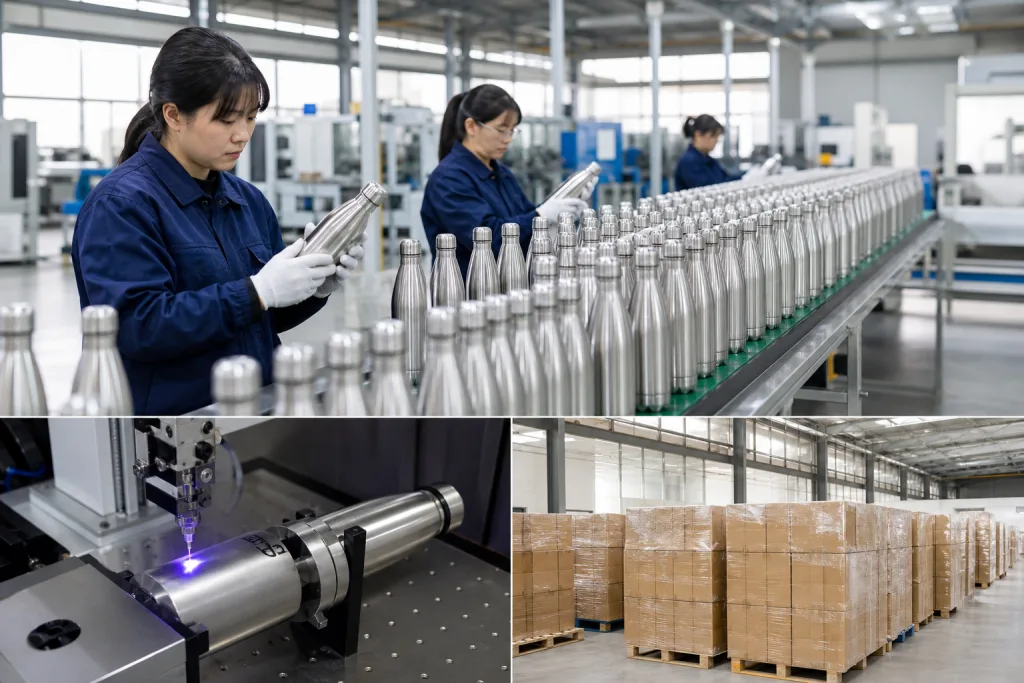
Key Takeaways
- A workable first order is often 3,000 to 5,000 units per SKU, with FOB China pricing around USD 2.80-5.90 depending on capacity, steel grade, and decoration
- Production lead time for customized drinkware is typically 25-35 days after sample approval and deposit, plus 3-7 days for lab tests or third-party inspection booking
- For stainless custom canteen orders, ask for 18/8 interior, 0.4-0.5 mm body wall, vacuum retention data, and AQL 2.5 final inspection
- America-bound retail programs should lock carton drop standard, barcode placement, and compliance scope early, including FDA, CPSIA where applicable, and California Proposition 65 screening
You are not buying a bottle. You are buying an outcome: the right capacity, the right coating, the logo finish you signed off, passed compliance, correct packing, and on-time delivery into America. Most failures start before the line runs. A loose spec sheet turns into a Pantone miss, dented lids, failed drop tests, or a 12-day delay because the carton mark file was still unapproved at booking.
We see this on first orders from Europe and North America. The buyer asks for a custom water bottles America program, then the RFQ mixes retail specs, promo pricing, and Amazon carton rules in one PO. QC pulled a sample last month where the logo position note said “centered” but gave no mm tolerance; the buyer flagged it after approval. A practical order flow fixes that. From our canteen factory in Zhejiang, China, we usually start with one buyer case and build from there: product spec, decoration method, sample approval, AQL, and freight plan. This is the wrong question to ask if you start with price only.
Start with the buyer brief
Use a real case. A U.S. brand is lining up a fall hydration program for specialty retail and its own site. The target is 8,000 units total: one 32 oz insulated bottle, two lid colors, four body colors, one one-color logo, plus individual retail boxes. They searched custom water bottles America because the sell-through is in the U.S., but most supply still sits in Zhejiang, China. That part is normal. The wrong question is “can the factory figure out the rest?” We can’t price from guesses, and we’ve seen this go sideways when the PO only says “assorted colors” with no split.
A usable brief needs numbers, not soft wording. On our line, the sales sheet and BOM have to match before we run samples. You should define:
- Volume: 32 oz / about 950 ml
- Material: 18/8 stainless interior and exterior, BPA-free PP lid, food-grade silicone seal
- Construction: double-wall vacuum, copper-coated inner wall if you want stronger heat retention claims
- Body thickness: 0.4 mm is common; 0.5 mm gives a sturdier feel but raises cost and weight
- Finish: powder coat, Pantone close match, 60-80 gloss if not matte
- Decoration: silk screen, laser engraving, or UV print
- Packaging: white box, color label, master carton count, barcode type
- Compliance: FDA contact safety, REACH for Europe if shared program, Proposition 65 screening, CPSIA if marketed to children
On an order like this, our Zhejiang plant will usually quote MOQ at 3,000 units per colorway, or 5,000 mixed units if all components are standard and we can run the same lid set across SKUs. If you want a full custom mold, MOQ often moves to 10,000 units, and tooling lands between USD 3,000 and 12,000 depending on cavity count and lid structure. We check these projects against a 0.4 mm or 0.5 mm body spec right away because the math changes fast on weight, carton drop risk, and freight. A canteen manufacturer prices cleanly only when your brief shows what is fixed, what can move, and which trade-off you will accept if the buyer flagged cost first.
Choose the bottle that fits margin
Narrow the product first. We often get one RFQ asking for a custom canteen, a customizable growler, and a custom drinkware gift box on the same PO, sometimes with a typo in the item code on line 3. It looks efficient. The math doesn’t work. Start with one hero SKU and cost that one cleanly.
For America retail, the safest first SKU is usually a 500 ml to 1,000 ml vacuum bottle on an existing mold. Existing molds cut 15-25 days from development and remove tooling risk on the first run. On our line, that often means 12 days sampling instead of 18 days. A proven body design from a canteen supplier in China also gives you known lid torque, known leak performance from the vacuum leak tester, and known carton fit.
Typical FOB Zhejiang pricing for standard molds
- 500 ml vacuum bottle, powder coat, one-color logo: USD 2.80-3.60 at 5,000 units
- 750 ml vacuum bottle, carry loop lid: USD 3.20-4.20 at 5,000 units
- 32 oz wide-mouth bottle, powder coat, retail box: USD 4.30-5.90 at 5,000 units
- 64 oz custom growler with handle lid: USD 6.80-9.50 at 3,000 units
Price moves with steel weight, coating line stability, and decoration yield on the line. QC pulled the sample last month on a 64 oz wrap print because the seam drifted 1.8 mm, and the buyer flagged it right away. Laser engraving often costs less than multicolor print because rejects are lower. A customized growler with a large wrap print can lose 3-5% in production from alignment issues, and that scrap is built into the quote.
If your channel is promotional instead of retail, canteen promotional programs usually accept simpler packaging and fewer colorways. We ship plenty of those in a plain 24-unit master carton with no inner tray. That can save USD 0.25-0.70 per unit. If your channel is wholesale through a distributor drinkware network, carton pack and replenishment speed matter more than gift-style packaging. We’ve seen this go sideways when a buyer spends on a rigid box but ignores pallet pattern. Good canteen distributors and canteen vendors ask about pallet pattern, UPC labels, and replacement lid stock at 2,000 pcs MOQ. Ask those questions first.
A cheap quote is the wrong thing to focus on. Check whether it includes leak test, inner box, desiccant, spare gasket, and export carton strength like a 5-layer carton. Cheap ex-factory pricing can turn into expensive landed pricing fast.
Lock artwork and samples before deposit
This is where custom water bottles America orders break. We have seen POs approved off a flat mockup, deposit paid, then the buyer flags the first bulk photo because the Pantone looks different on the shoulder radius. That is normal unless you lock a tolerance first. Powder coat on curved 304 stainless does not behave like offset print on paper.
Your sample path should usually be three steps:
- Stock sample: 2-4 days, to confirm shape and lid style
- Pre-production sample: 7-10 days, with your color and logo
- Golden sample: signed reference stored by both you and the canteen factory
For a one-color screen logo on powder coat, expect small variation in edge sharpness and placement, usually within plus or minus 1.5 mm. On our screen line, QC pulled samples where the logo sat 1.8 mm low, and those got held. For laser engraving, placement can be tighter, often within 1.0 mm. If your design wraps around the bottle, ask for a seam position note and artwork file in vector format. AI or EPS is standard. A 0.25 pt hairline from a rushed file often drops out on the line.
A practical approval sheet from canteen manufacturers should include bottle height, diameter, net weight, finish code, Pantone target, logo size, print method, barcode position, carton mark, and packing photo. Add the lid-body match list by SKU and mold number. This is not paperwork for its own sake. We have seen this go sideways when a PO says "black lid" but the buyer meant SK-02 flip lid, not the threaded A12 lid, and the result is leaks at inspection. If you are buying customizable canteen or customized canteen styles with interchangeable lids, list exactly which lids fit which bodies. Mixing parts from different molds is a common source of leaks.
At BottleForge Industrial, our line in Zhejiang, China can run about 600,000 units per month across bottles and tumblers, but sample approval still controls the whole schedule. That is the wrong place to rush. Once the golden sample is signed, changes are not free. Changing a lid color after material cutting can add 5-8 days and create dead stock. We ship on locked specs, not optimism. The most disciplined canteen supplier is not the one who says yes to everything; it is the one who tells you a late change will cost money.
Build quality control into the PO
Quality control does not start at final inspection. It starts on the PO. If your PO only says “good quality,” you do not have much to stand on when the buyer flags scratches or weak insulation. We see this on the line all the time. A solid custom drinkware PO should spell out tests, defect limits, and acceptance level, down to the leak test method and sample size.
For stainless customized drinkware, ask for these controls:
- Incoming material check: steel grade confirmation, plastic resin declaration, silicone hardness
- Process checks: vacuum retention sampling, coating adhesion, logo rub test, lid torque test
- Finished goods checks: 100% leak test, visual inspection, barcode scan, carton drop test
- Final random inspection: AQL 2.5 major / 4.0 minor unless your retail account requires tighter
Specific tests beat broad promises. Ask for a 4-hour hot retention benchmark and a 12-hour cold benchmark, then lock the method: fill volume, starting temperature, room temperature, and whether the cap stays closed for the full test. For coating, ask for a cross-hatch adhesion test with 1 mm cuts and a basic abrasion check. “Durable finish” is not a spec. QC pulled a sample last month where the powder coat looked fine, then failed after 20 rubs with a dry cloth.
If you source through canteen vendors or a canteen distributor instead of buying direct from a canteen manufacturer, ask who owns QC. This is the wrong question to skip. Some distributor canteen models rely only on factory self-inspection, with no outside check before shipment. That works on a 500-piece promo run with a simple 1-color logo. For retail or e-commerce, we have seen this go sideways, so we push for a third-party final inspection in China before balance payment. Booking SGS, Intertek, TUV, or AsiaInspection usually costs around USD 300-450 per man-day in coastal China.
Define carton standards in writing. A 32 ECT export carton is common, but heavier 64 oz customized growler orders often need stronger corrugate or fewer units per carton to prevent bottom burst. We ship drop-test samples with actual pack count because the math does not work if the carton is overloaded by 2 kg. One expensive U.S. failure is not a bad logo. It is dented product from overpacked cartons that passed at the factory door and arrived crushed at the warehouse.
Compliance is a schedule issue too
Buyers still treat compliance like back-office paperwork after production. That is the wrong sequence. In America, compliance moves the ship date. If you need California Proposition 65 screening, FDA food-contact declarations, or retailer-specific chemical restrictions, lock those into the schedule before bulk starts. We have seen a PO marked “rush” lose 9 days because the buyer flagged the decoration ink after sample approval.
For general adult drinkware, the usual path is material declarations plus targeted lab testing on coatings, plastics, and decoration inks. QC pulled the sample from the line and sent the printed lid, straw, and outer coating together to cut one round of back-and-forth. If the bottle is for children, the scope can expand to CPSIA-related concerns and ASTM considerations depending on marketing claims and age grading. Glass items bring different breakage and thermal-shock concerns. Customized growler products need extra attention on handle load and cap seal integrity; we have seen leakage show up at 0.03 MPa on a bad cap batch.
From a China factory point of view, the fastest route is using already qualified materials from stable suppliers in Zhejiang. Changing a powder supplier to save USD 0.03 per bottle is usually bad math if it forces retesting and adds 7 days. We run a controlled vendor list for coating, silicone, and packaging, and incoming material is tied back by lot code on the carton label. Ask whether your canteen manufacturer has BSCI, ISO 9001, and a documented traceability flow by lot number. These are not luxury credentials. They cut arguments when something goes wrong. Last year one buyer pushed for a cheaper gasket source, and the Shore A hardness came in 8 points off target.
Typical lab timing is 5-7 working days after sample receipt. If a failure happens, rework plus retest can easily cost another 7-10 days. So the clean buyer workflow is simple: approve materials, test the pre-production sample when needed, then run bulk. Short path. Better control. It feels slower on day one, but it is faster than finding a packaging ink issue when 8,000 units are already boxed and stacked 14 cartons high in the warehouse.
Plan shipping before production ends
Buyers searching custom water bottles America are usually asking a different question: how do these goods get into the U.S. without expensive surprises? Start with carton math, not freight quotes. A 32 oz vacuum bottle in an individual box might pack 24 units per master carton. Depending on bottle shape and insert design, that carton may be around 58 x 39 x 31 cm and weigh 15-17 kg gross. Run that against your order qty first. Then you know if LCL, FCL, or air freight makes sense. We have seen buyers ask for air pricing before they even confirm carton count, and that is the wrong question to ask.
For 8,000 units, sea freight is usually the only rational option unless you split the order. A common plan is 500-1,000 units by air for launch content and early sales, with the balance FOB or CIF by sea. We ship this way all the time. If you sell on Amazon, confirm FNSKU labeling, carton label format, and appointment booking responsibility before packing starts. One missed PO suffix on an outer carton label can hold a delivery appointment. Relabeling after arrival is pure waste, and the math does not work.
Lead time from Zhejiang, China for a standard custom canteen order is usually 25-35 days production after deposit and sample sign-off. Add 5-7 days if you need a new package structure, and another 3-5 days for final inspection coordination. On the line, a new insert usually means we cut and check a fresh die-line sample before mass packing. Ocean transit to the U.S. West Coast often runs around 18-25 days port to port; East Coast can be 30-40 days depending on routing and congestion. In peak season, we have seen 12 days at origin turn into 18 days just waiting on vessel space.
Ask your canteen vendors or canteen distributors a blunt question: what happens if there is a short shipment or hidden damage? A solid answer includes overrun planning, spare lids or gaskets, photo records, and a claims process tied to packing list and lot code. QC pulled the sample on one order last year because 6 cartons had corner crush and 2 inner trays had cracked. That record saved the claim. Export discipline is not glamorous, but this is what separates a dependable canteen factory from a quote machine.
If you are choosing between multiple canteen manufacturers, compare landed cost, defect exposure, and communication speed as one package. The supplier with the lowest unit price is often not the lowest-cost supplier once you count inspection, compliance delays, and replacement freight. We have seen a buyer save $0.18 per bottle and then spend more than that on one replacement shipment. Cheap quotes are easy. Clean execution is harder.
Get a quote built around your actual order
Send your target capacity, MOQ, logo method, packaging, and delivery window. We will reply with pricing, lead time, and a workable QC plan.
Frequently asked questions
What is a realistic MOQ for custom water bottles for the America market?
For a standard mold in stainless steel, a realistic MOQ is usually 3,000 units per SKU or 5,000 units across mixed colors if the lid and body are shared. Simpler promotional bottles can start lower, sometimes 1,000-2,000 units, but unit cost rises quickly. A fully custom mold normally needs 10,000 units or more plus tooling. If you need retail boxes, mixed lids, or several logo versions, ask the factory to quote MOQ by component, not just by finished bottle. In Zhejiang, China, most efficient runs are based on coating color and print setup, so two bottle colors with one logo may be easier than one color with four logos.
How much should I budget per unit for customized drinkware?
For FOB China pricing, most first-time buyers should budget USD 2.80-3.60 for a 500 ml vacuum bottle, USD 3.20-4.20 for 750 ml, and USD 4.30-5.90 for a 32 oz insulated bottle with standard powder coat and one-color logo at 5,000 units. Add roughly USD 0.18-0.45 for a retail box, USD 0.08-0.25 for upgraded decoration, and more if you want custom lids, full-wrap print, or premium gift packaging. A custom growler is usually USD 6.80-9.50 depending on capacity and handle design. Always check whether quote terms are EXW, FOB Ningbo, or FOB Shanghai because inland trucking and export fees can change the real comparison.
How do I check a canteen manufacturer in China before placing a deposit?
Start with documents, then verify production reality. Ask for business license, factory audit reports such as BSCI, quality system records like ISO 9001, and recent test reports for similar products. Then ask for line photos, monthly capacity, sample lead time, and a detailed quotation with material specs. A serious canteen factory should state steel grade, wall thickness, leak test method, packaging details, and normal lead time. Third, order a pre-production sample and inspect finish, lid fit, odor, barcode placement, and packaging strength. If the order value is meaningful, arrange a video audit or third-party inspection. In coastal Zhejiang, a one-day audit or inspection usually costs far less than one failed retail launch.
What quality standard should I put into the PO for custom drinkware?
Use measurable standards. For most retail-grade custom drinkware, specify 100% leak testing, AQL 2.5 for major defects and 4.0 for minor defects at final random inspection, coating adhesion test, logo rub test, and carton drop test. Define appearance tolerances too: acceptable Pantone variance, logo placement tolerance such as plus or minus 1.5 mm, and what counts as a dent or scratch. For insulated bottles, ask for vacuum performance data with exact conditions, not just marketing claims. Also define packaging acceptance: barcode readability, carton mark accuracy, gross weight limit, and inner packing orientation. Clear PO language gives both you and the supplier a workable standard when there is a dispute.
How long does it take to deliver custom water bottles from China to America?
For an existing mold, expect 2-4 days for a stock sample, 7-10 days for a pre-production sample, and 25-35 days for mass production after sample approval and deposit. Add 3-7 days if you need third-party inspection or lab testing. Sea transit from China to the U.S. West Coast is often 18-25 days port to port, while East Coast can be 30-40 days. Air freight is much faster but expensive for stainless drinkware because of weight. If your launch date is tight, split the shipment: send 500-1,000 units by air for first delivery and move the balance by sea. That usually costs less than flying the entire order.