Key Takeaways
- Most custom water bottle american orders start at 500–1,000 pcs, with printed samples in 5–7 days.
- A reliable canteen factory should quote lead times of 25–35 days for standard jobs and show AQL 2.5 inspection.
- For U.S. buyers, stainless 18/8, BPA-free Tritan, and REACH-compliant parts are the safest default specs.
- Laser engraving is usually more durable than 1-color silk screen for distributor drinkware and promotional canteen programs.
If you are sourcing custom water bottle american programs for retail, promotions, or distributor channels, design is rarely the problem. The hard part is repeatability. Can the factory hold Pantone within 1 delta, pass a 1 m leak drop test, match your carton spec to the mm, and ship on the ETD instead of stretching one bottle PO into 18 days of back-and-forth emails? We see this on the line all the time.
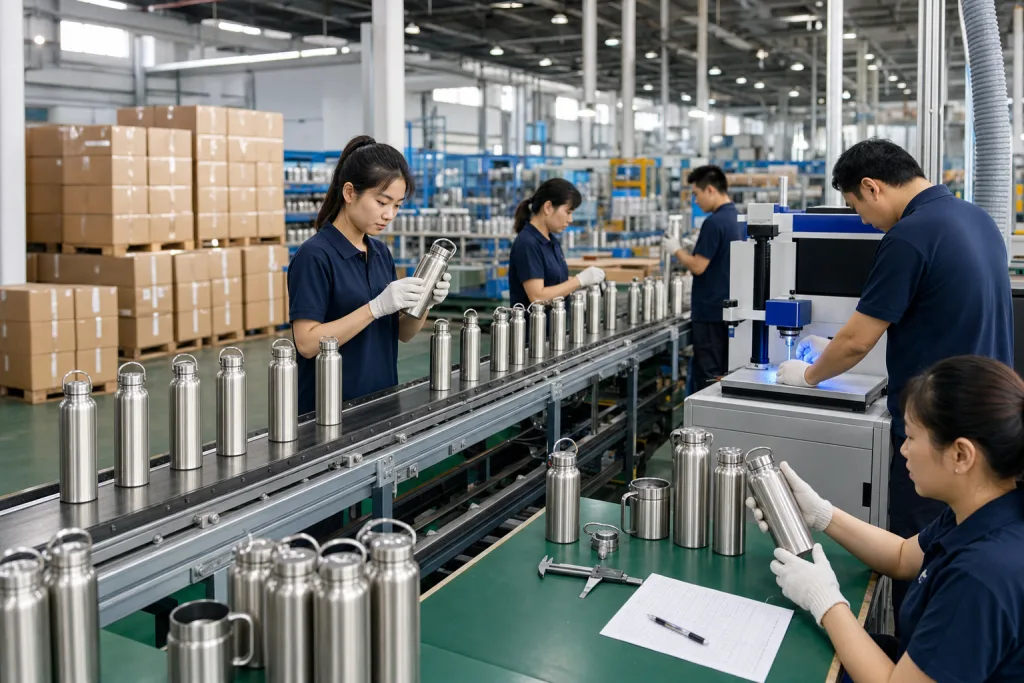
In Zhejiang, solid factories run this work every day, but suppliers are not the same. A serious custom drinkware buyer should separate a real canteen manufacturer that runs 20,000 units/month on in-house lines from a trading company that forwards AI files and waits. This is the wrong question to ask: “Can you make it?” Most shops will say yes. Ask who does the laser weld, who prints the FNSKU, and who signs off AQL 2.5 after QC pulled the sample. If you buy for the U.S. market, check FDA-contact materials, REACH, AQL, and FNSKU labeling before artwork approval, not after the buyer flagged a PO typo and the labels were already printed.
What should you buy first?
Start with the use case, not the bottle shape. A custom water bottle american program for gym retail needs different specs from a canteen promotional drop for a trade show, and both are miles apart from a custom growler for a beverage brand. Skip that step and the line ends up quoting the wrong cap, the wrong coating, or a carton size that kills freight on a 40HQ. We’ve seen this go sideways after one PO typo on box dimensions.
Ask four direct questions before you send RFQs. This is the right place to slow down.
- Will this sit in retail, e-commerce, or as distributor drinkware?
- Do you need stainless, Tritan, aluminum, or glass?
- Is the decoration permanent or seasonal?
- Will the item ship bulk, retail boxed, or with Amazon FNSKU?
For U.S. buyers, the practical default is a 500 ml to 750 ml bottle, 304 stainless body, 0.4–0.5 mm wall thickness, powder coat, and one-color logo. We run this spec every week, and QC pulled the sample last month with wall thickness right at 0.45 mm, which is where cost and dent resistance usually balance out. If you are building a custom canteen line for warehouse clubs or a promotional campaign, simpler is cheaper and usually safer. The math doesn’t work if you load up a first order with 3 lid styles at MOQ 3,000 per color.
Materials that pass buyer scrutiny
Material choice decides if your canteen customized project turns into a repeat PO or a complaint file. Start with 18/8 or 304 stainless and ask the canteen manufacturer for the material certs, not just a sales sheet. On the line, we check the shell thickness with a micrometer; for insulated drinkware, a double-wall vacuum build with 0.4–0.5 mm inner and outer shells is the standard spec that ships well and holds cost. For plastic, Tritan is the safe pick if you want clear walls without the odor issue cheap copolyester brings. Buyers flag that smell fast.
Glass fits premium retail, but the carton has to do more work. We usually run an EPE or molded pulp insert, and if the drop test target is 76 cm, loose packing is the wrong question to ask. Aluminum is light, though coating quality and dent resistance decide the claim rate more than any brochure line. If your customer wants a custom growler, stainless is safer than glass for parcel shipping and channel control; we've seen this go sideways after one dent test and two cracked samples. For schools or outdoor retail, a customizable canteen with a leak-proof straw lid or sports cap often outsells a wide-mouth bottle with a generic screw top. The buyer pushback is predictable: "kids lose caps."
In Zhejiang, the better factories show the full coating system, not just the outside color chip. QC pulled the sample once and found an off-spec gasket at 1 mm short on lip contact, and that kind of miss can sink an otherwise good order. Ask for REACH documents, LFGB where needed, and migration data when the market calls for it. If a factory avoids the liner spec, the math doesn't work.
Decoration that survives use
Decoration is where 7 out of 10 canteen distributors burn margin for no good reason. If the bottle gets handled every day, laser engraving is usually the safest call. We run fiber laser marking on the line, and the mark stays put after daily use. The quote often shows a simple silk screen at a lower price, but that math doesn't work if logos fade, crack, or trigger complaints after one dishwasher cycle. For premium retail, 360-degree UV print or a wrap label can work, though you need tighter artwork control and 2–3 approval rounds before mass production.
Use the decoration method that fits the margin:
- Laser engraving: best for stainless, clean and permanent, usually $0.20–$0.60 extra per unit.
- Silk screen: best for 1–2 colors, cheapest for 5,000+ pcs, but less durable. We still see buyer pushback after scratch tests.
- Heat transfer / UV print: good for complex art, higher setup control needed. QC pulled the sample last month because the logo shifted 1.5 mm on the shoulder curve.
A canteen customizable program for distributors works better with one neutral base bottle and variable logo placement. That gives you one SKU structure with different customer branding and fewer dead cartons in stock. We ship programs like this with print fixtures built for fast changeover, often cutting setup from 18 minutes to 9 minutes per logo swap. Ask the vendor for registration tolerance and imprint area in millimeters. If they can't answer with numbers, this is the wrong supplier.
MOQ, price, and lead time reality
Procurement usually goes off track when buyers compare catalog pricing to landed cost. They are not the same number. For a standard customized drinkware order from a canteen factory in China, MOQ is usually 500 pcs on stock molds and 1,000–3,000 pcs for fully customized shapes. If you ask for a custom canteen with a new lid, new coating, and special packaging, tooling cost goes up and approval takes longer. On our floor, a new cap often means a fresh fit check with a go/no-go gauge and 2–3 extra sample rounds. This is the wrong question to ask: “What’s your cheapest price?” Ask what drives the cost.
Typical ex-works pricing for a stainless promotional bottle sits around USD 2.80–6.50, based on size, coating, lid structure, and decoration method. A custom growler with double-wall construction plus premium packaging usually runs USD 6.50–12.00 or more. Standard production lead time is usually 25–35 days after sample approval. New molds or special caps push that to 45–60 days. We’ve seen this go sideways when the buyer flags the lid after color approval, because that can cost 12 days vs 18 days depending on whether the tool shop has to reopen the mold. One factory metric you should ask for is monthly output. A solid Zhejiang canteen manufacturer should tell you if the line runs 200,000 units/month or 20,000 units/month, not “about a lot.” If they cannot answer that in 30 seconds, the math doesn’t work.
Do not accept “fast delivery” without a production schedule. Ask for four dates: sample timing, mass production start date, carton completion date, and booking window. We ship against those milestones. QC pulled the sample, then packing checked carton drop resistance on a 62 x 42 x 28 cm master carton before booking. A canteen supplier that gives you those four dates is usually serious. One that only says “7 days faster” usually has not reserved line time.
How to vet the factory fast
You do not need a 40-page audit to spot a real canteen manufacturer from a trading company. You need 8 hard questions and the nerve to ask them. Ask for the business license, export records if available, BSCI or Sedex status where relevant, and photos or a live video of the actual line. We usually ask for one clip from welding, one from powder coating, and one from packing with the carton spec visible. Then check whether they run molding, coating, assembly, and final packing in-house. This is the wrong question to ask if you only care about price; ownership of process is what decides lead time and claim risk.
Use this buyer checklist:
- Can they quote AQL 2.5 for major defects and AQL 4.0 for minor defects?
- Do they provide pre-production samples and golden samples?
- Do they test for leaks, thermal retention, and dishwasher resistance?
- Can they support OEM artwork with AI, PDF, or vector files?
- Do they offer carton drop testing and barcode labeling for U.S. fulfillment?
A real canteen distributor or canteen supplier should answer in 10 minutes, not after two days of “checking with the factory.” QC pulled the sample is the phrase you want to hear. We have seen this go sideways when a seller sends workshop photos from another plant, then cannot explain a 0.3 mm logo offset or why the PO barcode was typed with one wrong digit. In Zhejiang, strong factories are direct about what they make and what they outsource. That saves 12 days versus 18 days on problem orders and protects your margin.
Compliance for U.S. and EU markets
If you sell into the U.S. or Europe, compliance is not optional paperwork. For custom water bottle american programs, ask for food-contact declarations, REACH compliance for the EU, and safety files for inks, coatings, and silicone gaskets. We usually check gasket hardness on the line at 60±5 Shore A, because that small detail shows up later in odor and migration results. If the item is sold for children, the requirement jumps and the packaging copy needs a second review. For Amazon and big-box retail, label layout, carton marks, and scannable codes matter as much as the bottle body. We have seen buyers focus on color first; this is the wrong question to ask.
For distributor drinkware and promotional canteen orders, use a simple rule: verify the product before the artwork. QC pulled the sample, checked the lid fit with a go/no-go gauge, then matched the approved unit to the report file and batch record. A solid canteen manufacturer should provide test reports, batch traceability, and a signed sample approval record. If your item needs FNSKU, country-of-origin marking, or retail polybag warnings, tell the factory before production starts. One PO we received said “Made in Chnia” on the ship mark; catching that before carton print saved a full rework. Late label fixes are expensive and often damage finished goods.
Some buyers ask if a canteen customized in China can meet both U.S. and EU requirements. Yes, if the factory plans for it from the BOM stage. In Zhejiang, the better teams lock approved stainless, tested seals, documented inks, and export packaging before mass production. We run drop tests on packed cartons from 76 cm, because ocean freight will punish weak inserts fast. That is what you pay for with a qualified China supplier instead of a catalog trader. The cheaper route looks fine on page 1, then the math doesn't work after one failed inspection.
What a clean RFQ should include
A clean RFQ is the difference between a 48-hour quote and 18 days of back-and-forth. If you want canteen customized pricing that holds up after PO review, send one spec sheet with volume, material, lid type, decoration method, target market, packaging, and expected annual usage. Add your forecast by SKU if you have it. We run into this every week: buyer asks for a “best price,” then the logo size changes from 35 mm to 60 mm and the carton spec flips from bulk pack to gift box. Price moves. If you are sourcing multiple SKUs, say it upfront. The line can sometimes share lids, cartons, or an existing mold base, and the math works better.
Your RFQ should include:
- Capacity: 16 oz, 20 oz, 32 oz, or custom
- Material: 304 stainless, 316 stainless, Tritan, glass, aluminum
- Finish: matte, gloss, powder coat, brushed
- Logo: size in mm, colors, print position
- Packaging: bulk, box, mailer, gift set
- Market: U.S., EU, Amazon, retail chain, B2B promo
If you are comparing canteen manufacturers, ask each supplier to quote the same terms: FOB Ningbo or FOB Shanghai, sample fee, tooling fee, lead time, and replacement policy for defects. This is the right baseline. We have seen quotes look 8% lower, then the buyer flagged that the sample fee was excluded, the export carton changed from 24 pcs to 20 pcs, or the replacement policy was vague. QC pulled the sample, and the issue was not the bottle body at all; it was a loose lid fit at 1.2 kg drop test. Cheapest is not always best. Once terms are aligned, you can compare numbers cleanly and buy without getting hit by hidden extras.
Send your spec and get a real quote
We can quote MOQ, lead time, compliance, and packaging for custom water bottle american programs without guessing.
Frequently asked questions
What MOQ should I expect for custom water bottle american orders?
For stock molds, 500 pcs is common and 1,000 pcs is safer if you want better pricing. For new shapes or special lids, expect 3,000 pcs or a tooling fee. A canteen factory in Zhejiang may quote lower MOQ on paper, but the real production break-even still depends on print setup, packaging, and inspection cost. If you need mixed colors, ask whether 100 pcs per color is allowed; many factories require 300–500 pcs per color to keep lines efficient.
How much does a custom canteen usually cost from China?
A basic stainless custom canteen often lands around USD 2.80–4.50 ex-works for 500–1,000 pcs. Insulated models with powder coat and laser logo are more like USD 4.80–8.50. Premium custom growler styles with upgraded lids and gift boxes can exceed USD 10.00. Freight, duties, and labeling add more. The real landed cost depends on carton count, CBM, and whether you ship FOB or DDP.
Which decoration method lasts longest?
Laser engraving is the most durable for stainless drinkware. It does not peel, and it tolerates daily handling better than silk screen. For a one-color logo, silk screen is cheaper, often by USD 0.15–0.40 per piece, but it can wear faster. If your customer is a distributor drinkware buyer or you expect heavy use, laser is usually worth it. For colorful promotional canteen programs, UV print can work, but only if the factory controls curing and adhesion well.
What compliance documents do I need for the U.S. market?
At minimum, ask for material declarations, food-contact confirmation, and coating or ink compliance if applicable. For the EU, REACH is important, and some buyers also request LFGB. If the product is for Amazon or retail, you may also need barcode setup, country-of-origin marking, and packaging warnings. A good canteen supplier should be able to provide batch traceability and test reports. If they cannot, your customs and marketplace risk goes up fast.
How do I choose between a canteen manufacturer and a canteen vendor?
Choose the factory when you need stable quality, repeat runs, and direct control over molds, coating, and lead time. Use a vendor only if they add value in sourcing multiple items or consolidating shipments. A true canteen manufacturer can usually give you monthly output numbers, inspection records, and sample control. A vendor may not. For serious custom drinkware programs, especially in China, direct factory communication usually reduces mistakes and saves 5–12% on hidden handling costs.