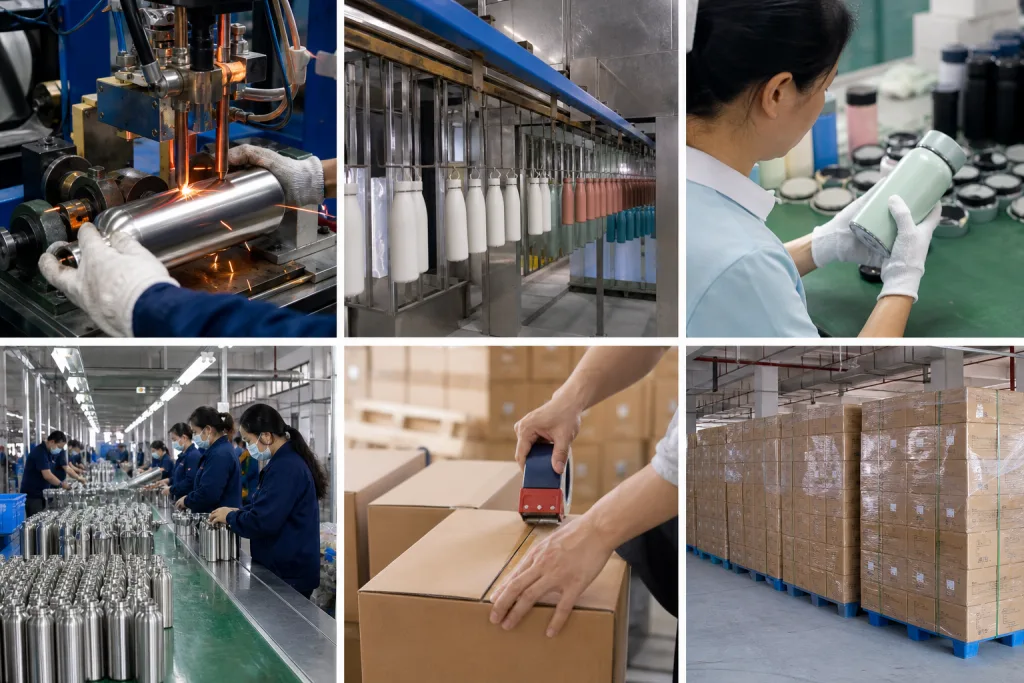
Key Takeaways
- For a custom vacuum insulated bottle, typical MOQ is 1,000-3,000 pcs per SKU, with 35-55 day lead time after sample approval
- Good 18/8 stainless bottles usually hold heat 8-12 hours and cold 18-24 hours, depending on wall design and cap structure
- Decoration cost can shift landed price by USD 0.18-0.90 per unit, especially for powder coat, laser, wrap print, and retail pack upgrades
- Use an inspection plan with AQL 2.5 major and AQL 4.0 minor before balance payment, especially for logo position, leak, and coating defects
You are not buying a sample for a trade show table. You are buying a production item that has to ship on time, pass compliance, print a clean logo, and hold up in customer hands without refund claims 6 months later. So a custom vacuum insulated bottle order needs more than a price sheet. On our line, QC pulled a flask with a 0.4 mm logo shift and that small miss was enough for the buyer to reject the carton. The job is to check steel grade, vacuum performance, coating adhesion, packaging spec, and whether the supplier in China can repeat the same result at 3,000 pcs, not just 3 samples.
Buyers come to Zhejiang asking for custom drinkware and then the list gets longer fast: MOQ, AQL, REACH, drop test standard, print size limit, carton burst strength. We hear this every month. If you are comparing a canteen manufacturer, canteen supplier, or canteen distributor program, price is the wrong first question. Ask what you are getting, where it fails, and how the factory controls it before deposit release. We have seen this go sideways over one typo on a PO and one missing barcode on an inner box.
What are you really buying?
A custom vacuum insulated bottle is not one SKU. It is a stack of specs that hits the line one by one: body shape, steel grade, wall build, cap structure, finish, logo method, carton pack, and compliance file set. Miss one, and the cost shows up later in claims, a 12-day approval turning into 18 days, or rework after QC pulled the sample.
For most B2B buyers, the baseline should start with food-contact 18/8 stainless steel on both inner and outer body, double-wall vacuum construction, a silicone sealing ring, and a lid matched to actual use. A sports lid on an office gift bottle gets leakage complaints. A narrow-mouth screw cap for gym retail hurts drinkability on the shelf test. We have seen first POs fail on this exact point, and once because the buyer flagged it only after the drop-test sample stage.
If you are buying custom drinkware for a private label or a canteen promotional project, ask the factory to confirm these points in writing:
- Body capacity tolerance, for example 500 ml nominal with +/-3% fill tolerance
- Inner and outer material grade, usually SUS304 inside and outside, or SUS316 inside for premium lines
- Weight target, such as 280-340 g for a 500 ml bottle depending on wall thickness
- Heat and cold retention test method and time points
- Cap material, BPA-free PP or Tritan components where applicable
- Finish type: spray paint, powder coat, rubber finish, electroplating, or bare steel
A capable canteen factory in Zhejiang should send a spec sheet fast, not just a pretty rendering. This is the wrong question to ask if you only compare unit price first. Ask for wall thickness and get numbers back: around 0.4-0.5 mm outer and 0.3-0.4 mm inner on mainstream models. If the supplier cannot answer that, or cannot tell you what the vacuum gauge on the line is checking, you are not talking to the right technical contact.
You are buying repeatability, not just a first sample. A pretty pre-production sample means little if mass production cannot hold color difference, logo position within 1.5 mm, and vacuum yield batch after batch.
How do MOQ and price actually work?
Most buyers ask for price first. That is the wrong question to ask. Price only means something after MOQ, bottle spec, lid, finish, and packing are fixed. For a standard custom vacuum insulated bottle from China, a realistic MOQ is 1,000 pcs per color per size if you use an existing mold. We run this volume on the line every week. At 500 pcs for a trial order, some Zhejiang factories will still take it, but unit cost usually rises by USD 0.40-0.90 because screen setup, powder loss at the spray booth, and hand packing time do not shrink in the same way.
On common 500 ml and 750 ml models, FOB China pricing often falls into these ranges:
- USD 2.80-3.60 for plain color bottle with one-color silkscreen
- USD 3.40-4.50 for powder coat plus laser engraving
- USD 4.20-5.80 for gift box pack, special lid, or wrap print
- USD 6.50+ for custom mold, SUS316 upgrade, or premium retail presentation
If you need a custom canteen or customizable growler shape, tooling changes may add USD 2,000-8,000 depending on complexity. That is normal. We have seen lid-thread revisions of 0.3 mm turn into a new neck tool, so the tooling line on the quote is not the part to fight first. Check who owns the tool, whether there is a minimum annual volume, and who controls replacement parts. If that stays vague, we have seen this go sideways.
Buyers comparing a canteen vendor, canteen suppliers, or distributor drinkware offer should split ex-factory cost from the real landed number. Ask for a line-by-line breakdown: bottle body, lid, logo, individual polybag or tissue wrap, inner box, master carton, and barcode labels such as FNSKU. QC pulled one order here because the PO said "inner bx" and the supplier packed 24 pcs straight into the master. Small details change the margin fast.
Checklist before you compare quotes
- Same capacity and same lid type
- Same steel grade and same finish
- Same logo process and print area
- Same packaging standard
- Same trade term: EXW, FOB Ningbo, or FOB Shanghai
A canteen distributor or distributor canteen buyer often gets trapped by a low opening quote that leaves out testing, export carton upgrades, or replacement lids. We ship plenty of orders where the buyer flagged a carton drop test only after sampling, and that adds cost. Lock the full bill of materials first. Then compare.
Which decoration methods hold up best?
Logo decoration is where custom drinkware margin gets eaten fast. The bigger issue is durability after carton transit, dishwashing, and daily scuffing on desks or in cup holders. For a custom vacuum insulated bottle, the best method depends on where you sell it. This is the wrong question to ask if you skip the channel first.
For corporate gifting and canteen promotional use, silkscreen still works because the setup is simple and the cost stays under control. Expect around USD 0.08-0.20 per color per position at normal volumes. On our line, a 1-color logo with a 280 mesh screen runs smoothly if the art is clean. The weak point is scratch resistance. For outdoor, gym, and long-term retail programs, powder coat plus laser engraving is the safer call. It usually adds USD 0.25-0.60 per unit, but the mark does not peel.
UV print gives you gradients, small text, and multi-color art, but the surface has to stay stable and the curing has to be right. On curved bottle bodies, print registration tolerance matters; we usually watch within +/-1.0 mm during first-piece approval. QC pulled a sample last month because a tiny serif logo filled in after curing. If your brand guide calls for fine serifs or a metallic effect, ask for a real sample on the exact bottle, not a flat panel test.
- Silkscreen: lower cost, best for simple spot colors, fair abrasion resistance after daily handling
- Laser engraving: premium feel, strong durability, works best on powder-coated surfaces where the beam burns clean
- Heat transfer or water transfer: better for complex graphics, but watch the film edge at the shoulder radius for lifting
- UV print: strong shelf impact, but failure risk goes up fast if curing energy or adhesion is off
If you need a canteen customizable line for multiple customers, standardize print areas early. That lets the canteen manufacturer or canteen vendor reuse jigs and cut setup mistakes on the line. We often see logo position tolerance of +/-1.5 mm as acceptable on cylindrical bottles; beyond that, brand owners start rejecting batches. We have seen this go sideways over a PO typo where the logo centerline was marked 12 mm instead of 21 mm.
Also ask for adhesion and abrasion checks. A quick internal rub test is not enough. Better factories in China will run tape adhesion, alcohol rub, and coating hardness checks on finished goods; on our side, QC usually uses 3M tape and a pencil hardness set before packing approval. If your market includes children or heavy outdoor use, require ASTM-relevant testing where applicable and keep records with the PO file.
What compliance documents should you request?
If you sell in Europe or North America, compliance is not optional paperwork. It sits inside the product cost from day one. For a custom vacuum insulated bottle, the exact file list depends on the sales market and end use, but most B2B buyers should ask for a current document pack before mass production starts. On our side, QC usually checks the BOM against the report set line by line, down to the 1.5 mm silicone gasket.
For EU programs, start with REACH and food-contact declarations backed by test reports from a recognized lab. For the US and Canada, buyers usually ask for food-contact testing, heavy metals checks for coatings and printed decoration, and extra review if the item is sold for children. If the bottle is marketed as a kids item, ASTM and CPSIA-related review may apply based on the straw, paint, carry handle, or other components. We have seen buyers flag a clean 304 stainless body while the issue was a soft-touch coating on the lid.
Do not accept a random PDF showing another SKU. Match the report to the actual construction: same body material, same lid resin, same coating family, same print process. This is where projects go sideways. In factory checks, the steel body is usually the easy part; the risk is the logo ink, the gasket compound, or a new powder coat that was swapped in after sampling.
Ask your canteen supplier or canteen manufacturers these direct questions:
- Are reports product-specific or material-family reports?
- What is the report date? Older than 2-3 years may need updating
- Does the report cover the exact logo process and exterior coating?
- Is the social compliance audit current, such as BSCI or equivalent?
- Does the factory work under ISO-based quality procedures?
A serious canteen factory in Zhejiang should also be comfortable with inspection standards like AQL 2.5 major / 4.0 minor and with pre-shipment checks for leakage, vacuum retention, barcode scan, carton drop, and assortment count. We run these checks before shipment, and QC pulled samples before over a barcode that would not scan at 30 cm. If a canteen manufacturer pushes back on written quality criteria, that is the wrong signal. It usually means the argument will come later, after the goods are on the water.
How do you control lead time risk?
On paper, the lead time looks clean: 3-7 days for samples, 2-5 days for artwork sign-off, and 35-55 days for mass production after deposit and sample approval. Real delays usually come from small misses stacking up, not one disaster. We see this on the floor all the time: a logo file is 0.3 mm off-center, the buyer asks for one more lid color check, and the line loses two days.
The usual delay points are color approval, lid sourcing changes, packaging artwork edits, carton drop test failure, and rework after inspection. From August to November, Zhejiang coating booths and packing lines run tight, so 12 days vs 18 days on one process starts to matter. QC pulled the sample last season and found a retail box crease after the 1A drop test, which pushed one shipment back 4 days. If your launch date is fixed, keep a 10-14 day buffer. The math doesn't work without it.
Here is the practical checklist buyers use:
- Freeze bottle model, color Pantone, logo size, and pack-out before deposit
- Approve one complete pre-production sample with bottle, print, and retail pack together
- Confirm production schedule by process: body forming, painting, printing, packing
- Book inspection when 80% of goods are packed, not when production is only half done
- Reserve vessel space early if shipping FOB from Ningbo or Shanghai
For Amazon FBA or big retail replenishment, add barcode application, carton marking, and pallet rule checks before goods leave the factory. We ship orders that are on time at the factory and still get blocked because an FNSKU label is 5 mm too low or the outer carton mark does not match the PO. The buyer flagged one case over a single typo in the destination code. Wrong labels are enough to miss delivery.
For reference, a medium-size Zhejiang line may produce 300,000-500,000 units per month across bottles and tumblers, but your order does not get that full capacity. Ask how many line days are blocked for your SKU, not just monthly output. We run into this question every week, and this is the right number to ask for. A generic promise means nothing if your order only has 6 days booked on the line.
When does a factory fit your program?
Not every supplier fits your program. Some factories are built for distributor business: 12 stock bodies, fast laser logo service, and a 7-day sample loop. Others are better for a customized canteen or customized growler program where the line holds tighter tolerances, carton drop test standards, and packaging details down to a 2 mm logo position shift. Your job is to match the factory setup to the way you sell. We’ve seen this go sideways when a buyer picked a stock-model shop for a retail launch.
If you are building a private-label retail line, choose a canteen manufacturer or canteen manufacturers group that can hold finish consistency batch after batch, manage retail packaging, and keep compliance files current. If you are a canteen distributor running 20 to 50 small customer programs a season, a canteen supplier with flexible MOQ, stable stock bodies, and 15-day repeat orders usually fits better. If you need seasonal campaigns, a canteen vendor with in-house decoration is easier to run than one sending prints outside; on our side, the screen-print line catches color drift faster because QC pulled the sample before packing.
Ask these blunt questions in the first serious meeting:
- What is the normal MOQ by stock model and by custom mold?
- What percentage of orders ship on time in the last 6 months?
- What is your vacuum failure rate after aging test?
- Which processes are in-house, and which are outsourced?
- Can you share defect photos from past inspections and how they were corrected?
Good answers are specific. For example: MOQ 1,000 pcs, repeat order 30 days, sample 5 days, vacuum leak below 0.3%, monthly output 400,000 units, and BSCI-audited site in Zhejiang, China. Ask what the aging test actually is too; this is the right question, because “passed internal test” tells you nothing if they cannot show the record sheet. Weak answers sound smooth and stay vague.
For custom canteen, custom growler, or distributor growler projects, also check whether replacement caps, straws, and seals are available after shipment. Put part codes on the PO. One buyer flagged this only after delivery because the seal drawing and the cap code were mixed up by one digit. After-sales parts look boring until a lid cracks in market. Then they decide whether your margin survives.
The right partner in China is rarely the cheapest canteen suppliers list you collect at the start. It is the supplier that keeps specs, quality, and shipping predictable on the third and fourth PO. First orders are easy. The real test is whether they still ship the same 304 stainless bottle, same carton mark, and same lead time after the line gets busy in peak season.
Get a bottle spec review before you place PO
Send your target size, lid style, logo method, and order quantity. We will flag MOQ, testing, lead time, and packaging risks before production starts.
Frequently asked questions
What MOQ should I expect for a custom vacuum insulated bottle?
For an existing bottle mold, most factories quote 1,000 to 3,000 pieces per SKU, usually defined by size and color. Some can accept 500 pieces for a trial order, but your FOB price may rise by USD 0.40 to 0.90 per unit because setup, coating, and packaging labor do not scale well. If you want a fully custom body or a customizable canteen with new tooling, MOQ often starts at 3,000 to 5,000 pieces, plus tooling cost around USD 2,000 to 8,000. If your program has several logo versions, ask whether the factory can keep the same body and split decoration runs. That can reduce MOQ pressure without changing the core bottle specification.
How can I tell whether a bottle will keep temperature well enough?
Ask for a written retention test, not just a sales claim. A mainstream 500 ml custom vacuum insulated bottle should usually keep hot water above usable temperature for 8 to 12 hours and cold for 18 to 24 hours, depending on cap design and ambient conditions. Request the method: starting water temperature, fill rate, room temperature, and measurement points. Also confirm inner and outer wall thickness, usually around 0.3 to 0.5 mm, because thin material can affect dent resistance. Good factories also run vacuum checks and aging tests on production lots. If the supplier cannot show routine test records, the sample performance may not match mass production.
Which logo process is safest for long-term use?
For durability, powder coat plus laser engraving is usually the safest choice. It costs more than silkscreen, often adding USD 0.25 to 0.60 per unit, but the logo will not peel like a weak surface print can. Silkscreen is still fine for canteen promotional projects or short-cycle campaigns if you keep artwork simple and accept moderate abrasion risk. UV print gives more visual freedom, but adhesion depends heavily on surface prep and curing control. The right decision depends on your sales channel. For retail, gym, and outdoor use, choose the decoration with the lowest warranty risk, not the lowest sample cost. Ask for tape adhesion and alcohol rub results on the exact finish.
What quality checks should I include before paying the balance?
Use a pre-shipment inspection with written criteria. A common standard is AQL 2.5 for major defects and AQL 4.0 for minor defects. Major checks should include leakage, wrong logo, incorrect color, sharp edges, vacuum failure, broken handles, and carton count errors. Minor checks usually cover small print shift, coating dust points, or light scratches within agreed tolerance. Ask the inspector to test lid fit, barcode scan, carton drop performance, and random capacity verification. If you sell customized drinkware into retail or Amazon FBA, also verify carton markings and FNSKU labels. Balance payment should follow passed inspection, not simply factory notice that production is complete.
Is it better to buy from a factory directly or through a distributor?
It depends on your order pattern. If you run stable volume, need tighter specification control, or want a custom canteen or customized growler program, buying from a canteen factory or canteen manufacturer in China usually gives better cost visibility and better control over materials, decoration, and packaging. If you place smaller mixed orders, need local inventory, or want faster replenishment, a canteen distributor or distributor drinkware partner can be more practical even at a higher unit price. The key is service fit. Direct factory buying often works best from about 1,000 pieces upward per SKU, while distributor models are useful when flexibility matters more than the last 5% of margin.