Key Takeaways
- A realistic MOQ for a custom vacuum flask USA order is 1,000 pcs, with 25-35 days lead time after sample approval
- Double-wall 304/201 stainless thermos builds usually price at USD 2.35-4.80 FOB China depending on finish and accessory set
- For retail and promo programs, keep artwork to 1-2 decoration methods to control yield and avoid 3%-5% rework
- Specify vacuum leak testing, AQL 2.5 inspection, and 48-hour thermal retention targets before you approve production
You need a custom vacuum flask USA program that lands on time, prints cleanly, and holds up in daily use. Sounds easy. Then you start comparing a 500 ml stainless thermos, a 750 ml travel flask, and a 1,000 ml promotional thermos across different molds, powder coat lines, and freight terms, and the gaps show up fast. Most buyers do not lose margin on unit price alone. They lose it on bad specs, loose QC, and rework after shipment 1. We have seen this go sideways over a 0.3 mm wall-thickness mismatch and a logo file that looked fine on screen but failed on the silk-print jig.
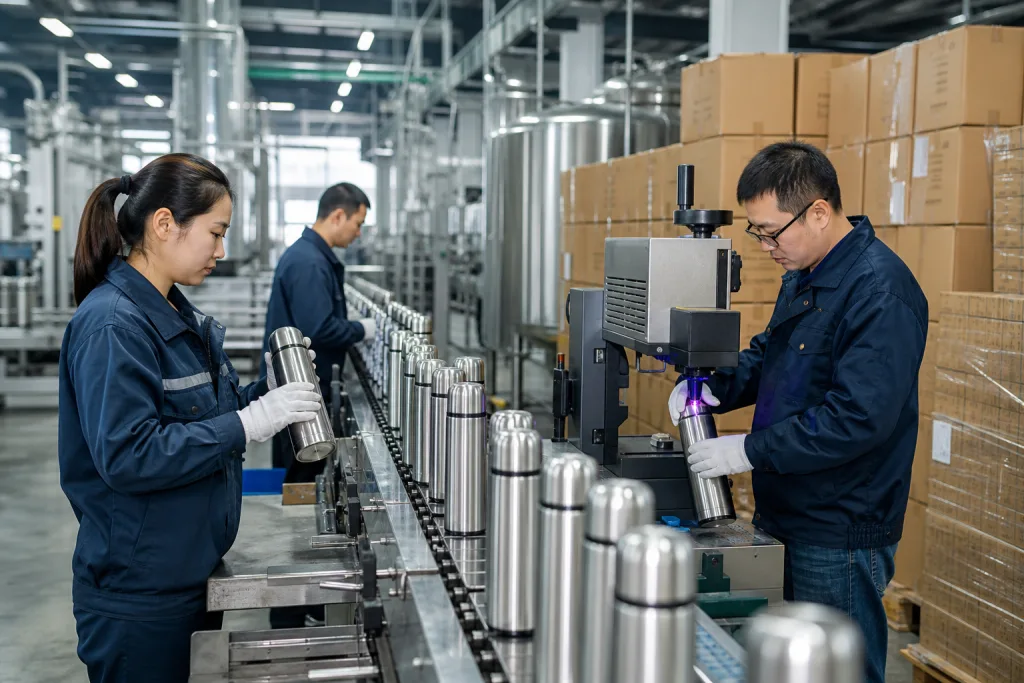
If you are sourcing from China, especially Zhejiang, treat the order like a production job, not a catalog buy. This is the right starting point. A serious thermos manufacturer should show you wall thickness, vacuum performance, coating standard, drop-test method, and a real monthly output figure, not vague promises from a sales sheet. At BottleForge in Zhejiang, our factory runs 120,000 units/month with MOQ 1,000 pcs for standard custom thermos builds, and that is the level of clarity you should demand from any supplier thermos partner. On our line, QC pulled the sample and checked vacuum retention, coating adhesion, and thread fit before mass production, because the buyer always flags those first.
Start with the real use case
The first mistake in a custom vacuum flask USA program is picking the bottle before the use case. We see this on the line all the time. A 500 ml custom thermos for golf giveaways does a different job from a 750 ml insulated flask for camping retail, and both are miles away from a 1 L distributor thermos packed into corporate kits. Start with the actual use: car cup holder or backpack side pocket, coffee or soup, 6-hour office hold time or 12-hour outdoor carry. This is the right question to ask. Bottle shape comes after that.
For outdoor retail, I usually recommend a 304 inner / 304 outer double-wall build with a 0.4-0.5 mm body wall and a 2.5-3.0 mm bottom structure. We check wall thickness with an ultrasonic gauge after forming. That spec gives better dent resistance than thin promotional thermos stock, and we ship fewer replacement claims after drop damage in carton transit. For mass promo work, some buyers accept 201 outer steel to cut cost, but do not let a thermos supplier hide that choice. Put it in the PO. We have seen POs with “SS body” only, and then the buyer flagged rust marks 3 weeks after arrival. If you need a branded gift set, ask whether the cap, handle, and cup lid are sourced in-house or outsourced. That answer affects color match and thread fit more than most teams expect.
One practical filter: if the flask will be resold in the USA through retail or Amazon, avoid vague specs like “food grade stainless.” QC pulled the sample once because the spray coating scratched at a 2H pencil test, even though the sales sheet looked fine. Ask for material declaration, coating details, and a sample review against your brand standard. Zhejiang factories that export every week know this language. Generic trading setups often do not, and this is where projects go sideways.
Lock the spec before sampling
Sampling is where plenty of custom thermos projects go sideways. We see it on the line all the time: the PO says “black bottle with logo,” then the buyer starts changing lid threads, gasket hardness, and carton spec after the sample is made. Backwards. Lock the spec first. For a typical 500 ml customized thermos, define capacity tolerance at ±5%, neck finish, lid type, silicone gasket grade, coating color, logo method, and packaging. If you want a matte powder coat, state the target thickness at 60-80 μm; our QC team checks that with a coating thickness gauge, not by eye. If you want laser engraving, ask for a 0.2-0.3 mm depth sample check on the logo area.
For print, keep the artwork realistic. Screen printing works well for 1-2 colors and usually costs less than laser engraving on short runs; on MOQ 1,000 pcs, that price gap is usually obvious. If your design has gradients, use heat transfer or UV print only after you verify scratch resistance. We have seen buyers push for a soft-touch look, then flag scuff marks after a simple carton rub test. A decent thermos manufacturer should send you a sample within 7-10 days. If they need 3 weeks to produce a simple sample, their engineering queue is already strained. This is the wrong question to ask: “Can you sample it?” Ask, “How fast can you sample after artwork, Pantone, and structure are confirmed?”
Ask for these before approval:
- Sample weight and packed carton weight
- Thermal test at 95°C fill, measured at 6, 12, and 24 hours
- Leak test after 24-hour inversion
- Lid torque and thread fit check
- Finish adhesion test, ideally cross-hatch on coated parts
That is how you separate a real manufacturer thermos partner from a generic thermos vendor. QC pulled the sample, measured it, tested it, and wrote it down. If the factory only sends pretty photos, the math doesn’t work.
Price the order like a buyer
For bulk thermos sourcing, break the quote into four buckets: product, decoration, packaging, and freight. That is how buyers catch padding. A standard 500 ml stainless thermos with 304 inner liner, powder coat, one-color logo, and color box often lands around USD 2.35-3.40 FOB China at 1,000-3,000 pcs. Move to a premium lid, copper-plated insulation, or gift packaging and you can push that to USD 3.80-4.80. If someone quotes USD 1.60 for a fully customized thermos with logo and box, the math doesn't work. We have seen this go sideways after first sample review, usually when QC pulled the sample and found the wall thickness was 0.32 mm instead of the quoted spec.
For USA buyers, FOB China is still the cleanest benchmark for comparing suppliers thermos options. Then add ocean freight, customs, and inland delivery line by line. On a 1,000 pc order, packaging can change landed cost by 6%-12%, especially if you insist on retail-ready inserts. We ship plenty of these, and a taller gift box can cut master carton packout from 24 pcs to 18 pcs, which changes freight fast. If you are a thermos distributor or promotional brand, ask for two price columns: one for standard stock carton, one for export gift box. Short list. Clear margin view. It also stops surprises when the buyer flagged a carton size mismatch against the PO.
My rule: if the supplier cannot explain why the price moves by USD 0.40 when the lid changes, they do not control their own factory thermos process.
Ask for annual volume tiers too. A serious thermos factory in Zhejiang can often save you USD 0.15-0.35 per piece once you move from 1,000 to 5,000 pcs. We run this by mold share, carton efficiency, and print setup hours on the line. This is the wrong question to ask: “What is your best price?” Ask instead what drops at 3,000 pcs and what drops again at 5,000 pcs.
QC the flask before shipment
You do not need a perfect factory. You need a controlled one. For custom vacuum flask USA shipments, write the QC points before production starts, not after the first sample is approved. Use AQL 2.5 for major defects and AQL 4.0 for minor defects if this is a promo job. For retail programs, I push tighter limits on leaks, dents, coating flaws, and logo misalignment. We usually mark the logo position on the golden sample with a 0.5 mm tolerance line because buyers flag crooked prints fast. One leaking cap can turn into a full chargeback if you sell through a distributor thermos channel.
Factory inspection should cover vacuum performance, cap seal, body denting, print position, carton drop condition, and barcode readability. That list is basic. The wrong question to ask is whether the factory has QC; ask what they record at the line, who signs it, and how often. If the order is for Amazon or similar channels, confirm FNSKU placement and carton labeling before stuffing. We have seen cartons blocked over a label placed 15 mm off spec. A thermos supplier in China should show in-process QC records, not just final photos. Ask for 3-stage control: incoming material check, inline inspection, and pre-shipment inspection. QC pulled the sample, scanned the barcode, and checked carton drop results before the container loading call.
Real numbers matter. On a 5,000 pc run, an honest factory thermos line may allow 1%-2% cosmetic rework and still ship on schedule. That is normal. We run rework on the bench for dust nibs in coating or a print shift caught before packing. What is not normal is a 6%-8% leak rate or random logo drift. We have seen this go sideways when lid threads were out by 0.3 mm after a mold repair. If you see that, stop the order and reset the tooling or lid assembly process.
Plan packaging for US retail
Packaging is part of the product. We see buyers miss this point all the time. A plain egg-crate carton cuts unit cost, but it loses on shelf and gets hit harder in transit; last month QC pulled a sample with a dented shoulder after a 78 cm drop test. If your custom thermos will sit on shelves, use a color box with product claims, care instructions, and a barcode panel sized for your channel. This is the wrong place to save $0.12.
For USA import programs, keep carton dimensions tight and pallet math clean. A 500 ml flask in a 48-pack master carton is usually a better freight decision than a loose 24-pack if the bottle shape allows it; we run a carton compression check on the line before mass packing. Protect the lid separately if the cap has moving parts, especially spring lids and push-button caps, because the buyer flagged cracked sliders on one PO after mixed loading. Include English-only warnings where needed. If the product is going into California retail, confirm your REACH and CPSIA-related documentation requirements with your compliance team. For food-contact materials, request stainless declaration, silicone declaration, and coating statement from the thermos manufacturer.
Good packaging cuts returns. In our Zhejiang export work, better inserts typically cut transit damage by 20%-30% on long ocean routes, and a 1.5 mm pulp tray usually beats a loose divider set for side-impact protection. We have seen this go sideways when buyers focus only on bottle cost and ignore the ship test. Refunding a full pallet costs more. The math doesn't work.
Work the timeline backward
A realistic production schedule keeps the order out of rush-fee territory. For a custom vacuum flask USA program, plan 7-10 days for sampling, 3-5 days for sample approval changes, 18-25 days for mass production, and 5-10 days for pre-shipment inspection and packing. If you are adding a new mold for a special lid, add 15-20 extra days. We’ve seen this go sideways when a buyer wants to ship in 30 days but the new PP lid tool still needs T1 and T2 trials. The math doesn’t work. Smart USA buyers place thermos custom orders before the season starts, not after the first forecast spike.
Here is the sequence I recommend: confirm spec, approve sample, freeze artwork, issue PO, pay deposit, inspect first article, run production, inspect finished goods, book freight, and release balance after final report if your terms allow it. Put dates against each step. For example, if the line starts on the 12th and QC pulled the sample at 10:30 a.m., your carton mark and logo position should already be signed off, not still sitting in somebody’s inbox. A reliable thermos distributor or supplier should update you at each step. If they only call when payment is due, you carry the risk.
Zhejiang has a dense supply chain for lids, cartons, coatings, and stainless forming, so lead times there are often 12 days vs 18 days inland when the factory is organized. We run into this every peak season. One carton supplier is 18 km away, and replacement lids can arrive the same afternoon if the buyer flagged a leak test issue. Still, geography does not replace discipline. Ask for a Gantt chart with dates, MOQ, and inspection points, not promises.
Send your flask spec and get a real quote
Tell us capacity, lid, logo, and target landed cost. We will quote your custom vacuum flask USA program with MOQ, lead time, and QC terms.
Frequently asked questions
What MOQ should I expect for custom vacuum flask USA orders?
For most standard stainless thermos builds, MOQ starts at 1,000 pcs per design and color. If you need multiple logo versions or mixed lids, expect 2,000 pcs or more to keep the line efficient. Simple stock-color customizations can sometimes drop to 500 pcs, but unit cost usually rises 12%-25%. For a thermos distributor or promotional brand, 1,000-3,000 pcs is the most workable range.
How long does production usually take in China?
After sample approval, standard production usually takes 25-35 days in Zhejiang or coastal China. If the order needs new tooling, special packaging, or a custom cap, add 15-20 days. Ocean freight to the USA often adds 20-35 days depending on route and port. A good thermos factory should tell you the critical path before you pay the deposit.
What is a fair FOB price for a custom thermos?
A common 500 ml custom thermos with 304 stainless inner wall, powder coating, one-color logo, and color box often prices at USD 2.35-3.40 FOB China at 1,000-3,000 pcs. Premium lids, copper plating, or retail packaging can move it to USD 3.80-4.80. If the quote is far below that, check wall thickness, vacuum quality, and print method carefully.
Which decoration method is best for promotional thermos orders?
For simple brand marks, screen printing is usually the lowest-cost choice and works well for 1-2 colors. Laser engraving is cleaner and more durable for a metal look, but it is better on matte or brushed finishes. UV print is useful for full-color logos, though abrasion resistance depends on the coating. Ask your supplier thermos partner for a rub test and a dishwasher-use recommendation before final approval.
What QC documents should I ask for before shipping?
Ask for pre-shipment inspection photos, AQL results, leak test records, carton drop test photos, and material declarations for stainless steel and silicone. If you are importing into the USA, also request barcode and carton label confirmation. For retail programs, insist on thermal retention data at 6, 12, and 24 hours. A proper manufacturer thermos should provide these without hesitation.