Key Takeaways
- 304 stainless inner and outer is the safe default; 316 inner usually adds USD 0.35-0.80 per bottle
- A real custom vacuum flask America program should define wall thickness, often 0.4 mm inner and 0.5 mm outer, not just bottle volume
- Common MOQ is 1,000 pcs per color per size, but logo-only repeat orders can drop to 500 pcs
- For sea shipments from China, a 1.2 m carton drop test and AQL 2.5/4.0 inspection reduce avoidable claims
You can buy a custom thermos from almost any catalog. The trouble starts when one 500 ml bottle comes in at USD 3.10, USD 4.40, and USD 6.20, with the same studio photo and the same soft claim on heat retention. We’ve seen this go sideways. For outdoor retailers and promotional brands in America, the pain shows up after shipment: dented base cups from a 0.3 mm thin part, powder coat that chips on the line-test rack, lids that leak at 60 kPa, or a logo print the buyer flagged after one trade show season.
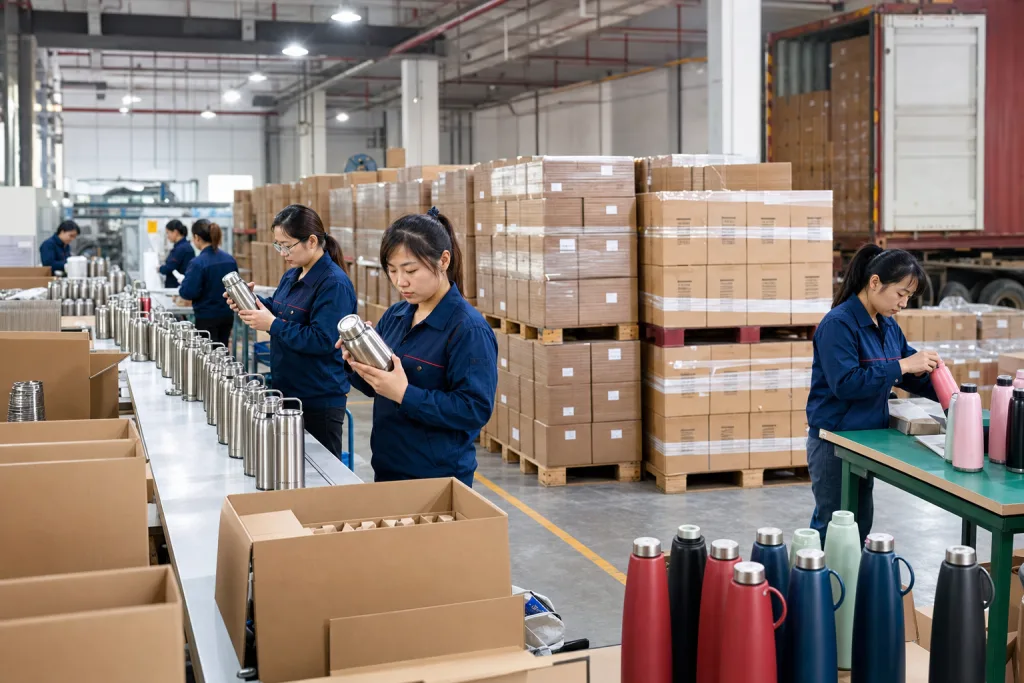
If you are sourcing from Zhejiang, China, read the spec sheet like the factory reads it, not like a trading catalog. Material grade, wall thickness, vacuum method, lid resin, carton drop performance, and AQL drive landed cost and complaint rate. This is the wrong question to ask: “Why is this bottle cheaper?” Ask what was cut. At BottleForge Industrial in Zhejiang, China, we run about 450,000 units per month, with typical MOQ from 1,000 pieces per SKU and lead times around 25 to 40 days. On our floor, QC pulled the sample more than once because a PO typo switched 304 stainless to “303,” and that kind of small miss can waste 12 days vs 18 days fast.
Start with steel grade
The first line on the spec sheet should be stainless grade, not color or logo. For a custom vacuum flask America order, the practical baseline is food-contact 18/8 stainless steel, usually called SUS304 in China. That gives you solid corrosion resistance, clean taste, and broad acceptance for North American and European retail programs. If the bottle will hold acidic drinks, electrolyte mixes, or sit filled for 24 to 48 hours, ask whether 316 is needed for the inner wall only. Most buyers do not need 316 on both walls. The math doesn't work. On our line, QC pulled a cut sample last month and checked the inner wall with an XRF gun before final packing.
Typical pricing impact for a 500 ml bulk thermos is simple. Moving from 201 outer + 304 inner to full 304 can add around USD 0.20 to 0.45. Moving from 304 inner to 316 inner can add another USD 0.35 to 0.80 depending on steel market fluctuations. If a supplier thermos quote is much lower than the market, ask exactly what steel is used on the outer shell, inner liner, lid plate, strainer, and tea infuser if included. We've seen this go sideways: the buyer flagged rust spots on a tea filter, and the PO only said "SS infuser" with no grade listed.
- SUS304: standard for most custom thermos and promotional thermos programs
- SUS316 inner: better for premium outdoor and medical or marine-adjacent use
- 201 outer: usable in low-cost projects, but less resistant to corrosion and denting expectations
Ask for REACH and LFGB or FDA-contact declarations from the manufacturers thermos side, plus migration data for plastic parts and silicone seals. A serious thermos manufacturer will know which resin is used in the lid, typically PP or Tritan, and which gasket compound is used. Ask for traceability by component, down to the lid plate and seal ring. If they cannot provide it, treat the quote as incomplete. This is the wrong question to skip. We ship plenty of clean-looking samples, but catalog photos do not tell you whether the silicone is Shore A 50 or 70, or whether the lid resin changed after a 3,000 pcs reorder.
Wall thickness changes real durability
Outdoor buyers love to talk about vacuum hours. The bottle body takes the real beating. Wall thickness decides if a flask survives drop bins, shelf knocks, and the returns desk. A common 500 ml customized thermos we run uses 0.4 mm inner wall and 0.5 mm outer wall, checked with a digital micrometer after deep draw. Cost-down builds may use 0.3 mm inner and 0.4 mm outer to trim material cost and freight weight. Premium builds may go to 0.5 mm plus 0.5 mm, especially on wide-mouth flasks and large 750 ml to 1,000 ml models where the shoulder gets hit first.
Here is where buyers feel it. A lighter shell may save USD 0.12 to 0.25 per unit and cut carton weight, but QC pulled the sample and found dents show up first around the shoulder radius and base ring. We have seen outdoor retail programs save that money on paper, then lose it on returns. The math doesn't work. For thermos bulk sold into outdoor retail, cosmetic dent returns can wipe out the saving fast. For thermos promotional campaigns, where the bottle is a 90-day gift item, lighter construction can pass if the packaging is strong enough and the drop test is set first.
What to put on the PO
- Inner wall thickness: for example 0.4 mm +/- 0.03 mm
- Outer wall thickness: for example 0.5 mm +/- 0.03 mm
- Base construction: with or without anti-slip pad
- Mouth diameter and thread specification
- Net weight tolerance: usually +/- 3% to 5%
If your thermos custom order will be sold on Amazon FBA or through a distributor thermos network, ask for a base impact test and handle torque test where relevant. Put it on the PO. We have seen this go sideways because a buyer approved a golden sample, then the line switched to a thinner base cup and no one caught it until carton drop marks showed up. A solid manufacturer thermos program should also state whether the bottom is standard concave, spun base, or welded base cup. Base design changes stability and dent resistance. In Zhejiang factories, small construction changes often add only a few cents if they are frozen before tooling and color approval. After production starts, they get expensive fast; even a base pad change can mean a new jig and 12 days vs 18 days on rework and approval.
Vacuum performance is not one number
If a thermos supplier says “12 hours hot, 24 hours cold,” ask for the test method first. This is the right question. Vacuum performance changes with fill temperature, room temperature, bottle shape, stopper structure, and the endpoint they used: 60 degrees C, 50 degrees C, or lower. We’ve seen buyers approve a claim on the PI, then push back after first delivery because the lab used a different endpoint. For a custom vacuum flask America project, the usable spec is a controlled retention test, not a sales line.
Take a 500 ml stainless flask as an example. Fill at 95 degrees C, test at about 20 degrees C room temperature, and a standard double-wall body will often stay above 60 degrees C for 6 to 8 hours. Premium narrow-body models usually hold heat better because the heat-loss area is smaller. Cold retention may show 24 hours on paper, but if the silicone gasket is 1 mm too thin or the thread fit has play, the user feels the difference fast. QC pulled samples like this before. Lab sheet looked fine; actual use did not.
Good sourcing practice: define the test endpoint and sample count. “Hot retention: after filling at 95 degrees C, temperature not lower than 60 degrees C after 6 hours, sample size 5 pcs.”
The vacuum process matters too. Most suppliers thermos in China use a vacuumized double-wall body with getter treatment, but the real question is the leak-test control on the line. Ask for the vacuum leak testing rate during production. A solid thermos factory should run 100% vacuum inspection or a validated sampling plan, and they should be able to show the reject data. We ship outdoor orders with boil-test records when the buyer asks. If you are buying bulk thermos for outdoor channels, add a boil test or heat-loss check to pre-shipment inspection, because we’ve seen this go sideways after long transit.
Don’t overbuy insulation if your market will not pay for it. The math doesn’t work. Better heat retention usually means thicker steel, tighter neck tolerance, and a lid set that costs more; on some SKUs, body weight goes up by 20 g to 35 g. For a promotional thermos used for commuting or conference gifting, your target may be price under USD 4.00 FOB China. For an outdoor retailer private label, spending USD 0.40 more for steadier thermal performance is usually the better call.
Lid geometry causes most complaints
Bodies are the easy part. Lids drive most post-shipment claims. On our line, QC pulled more closure issues than body defects in a typical 10,000-piece run: leakage, thread mismatch, odor, weak carry loops, broken flip tabs. Most of that traces back to lid geometry or resin grade, not the bottle shell. If you’re comparing thermos manufacturers, spend your time on the closure. A custom thermos with a complex sip lid looks good in a sales meeting, but every spring, pin, and hinge adds one more failure point. We’ve seen this go sideways.
For outdoor use, a simple screw cap with a food-grade silicone gasket is still the safest option. For promotional brands, a push-button pour stopper is fine, but ask for cycle-test data from the factory, not just a verbal claim. A reasonable factory spec is 3,000 to 5,000 open-close cycles for simple consumer use, tested on a fixture counter at the bench. If the lid includes PP, ABS, Tritan, or stainless trim, confirm that each part meets destination compliance requirements. North America buyers often ask for FDA-contact declarations; Europe buyers usually press on REACH and overall migration support. One buyer flagged a PO last season because the ABS insert changed shade after hot-fill testing at 95°C. Small part, big complaint.
- Leak test: 100% water leak test on finished bottles before packing
- Torque spec: define cap tightening range to avoid thread damage
- Gasket hardness: usually specified by Shore A range for repeat sealing
- Handle load test: important for 750 ml and 1,000 ml flasks
If you are a thermos distributor or one of the distributors thermos buyers supplying many smaller resellers, standardize lid platforms across several body sizes. That cuts spare-part SKUs and lowers replacement claims. In Zhejiang, China, most factories can change body paint and logo fast; custom lids are a different job because they need new tooling, fit checks, and usually 2 or 3 rounds of sample correction. New lid tooling often starts around USD 3,000 to 8,000 and extends development by 20 to 35 days. We run thread gauges and hinge checks on first shots, and the first issue is often flash at the sealing face or a 0.3 mm mismatch on the thread start. This is the wrong place to save money. You should only open a new lid mold when your annual forecast supports it, because otherwise the math doesn’t work.
Decoration spec decides brand lifespan
A customizable thermos stands or falls on the decoration spec. Outdoor retail and premium gifting should not share the same finish spec; this is the wrong question to skip. Powder coating is the default when buyers want grip and scratch resistance. On our line, a normal matte powder coat on a 500 ml bottle may add around USD 0.18 to 0.35 over plain spray finish, and the hand feel is better. Transit scratches also show less. For metallic effects, ask the supplier to state the process clearly: standard spray, UV print over coating, or PVD. We’ve seen POs marked only “silver shiny,” and that goes sideways fast.
Logo application needs the same discipline. Screen printing works for 1 to 2 spot colors and keeps cost under control on runs above 3,000 pcs. Laser engraving gives clean stainless exposure and long wear, but the cycle time is slower because the fixture has to hold position within 1.5 mm. Heat transfer or full-wrap printing fits promotional thermos designs with gradients, but rubbing resistance needs a real test. QC pulled the sample last month after 30 rub cycles with a cotton cloth and alcohol, and the red started lifting at the seam. If the bottle is headed to outdoor stores, ask for adhesion and abrasion checks with a tape test and basic rub cycles. If brand color is strict, approve Pantone against the coated sample from the line, not a digital mockup.
Common decoration choices
- Silkscreen logo: low cost, good for large thermos bulk runs, usually fastest setup on 1-color artwork
- Laser engraving: premium look, no ink wear, slightly slower production because the beam path and jig need tighter control
- Powder coat: better grip, usually better scratch perception, common film thickness on the body is around 60–80 μm
- PVD finish: premium appearance, higher reject sensitivity on cosmetic defects; the buyer flagged hairline marks on 4 pcs out of 200 in one recent check
For custom logo work in China, ask the thermos vendor to define logo position tolerance, usually +/- 1.5 to 2.0 mm, and whether the artwork is inspected 100% or by sample. Price per unit gets all the attention, but the math doesn’t work if 2,000 bottles arrive with crooked logos. We ship by approved sample, not by hope. If your campaign ships to multiple states or provinces, include a golden sample approval step before mass production. A signed sample with logo angle, height from base, and carton mark cuts arguments later.
Packaging, cartons, and shipping math
Buyers often leave packaging to the end, then find the custom thermos order blows past the freight budget. We see this every month. Gift box, white box, egg-crate divider, polybag, desiccant, master carton count, and carton dimensions all move landed cost in a measurable way. For a 500 ml thermos custom item, the gap between a plain white box and a printed rigid gift box can be USD 0.35 to 1.20 per unit. On the line, a rigid box also adds about 8 to 12 mm around the pack size, which hits carton cube fast. Freight impact is often bigger than the packaging cost itself.
For outdoor retail, a practical setup is bottle + polybag + white or kraft box + 5-layer export carton. Clean and shippable. For promotional thermos programs, especially event fulfillment, ask up front if you need individual barcode labeling, FNSKU application, insert cards, or mixed pack configurations. We have had buyers send the PO with the bottle spec correct and the barcode side wrong, then the warehouse scanner rejected the whole lot. A serious supplier thermos team should work out pieces per carton, gross weight, carton cube, and pallet pattern before you confirm the order. If they wait until mass production, we've seen this go sideways.
- Master carton drop: 1.2 m drop test is a useful baseline
- Gross carton weight: keep near 12 to 15 kg for easier warehouse handling
- Barcode placement: confirm scan orientation before printing
- Spare ratio: 1% extra caps or bottles can be cheaper than rework later
Do the shipping math early. This is the right place to be picky. If a factory thermos quote is FOB Ningbo or FOB Shanghai, compare ocean freight by carton cube, not only by unit price. The math doesn't work if you save USD 0.08 on the bottle and lose USD 0.22 in freight because the carton went from 0.048 CBM to 0.062 CBM. Zhejiang exporters usually ship through Ningbo, and carton optimization often saves more than hard unit-price pressure. For thermos suppliers serving America, inland distribution and final-mile handling punish oversized packaging fast. Ask for packed dimensions before deposit, not after production. QC pulled samples on one run last year and found the inner box was 6 mm taller than approved, which cut pallet efficiency by one full layer.
Quality plan before deposit
The best time to lock quality is before the PI is signed. For a custom vacuum flask America order, the PO should spell out the inspection standard, defect classification, and approved reference samples. Most buyers we ship for use AQL 2.5 for major defects and 4.0 for minor defects on finished consumer drinkware. If that line is missing, the buyer flags a scratch, the factory calls it acceptable, and the whole argument turns subjective. We have seen this go sideways over a 0.3 mm logo shift that was never defined on the signed sample.
Your quality checklist should cover leak test, vacuum retention, finish adhesion, odor, logo accuracy, thread fit, carton marks, barcode scan, and quantity count. On our line, QC pulled the sample after the 100°C hot-water hold test and checked the lid thread fit by hand before boxing approval. If children may use the item, or the product goes into a regulated retail channel, add relevant ASTM or CPSIA-related checks where applicable to accessories and packaging. For social compliance, some retail accounts ask for BSCI or similar audits. For management systems, ISO 9001 is still a baseline. It does not replace product inspection, and this is the wrong question to ask if the cup body weld or lid odor already failed.
Lead times in China move with the season, but a realistic schedule for custom thermos runs is 7 to 12 days for sample confirmation, 25 to 35 days for production after deposit and artwork approval, and a few extra days in peak periods. We usually see 12 days vs 18 days on sample approval when the buyer changes Pantone after decal layout. MOQ is commonly 1,000 pcs per color per size for standard bodies. Repeat orders with existing decoration may drop to 500 pcs if capacity allows. If a manufacturers thermos quote promises 10-day mass production in peak season, check whether blanks are actually in stock. If not, the math does not work.
The cleanest buying process is simple: approved drawing, approved pre-production sample, signed packing spec, signed AQL standard, and balance payment after inspection. We run projects faster when the carton mark, barcode position, and master carton weight limit are signed before deposit; one PO we got even had the ship mark typo baked in, and nobody caught it until final packing. That is how you cut surprises with thermos distributor, thermos manufacturers, and thermos supplier projects from Zhejiang. You do not need the cheapest quote. You need one the line can repeat.
Send your thermos spec and get a practical quote
Share volume, size, lid type, logo method, and target price. We will review the spec line by line and flag cost or quality risks before sampling.
Frequently asked questions
What MOQ should I expect for a custom vacuum flask America order?
For standard stainless bodies with custom color and logo, the normal MOQ is 1,000 pieces per size per color. If you use an existing mold, one print position, and common powder coat colors, some China factories can accept 500 pieces on repeat orders. Fully custom lids or new body tooling are different. Tooling can start around USD 3,000 to 8,000, and MOQ may rise to 3,000 to 5,000 pieces depending on complexity. If you are testing a promotional thermos concept, ask for a stock-body program first. That lets you validate demand before committing to custom molding and larger thermos bulk quantities.
How much does a custom stainless thermos usually cost FOB China?
A useful working range for a 500 ml double-wall stainless custom thermos is about USD 3.00 to 5.50 FOB China, depending on steel grade, wall thickness, lid type, coating, and packaging. A simple screw-cap model with 304 inner and outer, powder coat, and one-color silkscreen logo may land around USD 3.20 to 4.20 at 3,000 pieces. A premium outdoor flask with 316 inner, carry handle, complex lid, and gift box can move above USD 5.50. Be careful with unusually low quotes. Ask whether the price includes 100% leak test, export carton, barcode labels, and the exact decoration method. Small omissions can change the real delivered cost by 8% to 15%.
Which tests matter most before shipment?
For most outdoor retail and promotional programs, the non-negotiable tests are leak test, vacuum retention, logo/finish adhesion, odor check, and carton drop review. I would also specify an AQL inspection plan, typically 2.5 major and 4.0 minor. For thermal retention, define the exact method, such as filling at 95 degrees C and checking temperature after 6 hours. For packaging, a 1.2 meter master carton drop test is a useful shipping baseline. If the bottle has a handle, straw lid, or push button, add cycle and pull-force checks. The goal is not laboratory theater. It is to catch the 3 or 4 defects that create most customer complaints after the goods leave China.
Should I choose 304 or 316 stainless for my thermos line?
For most custom vacuum flask America projects, 304 is the correct default. It is widely accepted, food-safe when properly processed, and cost-efficient for coffee, tea, and water use. Choose 316 inner steel when your product positioning is premium or when users store acidic beverages, electrolyte mixes, or drinks for longer periods. The cost increase is usually around USD 0.35 to 0.80 per bottle depending on size and market conditions. You rarely need 316 on the outer wall. If a factory recommends full 316 for a mainstream promotional thermos, ask why. The smarter spend is often better lid quality, stronger powder coat, or tighter QC, not more expensive outer steel.
How long does production and shipping usually take to North America?
For a standard custom thermos order from Zhejiang, expect about 7 to 12 days for samples and approvals, then 25 to 35 days for mass production after deposit and artwork sign-off. During peak season, add 5 to 10 days. Ocean transit from China to North America commonly runs 20 to 35 days port to port, depending on routing and congestion. If you need Amazon FBA prep, barcode labeling, or mixed-carton packing, add a few days for packing control. Air shipment is faster but expensive for stainless drinkware because of chargeable weight. If your launch date is fixed, lock artwork, carton marks, and packaging specs early. Delay on those details causes more missed sailings than factory output does.